Portland Real Estate Appraisal Brief – Thursday, December 18, 2025: Portland’s Historic Homes and the PSU Demolition Debate

Portland State University plans to demolish two early-20th-century buildings on the Historic Resources Inventory for new student housing, highlighting preservation tensions mirrored in rare registered historic home sales.

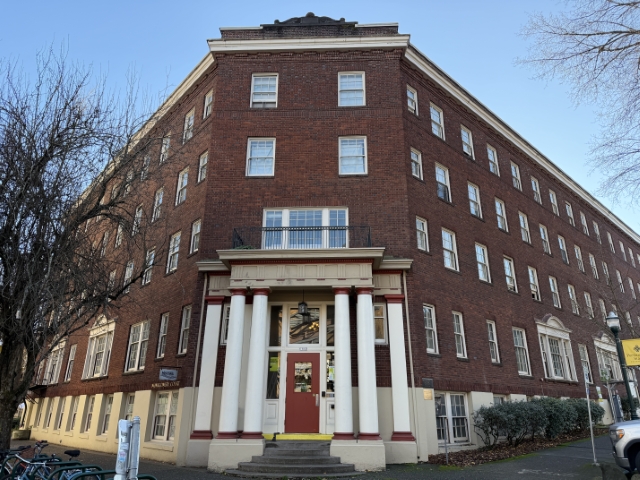
Montgomery Court is a historic apartment building erected in 1916, designed by architect A. E. Doyle. Located at 1802 SW 10th Avenue in Portland, Oregon, it now serves as a residence hall for Portland State University. The red brick structure features classical columns at the entrance and multi-pane windows.
Montgomery Court, a 1916 residence hall originally built as the Martha Washington Hotel for working women. The historic building is now slated for demolition.
Photo: Portland Appraisal Blog (CC BY-SA 4.0)

Portland State University continues to advance plans to demolish two early-20th-century buildings—Montgomery Court and Blackstone Hall—to make way for a new 550-bed student housing complex on the South Park Blocks. Both structures, acquired by the university in 1969, are included on Portland’s Historic Resources Inventory but lack stronger local landmark or National Register designation, offering limited protection against demolition. Deconstruction remains scheduled for fall 2026, despite ongoing advocacy from preservation groups emphasizing the buildings’ architectural and cultural significance, lower carbon impact of rehabilitation, and potential eligibility for tax incentives.

Close-up of the metal plaque on the exterior of Montgomery Court at 1802 SW 10th Avenue in Portland, Oregon. The plaque reads "MONTGOMERY BUILDING A. E. DOYLE, ARCHITECT ERECTED 1916". This historic structure, built in 1916, now serves as a Portland State University residence hall.
Dedication plaque on Montgomery Court identifying it as the Montgomery Building, designed by A. E. Doyle and erected in 1916.
Photo: Portland Appraisal Blog (CC BY-SA 4.0)
Blackstone Hall exterior at Portland State University, 1931 Egyptian Revival building on the city’s Historic Resources Inventory, facing planned demolition – Portland historic preservation and real estate appraisal context
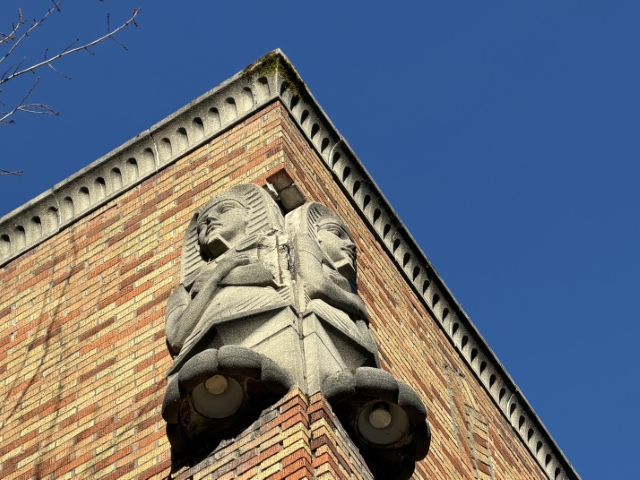
Blackstone Hall, a 1931 Egyptian Revival residence hall at Portland State University, showing distinctive corner sculptures and brick detailing, photographed in 2025.
Photo: Portland Appraisal Blog
Blackstone Hall exterior at Portland State University, 1931 Egyptian Revival building on the city’s Historic Resources Inventory, facing planned demolition – Portland historic preservation and real estate appraisal context. This photo zooms in on sculptures.
Close-up of Blackstone Residence Egyptian corner sculptures. Blackstone was designed by Elmer Feig and the sculptures reflected national interest following the discover of King Tutankhamun’s tomb. Photographed in 2025.
Photo: Portland Appraisal Blog

These institutional debates mirror tensions in the residential market, where buyers, sellers, realtors, and lenders frequently navigate historic designations and their implications for property alterations, maintenance, and value.

Understanding Historic Designations in Portland

Portland maintains multiple layers of historic recognition, each with varying implications for private owners:

  • National Register of Historic Places — A federal honorary listing that qualifies properties for rehabilitation tax credits (20% federal for income-producing; Oregon offers a 10-year special assessment freeze) but imposes no automatic local restrictions on alterations or demolition for private residential use.
  • Local Historic Landmarks or Conservation Districts — The strictest level; exterior changes, additions, or demolitions require Historic Resource Review, which can result in denial.
  • Historic Resources Inventory only — Documentation of significance with minimal protections (possible 120-day demolition delay for higher-ranked properties), similar to the PSU buildings.

A common misconception among buyers (and even a few agents) is that any pre-1930 home—or even one from the 1850s—is automatically “historic.” It is not. Only properties formally listed on official registries carry designation. Due diligence early in a transaction—via Portland Maps Historic Resource layer or title report—helps clarify responsibilities.

Rare Sales of Verified Registered Historic Homes in Portland

From 2023 through Q3 2025, only 15 single-family residential properties with confirmed historic designation changed hands in Portland—roughly one every two to three months—after excluding listings that described homes as merely old.

These historic-designated homes command elevated prices—averaging over $1.25 million across the period—reflecting strong demand for authentic early-20th-century architecture in Portland’s most marketable neighborhoods. However, they are not necessarily the most expensive properties in those areas. Many newly constructed or extensively remodeled custom homes (without historic restrictions) routinely sell for significantly more. For buyers specifically seeking a registered historic property, though, the investment is substantial.

Year Sold# of SalesAvg Close PriceAvg Yr BltAvg Total SF
20235$990,04419133,405
20244$1,226,42419034,701
20256$1,498,81719235,281
Total15$1,256,58819144,501

Sales cluster in Portland’s premier historic neighborhoods: Irvington, Mt. Tabor, Hosford-Abernethy, and Southwest Hills.

Map showing locations of the 15 verified registered historic home sales in Portland from 2023 to Q3 2025.

Surprisingly, sales price shows almost no correlation with exact year built—value is driven by historic status and prime neighborhood location.

Owning a designated historic home represents a significant financial commitment, with higher acquisition costs, ongoing maintenance, and regulatory review for major changes. Potential incentives, such as tax credits and special assessments, can offset some burdens for qualifying owners.

Historic properties—whether the institutional buildings at PSU or the late‑19th and early‑20th‑century homes across Portland—connect the present generation to the rich and vibrant history of previous generations and the loss of any of these structures feels like losing a bit of the past. The tension between retention or eventually letting such properties go will probably never go away.

Sources & Further Reading

Decorative text divider.

Thanks for reading—I hope you found a useful insight or an unexpected nugget along the way. If you enjoyed the post, please consider subscribing for future updates.

CODA

Are you an agent in Portland and wonder why appraisers always do “x”?

A homeowner with questions about appraiser methodology?

If so, feel free to reach out—I enjoy connecting with market participants across Portland and the surrounding counties, and am always happy to help where I can.

And if you’re in need of appraisal services in Portland or anywhere in the Portland Region, we’d be glad to assist.
Portland Real Estate Appraisal Brief – Saturday, December 13, 2025: FHA 2026 Loan Limits Rise to $701,500 in Portland Metro

FHA 2026 one-unit limit in Portland metro rises modestly to $701,500, opening 3.5% down-payment financing to ~48 additional Q3 2025 detached sales.

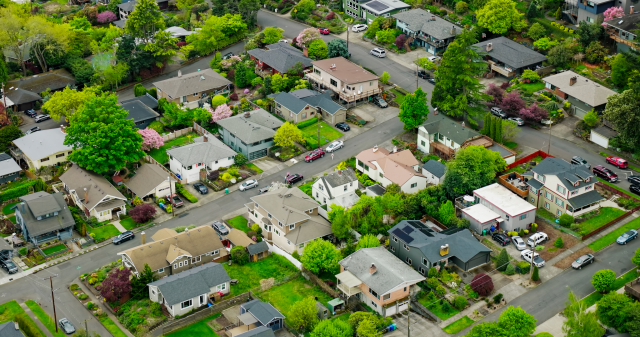
Aerial view of a tree-lined single-family residential neighborhood in Portland, Oregon – representative of homes now eligible for 2026 FHA loan limits up to $806,500
Single-family neighborhood in Portland, Oregon–representative of homes affected by 2026 FHA loan limit of $701,500
Via Canva Pro

HUD Announces 2026 FHA Loan Limits

The Federal Housing Administration has released its 2026 loan limits. In the Portland–Vancouver–Hillsboro MSA (38900)—covering Clackamas, Columbia, Multnomah, Washington, and Yamhill counties in Oregon, plus Clark and Skamania in Washington—the new one-unit limit increases from $695,750 in 2025 to $701,500 in 2026, a rise of $5,750 (0.83%).

Hood River County is not part of this MSA and retains its 2025 limit of $762,450 (unchanged for 2026). No detached SFR sales in Hood River County reported FHA financing in Q3 2025.

Appraisal & Lending Implications

In addition to developing an opinion of value, appraisers on FHA assignments focus primarily on identifying property deficiencies or conditions that could render a home ineligible for financing—lenders handle the loan-to-value calculations against the limit using the appraised value alongside borrower qualifications.

The modest increase means approximately 48 additional detached homes that closed in Q3 2025 now fall within FHA-insured financing eligibility. Lenders handling FHA assignments with case numbers assigned on or after January 1, 2026, will apply the new $701,500 ceiling across the core Portland metro counties.

Q3 2025 Context – Detached Single-Family Residences

RMLS data for Q3 2025 detached SFR closings in the region illustrate the practical effect:

Q3 2025 Portland metro detached SFR sales by price band showing 48 homes now eligible under the 2026 FHA loan limit of $701,500
  • 48 detached homes closed between $695,751 and $701,500—previously above the 2025 limit.
  • Only 2 of these 48 reported FHA financing (likely large down-payment exceptions). Now, all 48 would be eligible under the 2026 limit.
  • Above $701,500, FHA usage drops to 0.71% (11 of 1,548 sales).
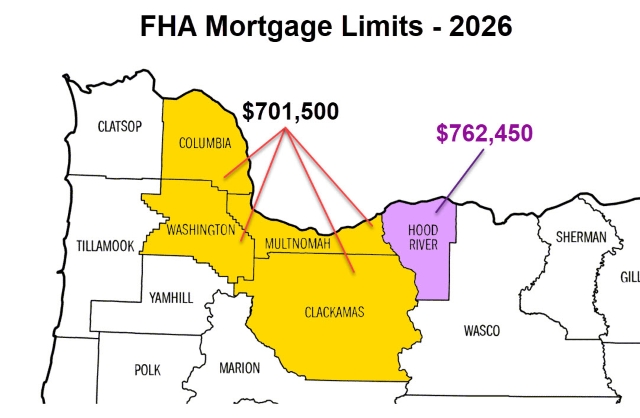
026 FHA loan limits by county in the Portland region – Portland metro MSA at $701,500, Hood River County at $762,450
2026 FHA one-unit loan limits by county. The Portland–Vancouver–Hillsboro MSA (yellow) rises to $701,500; Hood River County (purple) remains $762,450.
Source: HUD

2026 FHA one-unit loan limits by county. The Portland–Vancouver–Hillsboro MSA (yellow) rises to $701,500; Hood River County (purple) remains $762,450.

For broader Q3 2025 market trends, see the most recent quarterly update.

Sources & Further Reading

Decorative text divider.

Thanks for reading—I hope you found a useful insight or an unexpected nugget along the way. If you enjoyed the post, please consider subscribing for future updates.

CODA

Are you an agent in Portland and wonder why appraisers always do “x”?

A homeowner with questions about appraiser methodology?

If so, feel free to reach out—I enjoy connecting with market participants across Portland and the surrounding counties, and am always happy to help where I can.

And if you’re in need of appraisal services in Portland or anywhere in the Portland Region, we’d be glad to assist.
Portland Real Estate Appraisal Brief – Wednesday, December 10, 2025: TriMet Begins Targeted Evening Bus Service Reductions

TriMet’s November 30, 2025, evening bus frequency reductions prompt early rider concerns, meriting monitoring for subtle effects on multifamily demand in the Portland metro.

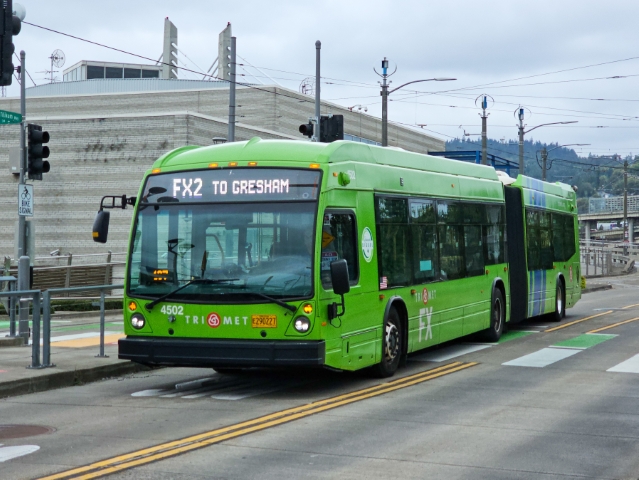
TriMet FX2–Division bus at OMSI SE Water station in Portland, representing one of the lines affected by evening service reductions impacting residential and multifamily property accessibility.
TriMet FX2–Division bus at the OMSI SE Water station in Southeast Portland.
Photo: Truflip99 via Wikimedia Commons (CC BY 4.0)

TriMet’s Initial Service Adjustments Take Effect

On November 30, 2025, TriMet implemented the first phase of service reductions, focusing on reduced frequency during low-ridership evening hours on five bus lines. These changes include:

  • Line FX2–Division: Every 24–35 minutes after 7 p.m. daily.
  • Line 35–Macadam/Greeley: Hourly after 9 p.m., with partial route suspension after 9 p.m.
  • Lines 52–Farmington/185th, 77–Broadway/Halsey, and 81–Kane/257th: Hourly after 9 p.m. on weekdays.

These targeted adjustments aim to address a projected $300 million budget gap over the coming years, driven by operating costs rising over 50% since 2019, ridership recovering to only about two-thirds of pre-pandemic levels, and insufficient new funding sources. A second phase of similar reductions on additional lines is planned for March 2026, with broader changes potentially following in late 2026 and 2027 if revenue challenges continue.

While these initial cuts are modest and timed for off-peak periods, they signal ongoing fiscal pressures on public transit in the Portland metro area.

Appraisal Implications

Residential Properties

Reliable transit access contributes to neighborhood demand and home marketability in the Portland region, particularly in areas with higher Transit Scores. These evening-focused reductions may have limited immediate impact on most single-family homeowners, many of whom have vehicle alternatives for off-peak travel.

Appraisers should remain attentive to buyer preferences in affected submarkets, such as parts of East Multnomah County or Washington County’s outer corridors served by these lines. Properties near core MAX stations or frequent daytime routes are likely to retain stronger connectivity advantages.

Multifamily Properties

Multifamily operators and investors may benefit from closer monitoring of these changes, especially for properties serving tenants with lower vehicle ownership rates. Reduced evening bus frequencies could subtly influence tenant convenience for shift workers or late commutes, potentially affecting renewal rates or lease-up pacing in directly impacted areas.

Early rider feedback highlights these concerns: parents report challenges managing long waits with children during appointments, while commuters note risks of lateness for evening shifts. For income valuations, any emerging softness in rents or occupancy—particularly in outlying complexes reliant on these specific lines—could inform minor adjustments to projected income streams. Core urban assets with redundant transit options should experience minimal effects.

Market Context

Portland’s housing policies continue to emphasize transit-oriented development and density to support affordability and sustainability goals. These initial service reductions—limited to off-peak hours—create some tension with those objectives, as reduced evening access may encourage greater car dependency in affected areas, countering recent efforts to reduce parking minimums and enhance walkability.

Appraisers, lenders, and investors in transit-reliant submarkets should monitor emerging patterns in lease-ups, renewal rates, and buyer feedback as riders adapt to the changes.

Sources & Further Reading

Decorative border text.

Thanks for reading—I hope you found a useful insight or an unexpected nugget along the way. If you enjoyed the post, please consider subscribing for future updates.

CODA

Are you an agent in Portland and wonder why appraisers always do “x”?

A homeowner with questions about appraiser methodology?

If so, feel free to reach out—I enjoy connecting with market participants across Portland and the surrounding counties, and am always happy to help where I can.

And if you’re in need of appraisal services in Portland or anywhere in the Portland Region, we’d be glad to assist.

Portland Real Estate Appraisal Brief – Thursday, December 4, 2025: National Home Sales Show Modest October Increases

National existing-home sales rose 1.2% and pending sales rose 1.9% in October 2025, providing context for Portland metro appraisers amid elevated regional prices.

Portland Oregon skyline at dusk with NAR Existing-Home Sales & Pending Sales October 2025 Report banner – context for national housing trends and Portland metro appraisals
Portland Oregon skyline at dusk.
Photo: Razvan Orendovici via Wikimedia Commons (CC BY 2.0)

National Home Sales Overview

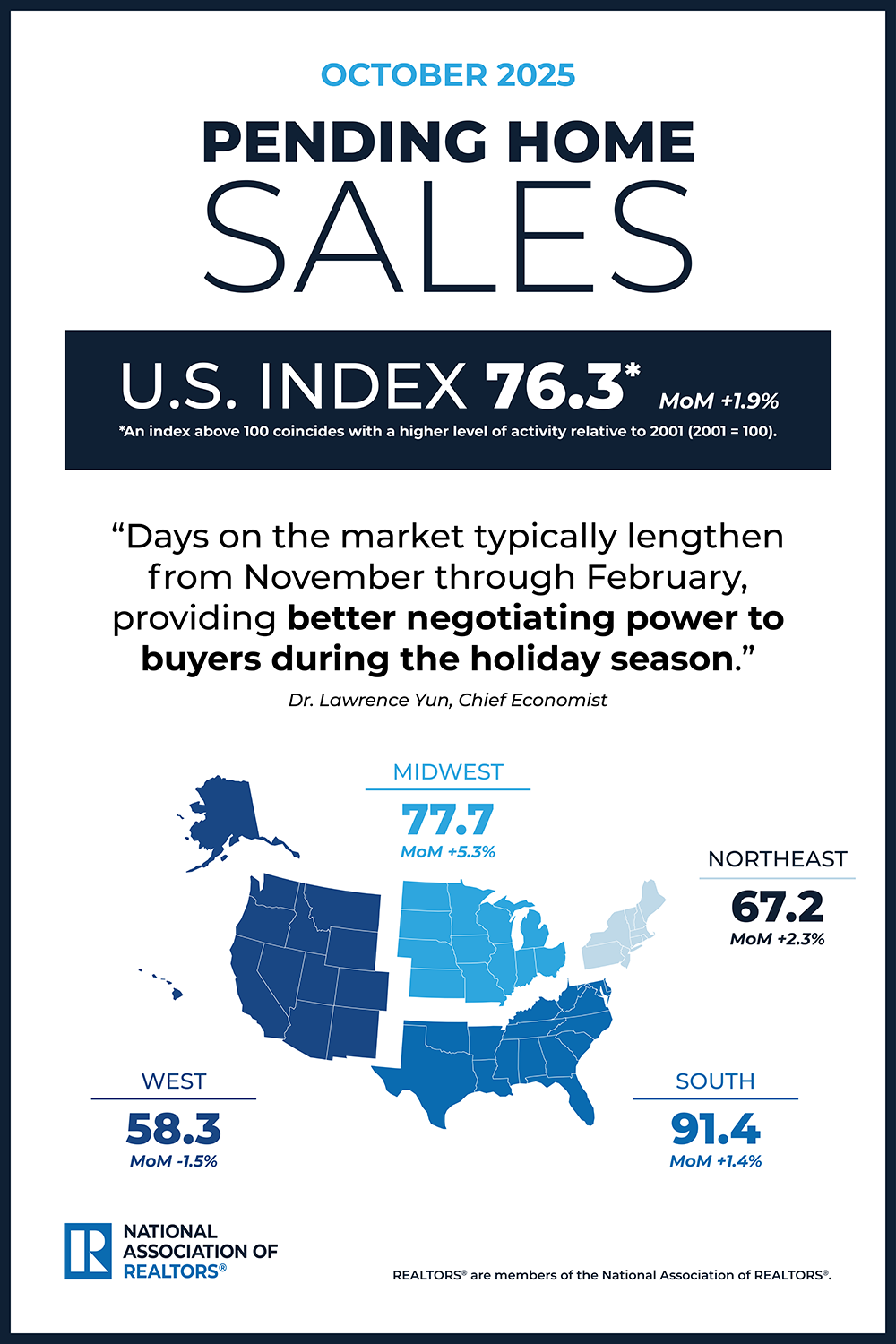
In October 2025, pending home sales across the U.S. rose 1.9% from September, reflecting a modest uptick in contract signings amid lower average mortgage rates(6.25%) for a 30-year fixed loan. Year-over-year, however, pending sales edged down by 0.4%. This monthly gain marks a continuation of buyer activity amid fluctuating economic signals.

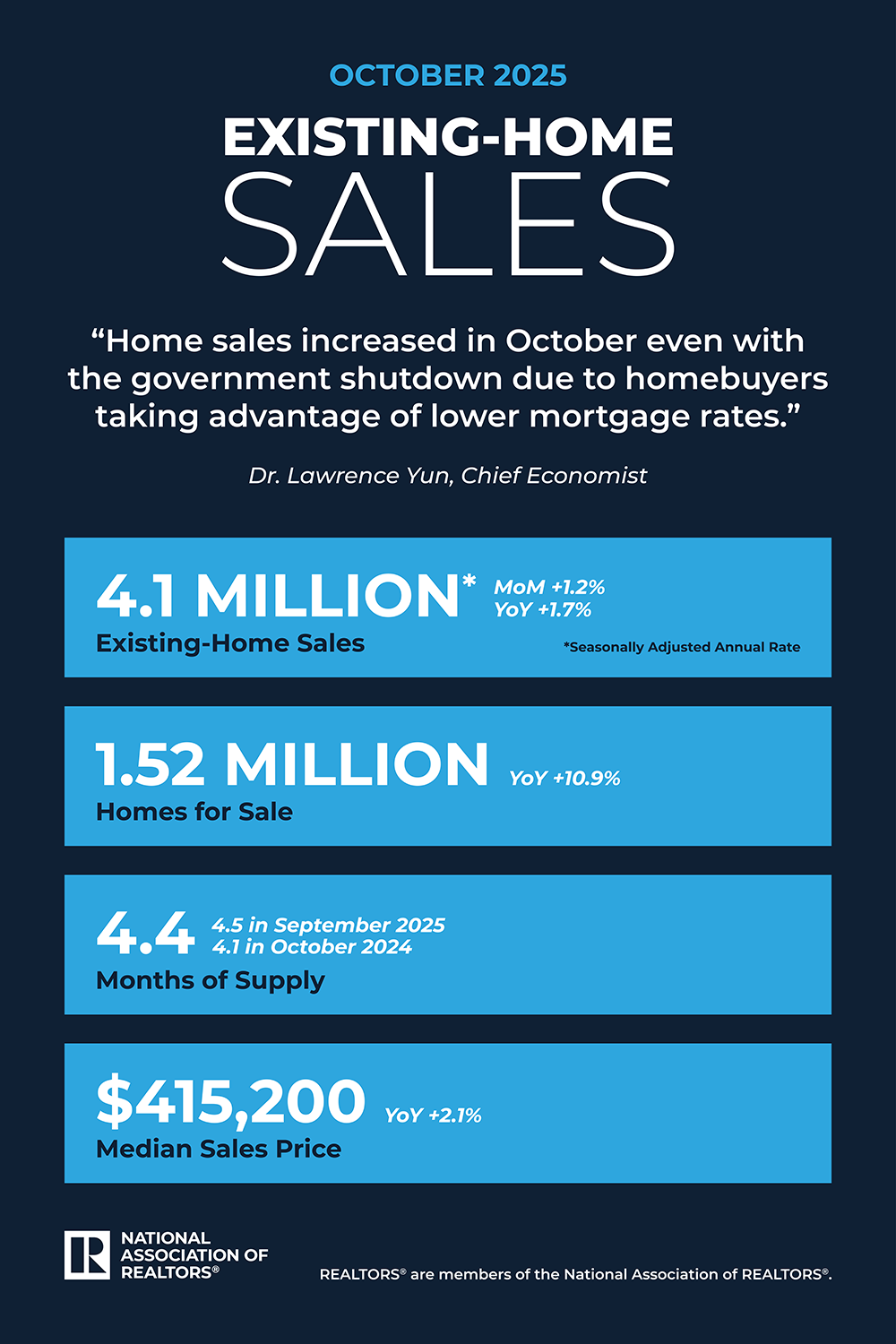
Existing-home sales also increased, climbing 1.2% month-over-month to a seasonally adjusted annual rate of 4.10 million units. On a year-over-year basis, existing sales were up 1.7%, with single-family homes comprising the bulk at 3.71 million units annually. Condominium and co-op sales contributed 390,000 units, showing stronger monthly growth at 5.4%.

The national median existing-home price stood at $415,200 in October, representing a 2.1% increase from the previous year. Single-family homes had a median price of $420,600, while condos and co-ops were at $363,700. These price levels underscore ongoing affordability challenges in certain markets.

NAR Pending Home Sales Index October 2025 infographic – national pending sales rose 1.9% month-over-month with regional breakdowns and Portland Oregon metro market context
NAR Pending Home Sales Snapshot – October 2025
Infographic courtesy National Association of REALTORS®

Regional Variations & Inventory

Regionally, pending home sales showed mixed results. The Midwest led with a 5.3% monthly increase and a 0.9% year-over-year gain, attributed to better affordability. The South followed with a 1.4% monthly rise and a 2.0% annual increase. The Northeast gained 2.3% month-over-month but declined 1.0% year-over-year. In contrast, the West saw a 1.5% monthly decrease and a 7.0% annual drop, highlighting price pressures in higher-cost areas.

For existing-home sales, the Midwest again outperformed with a 5.3% monthly increase to 990,000 units annually, up 2.1% year-over-year. The South edged up 0.5% monthly to 1.86 million units, with a 2.8% annual gain. The Northeast held steady monthly at 490,000 units but rose 4.3% year-over-year. The West declined 1.3% monthly to 760,000 units, down 2.6% annually. Median prices varied regionally, with the Northeast at $503,700 (up 6.5% year-over-year), Midwest at $319,500 (up 4.6%), South at $362,300 (up 0.3%), and West at $628,500 (up 0.1%).

NAR Existing-Home Sales October 2025 infographic – national median price $415,200, 4.4 months supply, regional sales and price trends relevant to Portland metro residential appraisals
NAR Existing-Home Sales Housing Snapshot – October 2025
Infographic courtesy National Association of REALTORS®

Inventory and Market Conditions

Total housing inventory dipped slightly to 1.52 million units in October, down 0.7% from September but up 10.9% from the prior year. This equates to a 4.4 months’ supply at the current sales pace, a minor decrease from September’s 4.5 months but an improvement from 4.1 months a year ago. These figures indicate a gradual easing in supply constraints nationally.

NAR Chief Economist Lawrence Yun noted that sales advanced despite external factors, with buyers responding to lower mortgage rates averaging 6.25% for a 30-year fixed loan. He emphasized regional disparities, with the Midwest and South benefiting from more affordable inventory, while the Northeast and West face supply shortages and elevated prices. Yun also highlighted decelerating rents potentially aiding inflation control and supporting further rate cuts by the Federal Reserve.

Implications for the Portland Region

These national trends offer context for stakeholders in the Portland metro area, where market dynamics may echo Western region challenges such as higher prices and softer sales growth. For perspective, the median close price for single-family detached residential properties in the Portland region held at $600,000 through Q3 2025. While this is significantly above the national October median of $415,200, it is slightly below the broader West region’s October median of $628,500, suggesting Portland is performing comparably on price relative to its regional peers. For detailed local metrics through September, refer to our Portland region Q3 2025 market update.

Sources & Further Reading

Thanks for reading—I hope you found a useful insight or an unexpected nugget along the way. If you enjoyed the post, please consider subscribing for future updates.

CODA

Are you an agent in Portland and wonder why appraisers always do “x”?

A homeowner with questions about appraiser methodology?

If so, feel free to reach out—I enjoy connecting with market participants across Portland and the surrounding counties, and am always happy to help where I can.

And if you’re in need of appraisal services in Portland or anywhere in the Portland Region, we’d be glad to assist.
Portland Real Estate Appraisal Brief – Wednesday, December 3, 2025: FHFA Raises 2026 Conforming Loan Limit to $832,750

FHFA raises the 2026 conforming loan limit to $832,750. In Q3 2025 alone, 99 Portland-area sales (70 conventionally financed) closed $806,501–$832,750 and will now avoid jumbo status.

Picture of Constitution Center (400 7th Street SW, Washington, D.C.) – headquarters of the Federal Housing Finance Agency (FHFA).
Constitution Center (400 7th Street SW, Washington, D.C.) – headquarters of the Federal Housing Finance Agency (FHFA).
Photo: Ajay Suresh via Wikimedia Commons (CC BY 2.0)

FHFA Announces 2026 Conforming Loan Limit Adjustments

The Federal Housing Finance Agency (FHFA) has released its annual conforming loan limit values for 2026, effective January 1 for mortgages acquired by Fannie Mae and Freddie Mac. The baseline limit for one-unit properties increases to $832,750 — up $26,250 from the 2025 figure of $806,500 — reflecting a 3.26% rise in the national House Price Index from the third quarter of 2024 to the third quarter of 2025.

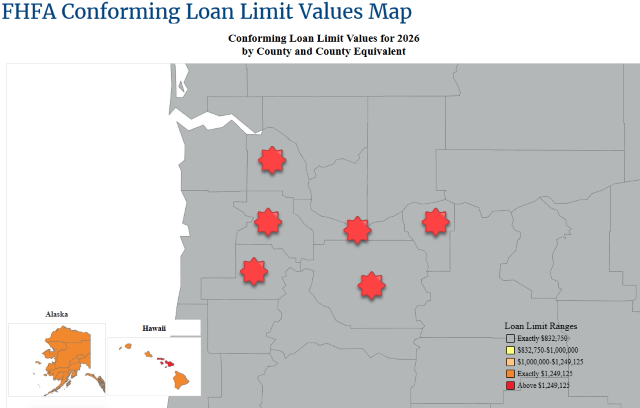
All counties in Oregon and the Portland-Vancouver-Hillsboro MSA remain at the baseline limit; no high-cost ceiling applies in our region.

FHFA Interactive Map

Appraisal Implications for the Portland Region

In Q3 2025 alone, 99 residential properties in the six-county region closed between $806,501 and $832,750. Of those, 70 were financed conventionally — transactions that would have required jumbo terms in 2025 but will now stay fully conforming in 2026.

Across the full quarter (4,682 total SFR detached-class closings):

  • 85.48 % (4,002 sales) closed under $900,000
  • Only 14.52 % (680 sales) closed at or above $900,000
  • The single busiest upper-tier band was $800,000 – $899,999 with 367 sales

Market Context from Q3 2025 Actual Sales

Price Band# of Sales% of Total MarketAvg Close PriceAvg CDOM
$800k– $899k3677.84 %$847,31351 days
$806,501 – $832,750992.11 %$820,86449 days
≥ $900k68014.52 %≈ $1,340,000+72+ days

For appraisers, lenders, realtors, estate planners, and attorneys, the 2026’s higher limit removes friction from one of the region’s most active price segments and keeps 85+% of transactions comfortably conforming.

Sources & Further Reading

Thanks for reading—I hope you found a useful insight or an unexpected nugget along the way. If you enjoyed the post, please consider subscribing for future updates.

CODA

Are you an agent in Portland and wonder why appraisers always do “x”?

A homeowner with questions about appraiser methodology?

If so, feel free to reach out—I enjoy connecting with market participants across Portland and the surrounding counties, and am always happy to help where I can.

And if you’re in need of appraisal services in Portland or anywhere in the Portland Region, we’d be glad to assist.