
Appraisal Deep Dive: Portland’s Starter Home Market (Q3 2025) — What $469k Really Buys

Q3 2025 RMLS data shows the Portland Region’s detached starter homes (5th–35th percentile) average $469k and are dominated by mid-century builds on larger lots—with new construction offering modern features but far less space. Appraisal and buyer insights below.

Yellow 20th-century bungalow in the Portland area typical of starter homes.
A classic early-20th-century bungalow in the Portland area—the type of modest, well-loved home that dominates today’s starter-tier inventory.
Via Canva Pro

Earlier this month, Redfin highlighted Portland as one of the stronger markets nationally for starter-home activity, defining starter homes as sales in the 5th–35th percentile by price. We adopt the same percentile convention here for consistency.

Redfin’s reported median of approximately $420,000 for Portland starter homes includes all property types (condos, townhomes, and single-family). Focusing solely on detached single-family residences—a popular choice across the region, including for many urban buyers seeking yard space and privacy over attached ownership—Q3 2025 RMLS data for the 5th–35th percentile tier shows an average close price of $469,000.

Few would be surprised that new construction plays a limited role in true entry-level pricing—after all, building costs remain elevated. Yet the data shows builders are still delivering a modest but meaningful number of brand-new homes into this tier (about 4.2% of starter sales, compared to 9.1% across the full market). This demonstrates that, through efficient design, infill strategies, and lot divisions, new product can compete in the lower price bands.

Local buyers want to know: how much home does a starter budget actually buy? This analysis examines square footage, lot size, build era, and location differences across counties—revealing a market dominated by mid-century homes with a modest but noteworthy presence of brand-new construction.

How Much Home a Starter Budget Buys by County

The table below summarizes Q3 2025 closed sales for detached single-family homes in the 5th–35th percentile across the core Portland Region counties (Hood River row excluded due to only two qualifying sales).

CountyAvg Close PriceAvg Yr BuiltAvg Total SFAvg Acres# of Sales
Clackamas$474,73819651,5530.279256
Columbia$457,10819831,7740.61758
Mult.$459,90919511,5910.163666
Wash.$488,95419761,4950.154323
Yamhill$453,52219811,5320.197113
Grand Total$468,59519631,5650.2031,418

Multnomah County drives nearly half the volume, delivering the oldest average build year (1951). Washington County posts the highest average prices and hosts the most new construction. Outer counties like Columbia and Yamhill provide newer homes on larger parcels, though with far fewer transactions.

Surprisingly, across the region, starter homes are very similar in average price. The standard numerical metrics which are easy to see in RMLS, (e.g. total square footage, lot size, year built, etc.), are not the primary determinant of value. As we shall see, what matters more is quality, condition, and overall site & functional utility. Buyers in the starter home tier make conscious trade-offs between older homes with larger lots and newer homes with little to no functional backyard.

Of all the standard numeric metrics, total square footage shows one of the stronger relationships with price in the starter tier—though the influence is still modest.

Scatter plot of Close Price versus Total Square Footage. The graph shows a slight tilt, indicate a noticeable though modest correlation between the two variables.
Close Price vs. Total Square Feet for Starter-Tier Detached Homes ≤ 0.5 Acres (Q3 2025 RMLS data – 1,380 observations).
Note: The Y-axis begins at $350,000 to allow for better viewing of the dataset.

Larger homes tend to sell for higher prices, though with considerable variation—most sales fall between 1,200 and 2,000 square feet. The very slight tilt to the right indicates a weak but present relationship between starter home size and close price. The coefficient of determination (R2) for this graph is 0.1253, meaning total square footage explains only about 12.5% of the variation in price. Since total square footage is often one of the primary determinants of value in the broader housing market, this is a big clue that the size of the home isn’t the primary factor for buyers looking to enter the starter home market.

The Historical Supply Pattern: Lot Size and Build Era

Portland’s entry-level inventory bears the clear imprint of the post-war building boom.

Scatter plot of Lot Size versus Year Build. The graph shows lot sizes rising up to the 1960s, where it begins steadily declining into the modern era, indicating the high cost of land and increasing lot splits.
Lot Size vs. Year Built for Starter-Tier Detached Homes ≤ 0.5 Acres (Q3 2025 RMLS data – 1,380 observations).

A polynomial trendline highlights the peak lot sizes during the 1940s–1950s post-war era, followed by a steady decline that began in the early 1960s and accelerated in recent decades. The pattern reflects an era when generous lots were standard, followed by shrinking parcels as land values rose, urban growth boundaries took effect, and lot divisions became common. Buyers choosing older starter homes today typically gain significantly more outdoor space than those selecting new construction.

New Construction: A Modest but Noteworthy Presence

While new homes account for only 4.2% of starter-tier sales, their ability to reach this price range in a high-cost building environment remains impressive.

SegmentAvg Close PriceAvg Total SFAvg Acres# of Sales
Existing$467,9961,5690.2071,359
New$482,3871,4790.10759
Grand Total$468,5951,5650.2031,418

New homes sell for only about 3% more than existing ones despite brand-new condition, but deliver less interior space and roughly half the land.

Buying a new home in the starter tier is akin to buying a new car on a tight budget: you gain the benefits of fresh systems, modern design, and warranty peace of mind, but often in a smaller package with fewer amenities compared to a well-maintained used model from a higher trim line.

CountyAvg Close PriceAvg Yr BuiltAvg Total SFAvg Acres# of Sales
Clackamas$489,80320251,6060.1548
Columbia$420,00020251,4580.1302
Mult.$450,82020251,0980.08818
Wash.$509,36620251,6990.07925
Yamhill$475,57820251,5400.2166
Grand Total$482,38720251,4790.10759

For buyers, this creates a clear choice: a brand-new home with modern efficiency but typically on a very small lot—often with minimal or no usable yard space, especially in Multnomah and Washington counties where most new construction occurs—or an existing mid-century home that generally offers significantly more land and outdoor space, albeit with the potential challenges of older systems and layouts. This trade-off is particularly relevant for growing families or those prioritizing play areas, gardens, or privacy.

Appraisal Insights and Challenges

One of the most revealing patterns appears when plotting close price against build year.
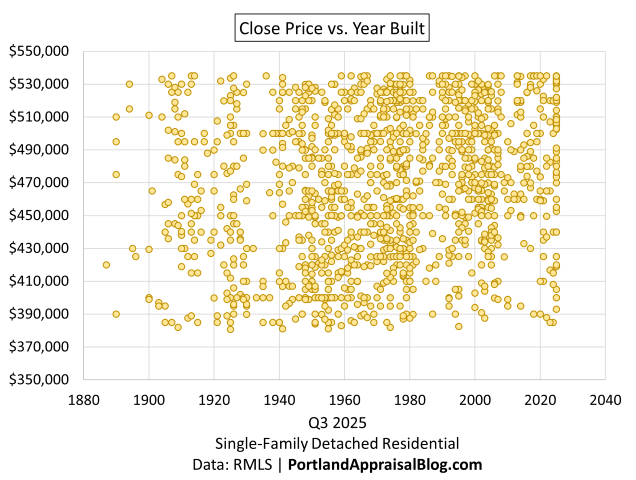
Scatter plot of Close Price versus Year Built. The graph shows virtually no correlation between the two variables, indicating start homes are driven by factors other than the year built.
Close Price vs. Year Built for Starter-Tier Detached Homes ≤ 0.5 Acres (Q3 2025 RMLS data – 1,380 observations).
Note: The Y-axis begins at $350,000 to allow for better viewing of the dataset.

The remarkably consistent price band across decades illustrates that chronological age has little direct influence on value in the Portland Region’s entry-level segment.

In this tier, actual age correlates weakly with sales price because buyers weigh multiple factors:

  • Functional obsolescence in mid-century stock (outdated floor plans, smaller kitchens/bathrooms, less efficient systems) is often mitigated by updates and strong location appeal.
  • Effective age and condition drive far more of the value than the original build date.
  • Lot size and site utility frequently favor older homes; the smaller parcels common in new construction require substantial negative adjustments that offset much of the credit for new condition.
  • Comparable selection remains within county, where abundant mid-century comps in Multnomah, Clackamas, and Washington provide solid support — but thinner volume in outer counties demands careful bracketing.
  • When appraising a new-construction home in this tier—where truly similar recent sales are still limited and down approximately 25% year-over-year in Q3 2025 (with Multnomah County off 48%)—appraisers typically rely on other relatively recent builds (often within 10 years) and apply appropriate adjustments for differences in site characteristics, size, and location.

The same pattern holds when looking at the data from a price-per-square-foot lens, but with a slight twist:
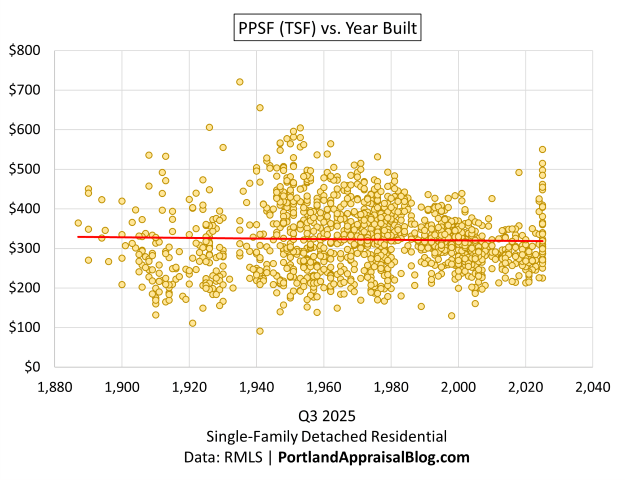
Scatter plot of PPSF (TSF) versus Year Built. The graph shows virtually no correlation between the two variables, but with a twist. There is a clear compression of PPSF for homes starting in the 1950s up to the modern era. This indicates a homogenization of the market following WWII. The only exception are completely brand new homes, where the PPSF widens again. This indicates new homes form a distinct submarket where location and site utility play a large role.
PPSF (TSF) vs. Year Built for Starter-Tier Detached Homes ≤ 0.5 Acres (Q3 2025 RMLS data – 1,380 observations).

From the 1950s onward, PPSF becomes progressively more compressed—older homes exhibit wide spreads driven by dramatic differences in condition, updates, historic appeal, and location premiums, while mid-era and late-20th-century stock tightens as market expectations and remodeling homogenize perceived value.

Brand-new 2025 homes, however, break this decades-long compression pattern. Their PPSF spreads out again, reflecting greater influence from location-driven land costs and builder-specific choices (e.g., finishes, lot configuration) rather than the uniformity imposed by age and updates on existing stock. In effect, today’s entry-level new construction reintroduces variation that mirrors pre-1950 homes—but for different reasons: land value dominance and strategic specs to hit price points, rather than condition swings. This underscores why new-construction starter homes often form their own submarket. Appraisers valuing them face a narrower but distinct comp pool.

These dynamics show that the starter home market is not uniform and the appraiser needs to carefully delineate the competitive market segment to avoid having to make large adjustments between disparate properties. One technique appraisers often employ is to use similar, but older sales when recent data is thin and make an appropriate market conditions adjustment.

Conclusion

The Portland Region’s Q3 2025 starter-home segment continues to rely predominantly on mid-century inventory on lots larger than anything new we’re building today—a pattern unlikely to shift dramatically in 2026 absent major changes in new supply. (Although the City of Portland is certainly trying to incentivize new projects with SDC waivers.) The modest foothold of new construction shows builders adapting through infill and efficient design, but at the clear cost of site size and outdoor space.

For buyers, the choice boils down to priorities: modern and low-maintenance on a small lot, or more space and yard with the realities of an older home. For appraisers, lenders, and agents, recognizing how effective age, site utility, location, and condition outweigh chronological age remains key to accurate valuation in this segment.

Sources & Further Reading

Decorative text divider.

Thanks for reading—I hope you found a useful insight or an unexpected nugget along the way. If you enjoyed the post, please consider subscribing for future updates.

CODA

Are you an agent in Portland who wonders why appraisers always do “x”?

A homeowner with questions about appraiser methodology?

If so, feel free to reach out—I enjoy connecting with market participants across Portland and the surrounding counties, and am always happy to help where I can.

And if you’re in need of appraisal services in Portland or anywhere in the Portland Region, we’d be glad to assist.
Appraisal Deep Dive: The Measure 50 Compression Trap and the 2024 MAV Reset Clarification

How pre-1997 Portland metro homes—especially those with veteran or active-duty exemptions—are facing sudden property tax jumps on sale or disqualification.

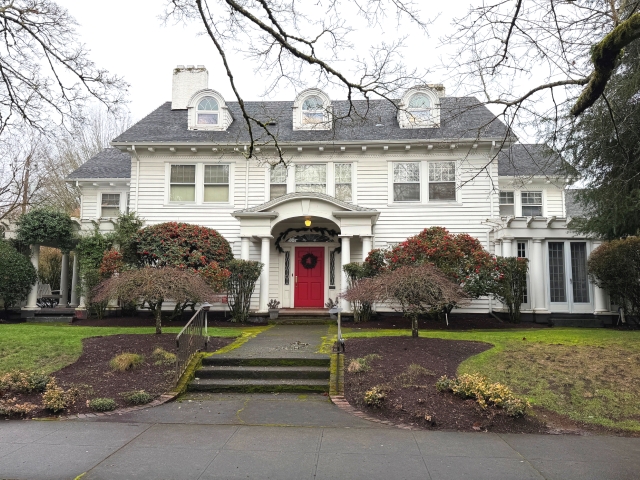
Exterior view of a well-maintained pre-1940 Colonial-style home in Portland, featuring a symmetrical facade, dormer windows, columns, red front door with wreath, and landscaped yard with steps leading to the entrance on an overcast day.
A classic pre-1940 home in the Portland Region – the type of property often benefiting from deep Measure 50 tax compression.
Photo: Portland Appraisal Blog

Table of Contents

  1. Introduction
  2. Understanding Measure 50: The Foundation of Tax Compression
  3. The Data: Tax Compression in the Portland Metro Market
  4. The Veteran and Active-Duty Exemptions
  5. The 2024 Rule Change
  6. Real-World Implications
  7. What Appraisers Should Do
  8. Closing Thoughts

Introduction

Imagine closing on a well-maintained pre-1940 Craftsman in an established close-in Portland neighborhood. The sale price felt fair, the taxes shown on the listing and county statement appeared reasonable, and the transaction cleared due diligence without issue. Then the next year’s tax bill arrives—$2,000 to $6,000 higher than anticipated. The increase isn’t due to a sudden spike in market value, but to a change in how Oregon counties now calculate Maximum Assessed Value (MAV) when certain partial property tax exemptions end.

This situation is no longer hypothetical. Oregon REALTORS first highlighted the risk in a December 12th, 2025 internal “Forms Tip of the Week” communication, alerting members that the loss of veteran or active-duty partial exemptions—commonly triggered when a qualifying veteran or surviving spouse sells the home or passes away without a qualifying successor—can lead to significant tax increases under updated guidance from the Oregon Department of Revenue.

While the veteran and active-duty exemptions (ORS 307.250 and 307.286) have drawn attention to the issue, the underlying driver is broader: the substantial tax compression created by Measure 50 for properties built or long-held before 1997.

Historically, when these modest partial exemptions ended, counties simply removed the discount and allowed the low underlying MAV to continue. The 2024 guidance change now enforces a constitutional requirement to reset MAV closer to current market reality upon disqualification.

The outcome: buyers may face permanently higher carrying costs they did not expect, sellers (including veterans and surviving spouses) can find their properties harder to market at full value, and appraisers encounter a marketability factor worthy of note when present.

This Deep Dive reviews the mechanics, illustrates the pattern with Portland Region sales data, and provides practical steps for identifying and addressing the issue in appraisal assignments.

Understanding Measure 50: The Foundation of Tax Compression

To grasp why the loss of a veteran or active-duty exemption can now lead to significant tax increases, we must first understand Oregon’s Measure 50 property tax system, approved by voters in 1997.

Measure 50 replaced the previous tax structure with two key values for each property:

  • Real Market Value (RMV): The county assessor’s estimate of what the property would sell for on the open market. This value can rise or fall annually with market conditions.
  • Maximum Assessed Value (MAV): A separate taxable value created by Measure 50. For existing properties in 1997, MAV was initially set at approximately 90% of the 1995–1997 RMV. Thereafter, MAV is generally limited to a 3% annual increase, with exceptions for major additions, improvements, or certain other events.

The Assessed Value (AV) is the lesser of RMV or MAV. Taxes are calculated by multiplying the AV by the local tax rate.

In high-appreciation markets like the Portland metro area, this 3% cap creates substantial tax compression over time. A home purchased or built before 1997 can have an MAV far below its current RMV after decades of strong market growth.

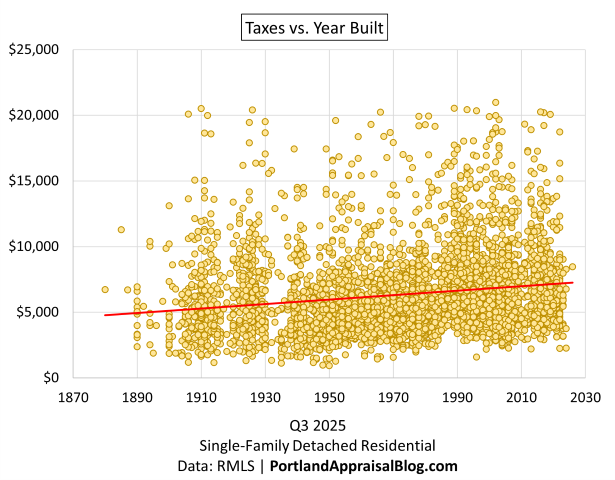
Scatter plot of annual property taxes versus year built for Q3 2025 single-family detached residential sales in the Portland Region, excluding new construction and data errors. Pre-1960 homes cluster tightly below $10,000–$12,000 in taxes; post-1990 homes show higher and wider spread, with a slight positive red trend line. Data source: RMLS via PortlandAppraisalBlog.com.
Annual property taxes vs. Year Built, excluding new construction and obvious data errors.
Note: Scatter plots are limited to properties with annual taxes of $21,000 or less to highlight the primary distribution and improve readability.

The scatter illustrates the effect clearly: pre-1960 homes are overwhelmingly clustered below $10,000–$12,000 in annual taxes, with the densest grouping under $8,000–$9,000. Properties on the far left (pre-1920 builds) often show the deepest compression, having benefited from the longest period of capped MAV growth. Post-1990 homes, by contrast, display significantly higher tax burdens, reflecting less historical compression.

When a triggering event occurs—such as disqualification from a partial exemption—the MAV can be recalculated using the Changed Property Ratio (CPR), typically around 0.54 for residential properties in Portland Region counties for the 2025–2026 tax year, applied to current RMV.

In the next section, we examine local sales data that quantifies the scale of this compression and illustrates why the reset can matter in real transactions.

The Data: Tax Compression in the Portland Metro Market

Q3 2025 sales data from detached single-family residences (SFR) in the Portland Region (Clackamas, Columbia, Hood River, Multnomah, Washington, and Yamhill counties) illustrates the scale of Measure 50 compression and why a MAV reset can create material differences in carrying costs.

The table below summarizes average sale prices and annual property taxes by approximate decade built. Flagged new construction is excluded due to frequently incomplete or preliminary tax assessments at the time of sale, which can distort the pattern of long-term compression. This brings the Q3 2025 dataset to 4,256 sales total.

Decade BucketAvg Sale PriceAvg Annual TaxesAvg Tax per $1k Sale Price
Pre-1940$671,295$6,396$9.33
1940–1959$607,466$5,766$9.53
1960–1979$640,000$5,783$9.16
1980–1999$714,535$7,367$10.31
2000–2019$761,061$7,685$10.10
2020+ (non-new construction)$924,420$8,016$9.12
Grand Total (excluding new construction)$688,838$6,665$9.68

Several patterns stand out:

  • Absolute tax burden increases with newer construction: pre-1980 homes average $5,766–$6,396 in annual taxes, while 2000–2019 properties average $7,685 and 2020+ non-new construction reaches $8,016.
  • Effective burden consistency: The Tax per $1k column remains remarkably stable at ~$9–$10 across all eras. This indicates the market prices properties assuming a similar overall tax load, regardless of age.
  • Pre-1940 premium: Outside recent construction, pre-1940 homes command the highest average sale prices ($671,295) despite paying among the lowest absolute taxes.
Street sign for NE Knott St in Historic Irvington, Portland, featuring the neighborhood's decorative column logo on a green and black background.
Street sign in Portland’s Historic Irvington neighborhood—one of the areas with many high-value pre-1940 homes exhibiting significant Measure 50 compression.
Photo: Portland Appraisal Blog (CC BY-SA 4.0)
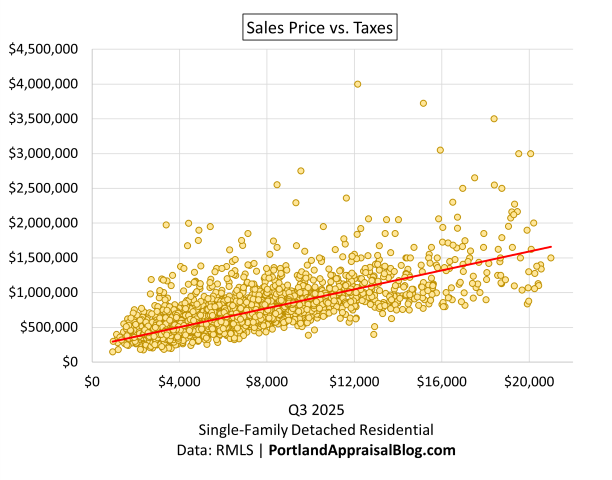
Scatter plot showing sale price versus annual property taxes for Q3 2025 single-family detached residential sales in the Portland Region. Points form a strong upward trend from approximately $500,000 sale price at $5,000 taxes to over $4,000,000 at $20,000 taxes, with a red trend line indicating positive correlation. Data source: RMLS via PortlandAppraisalBlog.com.
Sale price vs. annual taxes, excluding new construction and obvious data errors.
Note: Scatter plots are limited to properties with annual taxes of $21,000 or less to highlight the primary distribution and improve readability.

This scatter shows a strong positive correlation, confirming the market efficiently incorporates expected tax burden into pricing.

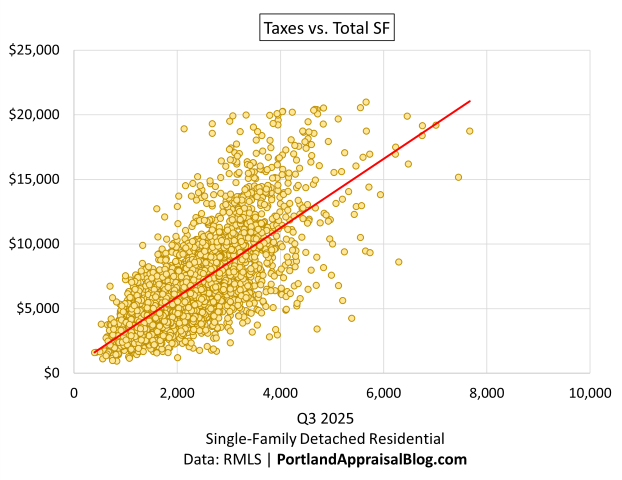
Scatter plot of annual property taxes versus total square footage for Q3 2025 single-family detached residential sales in the Portland Region. Points cluster along an upward red trend line, with many low-tax outliers below the line. Data source: RMLS via PortlandAppraisalBlog.com.
Annual taxes vs. total square footage, excluding new construction and obvious data errors.
Note: Scatter plots are limited to properties with annual taxes of $21,000 or less to highlight the primary distribution and improve readability.

Here, numerous low-tax outliers are visible below the trend line—properties paying substantially less than size and location would otherwise suggest, consistent with Measure 50 compression.

Taken together, the data reveals a market that rewards older stock with lower absolute taxes without discounting sale prices accordingly. When a MAV reset occurs, absolute taxes move toward levels seen in newer comparable properties, creating the potential for noticeable increases in annual carrying costs.

In the following sections, we explore the specific veteran and active-duty exemptions and the 2024 guidance change that can trigger this alignment.

The Veteran and Active-Duty Exemptions

The exemptions at the center of the current concern are partial property tax reductions for certain military veterans, surviving spouses, and active-duty service members. With approximately 267,000 veterans living in Oregon (and over 114,000 in the Portland metro region), even a fraction of qualifying owners selling or changing status can affect a meaningful number of transactions.

The disabled veteran or surviving spouse exemption (ORS 307.250) provides a reduction to assessed value for homeowners with a service-connected disability rating of 40% or higher (or unremarried surviving spouses). For the 2025–2026 tax year, the reduction is up to $31,565 (service-connected) or $26,303 (standard), worth roughly $400–$700 in annual tax savings in Portland metro areas depending on local rates.

A separate active-duty exemption (ORS 307.286) offers a larger reduction (up to $108,366 for 2025–2026) for Oregon-domiciled service members on qualifying active duty outside the state.

Both are partial exemptions applied to the assessed value of the owner’s primary residence and tied to personal status. Eligibility generally requires a one-time application and VA certification (re-filing needed only if moving to a new property or certified by a private physician rather than the VA).

While the direct savings from these exemptions is modest ($400–$700/year for most veteran claims), the 2024 DOR guidance change treats their disqualification as triggering a full MAV reset—potentially closing decades of Measure 50 compression and leading to significantly higher taxes.

Active-duty cases (e.g., exemption ending upon return home) are less common and typically involve properties with less historical compression.

In the next section, we detail the 2024 guidance change and how it activates the reset.

The 2024 Rule Change

For decades, when a veteran or active-duty partial exemption ended, county assessors typically removed the reduction but preserved the underlying compressed MAV, allowing it to continue growing at the standard 3% rate.

This practice changed with updated guidance from the Oregon Department of Revenue, effective for disqualifications on or after January 1, 2024.

The DOR clarified that disqualification from a partial exemption triggers the constitutional requirement to recalculate MAV using the Changed Property Ratio (CPR)—the county-wide ratio of average MAV to average RMV for the property class. The new MAV becomes current RMV multiplied by the CPR (typically around 0.54 for residential properties in Portland Region counties for the 2025–2026 tax year).

This administrative enforcement of the existing constitutional language means the modest exemption savings ($400–$700/year) is no longer the only consequence. The reset can close much of the Measure 50 compression gap.

In the Portland Region data, pre-1980 homes average $5,766–$6,396 in taxes. A reset aligns absolute taxes closer to 2000+ levels ($7,685–$8,016 average), producing increases commonly in the $1,500–$4,000 annual range on typical sales, with $4,000+ possible in deeper-compression or higher-rate scenarios.

The change is statewide, though impacts vary by local appreciation and rates. Some counties have noted the potential for “significant increase” on loss of exemption.

In the next section, we examine the real-world implications for transactions and what appraisers should watch for.

Real-World Implications

The 2024 guidance change does not turn every pre-1997 home sale into a crisis, but it introduces friction that can affect negotiations, marketability, and reconciliation of comparables.

Typical tax increases fall in the $1,500–$4,000 annual range for properties in the Portland Region dataset ($600,000–$800,000 sale prices with pre-1980 build years). This translates to $125–$333 extra per month.

The Silent Car Payment

In late 2025 terms:

  • Average used-car payment: ~$532/month
  • Average new-car lease: ~$596/month
  • Average new-car purchase payment: ~$748/month

A $2,000–$4,000 annual increase ($167–$333/month) is less than a typical car payment but still noticeable—equivalent to a permanent, non-negotiable “utility bundle” that never goes away. For buyers already stretched in a higher-interest-rate environment, it can shift affordability and prompt renegotiation.

Outlier cases with deeper compression (often “sweet” pre-1940 homes in high-appreciation locations) can see $4,000–$8,000+ increases ($333–$667/month)—territory overlapping average used-car or new-lease payments. These are the transactions Oregon REALTORS described as producing “increases in the thousands,” sometimes requiring substantial seller concessions or risking fallout during due diligence.

The primary impact is often on marketability rather than outright deal death:

  • Savvy buyers (or their agents/lenders) anticipate the higher future taxes and adjust offers downward.
  • Sellers—particularly veterans or surviving spouses downsizing—may receive lower net proceeds (capitalizing a $3,000 increase at 6% equates to ~$50,000 less effective value).
  • Listings can linger if the low current taxes mask the post-closing reality.

For appraisers, this creates a new lens for outliers:

  • A comparable with an unexplained lower price, large concession, or extended days on market may reflect buyer reaction to a pending MAV reset.
  • Low-tax outliers in the grid (visible in the Taxes vs. Total SF scatter) could indicate compressed MAV or an active exemption—worth verifying via county records when material.

The change is statewide, but effects are most pronounced in areas with strong historical appreciation, like the Portland Region.

In the next section, we outline practical steps appraisers can take to identify and address this factor in reports.

What Appraisers Should Do

The 2024 guidance change introduces a marketability factor that appraisers in Oregon should consider when the subject or comparables involve pre-1997 properties, particularly those with potential veteran or active-duty exemptions.

Practical Checklist

  1. Verify Exemption Status Review county tax records and the preliminary title report (if available) for indications of an active veteran, surviving spouse, or active-duty partial exemption. Many counties list it on the property tax statement or online portal.
  2. Estimate Post-Transfer Tax Liability If an exemption is present and likely to disqualify on transfer (e.g., sale to non-qualifying buyer), note the potential increase. Use county assessor tools or CPR data to project the reset MAV (current RMV × CPR) and resulting taxes. Typical jumps in the Portland Region fall in the $1,500–$4,000 annual range, with higher amounts possible in deep-compression cases. Note that tax rates vary by code area.
  3. Comment on Marketability When Material Include commentary if the differential is significant: “The subject property currently benefits from a veteran partial exemption expected to end upon transfer, potentially increasing annual taxes by an estimated $X. This may affect buyer affordability and market reaction.”
  4. Reconcile Outliers with This Lens Low-tax outliers in the sales grid (visible in Taxes vs. Total SF analysis) may reflect compressed MAV or an active exemption—a “decaying asset” under the new guidance. Check effective tax rate (annual taxes ÷ sale price): ~0.6–0.8% may indicate compression; consider post-reset alignment (~1.1–1.3%) in reconciliation. Using a compressed comparable without adjustment risks overvaluing the subject’s marketability, as savvy buyers increasingly factor in the reset.
  5. Use Dual Scenarios if Appropriate For subjects with active exemptions, provide current and projected post-reset tax estimates in the addendum or comments to inform the intended user.

Resources:

  • County assessor websites (tax statements often flag exemptions)
  • DOR Veteran Exemptions page
  • MAV Manual for general mechanics

As resets propagate into closed sales (expected more visibly in 2026 onward), this factor may explain otherwise puzzling comparables. Early identification helps ensure accurate valuation and informed clients.

In the closing section, we look at the broader outlook.

Closing Thoughts

The 2024 DOR guidance change is an administrative enforcement of a long-standing constitutional provision, but its impact is only now becoming visible as disqualifications occur and 2025–2026 tax statements arrive. Larger effects are expected in the 2026–2027 cycle as more veteran-owned properties sell or change status.

The 2025 Oregon Legislative Session saw bills (e.g., HB 2361/SB 387 aiming to lower the disability threshold, HB 3287 to increase exemption amounts) intended to expand veteran benefits. While these efforts highlight recognition of the issue, none addressed the MAV reset trigger itself. The constitutional requirement remains unless amended or re-interpreted.

For appraisers working in the Portland Region and similar appreciation-driven markets, this issue adds one more layer to marketability analysis. Low-tax outliers in older properties represent a benefit that can evaporate on transfer—reliable today, but potentially “decaying” tomorrow.

Awareness helps everyone involved: appraisers reconcile comparables more accurately, agents counsel clients proactively, and buyers/sellers avoid surprises.

If you encounter real-world examples (anonymized comps with concessions due to reset concerns, or listings noting the risk), please share them for future updates. Documenting patterns strengthens our collective understanding.

Thank you for reading this Appraisal Deep Dive. Stay informed and precise in your work.

Quick Reference Cheat Sheet

Reset FormulaReal Market Value (RMV) × Changed Property Ratio (CPR)
Typical CPR (2025–2026, Portland Region residential)~0.54 (updated annually each October)
Reset TriggerDisqualification from veteran/active-duty exemption
Typical Annual Increase$1,500–$4,000 ($125–$333/month)
Outlier Increase$4,000–$8,000+ ($333–$667+/month)

Sources & Further Reading

Decorative text divider.

Thanks for reading—I hope you found a useful insight or an unexpected nugget along the way. If you enjoyed the post, please consider subscribing for future updates.

CODA

Are you an agent in Portland who wonders why appraisers always do “x”?

A homeowner with questions about appraiser methodology?

If so, feel free to reach out—I enjoy connecting with market participants across Portland and the surrounding counties, and am always happy to help where I can.

And if you’re in need of appraisal services in Portland or anywhere in the Portland Region, we’d be glad to assist.