Oregon’s new OHNA model zoning code removes barriers to small-scale neighborhood apartments in Portland-area cities, with gradual changes expected where market conditions support them.
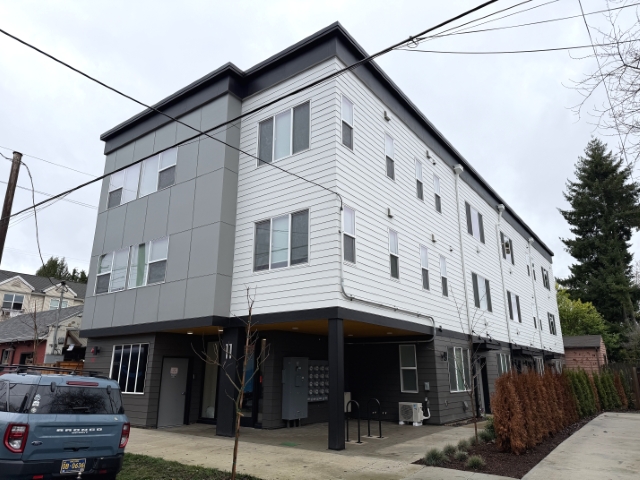
Three-story, 16-unit apartment building on a standard Portland residential lot, illustrating potential density under middle housing reforms 11 NE 55th Ave, Portland, Oregon – December 2025 Photo: Abdur Abdul-Malik, Certified Residential Appraiser
New Statewide Model Zoning Code for Middle Housing
Oregon’s Land Conservation and Development Commission unanimously adopted new rules under the Oregon Housing Needs Analysis (OHNA) framework on December 4, 2025, establishing a statewide model zoning code to accelerate housing production in cities that underperform relative to peers. The amendments build on prior middle housing reforms by moving away from strict unit counts per building toward form-based regulation—controlling height, footprint, lot coverage, and floor area ratios instead.
In practice, the model code re-legalizes neighborhood-scale apartment buildings (typically three to four stories) that have long been prohibited in low-density residential zones. It permits duplexes, triplexes, fourplexes, townhouses, and cottage clusters outright, with bonuses such as additional height or reduced courtyard sizes when projects include accessible units or deeper affordability. Parking requirements are significantly reduced or eliminated for many of these housing types.
Affected cities—primarily Oregon’s larger municipalities, including Portland, Beaverton, Gresham, Hillsboro, and others in the metro area—must align zoning with the model code if they fail to meet production targets, though implementation timelines vary by jurisdiction and can extend several years.
Appraisal Implications
Residential Properties
These rules expand as-of-right development options on residential lots, particularly corner or larger parcels in single-family zones. Highest-and-best-use analyses may now reflect stronger redevelopment potential for small multifamily or middle housing types in cities subject to the model code.
Although the model code removes unit-count caps, form-based limits on height, coverage, and floor area ratio keep development firmly neighborhood-scale—typically supporting 6–12 units on a standard lot, not the higher densities seen in multi-dwelling zones. While larger projects, such as a 16-unit building, are now more feasible, it is important to remember they remain a different undertaking: they involve more complex regulatory review, commercial-grade construction requirements, specialized financing, and contractor expertise that many local rehabbers and small builders are not equipped to handle. Market activity will likely continue to favor rehabilitation of existing homes alongside gradual small-scale infill.
New construction of even single-family homes remains a regular occurrence in Portland despite years of higher density allowances—often with an ADU added. Many builders are primarily set up for that work and not much else. While residential appraisers need to be mindful of what is possible with the new zoning allowances, they must analyze what the market is actually doing.
Income-Producing and Multifamily Properties
Form-based standards and reduced parking mandates lower barriers to feasible small apartment or townhouse projects. Affordability and accessibility bonuses provide quantifiable density incentives that investors can underwrite with greater certainty. Over time, this may broaden comparable selection for emerging middle housing product.
These changes simply remove long-standing barriers to the creation of small-scale apartment buildings in cities that previously had hostile zoning laws for such structures. It does not mean they will sprout on every street, but we may gradually begin to see more of them where it makes economic and market sense.
Portland’s Temporary SDC Exemption for New Housing Units (2025–2028): PortlandAppraisalBlog
Thanks for reading—I hope you found a useful insight or an unexpected nugget along the way. If you enjoyed the post, please consider subscribing for future updates.
CODA
Are you an agent in Portland and wonder why appraisers always do “x”?
A homeowner with questions about appraiser methodology?
If so, feel free to reach out—I enjoy connecting with market participants across Portland and the surrounding counties, and am always happy to help where I can.
And if you’re in need of appraisal services in Portland or anywhere in the Portland Region, we’d be glad to assist.
Portland’s Home Forward reverses rent hikes at subsidized properties amid 14% vacancies, $20.7M RSO reallocation, and HUD’s CoC pause—appraisal risks for multifamily in the Portland–Vancouver region.
The paradox of empty apartments amidst a backlog of applications Via Canva Pro
The Affordable Housing Paradox: Local Action and Federal Uncertainty
The dynamics of affordable housing in the Portland metro area are currently defined by a convergence of major local policy responses and intense federal uncertainty. The situation presents a complex risk profile for homeowners, investors, lenders, and appraisers focused on the multifamily sector across the region.
Locally, the Portland Housing Authority, Home Forward, recently reversed planned rent increases at two properties, The Yards at Union Station and Pearl Court Apartments, after tenant outcry. The decision was made following reporting that the region has at least 1,863 income-restricted apartments sitting empty while waitlists remain years long—an affordable-housing paradox our brief from Sunday, December 7th examined. Home Forward’s vacancy rate is approximately 14% across its portfolio, significantly above the general market rate. The rent increases, which were as high as 10% for tenants using government rent subsidies, were originally deemed necessary due to a combination of rising operating costs and delayed federal voucher renewals and payment shortfalls. This immediate reversal highlights the degree to which local administrative and political pressures are mitigating instability that often originates from federal payment issues.
Local Fiscal Correction and Spending Priorities
Adding to the local action is the controversy over approximately $20.7 million in unspent funds from the Rental Services Office (RSO), as uncovered in last month’s reporting on landlord relocation fees. This surplus prompted concern after former Housing Director Shannon Singleton told city council she was instructed not to disclose the accumulated balance. The discovery has pushed the City Council to act quickly, especially as Home Forward is currently facing an estimated $35 million budget gap next year due to insufficient federal funding.
The Council introduced a resolution to allocate the approximately $20.7 million. The intent is to “slow the inflow into homelessness” by prioritizing upstream renter stabilization and prevention programs. Key components of the Council’s directed priorities include:
$9 million designated for Home Forward to stabilize households affected by ongoing federal funding cuts and help close the agency’s widening budget gap.
$4 million over three fiscal years for new, flexible, short-term rent assistance aimed at tenants facing imminent eviction.
A minimum of $2 million of RSO revenue set aside for capitalizing a Revolving Loan Fund, which would be used for the future acquisition of market-rate housing or land banking for the development of social housing.
The allocation of these funds underscores a local commitment to mitigating housing instability in the face of dwindling or volatile federal support.
Federal Policy Shifts and HUD Overhaul Pause
The urgency behind the local fund allocation is intensified by volatility at the federal level, which affects the entire Portland–Vancouver region. Nationally, housing authorities and property owners have been dealing with operational disruptions, including delayed Housing Choice Voucher (Section 8) payments to landlords due to a recent federal government shutdown. Furthermore, Home Forward was forced to halt the issuance of new vouchers in August due to the looming $35 million budget gap driven by insufficient HUD funding.
On December 8th, the Department of Housing and Urban Development (HUD) temporarily withdrew its highly controversial Continuum of Care (CoC) Notice of Funding Opportunity (NOFO). This withdrawal occurred just hours before a court hearing related to multiple lawsuits, including one in which both Oregon and Washington were key plaintiffs, as detailed in our December 2nd brief on the HUD lawsuit. The NOFO was widely criticized for proposing a significant shift in federal policy by drastically limiting the amount of CoC funds—the largest federal grant source for homelessness prevention—that could be used for Permanent Supportive Housing (PSH). Oregon Housing and Community Services (OHCS) and other local providers had warned that this policy change would create a conflict with state policies requiring services to be voluntary, threatening to disrupt or displace existing programs. The temporary pause on the overhaul grants local housing authorities and service providers a crucial—though potentially brief—reprieve as HUD reviews its funding strategy.
Appraisal Implications
The confluence of extreme local policy action, high subsidized vacancy rates, and unstable federal funding introduces unique valuation and market risks for properties, particularly in the multifamily segment across Clackamas, Multnomah, Washington, and Clark counties.
Income-Restricted and Section 8 Properties
The financial state of Home Forward, marked by a 14% vacancy rate and a $35 million budget gap, injects severe income-approach risk for appraisers. Restricted rents that appeared stable only weeks ago have proven volatile, and operating expenses continue rising faster than allowed rent adjustments. Appraisers valuing LIHTC, project-based Section 8, or other regulated affordable properties must account for elevated policy risk.
Vacancy Analysis: The high vacancy is driven by both administrative issues and market factors. Specifically, many 60% AMI units are no longer competitive as market-rate rents have dropped, causing demand to lag in this specific income tier while the deepest need remains in the 0-30% AMI range. Appraisers must carefully analyze these tiers, alongside physical risks, to determine the actual loss-to-lease and economic vacancy.
Market-Rate Multifamily Rentals
The $20.7 million reallocation and potential influx of new renter stabilization resources may modestly ease pressure on market-rate rents in lower-price segments, though the effect will likely be concentrated in central Portland submarkets.
Sources & Further Reading
Home Forward reverses rent hikes at buildings with vacant units: OregonLive
Federal government late on Section 8 payments: The Real Deal
Former housing director on undisclosed $20.7M in funds: Portland Mercury
City Council resolution to reallocate $20.7M in rental funds: City of Portland
Thanks for reading—I hope you found a useful insight or an unexpected nugget along the way. If you enjoyed the post, please consider subscribing for future updates.
CODA
Are you an agent in Portland and wonder why appraisers always do “x”?
A homeowner with questions about appraiser methodology?
If so, feel free to reach out—I enjoy connecting with market participants across Portland and the surrounding counties, and am always happy to help where I can.
And if you’re in need of appraisal services in Portland or anywhere in the Portland Region, we’d be glad to assist.
Portland’s code now allows single-exit stairwell apartments, raising the maximum unit count on infill lots and posing a compliance challenge for Portland Certified Residential Appraisers.
Three-story, 16-unit apartment building on a 5,000 sq ft lot—an early example of the infill density now fully achievable in Portland’s RM1 and RM2 zones under current zoning and the 2025 single-exit stairwell provisions 11 NE 55th Ave, Portland, Oregon – December 2025 Photo: Abdur Abdul-Malik, Certified Residential Appraiser
Easing Regulatory Barriers to Mid-Rise Infill
The City of Portland’s Bureau of Development Services, in coordination with Portland Fire & Rescue, approved a final Building Code Guide (BCG 25–10) on October 22, 2025, that permits single-exit stairwells in certain apartment buildings up to four stories in height. This guide implements a provision already adopted within the 2025 Oregon Structural Specialty Code (OSSC), removing a significant regulatory barrier that often rendered mid-rise infill housing financially and physically impractical on constrained urban lots throughout the Portland metro area.
This code clarification aligns Portland with the practices of progressive code adopters, including Seattle and various international jurisdictions, which have successfully and safely utilized single-stair designs for decades. The change is particularly relevant for infill sites—common in Portland’s established neighborhoods—where lot width or depth previously made the mandatory two-stairwell design economically unfeasible.
The economic advantage is substantial: traditional two-stair designs can consume 13–16% of the total floor area for circulation (stairs and hallways). A single-stair “point access block” can reduce circulation space to as little as 6.5% of the floor area, effectively converting otherwise unusable common space into leasable or saleable residential square footage. The push to allow this type of construction illuminates the entangled intersection between safety, housing affordability, and building codes at a national level. This efficiency boost is key to making medium-density projects feasible in high-cost urban environments. The new allowance is expected to have a greater impact on Multi-Dwelling (RM) zones than on the R2.5–R20 zones, where unit counts are generally capped at six.
Appraisal Implications for Real Estate Valuation
The finalization of single-exit guidelines has direct implications for certified residential appraisers (CRs), lenders, and real estate professionals in the Portland region.
Multifamily Development and the CR 4-Unit Limit
The new guideline creates a direct compliance challenge for CRs. CRs are restricted to appraising residential properties containing four or fewer units.
The 16-unit apartment building at 11 NE 55th Ave provides a perfect case study: it is constructed on a 5,000 sq. ft. lot, which is a standard lot size for Portland. While this specific site is zoned CM2 (Commercial Mixed Use 2), it is a very common setup in transitional zones like RM1 or RM2 and makes for a warning of the complexities residential appraisers will now face on an increasing number of sites throughout the City of Portland. A comprehensive and thorough highest and best use analysis (H&BU) will be even more paramount for CRs going forward.
The Land Sale vs. Home Sale Trap (The H&BU Pitfall):
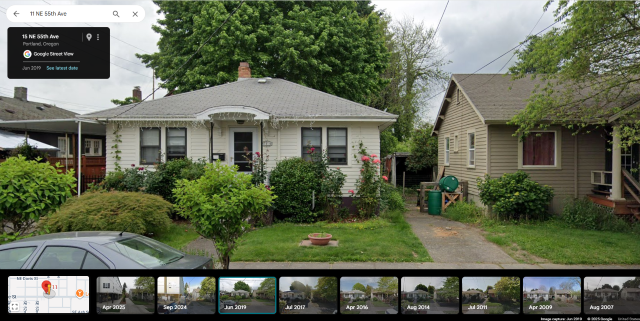
Here is what existed on the site prior:
Single-family residence formerly at 11 NE 55th Ave (CM2 zone) prior to demolition and redevelopment into 16-unit multifamily Portland, Oregon – circa 2019 (Google Street View archive) Photo: Google Street View (public domain)
Note the home to the right of the subject. That neighboring home has RM2 zoning and still exists to this day. For the sake of illustration, let’s pretend the subject itself was located in the same RM2 zone. (The problem would also exist if it were in the RM1 zone.) I have always been wary of appraising properties in RM1 and RM2 zones due to the potential of unit density exceeding my license scope. However, in some select areas, a careful highest and best use analysis shows four units or less is still the market preference, or perhaps the only options feasible. Constructing an apartment building like the subject in an RM1 or RM2 zone was more difficult prior to the recent zoning change. A residential appraiser viewing the subject’s original home could easily come to the conclusion that the H&BU is still residential, as that conforms to the next door property. However, the financial data proves the site’s H&BU shifted long ago:
Negative Value: The original house effectively had negative value, as the developer purchased the site for $650,000 in early 2024, intending only to demolish the structure and build up.
Land Value: The $650,000 purchase price was solely a land sale based on the potential to build high density—a potential maximized by the single-stair allowance.
The New H&BU: The resulting 16-unit asset, listed at over $3.3 million, confirms the H&BU is a multifamily property that requires a Certified General (CG) Appraiser.
Pro Forma Income: Because the building is new and actively offering rental concessions (e.g., free rent) to tenants, the listing’s financial figures are projected (pro forma). It has a Projected Gross Annual Income of $256,005 and a Pro Forma Cap Rate of 5.17%—financial metrics based on achieving full market rents and directly tied to the single-stair design’s efficiency. Appraising such a property requires a lease-up analysis and would necessitate a Certified General Appraiser to determine both the As-Is and As-Stabilized values.
Risk Area (RM1 & RM2): The greatest risk for CRs lies in Transitional Multi-Dwelling zones (like RM1 or RM2). These zones can get complicated quickly, and the single-stair allowance now pushes the practical development cap far beyond the CR’s 4-unit limit, even on small parcels.
Required Due Diligence: CRs must perform careful due diligence when analyzing the H&BU of transitional or infill parcels. If the H&BU conclusion is a multi-unit property exceeding four units, the assignment falls outside the scope of a CR license, and the assignment must be transferred to a Certified General Appraiser.
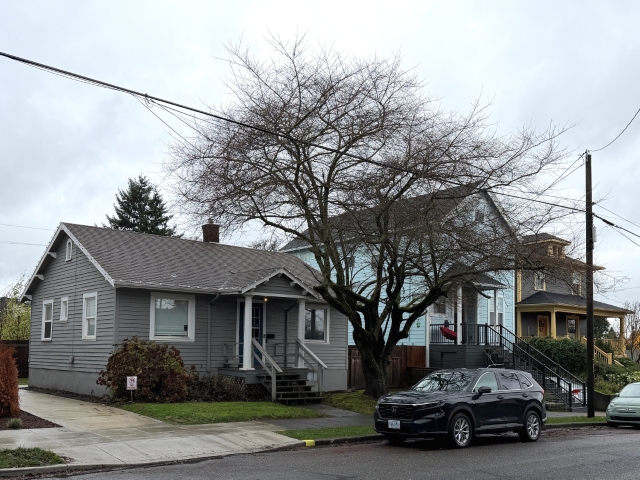
This apartment building on the street (made possible by the single-stair allowance) has now greatly complicated any future appraisals for the adjacent home. The adjacent home sits on a lot the same size (5,000 sq. ft.).
Adjacent single-family home on a matching 5,000 sq ft lot zoned RM2—identical in size to the 11 NE 55th Ave site now redeveloped with a three-story, 16-unit apartment building NE 55th Ave (North Tabor), Portland, Oregon – December 2025 Photo: Abdur Abdul-Malik, Certified Residential Appraiser
An appraisal on this home would now need to take into account the potential to remove the dwelling and place a 16-unit apartment building on the site. The apartment building next door, even though in a different zoning, proved that such a structure is physically possible on a 5,000 sq. ft. lot. Now, with the zoning law change, such a structure is also much more likely to be greenlit following a formal review by the planning department. Even if all the structures on this street were residential homes, a CR can no longer assume four units or less is the H&BU if the zoning is RM1 or RM2.
Density Rules Every Portland Appraiser Needs Tattooed on Their Forearm
In most of Portland’s multi-dwelling zones (RM1–RM4 and RX) there is no maximum density—only minimums. The City’s own table spells it out clearly:
Zone
Maximum Density
Minimum Density (base)
RM1
None
1 unit per 2,500 sf
RM2
None
1 unit per 1,450 sf
RM3
None
1 unit per 1,000 sf
RM4
None
1 unit per 1,000 sf
RX
None
1 unit per 500 sf
RMP
1 per 1,500 sf (bonus to 1 per 1,000 sf)
1 per 1,875 sf
Source: City of Portland Bureau of Development Services – Density and Lot Dimensions in Multi-Dwelling Zones (09/27/2024)
On a typical 5,000 sq ft lot with no overlays:
RM1 → minimum 2 units, no upper limit
RM2 → minimum 3–4 units, no upper limit
Highest-and-Best-Use Reality Check for Certified Residential Appraisers
Unless a site in RM1, RM2, RM3, RM4, or RX has obvious, insurmountable physical or regulatory constraints (steep topography, protected trees requiring preservation, environmental overlay zones, landslide hazard, historic designation, or similar), a credible H&BU analysis can no longer conclude that single-family, duplex, triplex, or fourplex development is the concluded use without first testing a multifamily pro forma that likely exceeds four units.
Doing so risks an incomplete analysis and, more critically, completing a valuation that falls outside the Certified Residential license scope.
Appraisers: be careful!
Land Value and Investment Properties
The zoning change also directly affects land value and the as-completed project feasibility by allowing for a more efficient and profitable building design. This local regulatory shift also aligns with supporting federal policy, such as the Federal Housing Finance Agency (FHFA) increasing the combined volume cap for Fannie Mae and Freddie Mac’s multifamily loan purchases to $176 billion for 2026.
Market Context
Portland continues to grapple with a housing shortage, making any code modification that reduces hard construction barriers on infill parcels a necessary and impactful step. The North Tabor neighborhood where this property is located is appealing for investors, characterized by an urban-suburban mix and a high proportion of renters. This demographic composition and investor demand underscores the high asking price for turnkey rental assets like the new construction apartment building in our case study.
For lenders, realtors, estate planners, and attorneys, it is crucial to recognize that the appraisal of these new single-stair buildings will require a deep understanding of the regulatory context. Appraisers must accurately reflect the specific size, unit count, and advanced fire-safety features required by the Building Code Guide 25–10 to ensure a credible valuation and appropriate comparable selection.
Sources & Further Reading
New Portland guidelines for single-stair apartment buildings: News
Thanks for reading—I hope you found a useful insight or an unexpected nugget along the way. If you enjoyed the post, please consider subscribing for future updates.
CODA
Are you an agent in Portland and wonder why appraisers always do “x”?
A homeowner, lawyer, or estate planner with questions about appraiser methodology?
If so, feel free to reach out—I enjoy connecting with market participants across Portland and the surrounding counties, and am always happy to help where I can.
And if you’re in need of appraisal services in Portland or anywhere in the Portland Region, we’d be glad to assist.
Oregon’s 9.5% rent cap for 2026 combines with Portland’s relocation assistance rules, creating distinct valuation considerations for rental properties across the metro area.
When I appraise 2–4 unit residential income properties in the Portland metro area for estate, trust, or probate purposes, the single largest value depressant is almost always a long-term tenant paying far below-market rent. Oregon’s statewide rent-stabilization law and Portland’s additional relocation-assistance requirements combine to make it expensive and slow for heirs to reset those rents after the original landlord passes away.
How Below-Market Rents Survive Inheritance
Oregon law limits rent increases to once every 12 months and caps the allowable increase at 7% plus the Consumer Price Index (CPI), with an overall hard cap of 10%. For calendar year 2026, this limit is 9.5%. Certain units—such as regulated affordable housing and buildings less than 15 years old—are exempt. No-cause evictions are prohibited after the tenant’s first year of occupancy.
Many inheritors lack the cash or desire to front relocation fees and perform renovations, so the low-rent tenancy often remains in place for years. (I go into more detail in my discussion of Oregon rent control laws and the overlays the City of Portland adds.)
Appraisal Impact: Contract Rent vs. Market Rent
In the income approach for 2–4 unit residential properties, appraisers derive a gross rent multiplier (GRM) by dividing comparable sales prices by their monthly (or annual) scheduled rents, typically resulting in a three-digit figure (e.g., 165–195 in most Portland metro submarkets at present). Appraisers may also cross-check conclusions with a direct capitalization approach when income and expense data are reliable.
That GRM is then applied to the subject property’s actual contract rent. When contract rent lags 20–40% behind market—a common range in inherited portfolios— the indicated value is often proportionally lower than the same property delivered vacant or at market rent.
Example: A duplex with market rent of $2,700 per side ($5,400/month total, $64,800/year) but current contract rent of $2,000 per side ($4,000/month total, $48,000/year) and a reconciled GRM of 180 yields:
Market-rent value: $5,400 × 180 = $972,000
Contract-rent value: $4,000 × 180 = $720,000
Result: $972,000 – $720,000 = $252,000 → Difference of approximately 26% solely due to the locked-in tenancy.
For a real-world illustration, consider a recent North Portland fourplex sale from 2024. This 1966-built property sold for $768,000 with actual gross scheduled income of $58,026 annually ($4,835 monthly average across four 2-bedroom units on month-to-month leases). The listing projected $66,120 in gross income—a 14% increase—highlighting below-market rents with “opportunity for growth.” Using the market-derived monthly GRM of approximately 159 (consistent with the listing’s implied metrics), the contract-rent value aligns with the sale price, while the projected rents suggest a potential value around $875,000, representing a 12–14% discount due to the existing tenancies and regulatory hurdles to realizing that upside.
RMLS multifamily listings display scheduled rents in the public fields, and confidential remarks may note “long-term tenants – below-market rents” as an upfront acknowledgement to a potential purchaser. Savvy buyers and appraisers run the numbers immediately and adjust offers (and appraised values) accordingly.
The Challenge Scales with Unit Count
Duplexes remain the most manageable. Under Oregon law, a new owner or an immediate family member moving in is a “Qualifying Landlord Reason” for termination. This creates a realistic path to market rent within 12–18 months. Crucially, Portland’s mandatory relocation assistance is generally NOT required if the new owner occupies one unit of a duplex as their primary residence and terminates the tenancy of the second unit. This key exception significantly lowers the cost and risk of resetting the rent on a duplex in the city.
Triplexes and fourplexes are far harder. While an owner or immediate family member can still reclaim a unit (or units) in a triplex or fourplex for occupancy, this move-in termination does trigger the full Portland relocation assistance payment for each unit vacated. The cost of reclaiming multiple units often becomes the practical—and high-cost statutory—constraint. As a result, at least one protected tenant and their below-market rent often remains in place, sometimes indefinitely.
Regulatory Scenario
Duplex (Owner-Occupied)
Triplex / Fourplex
State Law Termination (Owner Move-In)
Allowed (with 90-day notice)
Allowed (with 90-day notice)
Portland Relocation Fee Required?
NO (Exempt under PCC 30.01.085.G.3)
YES (Full fees apply)
Cost to Recoup 1 Unit
Minimal (Time/Legal fees)
$4,200 – $4,500+ (plus legal fees)
Practical Guidance for Heirs and Estate Professionals
Inherited small income properties with long-term, below-market tenants routinely trade at meaningful discounts to physically identical buildings that are vacant or leased at market rates. The regulatory environment creates a durable “locked-in tenancy discount” that survives the death of the original landlord.
Appraisers must document both contract and market rent, then apply the market-derived GRM to the realistic income stream the property actually produces under current law. Understanding this dynamic early avoids surprise when the date-of-death value comes in lower than expected.
In many cases, keeping the stable tenant and modest cash flow is the path of least resistance—and still the highest and best use. Rents can be gradually raised each year until all units are in alignment with the rest of the market, provided increases comply with the annual cap and notice requirements; in Portland, certain increases trigger relocation assistance.
If you are an estate planning attorney, personal representative, or heir handling a 2–4 unit rental in Multnomah, Washington, Clackamas, Yamhill, Columbia, or Hood River counties, reach out. These scenarios are a routine part of my practice.
Sources & Further Reading
PortlandAppraisalBlog discussion on Oregon 2026 Rent Cap: Post
PortlandAppraisalBlog discussion on Oregon Rent Laws vs. Portland’s Tenant Protections: Post
Portland Housing Bureau Relocation Rules & Exemption Form: HOU-3.05
Oregon Law Help – Eviction & Termination Notices: Guide
Thanks for reading—I hope you found a useful insight or an unexpected nugget along the way. If you enjoyed the post, please consider subscribing for future updates.
Question: How have the current rent control laws affected your portfolio?
CODA
Are you an agent in Portland and wonder why appraisers always do “x”?
A homeowner with questions about multifamily income properties, GRMs, or income calculations?
If so, feel free to reach out—I enjoy connecting with market participants across Portland and the surrounding counties, and am always happy to help where I can.
And if you’re in need of appraisal services in Portland or anywhere in the Portland Region, we’d be glad to assist.
Oregon vs Washington rent cap and relocation rules create sharply different risk profiles for 1–4 unit (conventional) and 5+ unit (commercial) investors in the Portland and Vancouver metro areas.
Via Wikimedia Commons
Why This Matters
In the Portland–Vancouver metro, rent regulations directly shape cash‑flow stability, refinance eligibility, and valuation. Appraisers rely on predictable rental streams for income approach comparables, while lenders model risk differently across state lines. For investors, the 4‑to‑5 unit threshold is pivotal: properties with 1–4 units typically qualify for conventional Fannie Mae/Freddie Mac financing, while 5+ unit buildings fall into commercial lending. Because rent‑cap rules and relocation‑assistance exposure diverge sharply at this threshold, understanding the cross‑border distinctions is critical before acquiring or refinancing multifamily assets.
No rent increase permitted during the first 12 months of tenancy
Cap: 7% + CPI (West Region), maximum 10% annually
Notice: 90‑day written notice required for any increase
Relocation assistance: applies only if landlord owns 5+ units statewide – One month’s rent paid to tenant for no‑cause terminations (ORS 90.427)
Exemption: units with certificates of occupancy issued within the prior 15 years
Portland City‑Specific Rules (PCC 30.01.085 – effective Jan 1, 2025)
Applies regardless of landlord unit count
Portland City‑Specific Rules (PCC 30.01.085 – effective Jan 1, 2025)
Applies regardless of landlord unit count
Any increase ≥5% in a rolling 12‑month period requires 90‑day notice
Increases ≥10% give tenants the right to terminate with reduced notice and receive mandatory relocation assistance – $2,900 studio/SRO – $3,300 1‑bed – $4,200 2‑bed – $4,500 3+ bed
Exemptions require advance approval from the Portland Housing Bureau (e.g., week‑to‑week tenancies, owner‑occupied duplexes)
Enforcement: non‑compliant landlords face liability for up to 3× monthly rent, damages, and attorney fees
Washington Statewide Stabilization (HB 1217 – signed May 2025)
No rent increase in the first 12 months
Cap: lower of 7% + CPI or 10% through Dec 31, 2025
Manufactured homes: 5% cap
Notice: 90 days for residential units; 180 days for mobile‑home parks
Relocation assistance: no statewide mandate (though RCW 59.18.440 allows local governments to adopt programs)
Exemptions: – New construction (<12 years old) – Nonprofit affordable housing – Owner‑occupied 2–4 plexes
Enforcement: Washington Attorney General; penalties up to $7,500 per violation. August 2025 saw inaugural fines against landlords for unlawful increases.
Key Investor Takeaways
1–4 unit owners: favorable treatment in both states; no mandatory relocation payments (except inside Portland city limits, where PCC 30.01.085 applies)
5+ unit owners: Oregon relocation exposure (one month’s rent on no‑cause moves); Portland relocation exposure even for small landlords if increases ≥10%; Washington no statewide relocation mandate, creating a material cash‑flow difference across the Columbia River
Comparison Table
Issue
Oregon Statewide
Portland (overlay)
Wash. HB 1217
Impact 1–4 Units
Impact 5+ Units
First-year increase allowed?
No
No
No
Same both states
Same both states
Rent cap (2025)
7% + CPI ≤10%
Same statewide cap
≤10% (5% Mobile/ Manufact. parks)
Effectively identical
Effectively identical
Relocation assistance required?
Only if landlord owns 5+ units
Yes on ≥10% increase or qualifying no-cause
None statewide
Portland exception
Oregon yes / WA no
New build exempt
15 years
Same
12 years
WA slightly shorter
WA slightly shorter
Owner-occupied 2–4 plex exempt?
No
Possible with PHB approval
Yes
WA more favorable
WA more favorable
Regional Implications for Appraisals
Both states prohibit first‑year increases and require ample notice, promoting predictability in rental streams.
Oregon’s relocation rules (especially Portland’s) stabilize occupancy in high‑turnover areas, dampening vacancy risk.
Washington’s broader exemptions favor newer developments, potentially accelerating value growth in Clark County compared to Oregon’s focus on small‑landlord relief.
Enforcement differences matter: Oregon emphasizes tenant remedies via damages, while Washington’s AG fines signal robust compliance.
Thanks for reading—I hope you found a useful insight or an unexpected nugget along the way. If you enjoyed the post, please consider subscribing for future updates.
Question: Do you think other states will follow Oregon’s and Washington’s rent control laws?
CODA
Are you an agent in Portland and wonder why appraisers always do “x”?
A homeowner with questions about multifamily income properties, GRMs, or income calculations?
If so, feel free to reach out—I enjoy connecting with market participants across Portland and the surrounding counties, and am always happy to help where I can.
And if you’re in need of appraisal services in Portland or anywhere in the Portland Region, we’d be glad to assist.











 Portland Appraisal Blog