Portland Real Estate Appraisal Brief – Monday, November 24, 2025: NAR RCI Shows Rising First-Time Buyers Amid Cooling Confidence

NAR October 2025 RCI: First-time buyers at 32%, DOM at 34 days, and 19% waived appraisals in Portland metro. Insights for realtors and homeowners on comp stability and market shifts.

October 2025 NAR REALTORS® Confidence Index report cover with Portland Oregon skyline and Mount Hood – key market trends for Portland metro real estate appraisers


The National Association of REALTORS® (NAR) has released its October 2025 REALTORS® Confidence Index (RCI), revealing a market with subtle shifts that Portland metro real estate professionals should monitor closely. First-time buyers climbed to 32% of transactions, supported by growing inventory and modestly lower rates, though overall confidence dipped—with only 17% of REALTORS® expecting year-over-year buyer traffic increases in the next three months, and 16% for sellers. Cash sales remained steady at 29%, while homes received an average of 2.1 offers, and 19% sold above list price.

For appraisers in the Portland area, these trends suggest more stable comparable sales (comps), but they also highlight persistent risks from contingencies, with 19% of buyers waiving appraisals and 6% of delayed settlements linked to valuation issues. This creates opportunities for thorough, defensible reports that address local market segmentation.

The RCI: A National Pulse with Local Relevance

The RCI draws from a survey of approximately 1,800 REALTORS® conducted November 1–16, 2025, focusing on buyer and seller activity, financing, contingencies, and sentiment. Unlike local MLS data such as RMLS, which tracks completed transactions, the RCI captures forward-looking expectations. In the Portland metro, including Vancouver, WA, combining these insights ensures appraisals reflect both anticipated trends and on-the-ground realities, particularly in cross-border markets.

Key Market Indicators Shaping Appraisals

October’s data points to a gradual easing:

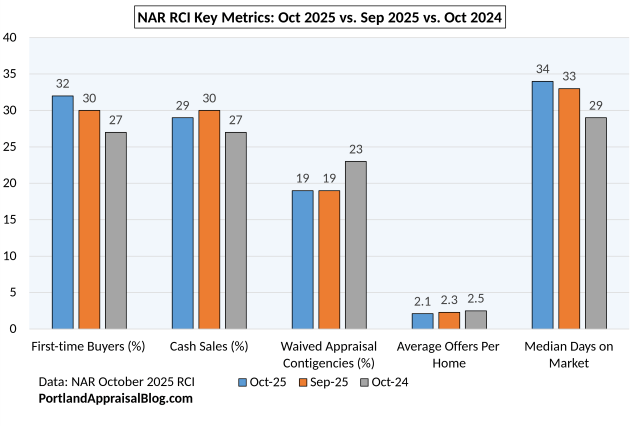
  • Median Days on Market (DOM): 34 days (up from 33 in September 2025 and 29 in October 2024).
  • First-Time Buyers: 32% of transactions (up from 30% in September 2025 and 27% in October 2024), signaling stronger entry-level demand.
  • Cash Sales: 29% (down slightly from 30% in September 2025, up from 27% in October 2024).
  • Distressed Sales: 2% (unchanged from prior months).

While days on market are up year over year, the time homes are spending on market is not excessive. There is a bit more time for negotiations. I go into detail about rising days on market in my Portland Region Q3 2025 Market Update.

Buyer Shifts and Contingency Considerations

Buyers are navigating a slightly less competitive landscape, which influences appraisal timelines and risks:

  • 20% waived inspection contingencies (flat from September 2025).
  • 19% waived appraisal contingencies (flat from September 2025, down from 23% in October 2024)—a trend that eases renegotiation pressures for Portland appraisers.
  • 5% completed purchases via virtual tours only (unchanged).
  • 82% of purchases occurred in suburban, small town, rural, or resort areas (down from 87% in September 2025).

In Multnomah County and Vancouver, WA, this suburban preference reshapes comp pools, emphasizing the need for carefully defined competitive areas—location matters!

Seller Dynamics: Fewer Offers, More Scrutiny

Sellers are adjusting to softer demand, with implications for pricing and close processes:

  • Average offers per home: 2.1 (down from 2.3 in September 2025 and 2.5 in October 2024).
  • 19% sold above list price (down from 21% in September 2025, flat from October 2024).
  • 2% sold to iBuyers (up from 1% in September 2025).
  • Median time to close: 30 days (unchanged).
  • 7% of contracts terminated (up from 6% in September 2025).
  • 14% experienced delayed settlements (unchanged).
NAR October 2025 REALTORS® Confidence Index Key Market Indicators table showing median days on market 34, first-time buyers 32%, cash sales 29%, and properties sold above list price 19% – critical data for Portland Oregon real estate appraisers

For realtors and lenders in the Portland metro, rising terminations underscore the importance of appraisals backed by solid, verifiable comps. As I detailed in my Portland Region Q3 2025 Market Update, the sales price to original list price ratio has been declining.

Outlook: Tempered Optimism and Suburban Focus

REALTOR® confidence softened amid these changes:

  • 17% anticipate buyer traffic growth year over year in the next three months (down from 20% in September 2025).
  • 16% expect seller traffic increases (down from 19% in September 2025).
  • 29% of buyers prioritized work-from-home features (down from 34% in September 2025).

This aligns with the Portland Region’s ongoing suburban migration, impacting comp selection in Clackamas and Washington Counties. Homeowners and attorneys preparing for transactions should carefully read reports to verify they incorporate these broader sentiment shifts.

Implications for Portland Metro Valuations

The RCI’s blend of buyer gains and fading enthusiasm points to a transitional market: enhanced first-time activity promotes equitable pricing, but elevated terminations (7%) reveal gaps in expectations. For further details, explore the full report here, the main RCI page, or the existing-home sales tie-in. See also my Portland Region Q3 2025 Market Update.

NAR REALTORS® Confidence Index bar chart comparing Oct 2025 vs Sep 2025 vs Oct 2024: first-time buyers 32%, cash sales 29%, waived appraisal contingencies 19%, average offers 2.1, median DOM 34 days – PortlandAppraisalBlog.com

Thanks for reading—I hope you found a useful insight or an unexpected nugget along the way. If you enjoyed the post, please consider subscribing for future updates.

Question: Do you think lower mortgage rates will propel the market to new heights?

CODA

Are you an agent in Portland or Clackamas County and wonder why appraisers always do “x”?

A homeowner in Lake Oswego with questions about appraisal contingencies or valuation delays?

If so, feel free to reach out—I enjoy connecting with market participants across Portland and the surrounding counties, and am always happy to help where I can.

And if you’re in need of appraisal services in Portland or Clackamas County, we’d be glad to assist.

Why is an Appraiser Asking Me About an Old Comp?

time-3222267_1920

“Why is an appraiser asking me about an old comp?” In the course of my work, I have elicited that question from quite a few agents and brokers. One agent said, “I thought you guys could only use comps going back 6 months.” Another replied back to me: “Please, why you would use a comp from 2.5 years ago when there have been many[,] many sales in this development just in the last year?” When I told her why, she replied: “How interesting. Thank you for clarifying.”

Since this question keeps popping up, I thought it might be helpful to address it with a blog post.

The appraisal report is not for lending: The overwhelming majority of appraisal reports are written for a lending institution due to a sale or refinance—certainly over 90% and most likely approaching 99.9%. So, it’s understandable why an agent might be skeptical about an appraiser querying them about a sale they closed over a year ago or, sometimes, a few years ago. Is this appraiser clown going to screw up someone’s deal by using a dated comp?

No. Sometimes the report is not for lending and the effective date of value is not contemporary but is a point in the past. Examples:

  • Estate Tax: When a family member with property passes away an appraisal report with a valuation date as of the date of death is often needed. Sometimes years might pass by before this legal requirement is understood by the family and an appraisal report is ordered.
  • Legal Disputes: Problems can arise between neighbors that is brought to litigation. If someone is attempting to prove damages to their property multiple values may be needed: one contemporary and one prior to the start of the problem. A good example of this is a view encroachment by a neighbor. Views often add a considerable amount to a property’s total value and when a neighbor blocks a scenic view lawsuits can fly!

The appraisal report is for lending, but the property is complicated: The ideal appraisal report, for a lending job, would contain three sales that have closed within the last 90 days and those sales would match each and every attribute of the subject be they physical or locational. The real world is seldom ideal, and the property the appraiser is working on might have some unusual physical attributes or complicating factors. These factors might include:

  • A home with an owned solar system in a market where very few sales have solar.
  • An unusually large or unusually small house.
  • A home that is lakefront or riverfront.
  • A home on acreage in an area where few similar sales have occurred.
  • A home with some adverse locational influence like a cell tower, power lines, or a large water tank behind it.
  • A home in a small prestigious subdivision that has had few recent sales.
  • A home on a city lot that is divisible.
  • A home that is a borderline tear down.

There are many other reasons, but the above suffices to show how complicated things can get. The only way to figure out how much that cell tower looming over the backyard is affecting the subject’s value is to pull similar comps, even if they are dated, and examine the conditions of their sale. For one report I recently completed, a PGE power transmission tower was on the site. (The home was on about 20 acres.) I carefully followed all major power transmission lines within a radius that took in tens of miles. I finally found one property that had a transmission tower on it and phoned the agent. Even though the sale was five years old she had a vivid recollection of it—not surprising because it was an unusual sale for her—and we discussed the impact on value.

Keep in mind too, a report may have more than three comparables; sometimes a fourth, fifth, or even sixth comparable might be used to tighten the report and the developed opinion of value. (I’ve had to use nine comps on occasion.) A home selling right next door to the subject is about as good as it gets when it comes to bracketing location and might merit inclusion in a report even if it did sell more than a year ago.

An appraiser can account for time: Appraisers have a variety of analytical tools at their disposal and can adjust for time once the proper data analysis is performed. I frequently have to grid older sales since I specialize in the valuation of complicated properties. It is amazing how often a much older sale will line up with a sale that occurred just a few weeks ago once the proper adjustment is made. Doing this has allowed me to demonstrate with verifiable market data that a certain aspect of the subject really does not have a significant impact on value. This has prevented me from accidentally under-appraising a property—something the seller (and their agent) often appreciates!

It’s never good when an appraiser makes a wild guess about something. Data, even older data, can make all the difference in the world. So, if I, or another appraiser, reach out to you about an older sale, rest assured, we have a valid reason for doing so and your recollections might even help save a fellow agent’s deal!

What is a Histogram? Why is it Important in Real Estate Data Analysis for Portland, Oregon?

Appraisers endeavor to take the measure of a neighborhood with a variety of charts and graphs. It helps them to frame the value opinion and see how the subject property relates to the neighborhood or market area as a whole. 

A histogram is a graphical display of data using bars of varying heights. In a histogram, each bar groups data for a single variable into ranges (or bins). Taller bars show that more data falls in that range. A histogram may be used to display the shape and spread of the data of the real estate market and illustrate trends of properties that have sold and/or are listed. They’re a great visual tool!

Example

Lot Size

The above histogram depicts the various lot sizes for detached single-family residences in the Ladd’s Addition historic district. The data represents sales and/or listings in the RMLS database from the year 2000 to July 2019. What can we learn from the above chart?

1) There is a tight uniformity of lot sizes in this district. 57% of the data falls into just one bin! 
2) 87% of the data falls into the bins representing lots from 0.08 acres to 0.159 acres (~3,485 sq. ft. – ~6,926 sq. ft.). This shows that large lots in Ladd’s addition are rare.
3) Properties outside the aforementioned bins would require more careful analysis by the appraiser (or agent).
4) Dealing with extreme outliers (properties on tiny lots or larger ones for the district) may require the use of a number of data science and appraisal techniques as comparable properties would be hard to find.
5) There is little developer potential for subdividing lots as virtually no lot is large enough to be reasonably partitioned.

Portland Real Estate Market

As you can see, you can squeeze a lot of information out of just one histogram. These charts can be used to display many different variables: age, gross living area, bedroom & bathroom count, sales prices, etc. By evaluating histograms of several key metrics, one can quickly see how a particular property fits into a neighborhood (or district) as a whole.

The Portland market is eclectic and appraising unusual properties requires the careful application of local expertise, the tools of statistics and data science, and sound judgement.  

Appraisal Reports

If you are a homeowner and are looking to sell your home, you would greatly benefit from a prelisting appraisal. Our firm will bring high-level analytics to your report and give you a sound understanding of the current market.

If you are an agent and need detailed neighborhood analysis, or analysis of specific areas or specific segments of the market, please contact us and we can generate a custom report to help you frame a listing price for your client!

Getting Appraisers to Reconsider Value—Do’s & Don’ts

You’re a real estate agent and after a lot of back-and-forth, give-and-take, offers and counteroffers, you’ve helped your client negotiate a sweet price for their home. All the work getting the property ready for listing, the extensive marketing, the numerous showings, the sometimes tedious offer evaluations has paid off. There has been a meeting of the minds, the contract has been signed and everyone is anticipating a smooth closing. Shortly before the home is set to close a bright light appears in the sky. Streaking through the atmosphere is a meteor scientists have dubbed “the appraisal”; it came of out nowhere and impacts your deal at hypersonic velocity, obliterating it in an instance. You, the seller, the buyer, the lender—heck, even the mailman, are all shocked the deal has fallen apart. What just happened?

If you are a real estate agent, has this ever happened to you? If so, you’ve probably run through the five stages of grief:

1) Denial—there’s no way that idiot appraiser killed my deal! There must be some mistake.
2) Anger—that idiot appraiser killed my deal!
3) Bargaining—I can fix this!
4) Depression—that idiot appraiser killed my deal. It’s not fair.
5) Acceptance—that idiot appraiser killed my deal. We’ll have to cut price or find another buyer.

The purpose of this blog post is to lend some insight into what an agent should do and not do during the third stage. It is quite possible that you can fix this—but only if the facts are on your side. This post is not a list of tricks to pull over on the appraiser in the hopes you can cajole him/her to change their mind. Given that appraising is part art and part science and is an opinion, it may be that there are important considerations the appraiser has overlooked. How best to frame such considerations? How best to convey the facts? That is what we will consider.

It’s important to note that we’re in this situation in the first place because we didn’t get a cash buyer. There is no law forbidding someone from paying more than the average market participant for a home unless the motive for doing so falls under money laundering, bribery, or some other equally nefarious scheme. That’s not the case here. The buyer loves the home and both buyer and seller feel the price is fair. However, anything other than cash means a lender gets involved and a lender means strings come attached. While lenders can differ considerably in underwriting standards and risk tolerance, most will require an appraisal to make sure the collateral supports the amount being loaned. In many cases even if the appraisal is just few thousand short, the underwriter will not go through with the deal or require the seller to cut the price.

If an agent feels the price is reasonable they have the option of requesting the buyer’s lender get the appraiser to rethink their conclusions. Usually this is done via a document known as a “reconsideration of value” (ROV for short).

Don’t Take it Personally or Get Personal—Don’t Go There

Before we get into the weeds defining ROVs and how to craft them, I think it good to say something that should already be universally understood: don’t take the appraiser’s opinion personally and, please, don’t get personal.

While relatively rare, a number of appraisers can attest, including yours truly, that some agents do seem to take the appraisers opinion as a personal affront and get personal in return. I’ve had some agents get abusive with me and send me either a nastygram or leave me a charming voicemail. Don’t send an appraiser a dead fish and don’t question their parentage or general intelligence. Trust me, appraisers don’t want to “kill your deal.” If the appraiser really has messed up, that’s where the ROV comes in. So, let’s define it.

Recap #0:
Do: Remain professional.

Don’t: Get personal.

What is a Reconsideration of Value?

In short, a reconsideration of value is another appraisal. This is an important point. Anytime an appraiser is asked to proffer an opinion of value (even if it is just to reconsider one already made) it is an appraisal. Therefore, an ROV is a big deal and most appraisers take it seriously.

Richard Hagar, a nationally recognized appraiser and valuation expert, points out the various reasons why an ROV may be necessary:

  • To correct a serious mistake of material deficiency in the original report.
  • A means of passing along important information not previously disclosed to the appraiser.
  • A means of getting the appraiser to consider information that was not available during the original appraisal.

If any of the above points are all valid for your deal it could result in a different value conclusion. However, in 9 cases out of 10, an ROV is often used as a vehicle to influence the appraiser’s opinion of value. (Which is a legal no-no.)

Most appraisers are hard-working professionals who spend a lot of time researching and analyzing market data. Appraisal reports can easily balloon to 50 pages or more with commentary and exhibits. Oftentimes appraisers will embed a short essay/commentary about why their opinion of value doesn’t align with the negotiated sales contract. Read it.

All appraisers have stories about questions they get about their reports that are already answered in the narrative commentary. It’s annoying to say the least. Even more annoying is being given a list of possible comparables only to find you either already used those sales in the original report or talked about why you didn’t. Appraisers, while required to remain neutral and objective, are still human beings. An ROV is going to put an appraiser on the defensive right out of the gate since they are being paid for their opinion and now are being implicitly told that their opinion stinks. Most appraisers are loathe to change their conclusions and will be even less inclined to rethink their conclusions if an ROV is riddled with questions or items already dealt with in the report. It’s okay to question an appraiser’s conclusions/findings, but make sure the ROV shows that you know the appraiser already addressed any item you’re questioning if they did, in fact, address it. It shows professionalism on your part and the appraiser immediately shifts their perspective. Oh, I got a serious one here. Let me dig into this.

Recap #1:
Do: Take ROVs seriously.

Don’t: Use an ROV as a frivolous means to see if you can squeeze a little more money out of the appraisal. Read the report!

Speaking the Same Language—Appraisers are from Mars, Agents Are from Venus

Most loans will fall under federal guidelines and use a definition for market value found on the form report workhorse of the appraisal world—the Fannie Mae 1004 Form.

Virtually all agents are familiar with the Fannie Mae form report. However, many agents (and sadly, more than a few appraisers) have not taken the time to read the definitions and certifications contained in the form. It could save everyone a lot of grief. Remember, the lender is the appraiser’s client and intended user. Not even the borrower is the appraiser’s client. The lender has hired the appraiser to produce a report that conforms to the guidelines set forth by Fannie Mae—and that includes using their definition of market value. It is:

DEFINITION OF MARKET VALUE: The most probable price which a property should bring in a competitive and open market under all conditions requisite to a fair sale, the buyer and seller, each acting prudently, knowledgeably and assuming the price is not affected by undue stimulus. Implicit in this definition is the consummation of a sale as of a specified date and the passing of title from seller to buyer under conditions whereby:

(1) buyer and seller are typically motivated;
(2) both parties are well informed or well advised, and each acting in what he or she considers his or her own best interest;
(3) a reasonable time is allowed for exposure in the open market;
(4) payment is made in terms of cash in U. S. dollars or in terms of financial arrangements comparable thereto; and
(5) the price represents the normal consideration for the property sold unaffected by special or creative financing or sales concessions* granted by anyone associated with the sale.

There is a lot to unpack here, but let’s just focus on the idea that market value is the most probable price.

A little time may have passed since your last high school/college statistics course. (My growing number of gray hairs can attest to that for me.) The most probable price doesn’t mean the highest price (or the lowest price). It’s the “Goldilocks Price,” the price that is just right.

If an appraiser uses comparables that adjust out to something like the illustration below, what conclusion would you draw regarding the most likely price the typical buyer would pay for the subject property?

1

If your subject’s contract price is more in line with comparable #4, it would be awfully tempting to fixate on that. Appraisers have a saying: one comp does not a market make. It’s why Fannie Mae mandates at least 3 closed sales be used in a report. They want assurances there’s more than one buyer for the subject at the negotiated price. In the above case, the appraiser’s value conclusion ($350,000) is tightly aligned with 5 out of the 6 comparables used. Comparable #4 may represent the maximum value of the subject, but it is not the most likely price for homes similar to the subject.

You may be 100% correct that the subject’s higher contract price has some market support; but if careful analysis shows that price to be outside the most probable range, the appraiser is contractually obligated to go with the most probable.

But what if the market is rapidly changing? That’s a fair point. In that case, review the report to see if a careful discussion has been made of any applicable pending sales. In my own practice, I try and reach out to agents for pendings (and even actives). I have no problem giving weight to a pending sale—especially if I reached the agent and they confirmed the final price is pretty close to the price advertised in MLS. That’s why its good agent practice to return an appraiser’s phone call or reply to any email inquiries.

(Note: Agents differ in interpreting confidentiality requirements for pending sales. I personally never press an agent. Again, many will at least hint if the final price is above or below the published MLS price.)

Keep in mind: an active listing is like a person looking for a date; a pending sale is like a person engaged; a closed sale is like a person who’s walked down the aisle. An engagement ring ain’t nothing, but it ain’t any guarantee either.

The most persuasive package is a strong mix of recent closed sales, some verified pending sales, and perhaps (if you have it) some signed backup offers on the subject. All of that together should strongly indicate what the most probable price for the subject is. In an ROV, if the appraiser failed to do their homework verifying what the pending sales are doing (or doesn’t even talk about them), you can talk to fellow agents and see if they can confirm some details. Then you’ll have factual and relevant information to include in the ROV. Cold hard facts are your best friends.

Recap #2:
Do: Use a “most probable price” definition of market value.

Don’t: Use a “maximum price” definition of market value.

Out of This World Comps—Well, Out of This Neighborhood

Appraisers are given guidelines from Fannie Mae and then usually given additional guidelines from the lender (or the lender’s agent). Some standard comparable guidelines include:

1) Two sales within the last 90 days.
2) No sales over a year.
3) Comps within a mile for urban/suburban properties; within 5 miles for rural properties.
4) “Bracketing” of most major features. (No across-the-board adjustments.)
5) Adjustments be within a certain percentage. (Fannie Mae actually doesn’t require this and lenders shouldn’t either, but it still lingers in some published guidelines.)

It goes on. (Some lender guidelines are over 10 pages long.)

Rules of thumb are okay and may work in many cases, but sometimes appraisers can get tunnel vision and apply guidelines too strictly and miss the forest for the trees.

I think we can all agree that Ladd’s Addition is a visually striking neighborhood when viewed from a map:

2018-11-07_18-10-38

Imagine you’re the agent for a home in this neighborhood and imagine a report that meets all Fannie Mae and lender guidelines but fails to include a sale from within Ladd’s Addition! If it cuts the price, you wouldn’t be a happy camper. While no appraiser would commit an error that egregious (I hope), all agents are aware of smaller “pocket” neighborhoods that command a premium but may not have had a recent sale.

I often pull all data RMLS has for homes on a subject’s street and immediate pocket area. Yup, all 20 years. This allows me to sniff out if there is some strong locational influence. As an illustration, the graph below shows similar properties from the subject’s pocket area and similar properties from a competing one:

2019-04-14_9-06-13

There have been no recent sales in the subject’s pocket area, but the yellow-orange dots depicting sales from the subject’s area are all above the gray dots from a nearby competing area (perhaps where the appraiser pulled all of their comps). This shows that the subject’s area commands a noticeable premium. Did the appraiser include that premium in the report? If not, again, cold hard facts are your best friends.

However, and a word of caution, appraisers often encounter this problem in reverse. They are forwarded sales from areas that command a premium the subject’s neighborhood or pocket area lacks. (I’ve been sent homes from a golf course community for a property in a standard residential tract area.)

Obvious tricks like that shreds your credibility in the ROV and will cause both the appraiser and the lender to take your request less seriously.

Recap #3: 
Do: Use clear market data that shows the subject’s neighborhood or pocket area commands a premium.

Don’t: Suggest homes from competing neighborhoods or market areas that you know command a premium the subject’s area lacks.

Superior Comparables—Arnold Schwarzenegger vs. Napoleon Dynamite

If the subject property is one of the nicer homes in the market area, the appraiser should take great care to find sales as similar as possible—even if they violate some of the typical lender guidelines. That might mean going further back in time or a bit farther in distance to find the right comparables. I routinely grid sales 12-24 months old and then use time indexing to bring the value current. For acreage or very unusual properties, 36+ months might be needed. Time indexing is an extremely important tool and one all appraisers should be familiar with.

Don’t be afraid to stay in the neighborhood and pull all available data to see how homes like the subject perform relative to the market area. It might be that a clear case can be made for a higher valuation of the subject.

If the subject has sold multiple times on the open market, a review of those prior sales may show that whenever it is on the market, it commands a premium due to its overall quality or some special amenity or feature(s).

However, if a home is deemed an over-improvement for a neighborhood, it likely suffers from an obsolescence stemming from a lack of conformity to the neighborhood. If most homes are under 3,500 sq. ft. and the subject is 6,500 sq. ft. and all similar homes are located far away, then the property won’t likely bring in the same price as those homes in a more conforming area.

A word of caution: appraisers are used to getting vastly superior properties suggested to them in the hopes of making the contract price. You may have seen this illustration floating around some of the agent forums:

2018-12-15_18-40-48

Don’t do that. If your home is Napoleon Dynamite don’t suggest Arnold Schwarzenegger. Again, it reduces your credibility in the eyes of the appraiser and the lender. We need to compare apples to apples as much as possible.

Recap #4:
Do: Suggest similar properties—even if a bit dated or a bit farther away than typical.

Don’t: Suggest vastly superior properties that are in a different market segment than the subject.

Fuzzy Numbers—Did They Remember to Carry the 1?

Appraisers typically use some type of dedicated software package to “grid” comparables and make adjustments for superior or inferior features. While there are some error correction tools, they don’t always catch all mistakes. An examination of the sales grid might show that adjustments are not mathematically consistent. Check the numbers.

Broader issues with the numbers in the grid might be how the adjustments were derived in the first place. That’s a complex topic (and one for another blog post). But check comments in the report to see how some of the more important adjustments were derived.

A word of caution: don’t nitpick. If the appraiser didn’t adjust for a small shed, will that really make or break your deal?

Recap #5:
Do: Check adjustments for mathematical and logical consistency.

Don’t: Nitpick or quibble about minor amenities or features.

What Can You Do Proactively?

If you have an atypical property on your hands, you and your client would greatly benefit from a prelisting appraisal. Having an appraiser give a value opinion prior to listing can help with setting the right price and can point out issues ahead of time. You’ll get a list of comparables an appraiser feels is most relevant to the subject. (You’ll also get an accurate sketch of the subject’s size and dimensions.)

Some agents fear getting a prelisting appraisal “locks” them in somehow. It doesn’t. You may keep it in your back pocket if you want. All appraisals are confidential.

*~*~*~*~*~*~*~*~*~*~*~*~*~*~*~*~*~*~*~*~*~*~*~*~*~

I hope this article is somewhat helpful for agents. There are many other aspects to discuss about ROVs and I will write about the topic some more in the future.

Click here for a one-page summary of this article.

An Appraiser’s First Impressions of Clear Capital’s AVM

Collage_HD 2018-12-27 23_53_58

It’s no secret the lending industry is aggressively pursuing alternatives to traditional appraisals. While most participants in the industry will concede an appraisal is still the gold standard for collateral valuation, they increasingly see the appraisal as something to be steered around or avoided altogether. An array of products/alternatives are being bandied in lieu of a traditional appraisal: Hybrids, Evaluations, BPOs (broker price opinions), Desktop Appraisals, and outright Appraisal Waivers. The industry is also turning its attention more and more to AVMs (automated valuation models).

AVMs have been around for nearly three decades now. The first AVMs had a hard time with consistency and accuracy, but as the world has become increasingly digital and data driven, the accuracy of the models has been steadily increasing. In conforming tract home subdivisions with sufficient recent sales, their value may be extremely accurate.

An appraiser should keep an eye on alternatives to the services he/she offers, so I recently downloaded a number of white papers on AVMs from different websites, including Clear Capital’s. I was somewhat surprised that Clear Capital’s white paper freely admitted that an AVM is not as good as an appraisal, but could be a starting point in risk assessment and collateral valuation. I had to provide my email address and phone number to access the white paper. This resulted in me receiving a follow-up call from Clear Capital. (Full disclosure: I previously worked for Clear Capital for a couple of years doing quality assurance work on incoming appraisals.) The gentleman on the phone was very nice. We chatted a bit and I asked him how long the product has been offered and he mentioned they took their previous AVM off the market and just released a new and improved model a couple of months ago. I asked him if they needed beta testers and he said no, but he did email me a code to sample five AVM valuations for free on their website.

Clear Capital AVM Sample Redacted

That day I had just completed an appraisal report and, after completing it, ran the subject property’s address through their portal. The AVM is highly specific in its dollar output: $416,771, which I thought was a bit weird. It might be their way of emphasizing this is an algorithmic valuation. If so, that is the opposite of what we as appraisers do, which is round an opinion of value to emphasize a measure of uncertainty. (I sure hope no licensed appraiser is signing their name to an opinion of value as specific as $416,771!) For reference, my developed opinion of value was: $400,000, so the AVM was ~4.2% higher.

The AVM output is very bare bones: just three pages and mainly a list of addresses. I got 30 addresses in total; 15 apparent sales and 15 apparent listings; I say apparent because, oddly enough, there is no legend anywhere in the document explaining what the colors denote. The AVM gives a high estimated value of $451,500; a low estimate of $390,000; and the official, highly specific, estimate mentioned previously. It also provides a confidence score with a letter next to it: “H,” “M,” or “L” to presumably denote either high, medium, or low confidence. (My AVM report had an “H” next to the confidence score.) A map of the properties is provided on the second page. The third page consists of just two paragraphs of disclaimers: first warning the product is not an appraisal and then warning the reader not to reverse engineer their work or infringe on their intellectual property. With so little explanatory material in the document itself, I don’t think they need to worry about anyone being able to reverse engineer their system.

All the sales listed are within approximately one third of a mile of the subject property and the dates of sale within ten months of the date of the AVM report. (The listings are selected from within three quarters of a mile.) Five of the seven comparables I used in my report are found on the list, but none of the comparables I used cracked the top ten on either the sales or listings tally. My subject is a single-level home and all the properties I gridded in the report are single-level as well. Of the top ten sales the Clear Capital AVM used: five are two-story structures; one was not listed in the local MLS; another was listed but had no photos and no agent comments at all; one was a bit older and smaller; and the other two would have made acceptable alternative comparables in my report.

As I mentioned before, there is almost no explanatory material with the AVM output, so I really don’t have a clue how it derived its value estimate. I checked to make sure the AVM didn’t do something as simple as average the 15 sales (or the 15 sales with the 15 listings). It didn’t.

So, is something like this useful? I think so. While many of the properties it listed were rejected by me in my comparable search, the results were within 4% of my opinion of value. As their own white paper stresses—and the disclaimers in the AVM report itself reiterates—the AVM output is not an appraisal. The cost of the AVM would have been $10 if I didn’t have the promo code. I can see lenders using products like this when the loan-to-value ratio is low and the credit score of the applicant is high. (A full-blown appraisal may be overkill in that situation.) A $10 charge is also nominal considering the total fees a mortgage or other real estate loan product may generate. A quick peak at the AVM early on may give a loan officer an idea of what they’re in for or if the deal is feasible or not. (It is hoped said loan officer is also paying mighty close attention to the confidence score.)

(I am glossing over the bigger question as to how these products will be checked for accuracy, data integrity, tamper resistance, etc. But that is a blog entry for another day.)

While my opinion may be considered biased for obvious reasons, I genuinely believe appraisers offer an extremely valuable service to the public and are a pillar in sound collateral valuation and risk mitigation. However, it is clear that the future of valuation will include increased utilization of AVM products such as the one Clear Capital offers or the free Zillow “Zestimate.” Appraisers who work in areas with highly conforming properties will need to make sure they level-up their skill set to specialize in the valuation of complex properties; the type that currently gives computer algorithms nervous breakdowns. I strongly suspect the appraiser of the future will be, essentially, a data scientist. One that has strong Excel, R, Python, and/or SAS proficiency. There may be fewer of us in the future, but the ones that remain will be extremely talented professionals who offer local, boots-on the-ground expertise with high-level analytical skills. And we can offer what no computer currently can: a friendly smile and a listening ear as the homeowner tells the story of their property!