What Happened This Week
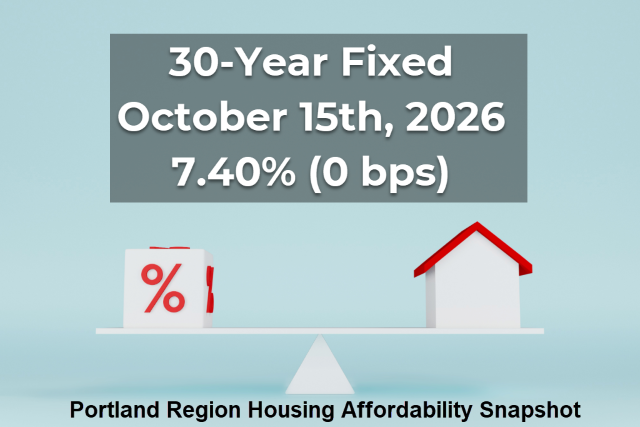
Mortgage rates declined modestly this week, with the 30-year fixed falling to 7.32% from 7.40% one week ago. The 8-basis-point decrease marks the first meaningful pullback since rates began their rapid ascent in September. Even with this week’s improvement, mortgage rates remain near 2026 highs and continue to reflect one of the least affordable borrowing environments of the year.
The table below shows where the current rate sits within the 2026 range, including the February low, last week’s reading, and this week’s reading.
| Time Frame | Date | Rate | Rate Delta |
|---|---|---|---|
| YTD Low | February 26, 2026 | 5.98% | -1.34% |
| Last Week – YTD High | October 15, 2026 | 7.40% | +0.08% |
| Current Week | October 22, 2026 | 7.32% | — |
January 1, 2026 – October 22, 2026
Primary Mortgage Market Survey® (PMMS®)
Data: Freddie Mac | PortlandAppraisalBlog.com
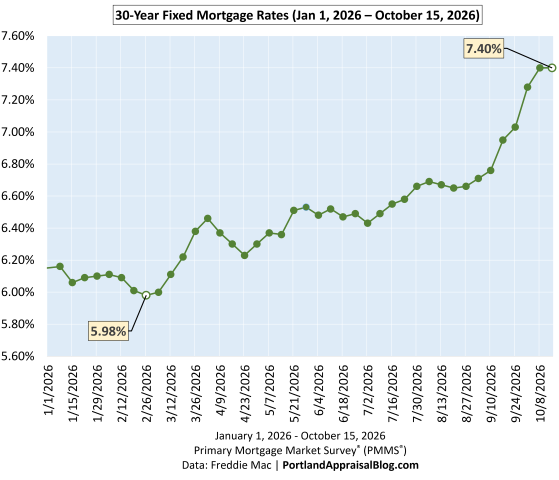
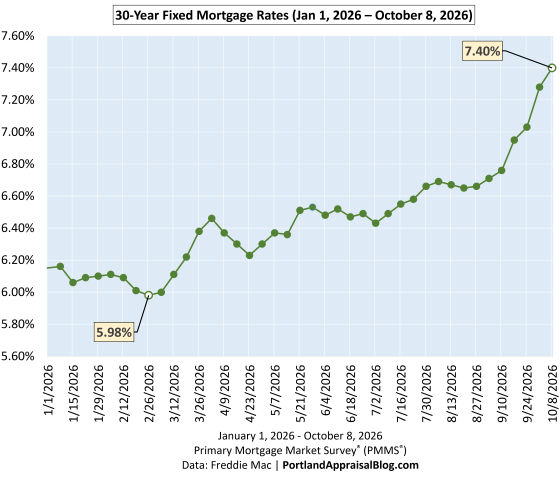
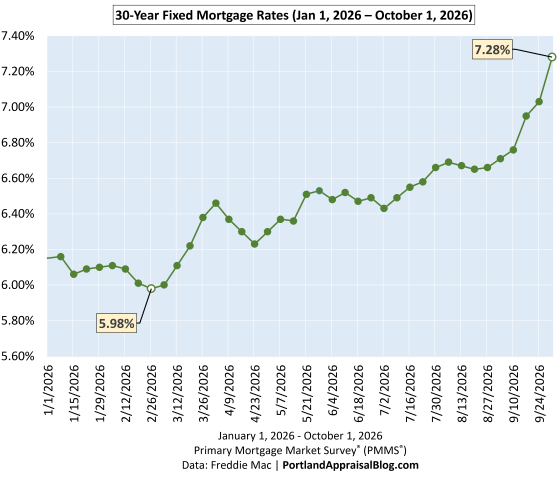
The broader 2026 pattern remains largely intact: rates bottomed in late February, climbed sharply through early April, cooled briefly, and then resumed their upward drift beginning in late April. What began as a gradual rise over the summer accelerated noticeably during the second half of the year, carrying rates to a series of successive year-to-date highs during September and early October. This week’s decline interrupts that upward trajectory, but rates remain firmly lodged near the top of the annual range.
Affordability remains strained at these levels, even after this week’s modest relief. This week’s decline provides some improvement in purchasing power and monthly payment affordability, but borrowing costs remain substantially higher than they were earlier this year. Buyers benefit from slightly lower financing costs than they faced last week, yet the overall affordability environment remains historically challenging throughout the Portland Region.
As the charts below show, this week’s rate remains near the very top of the 2026 range, and the Portland Appraisal Blog Affordability Index (PABAI) reflects the ongoing affordability pressures facing homebuyers throughout the Portland Region.
Weekly Rate Change (Basis Points)
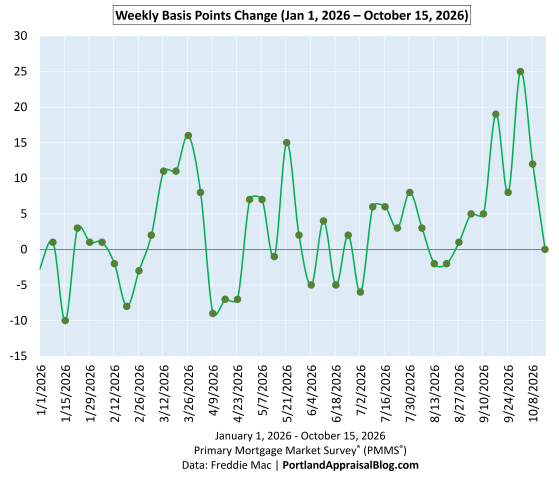
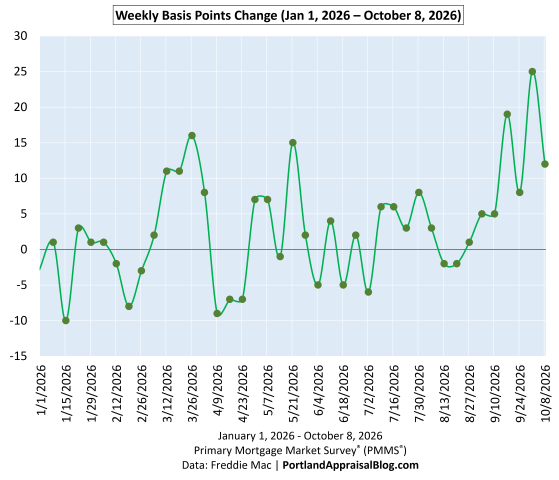
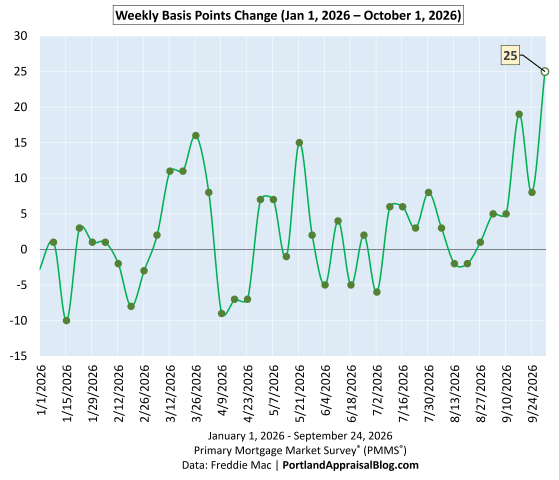
The chart below shows the weekly change in mortgage rates, not the actual mortgage rate. Values above the zero line indicate rates increased from the prior week, while values below the line indicate rates decreased. One basis point equals 0.01%.
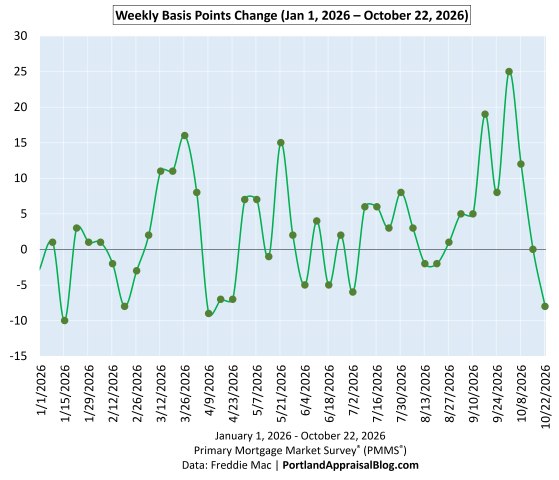
This week’s takeaway: Mortgage rates declined by 8 basis points, marking the largest weekly decrease since July 2, 2026, when rates fell 6 basis points. The 30-year fixed dropped from 7.40% to 7.32%, ending a six-week stretch that culminated in a series of successive year-to-date highs.
The recent pattern remains noteworthy. Four of the five largest weekly rate increases recorded in 2026 have occurred since September 3, helping drive rates from 6.66% on August 27 to 7.32% today—a cumulative increase of 66 basis points (0.66%). This week’s decline provides a modest measure of relief, but it does little to alter the broader trend. Mortgage rates remain near their highest level of the year, and affordability conditions remain materially less favorable than they were just two months ago.
Table of Contents
- Mortgage Rate Context
- Portland Appraisal Blog Affordability Index (PABAI)
- Affordability Snapshot (This Week)
- TIP: Total Interest Paid — Why Small Rate Moves Matter
- Payment Delta
- Purchasing Power
- Payment Milestones
- Closing Thoughts
- Sources & Further Reading
- Coda
Mortgage Rate Context
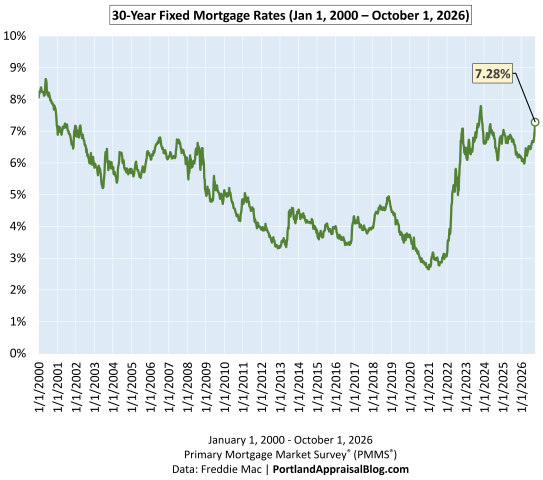
Long‑Run View (Since 2000)
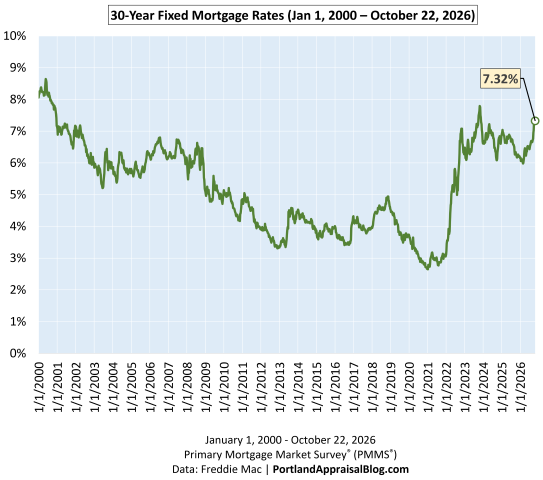
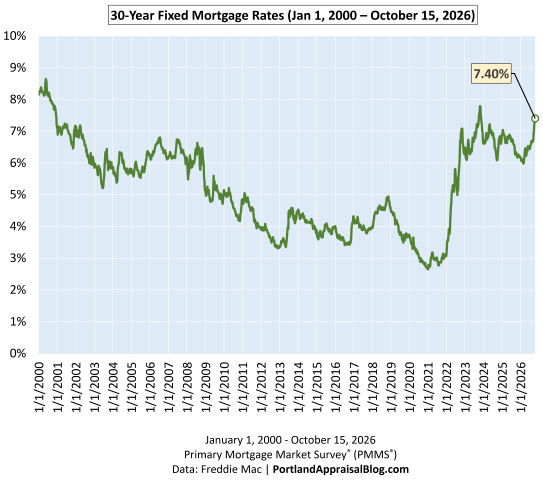
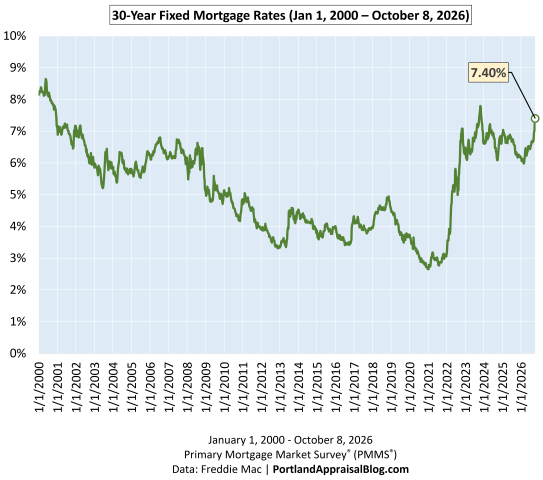
The long‑run chart shows how this week’s rate fits into a 25‑year history of mortgage cycles. The early 2000s sat in the 6–8% range, the post‑Great Recession era brought a decade of unusually low rates, and the pandemic period pushed borrowing costs to historic lows. Years after leaving that ultra‑low‑rate environment, the market continues to adjust to more difficult financing constraints, and this week’s 7.32% reflects that ongoing shift. While current rates remain below the peaks seen in the early 2000s, they are elevated relative to most of the past two decades and are hovering at levels last generally seen in late 2023. Affordability continues to be shaped by the same structural pressures highlighted in the medium‑run and short‑run views.
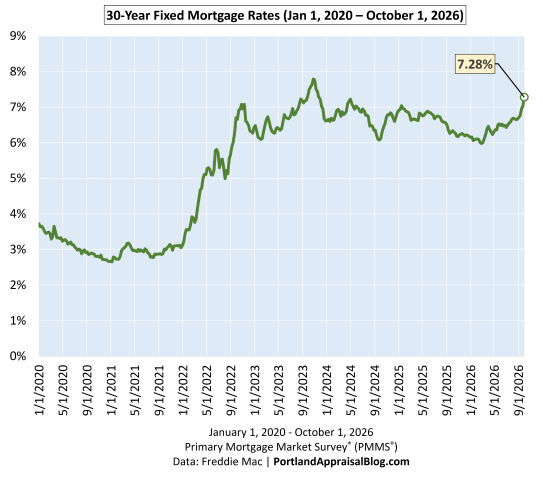
Medium‑Run View (Since COVID)
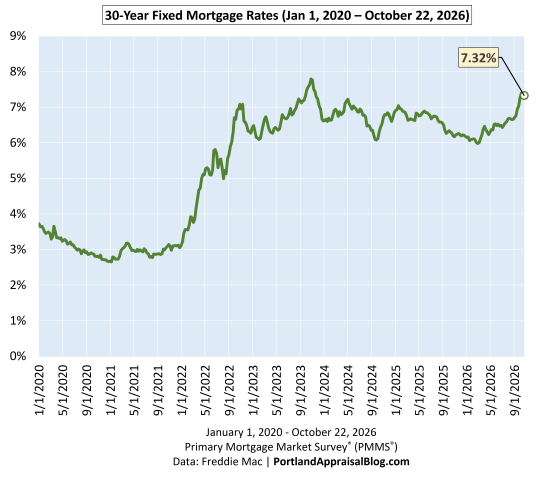
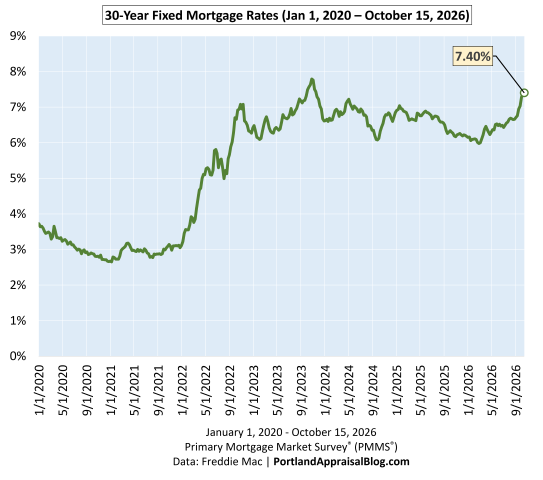
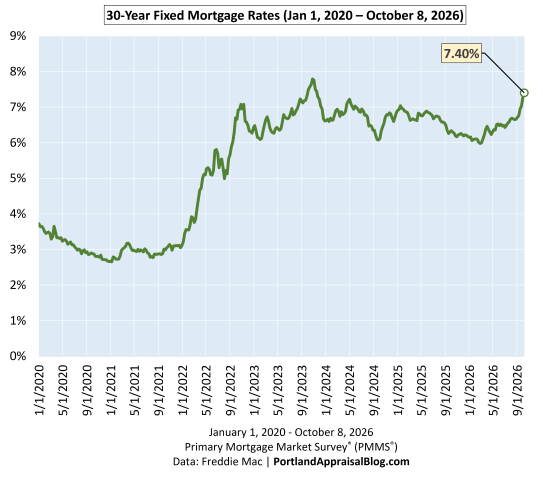
The COVID‑era chart highlights the dramatic rate compression of 2020–2021, the rapid surge of 2022, and the choppy plateau that has defined the past several years. Rates have generally oscillated between roughly 6% and 7% since mid‑2023, though the last few weeks have broken out of that range. This week’s rate of 7.32% has kept borrowing costs at levels not generally seen in three years. The medium‑run trend remains one of elevated and persistent borrowing costs, with the market continuing to adjust to structurally higher financing conditions across the Portland Region.
Short‑Run View (2026 YTD)
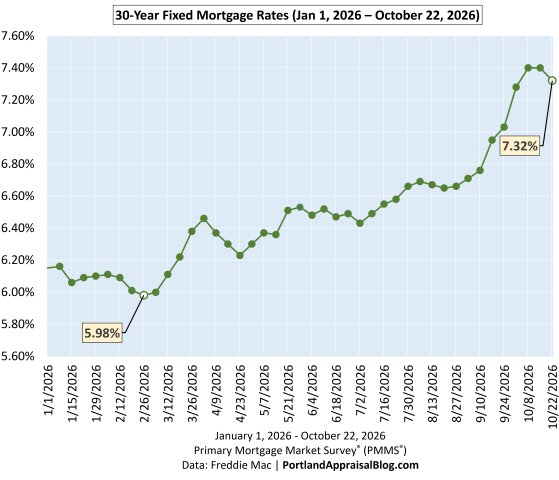
The year‑to‑date chart shows the full shape of the 2026 cycle: a clear bottom at 5.98% on February 26th, a sharp rise into early April, a brief cooldown, and a renewed climb that pushed rates into the mid‑6% range by late May. While rates spent much of the summer fluctuating within a relatively narrow band, the past 8 weeks has seen a pronounced upward move. The current 7.32% reading keeps rates near the year‑to‑date high and places rates 134 basis points above the February low.
Affordability continues to sit at its weakest point of 2026. The short‑run trend remains the most relevant for buyers currently because it directly influences monthly payments, debt‑to‑income ratios, and qualifying power across the Portland Region. The recent surge higher underscores how quickly affordability conditions can deteriorate when mortgage rates rise, even without corresponding changes in home prices or household income.
Portland Appraisal Blog Affordability Index (PABAI)
What PABAI Measures
The Portland Appraisal Blog Affordability Index (PABAI) is a model that estimates how home sale prices compare to what a median‑income household can qualify for under standard lending assumptions (HUD Portland‑Vancouver‑Hillsboro MSA median income, 20% down, and a 28% DTI for principal, interest, taxes, insurance, and HOA dues).
Unlike national affordability indices, PABAI is built from actual RMLS transactions rather than a single hypothetical price point. It computes an affordability ratio for every closed sale in the Portland Region during the analysis period using rates matched to the date of close, reported taxes, reported HOA dues, and an insurance estimate based on a percentage of the home’s value. The individual affordability ratios are then averaged to produce the reported PABAI value for that period. For Q1 2026, this approach captures the actual mix of homes sold and the financing conditions present at the time those transactions occurred. Each housing segment—detached, attached, condos, and manufactured—is calculated separately, ensuring that segment‑specific dynamics are preserved rather than blended together. This approach provides a more detailed, locally grounded view of Portland‑area affordability and avoids the distortions that occur when fundamentally different housing types are combined into a single regional metric.
A PABAI of 100 means the market is exactly affordable at that income level (the Q1 2026 HUD median MSA income was $124,100 for a family of four). Values above 100 indicate excess qualifying capacity (more affordable), while values below 100 indicate a shortfall (strained affordability). Full methodology and the interpretation scale are available on the PABAI explainer page.
| PABAI Range | Interpretation |
|---|---|
| 120+ | Strongly Affordable |
| 100–119 | Moderately Affordable |
| 80–99 | Strained |
| Below 80 | Severely Constrained |
Q1 2026: Actual vs. Constant‑Rate Affordability
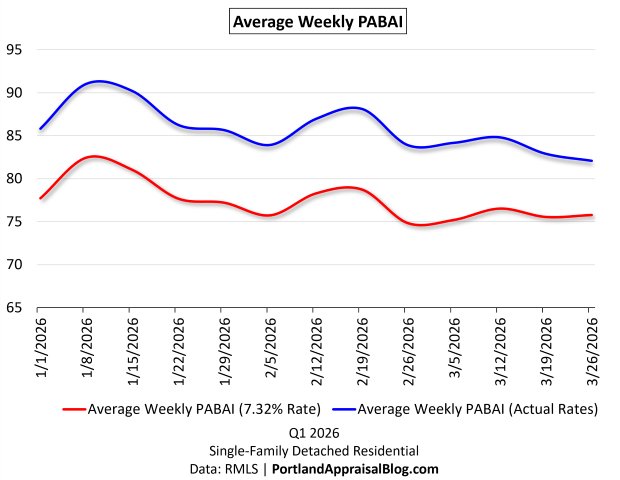
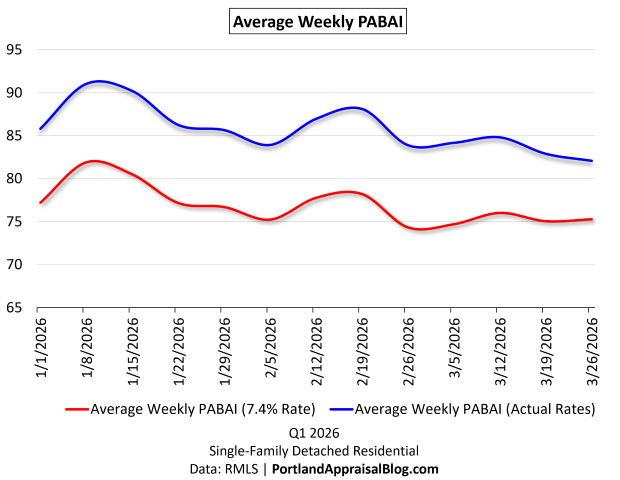
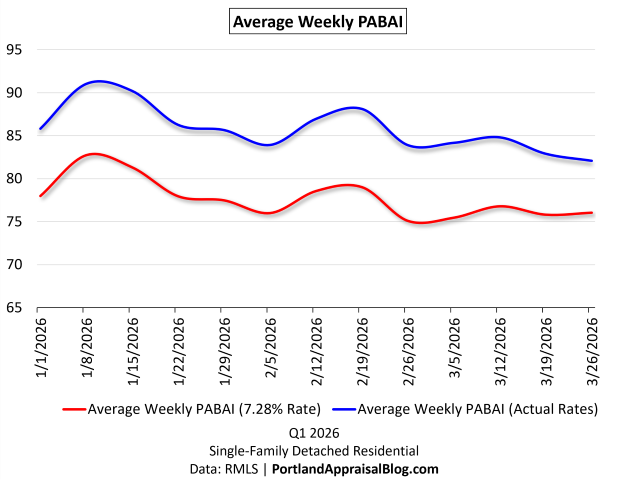
The Q1 chart compares two versions of PABAI: one using actual weekly mortgage rates, and one using this week’s rate (7.32%) applied as a constant across the entire quarter. Because the constant-rate line uses a rate that sits well above every mortgage rate observed during Q1, it consistently falls below the actual-rate line throughout the entire period. That part isn’t the story.
The key insight is the size and persistence of the gap between the two lines. During Q1, buyers benefited from mortgage rates that ranged from 5.98% to 6.38%, substantially below the current 7.32%. As a result, the actual-rate PABAI readings exceed the constant-rate equivalents every week, often by a wide margin.
The quarterly averages tell the story clearly: 85.45 under actual rates versus 77.10 under a constant 7.32% rate. In other words, if this week’s financing environment had existed throughout Q1, affordability would have been materially worse despite identical home sales, taxes, HOA dues, and household income assumptions.
The current 7.32% rate pushes the constant-rate line even further below the actual-rate line, illustrating how much affordability has deteriorated since the first quarter of the year. The comparison highlights the compounding effect of higher borrowing costs and shows how rapidly qualifying power can erode when mortgage rates move substantially above the levels that prevailed during Q1.
Structural Unaffordability and the Seasonal Pattern
Detached homes in the Portland Region remain structurally unaffordable to a household earning the HUD median MSA income. PABAI has been below 100 for years, and Q1 2026 continues that pattern. What the chart makes clear is that winter remains the best window for buyers on tight qualifying budgets: affordability improves when rates soften and seasonal pricing cools. As spring approaches, both rates and prices firm up, and affordability reliably compresses.
With the 30‑year fixed at the 7.32%, the separation between the two PABAI lines illustrates how much qualifying power has been lost since Q1, pushing the market into severely constrained territory. The early‑year affordability advantage reflected in the actual‑rate series have been meaningfully reduced.
The 7.32% reading keeps affordability firmly in the severely constrained range and reinforces the sensitivity of housing qualification to mortgage rates. The current rate environment underscores how quickly affordability can deteriorate when financing costs rise while home prices remain elevated.
Affordability Snapshot (This Week)
Maximum Sustainable Payment (MSP) — Median Income
Understanding affordability begins with a simple anchor: how much housing payment a median‑income household in the Portland Region can sustainably carry. Using the Q1 2026 HUD median MSA income and applying a standard front‑end debt-to-income ratio, we can calculate the Maximum Sustainable Payment (MSP) that fits within traditional affordability guidelines. This number does not change with mortgage rates—it is tied purely to income and serves as the baseline against which all market payments are measured.
| Affordability Metric | Value |
|---|---|
| Median MSA Income (Q1 2026) | $124,100 |
| Qualifying Ratio (Front‑End) | 28% |
| Max Sustainable Payment | $2,895.67 |
This ceiling is also the reason PABAI incorporates all components of monthly housing cost rather than focusing solely on principal and interest. As mortgage rates rise, interest consumes a larger share of the allowable payment “space,” leaving less room for taxes, insurance, HOA dues, and mortgage insurance. When these components collectively exceed the sustainable threshold, the buyer must either reduce the loan amount or shift to a lower‑priced segment of the market.
In practical terms, higher rates compress the principal that can be repaid within the same affordability boundary—which is why rising rates translate directly into fewer accessible homes and tighter qualifying margins.
Q1 2026 Affordability Recomputed at This Week’s Rate
The table below shows how Q1 2026 affordability metrics change when all 3,349 detached sales are recalculated at this week’s 7.32% rate. This is the clearest way to see how rising rates reshape qualifying power, housing burden, and the share of homes accessible to a median‑income household.
| Metric | Actual Q1 2026 | Recomputed at 7.32% Rate | Change |
|---|---|---|---|
| Average PABAI | 85.45 | 77.10 | -8.35 pts |
| Required income (28% ratio) | $145,236 | $160,970 | +10.83% |
| Median‑income shortfall | 17.03% | 29.71% | +12.68 pts |
| Avg monthly mortgage pmt | $3,932.66 | $4,355.26 | +$422.60 |
| Avg housing burden (DTI) | 38.03% | 42.11% | +4.08 pts |
| # of Affordable homes | 967 | 571 | -396 homes |
| % of homes affordable | 28.87% | 17.05% | -11.82 pts |
HUD Portland‑Vancouver‑Hillsboro MSA median income: $124,100
Data: RMLS (3,349 observations) | PortlandAppraisalBlog.com
Note: Required income and median-income shortfall are derived from PABAI, which is calculated using the affordability ratio of all sales in the dataset. The Payment and housing-burden metrics are arithmetic averages and therefore will not reconcile directly through the 28% affordability threshold. The average monthly housing payment consists of principal and interest, plus actual reported taxes and HOA dues and an estimated insurance cost. Principal and interest use the rate matched to each sale’s week (Actual column) or 7.32% for every sale (Recomputed column).
Because this week’s rate sits well above the mortgage rates that prevailed during Q1, the recomputed metrics show a substantial deterioration in affordability relative to the actual first-quarter environment. Required income rises sharply, housing burden increases, and the number of homes affordable to a median-income household falls dramatically.
The shift is visible across every metric. PABAI declines sharply, required income increases from $145,236 to $160,970, and the median-income shortfall expands from 17.03% to 29.71%. Average monthly mortgage payments increase by nearly $423 per month, while housing burden rises to 42.11% of gross income, far above the benchmark 28% qualifying ratio used in the model.
Perhaps most striking, the number of homes affordable to a median-income household falls from 967 to 571, eliminating 396 affordable homes from the Q1 dataset. The affordable share of the market drops from 28.87% to 17.05%, meaning fewer than one in six detached homes would qualify as affordable under current financing conditions. The comparison illustrates how quickly affordability can deteriorate when mortgage rates move higher and remain elevated.
How Rising Rates Reshape Affordability
Taken together, these metrics illustrate how mortgage rates influence affordability through multiple channels simultaneously. Higher rates do not merely increase monthly payments. They also increase the income needed to qualify, reduce borrowing capacity, and shrink the portion of the market accessible to median‑income households.
Higher rates reduce qualifying power, remove homes from the affordable inventory pool, and force buyers to make difficult tradeoffs between location, home size, housing type, and monthly payment. As financing conditions tighten, affordability becomes a constraint not just on how much buyers can spend, but on the range of housing options realistically available to them.
The Buyer‑Side Impact
For buyers, the experience varies by circumstance but the direction is the same. Households with limited financial flexibility tend to feel the tightening most acutely, as higher rates reduce qualifying power and narrow the range of homes available within budget. In many cases, buyers are forced to make tradeoffs involving location, home size, housing type, condition, or commute time in order to keep monthly payments manageable.
Move‑up buyers face a different challenge. While existing home equity may help offset some of the affordability pressure, higher mortgage rates increase the payment gap between a current home and the desired replacement property. As a result, the financial benefit of moving often becomes less clear, even when household income and equity positions remain strong.
Cash buyers, by contrast, can gain relative leverage when financing conditions become more restrictive. As affordability pressures reduce the pool of financed buyers, cash purchasers may encounter less competition in certain segments of the market. The effect, however, is not uniform and can vary significantly by price range and property type.
Across all buyer groups, elevated mortgage rates are influencing not only what buyers can afford, but also the choices they make and the segments of the market in which they can realistically compete.
The Seller‑Side Impact
Rising rates don’t just reshape the buyer experience—they influence seller outcomes as well. In the Q1 2026 detached market, cumulative days on market (CDOM) increased 11.26%, and the current rate environment suggests that upward pressure on market times may persist. As affordability tightens and the pool of qualified buyers shrinks, homes that would have moved quickly in a lower‑rate environment may begin to sit longer, particularly in segments where pricing is already stretched.
This week’s 7.32% rate keeps financing conditions near the most challenging level of 2026, reinforcing the same dynamic: fewer qualified buyers, more selective demand, and a market where pricing precision matters. This does not necessarily imply an abrupt market slowdown, but it does suggest sellers should expect a more deliberate buyer pool and be prepared for longer market times.
TIP: Total Interest Paid — Why Small Rate Moves Matter
Total Interest Paid (TIP) is one of the clearest ways to understand how mortgage rates shape long‑run affordability. While buyers shop based on monthly payment, the lifetime cost of borrowing moves far more dramatically than the payment itself. Even small rate changes can add—or remove—tens of thousands of dollars in interest over the life of a loan.
At this week’s 7.32% rate, the lifetime interest on a standard Portland Region purchase sits far above the levels buyers saw during the pandemic and substantially higher than the lows recorded earlier this year. The difference between a 5.98% environment and a 7.32% environment may appear manageable when viewed as a weekly rate chart, but over a 30‑year loan the additional interest compounds into a significant increase in total repayment. This is the type of change that can materially affect long‑run household finances across the Portland Region.
This is why TIP matters: it captures the hidden cost of rising rates. Buyers feel the payment, but the long‑run financial burden is embedded in the interest curve. As the charts below show, the 2026 rate path has pushed TIP to the highest levels of the year, even as monthly payment changes appear more gradual. The cumulative effect is what reshapes affordability—a dynamic that becomes especially clear when comparing TIP across different rate environments.
2026 YTD Total Interest Paid
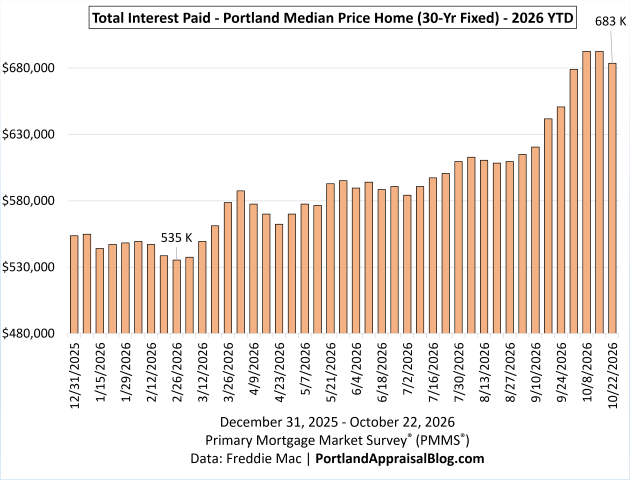
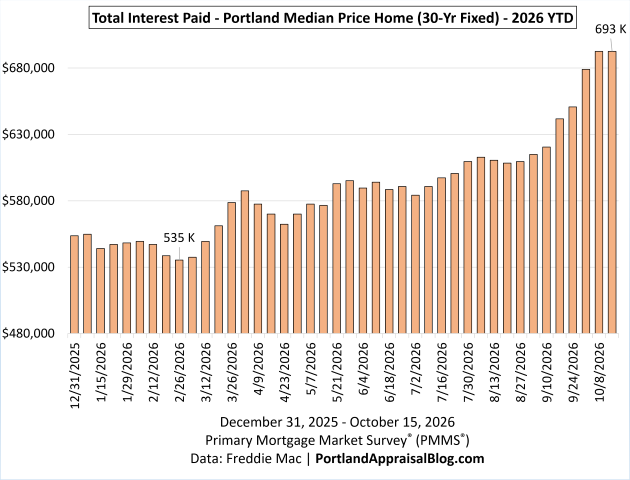
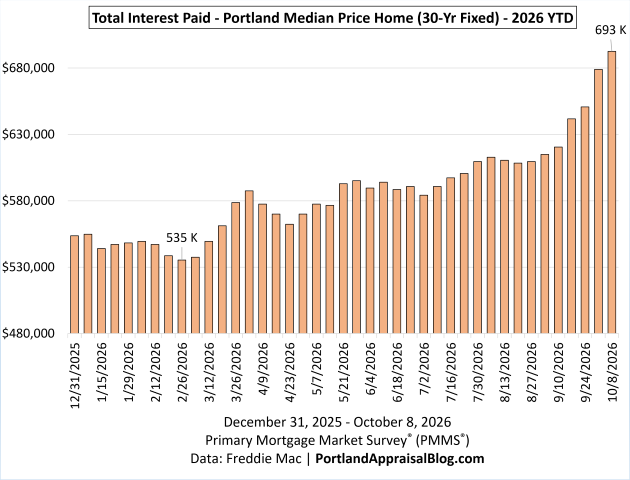
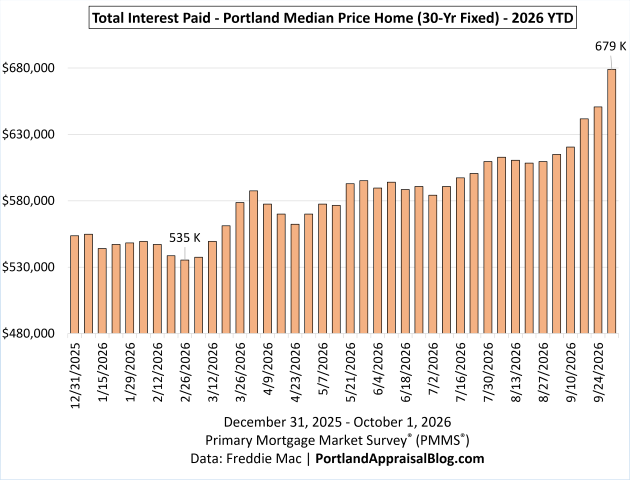
The 2026 YTD TIP chart shows how sharply lifetime borrowing costs have increased as mortgage rates moved higher throughout the year. These calculations are based on the total interest a buyer would pay on the Q1 2026 Portland Region median-priced home of $580,000, assuming a 20% down payment and applying the rate effective in each week. This isolates the impact of rate movements alone, holding price and loan structure constant.
The low point came on February 26, when a 5.98% mortgage rate produced a total interest burden of $535,342. As rates moved higher through the spring and summer, TIP increased steadily, crossing $600,000 in July and accelerating sharply during the past several weeks as mortgage rates pushed to new highs.
The current 7.32% mortgage rate produces a total interest burden of $683,449, near the highest reading of 2026. Compared with the February low, that represents an increase of $148,107 in lifetime interest—a change driven entirely by mortgage rates rather than home prices.
The shape of the chart makes the pattern unmistakable. Buyers naturally focus on the monthly payment, but the lifetime interest curve tells a different story. By spreading borrowing costs across a 30-year loan term, even relatively small changes in mortgage rates accumulate into meaningful differences in total repayment. This long-run perspective is what makes TIP such a useful complement to traditional affordability measures.
TIP per $1 Borrowed
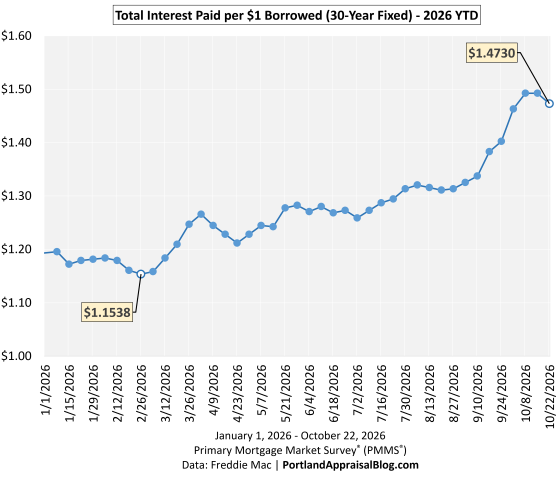
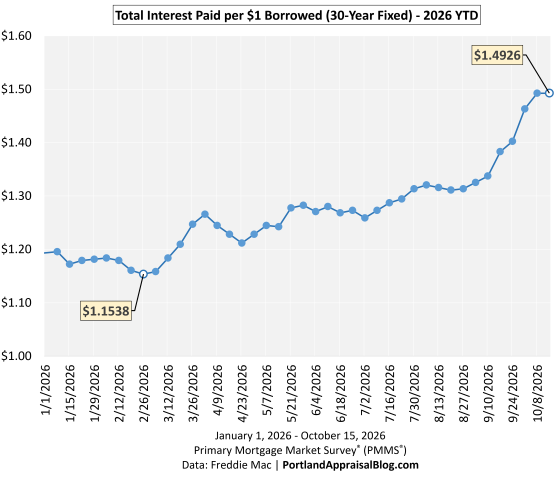
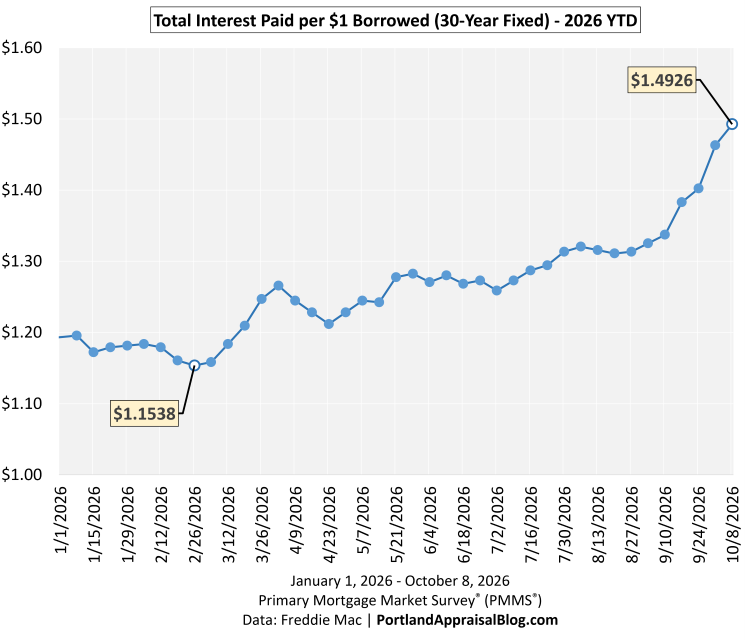
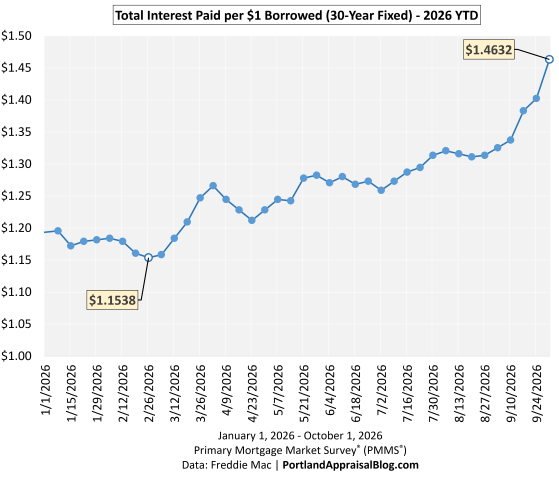
The TIP-per-$1 chart shows how much interest a buyer pays for every dollar borrowed at different mortgage rates. This is one of the clearest ways to visualize the long-run cost of financing. At the year-to-date low of 5.98%, each dollar borrowed generated approximately $1.1538 in interest over the life of the loan. As rates moved higher throughout the year, that figure increased steadily, reflecting the growing cost of mortgage debt.
This week’s 7.32% rate produces $1.4730 of interest for every $1 borrowed, close to the highest reading of 2026. Put differently, a borrower would repay substantially more in interest than in principal over the life of the loan. For example, a borrower financing $100,000 would pay roughly $147,300 in interest over the life of a 30-year fixed mortgage held to maturity, resulting in a total repayment of approximately $247,300.
The chart highlights how the cumulative cost of borrowing has accelerated in recent weeks. While buyers often focus on monthly payment, the TIP-per-$1 metric illustrates the long-run consequences of higher rates by converting abstract percentage changes into dollars and cents. As mortgage rates rise, each borrowed dollar carries a larger lifetime interest obligation, increasing the total cost of homeownership even when home prices remain unchanged.
Regional Interest Delta (RID)
The Regional Interest Delta (RID) models how much total lifetime interest the Portland Region’s Q1 detached‑home buyers would collectively pay when mortgage rates shift. To keep the metric consistent, RID assumes that all 3,349 Q1 detached sales were financed under standard 20%‑down, 30‑year conventional underwriting, even though the actual dataset includes cash purchases and loans under FHA, VA, jumbo, and other programs. Rates are matched to each home’s close date to reflect the real timing of rate movements, but individual buyers may have locked slightly different rates depending on their specific loan terms. This approach provides a clean, apples‑to‑apples way to measure how rate changes affect the region’s total interest burden.
| Scenario | Rate | Total Lifetime Interest | RID |
|---|---|---|---|
| Actual Q1 2026 Pipeline | Actual rate matched to close date | $2,091,901,976 | — |
| Modeled at Current Rate | 7.32% | $2,601,406,017 | +$509,504,041 |
Single-family Detached | Q1 2026
Data: RMLS (3,349 observations) | PortlandAppraisalBlog.com
Using those actual matched rates, the region’s Q1 2026 pipeline will generate $2,091,901,976 in lifetime interest. Recomputing the same loans at the current 7.40% rate increases the total to $2,601,406,017. The difference—the Regional Interest Delta (RID)—is $509,504,041 in additional lifetime interest.
To put that number in perspective: $152 million is the estimated cost of hollywoodHUB, a 222-unit affordable housing development in Portland. The current RID is more than 3.35 times that amount. In other words, applying this week’s mortgage rate environment to a single quarter of Portland Region detached home sales generates more than half a billion dollars in additional lifetime interest compared with the actual financing conditions buyers experienced during Q1.
RID makes the scale of rate changes unmistakable. What begins as a higher monthly payment for an individual buyer becomes a massive financial shift when applied across thousands of loans. While households experience rising rates through reduced purchasing power, higher qualification thresholds, and larger lifetime interest obligations, RID reveals the broader regional impact: more than half a billion dollars in additional lifetime interest could be generated if the entire Q1 2026 pipeline were financed under the current mortgage rate environment.
Payment Delta
The Payment Delta shows how monthly affordability shifts as mortgage rates move. Using the Q1 2026 Portland Region median‑priced home of $580,000 with a 20% down payment, the monthly principal‑and‑interest payment changes meaningfully even with small rate movements.
| Date | Rate | Monthly P&I | Payment Delta |
|---|---|---|---|
| Feb 26, 2026 – YTD Low | 5.98% | $2,775.95 | — |
| Oct 15, 2026 – YTD High | 7.40% | $3,212.64 | $436.69 |
| Oct 22, 2026 – Current Week | 7.32% | $3,187.36 | $411.41 |
Monthly payment for home using median Q1 2026 detached home price ($580,000) and 20% down.
Primary Mortgage Market Survey® (PMMS®)
Data: Freddie Mac | PortlandAppraisalBlog.com
Monthly payments remain meaningfully higher than the February low and now sit well above the region’s Maximum Sustainable Payment (MSP) of $2,895.67. At the year-to-date low on February 26, a 5.98% mortgage rate produced a monthly principal-and-interest payment of $2,775.95, comfortably below the affordability ceiling.
This week’s 7.32% rate puts that payment at $3,187.36, an increase of $411.41 per month relative to the February low and $291.69 above the MSP. This figure reflects principal and interest only; including taxes, insurance, HOA dues, and mortgage insurance (if applicable) would increase the monthly housing obligation further.
For many households, finding an extra $411 every month is not a trivial adjustment. Higher housing costs often compete directly with discretionary spending, savings goals, retirement contributions, vacations, entertainment, and other components of the household budget.
While Payment Delta is smaller in scale than the lifetime borrowing costs shown in the TIP and RID sections, it is the metric buyers experience most directly. For many households, rising payments affect not only what they can afford, but also where they can buy and which housing options remain within reach.
Purchasing Power
The table below shows how purchasing power has changed since the year‑to‑date low, based on a range of monthly P&I budgets. At February’s 5.98% rate, buyers could finance meaningfully more than they can at this week’s 7.32% rate.
| Target Monthly P&I Budget | Purchasing Power at YTD Low Rate (5.98%) | Purchasing Power at 7.32% Rate | Change in YTD Low Purchasing Power |
|---|---|---|---|
| $2,000 | $417,875 | $363,938 | -$53,937 |
| $2,500 | $522,344 | $454,922 | -$67,421 |
| $3,000 | $626,812 | $545,907 | -$80,906 |
| $3,500 | $731,281 | $636,891 | -$94,390 |
| $4,000 | $835,750 | $727,876 | -$107,874 |
| $4,500 | $940,218 | $818,860 | -$121,358 |
| $5,000 | $1,044,687 | $909,844 | -$134,843 |
| $5,500 | $1,149,156 | $1,000,829 | -$148,327 |
| $6,000 | $1,253,624 | $1,091,813 | -$161,811 |
Rates are based on the Primary Mortgage Market Survey® (PMMS®)
Data: Freddie Mac | PortlandAppraisalBlog.com
Purchasing power has fallen by $53,937 to $161,811 since the year-to-date low, depending on the monthly budget. For many buyers in the Portland Region—especially those shopping near the Q1 2026 median price of $580,000—the relevant range is often $2,500 to $3,000 in monthly principal-and-interest payments. Within that range, purchasing power has declined by approximately $67,421 to $80,906, highlighting how rising rates reduce borrowing capacity even when household income remains unchanged.
It’s also important to remember that these figures reflect principal and interest only. Actual purchasing power is lower once property taxes, insurance, HOA dues, and other housing costs are included. These expenses can further reduce the effective price range available to buyers.
The practical effect is straightforward: buyers can qualify for less house than they could earlier in the year. A household that could support a given monthly payment in February can now finance substantially less at the current rate. That shift often forces buyers to make tradeoffs involving location, home size, condition, or housing type, even if their budget has not changed.
For sellers, declining purchasing power can translate into softer demand at certain price points and increased sensitivity to pricing. As financing capacity contracts, buyers become more selective and may seek concessions, credits, or rate buydowns to offset the impact of higher borrowing costs.
Payment Milestones
The table below shows the key payoff milestones for a loan originated this month, with the first payment due on the first of next month. Each milestone reflects how much of the loan has been repaid and how much interest has accrued by that point at this week’s 7.32% rate.
| Milestone | % of Loan Paid | Calendar Date | Interest Paid to Date |
|---|---|---|---|
| Early Repayment | 10% | Oct-2034 | $259,589 |
| Quarter Paid | 25% | Oct-2041 | $457,381 |
| Half Paid | 50% | Oct-2048 | $608,539 |
| Three-Quarters Paid | 75% | May-2053 | $668,079 |
Data: Freddie Mac | PortlandAppraisalBlog.com
These milestones illustrate how interest-heavy the amortization schedule remains at the 7.32% rate. A borrower does not reach 10% repayment through principal repayment alone until October 2034, after approximately $259,589 in cumulative interest has already been paid. The loan is not 50% repaid until October 2048, by which point total interest paid reaches approximately $608,539.
The pattern reflects a fundamental characteristic of fixed-rate mortgage amortization: interest dominates the early years of the loan, while principal reduction accelerates later in the schedule. By the time the loan reaches the 75% repaid milestone in May 2053, most lifetime interest has already been paid and the remaining payments are increasingly directed toward principal.
These milestones help explain why mortgage rates have such a powerful influence on long-run affordability. Higher rates increase the share of each early payment devoted to interest, slowing principal reduction and extending the time required to build meaningful equity through amortization alone.
Closing Thoughts
The story of this week is straightforward: mortgage rates dipped slightly, dropping the 30‑year fixed to 7.32%, very close to the highest reading of 2026. The effects are visible across every major affordability metric. The Portland Appraisal Blog Affordability Index (PABAI) continues to signal structural strain for median‑income households, while the recalculated Q1 data illustrates how higher financing costs reduce qualifying power, increase housing burden, and shrink the share of homes accessible to a typical buyer.
For buyers, the takeaway is simple: affordability conditions have become increasingly restrictive. The Purchasing Power analysis shows that buyers can afford substantially less house than they could at the February rate low, even when their monthly budget remains unchanged. The Payment Delta illustrates the same challenge from another angle, with the monthly payment on a median‑priced home now nearly $411 higher than it was at the year‑to‑date low.
For sellers, the implications are more nuanced but no less important. Reduced purchasing power and higher monthly payments mean buyers often become more selective and increasingly sensitive to pricing. Homes that are appropriately priced and well positioned within their market segment can still attract demand, but elevated financing costs leave less room for error than in lower‑rate environments.
The broader lesson is that mortgage rates influence affordability in multiple ways simultaneously. Higher rates increase monthly payments, reduce purchasing power, delay equity accumulation, and expand the long‑run cost of borrowing. Whether viewed through PABAI, Payment Delta, TIP, RID, Purchasing Power, or the Payment Milestones analysis, the conclusion remains consistent: the Portland Region is operating under the most restrictive financing conditions of 2026—and buyers, sellers, and market participants are all adapting to that reality.
Sources & Further Reading
All data presented in this weekly mortgage rate update is based on the Q1 2026 detached homes segment. The data is sourced directly from RMLS and has been subjected to rigorous cleaning and validation processes to ensure reliability for detached single-family residential analysis in the six-county Portland Region. The trends, comparisons, and commentary are the result of original appraisal expertise and independent analysis—not aggregated from secondary sources or news summaries.
- Freddie Mac Primary Mortgage Market Survey® (PMMS®): Dataset
- HUD Portland-Vancouver-Hillsboro, OR-WA MSA: Median Household Income
- Mortgage Rates & the Portland Region Housing Market: Portland Appraisal Blog
- RMLS Data Challenges: Portland Appraisal Blog
- Portland Affordability Index – PABAI: A Realistic Housing Qualification Metric for the Portland Region: Portland Appraisal Blog
- The Portland Region – Six-County Market Area Overview: Portland Appraisal Blog
- The Portland Region Q1 2026 Detached Homes Market Update: Portland Appraisal Blog
- The 2025 Portland Region Detached Homes Market in Review: Portland Appraisal Blog
- Portland Region Housing Affordability Snapshot – Rates Remain at YTD High of 7.40% (October 15, 2026): Portland Appraisal Blog
- Portland Region Housing Affordability Snapshot – Rates Climb to YTD High of 7.40% (October 8, 2026): Portland Appraisal Blog
- Portland Region Housing Affordability Snapshot – Rates Soar to YTD High of 7.28% (October 1, 2026): Portland Appraisal Blog
- Portland Region Housing Affordability Snapshot – Rates Hit YTD High of 7.03% (September 24, 2026): Portland Appraisal Blog
- Portland Region Housing Affordability Snapshot – Rates Soar to YTD High of 6.95% (September 17, 2026): Portland Appraisal Blog
- Portland Region Housing Affordability Snapshot – Rates Hit YTD High of 6.76% (September 10, 2026): Portland Appraisal Blog
- Portland Region Housing Affordability Snapshot – Rates Hit YTD High of 6.71% (September 3, 2026): Portland Appraisal Blog
- Portland Region Housing Affordability Snapshot – Rates Return to 6.66% (August 27, 2026): Portland Appraisal Blog
- Portland Region Housing Affordability Snapshot – Rates Dip to 6.65% (August 20, 2026): Portland Appraisal Blog
- Portland Region Housing Affordability Snapshot – Rates Dip to 6.67% (August 13, 2026): Portland Appraisal Blog
- Portland Region Housing Affordability Snapshot – Rates Hit YTD High of 6.69% (August 6, 2026): Portland Appraisal Blog
- Portland Region Housing Affordability Snapshot – Rates Hit YTD High of 6.66% (July 30, 2026): Portland Appraisal Blog
- Portland Region Housing Affordability Snapshot – Rates Hit YTD High of 6.58% (July 23, 2026): Portland Appraisal Blog
- Portland Region Housing Affordability Snapshot – Rates Hit YTD High of 6.55% (July 16, 2026): Portland Appraisal Blog
- Portland Region Housing Affordability Snapshot – Rates Return to 6.49% (July 9, 2026): Portland Appraisal Blog
- Portland Region Housing Affordability Snapshot – Rates Drop to 6.43% (July 2, 2026): Portland Appraisal Blog
- Portland Region Housing Affordability Snapshot – Rates Nudge Upwards to 6.49% (June 25, 2026): Portland Appraisal Blog
- Portland Region Housing Affordability Snapshot – Rates Dip to 6.47% (June 18, 2026): Portland Appraisal Blog
- Portland Region Housing Affordability Snapshot – Rates Climb to 6.52% (June 11, 2026): Portland Appraisal Blog
- Portland Region Housing Affordability Snapshot – Rates Dip to 6.48% (June 4, 2026): Portland Appraisal Blog
- Portland Region Housing Affordability Snapshot – Rates Rise to 6.53% (May 28, 2026): Portland Appraisal Blog

Coda
Thanks for reading—I hope you found a useful insight or an unexpected nugget along the way. If you enjoyed the post, please consider subscribing for future updates.
Are you an agent in Portland who wonders why appraisers always do “x”?
A homeowner with questions about appraiser methodology?
If so, feel free to reach out—I enjoy connecting with market participants across Portland and the surrounding counties, and am always happy to help where I can.
And if you’re in need of appraisal services in Portland or anywhere in the Portland Region, we’d be glad to assist.
About the Author — Abdur Abdul‑Malik, SRA, ASA
Abdur Abdul‑Malik is the founder, author, and publisher of the Portland Appraisal Blog, where he produces original regional and neighborhood‑level housing analytics for the Portland Region. He is a certified residential appraiser serving Oregon and Washington, drawing on RMLS transaction data, public records, and custom segmentation models he has built.
He developed the Portland Appraisal Blog Affordability Index (PABAI), a payment‑based affordability metric built from actual RMLS sales. PABAI incorporates weekly updates based on the prevailing 30‑year fixed mortgage rate, providing a locally grounded measure of housing affordability across the region.
Learn more → PABAI explainer • mortgage rate series • full author bio