Portland Real Estate Appraisal Brief – Saturday, December 20, 2025: Alberta Alive Townhomes Rise Opposite Historic Alberta Abbey

Early look at the Alberta Alive Townhomes rising opposite the historic Alberta Abbey in Northeast Portland—eight new permanently affordable homes in the King neighborhood.

Historic Alberta Abbey building with rainbow mural and steeple viewed across NE Alberta Street in Northeast Portland's Alberta Arts District
Historic Alberta Abbey building at 126 NE Alberta Street in Northeast Portland’s King neighborhood, viewed across the street in December 2025.
Photo: Portland Appraisal Blog (CC BY-SA 4.0)

Site work is underway on a corner parking lot in Northeast Portland’s vibrant Alberta Arts District, where eight new townhomes are rising directly opposite the historic Alberta Abbey.

The Alberta Alive Townhomes project, located at the northwest corner of NE Alberta Street and NE Mallory Avenue in the King neighborhood, will deliver permanently affordable three-bedroom homes through the Proud Ground community land trust model.

Satellite aerial view showing the Alberta Alive Townhomes construction site at NE Alberta and Mallory in Northeast Portland, labeled opposite the historic Alberta Abbey
Satellite view of the Alberta Alive Townhomes construction site at NE Alberta and Mallory in Northeast Portland, opposite the historic Alberta Abbey.
Image: Google Maps

Lead developer Community Development Partners (CDP), in partnership with Self Enhancement Inc. (SEI) and Proud Ground, has begun early site preparation. The project architect is Scott Edwards Architecture, with Owen Gabbert, LLC serving as general contractor. The three-story units will each offer 3 bedrooms, 2.5 baths, private porches, fenced yards, and dedicated parking—approximately 1,275 square feet of living space—in an all-electric design with sloped roofs to accommodate future solar panels, targeting Earth Advantage Platinum certification. Completion is anticipated in fall 2026, with home sales expected in spring 2027.
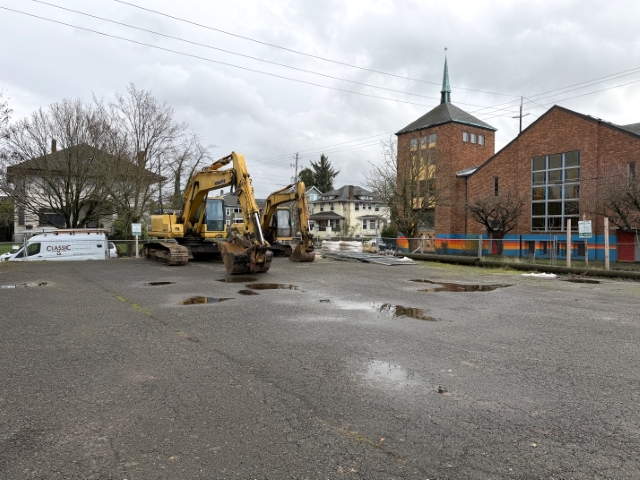
Early construction activity with excavators on the Alberta Alive Townhomes site in Northeast Portland, historic Alberta Abbey in background.
Early site preparation underway for the Alberta Alive Townhomes in Northeast Portland, with the historic Alberta Abbey visible in the background.
Photo: Portland Appraisal Blog (CC BY-SA 4.0)

During a recent site visit, the blog author had the opportunity to speak briefly with John, site supervisor for general contractor Owen Gabbert, LLC. With experience on numerous affordable housing initiatives, including Habitat for Humanity builds, John’s passion for creating homes for families in need was readily apparent. He expressed optimism about the City of Portland’s current commitment to affordable housing and highlighted the role of recent system development charge (SDC) waivers in helping accelerate much-needed projects. John also pointed out an environmental benefit specific to this site: the former parking lot generated higher sewer fees due to impervious-surface runoff, and the new townhomes—with permeable features and reduced hardscape—will lessen the impact on the sewer system, delivering a double win for housing supply and infrastructure.

Construction site supervisor John in high-visibility gear working on laptop at the Alberta Alive Townhomes project in Northeast Portland.
Site supervisor John of Owen Gabbert, LLC coordinating early work on the Alberta Alive Townhomes project (photo taken with permission).
Photo: Portland Appraisal Blog

Market Context in King and Humboldt Neighborhoods

From an appraisal perspective, the King and Humboldt neighborhoods surrounding the Alberta Alive site continue to show robust demand for family-sized attached homes. Over the past four years, three-bedroom fee-simple units have averaged $574,900 in closed sales, with an average of approximately 1,650 square feet and $355 per square foot (24 sales, RMLS data). Notably, new-construction sales in this attached segment remain rare, with only four recorded over the same period.

For broader perspective, the 2024 Portland Region Attached Housing Market in Review reported an average sale price of $445,867 for non-condo attached homes across all of Multnomah County. The higher average in King and Humboldt illustrates the location premium associated with the Alberta Arts District and surrounding high-opportunity areas.

The eight new Alberta Alive Townhomes, at 1,275 square feet, are more compact than existing townhomes in the neighborhoods surveyed, indicating a tradeoff between size and quality. These townhomes—offering comparable three-bedroom layouts with modern amenities—deliver Earth Advantage-certified construction at prices restricted to households earning no more than 80% of area median income. This is made possible through the Proud Ground community land trust model and an approximate $217,000 per-unit contribution from the Portland Housing Bureau ($1.73 million toward the $6.03 million total development cost).

Appraisal Considerations for Community Land Trust Properties

The Alberta Alive Townhomes operate under a community land trust (CLT) structure in which buyers own the improvements (the townhome building) in fee-simple, but the underlying land remains owned by Proud Ground and is subject to a long-term ground lease. This legal arrangement imposes resale price restrictions and income qualifications to preserve affordability for future buyers.

As a result, these units do not serve as direct comparables for unrestricted fee-simple attached housing in the open market. Appraisers valuing nearby conventional townhomes must distinguish the hypothetical unrestricted market value of similar improvements from the encumbered resale price dictated by the ground lease.

That said, the introduction of high-quality new construction in a historically disinvested corridor can still provide positive externalities. Such projects often contribute to neighborhood stabilization and may exert an upward anchoring influence on surrounding market-rate properties.

For prioritized families—particularly those with historic ties to North/Northeast Portland or displaced descendants under the N/NE Preference Policy—Alberta Alive creates access to high-quality homeownership on terms that would otherwise be unattainable at market rates.

While the CLT structure enables meaningful wealth-building through mortgage principal reduction, limited appreciation, and potential intergenerational transfer, it intentionally caps resale prices to preserve permanent affordability—meaning owners forgo the full market upside available in unrestricted sales nearby.

Portland Appraisal Blog will keep an eye on this project’s progress and eventual absorption by the market.

Sources & Further Reading

Decorative border text.

Thanks for reading—I hope you found a useful insight or an unexpected nugget along the way. If you enjoyed the post, please consider subscribing for future updates.

CODA

Are you an agent in Portland who wonders why appraisers always do “x”?

A homeowner with questions about appraiser methodology?

If so, feel free to reach out—I enjoy connecting with market participants across Portland and the surrounding counties, and am always happy to help where I can.

And if you’re in need of appraisal services in Portland or anywhere in the Portland Region, we’d be glad to assist.

Portland Real Estate Appraisal Brief – Sunday, December 14, 2025: Julia West House Supportive Housing Tower Opens

Julia West House, a 12-story mass timber tower in downtown Portland, opens with 90 units (89 regulated) of supportive housing for seniors amid ongoing regional affordability challenges.

Full-height view of Julia West House, a 12-story mass-timber building in downtown Portland, Oregon, showing the light brick facade with protruding window surrounds, orange accents, and the building name on the lower canopy, under a clear blue sky.
Julia West House, Oregon’s tallest mass-timber affordable senior housing building, viewed from the street corner in downtown Portland.
580 SW 13th Ave, Portland, Oregon – December 2025
Photo: Abdur Abdul-Malik, Certified Residential Appraiser

Julia West House Opens in Downtown Portland

The Julia West House, a 12-story mass timber apartment tower in downtown Portland’s West End, officially opened in late 2025, delivering 90 units of permanent supportive housing targeted at formerly unhoused seniors. Located at 580 SW 13th Avenue on a former surface parking lot owned by First Presbyterian Church—the site of a historic home previously used for church programs—the project provides 90 total units: 89 regulated affordable units (60 studios and 30 one-bedrooms) reserved for individuals earning 30% or less of area median income, with the remaining unit serving as an unrestricted on-site manager apartment.

The tower retains the name Julia West House in honor of Julia West Lindsley, wife of the church’s first pastor, continuing a legacy of community service at the address. Situated directly across SW 13th Avenue from the Sam Galbreath Alder House—a renovated income-restricted single-room occupancy building also offering supportive services—the location creates a concentrated hub for permanent supportive housing in the West End. This focus addresses a critical segment of need: nearly a quarter of Portland’s unhoused population is age 55 or older, with BIPOC communities disproportionately represented.

Before-and-during views of the Julia West House site at 580 SW 13th Avenue in downtown Portland: pre-demolition historic structure (2023, top) and cleared construction site (2024, bottom)
Before-and-during views of the Julia West House site at 580 SW 13th Avenue in downtown Portland: pre-demolition historic structure (2023, top) and cleared site (2024, bottom)
Image: Google Street View (composite screenshot)

On-site wraparound services, delivered by Northwest Pilot Project, Native American Rehabilitation Association of the Northwest, and Community for Positive Aging, include case management, health support, and programs to promote aging in place and housing stability. As Oregon’s tallest mass timber residential structure at 145 feet, the building utilizes cross-laminated timber floors and glulam beams above a concrete podium, enabled by Type IV-B heavy timber provisions. This construction method reduced embodied carbon, shortened the schedule by approximately 14 weeks, and incorporates biophilic and trauma-informed design elements—such as exposed wood ceilings—for resident well-being.

Financing combined public and private sources, including 4% Low-Income Housing Tax Credits and contributions from the Portland Clean Energy Community Benefits Fund, demonstrating a viable model for deeply affordable urban infill.

Low-angle view of the Julia West House, a tall building with light-colored brick exterior and grid-patterned windows, showcasing its modern architectural design and prominent entrance signage.
The Julia West House, a modern multistory building in downtown Portland, stands tall with its grid of windows and light brick facade—captured from a low angle that emphasizes its architectural presence.
580 SW 13th Ave, Portland, Oregon – December 2025
Photo: Abdur Abdul-Malik, Certified Residential Appraiser

Appraisal Implications

Residential Properties

Developments like Julia West House expand the supply of deeply affordable and supportive rental housing in the Portland metro area, where single-family inventory remains limited. These projects provide market evidence of ongoing efforts to address affordability and homelessness in central locations with strong transit access, informing highest and best use considerations for nearby properties and enhancing neighborhood marketability.

Multifamily Properties

Mass timber construction in high-density supportive projects sets emerging precedents for sustainable building practices, potentially affecting future replacement costs, capitalization rates, and development feasibility in urban zones. Restricted affordable units, supported by Low-Income Housing Tax Credits and similar programs, require appraisers to carefully isolate restricted interests from fee simple value. While challenges persist—as illustrated by the 1,863 vacant regulated units reported earlier this week—successful openings like Julia West House highlight effective delivery models for mission-driven housing with integrated services.

Market Context

Q3 2025 median prices for detached single-family homes stood at $600,000 regionally and $555,000 in Multnomah County, reinforcing the ongoing need for affordable alternatives beyond the for-sale market. Purpose-built supportive housing adds targeted supply that supports broader regional stability without directly competing in the single-family segment.

Sources & Further Reading

Decorative text divider.

Thanks for reading—I hope you found a useful insight or an unexpected nugget along the way. If you enjoyed the post, please consider subscribing for future updates.

CODA

Are you an agent in Portland and wonder why appraisers always do “x”?

A homeowner with questions about appraiser methodology?

If so, feel free to reach out—I enjoy connecting with market participants across Portland and the surrounding counties, and am always happy to help where I can.

And if you’re in need of appraisal services in Portland or anywhere in the Portland Region, we’d be glad to assist.

Portland Real Estate Appraisal Brief – Sunday, December 7, 2025: Affordable Housing Paradox – 1,863 Vacant Units Amid Record Need

Portland’s inclusionary zoning is producing units, but 1,863 income-restricted apartments remain vacant amid funding cuts and administrative delays—creating measurable valuation risk for residential and multifamily professionals.

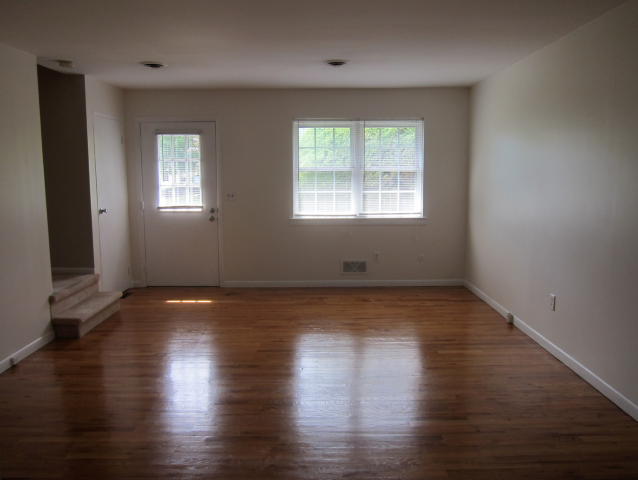
Empty interior of a newly completed or income-restricted apartment unit in the Portland metro area, illustrating persistent vacancies in affordable housing relevant to real estate appraisal and valuation.
Empty interior of an income-restricted apartment unit in Portland, symbolizing the region’s persistent vacancies in affordable housing programs
Via Canva Pro

Policy Wins Collide With Activation Barriers

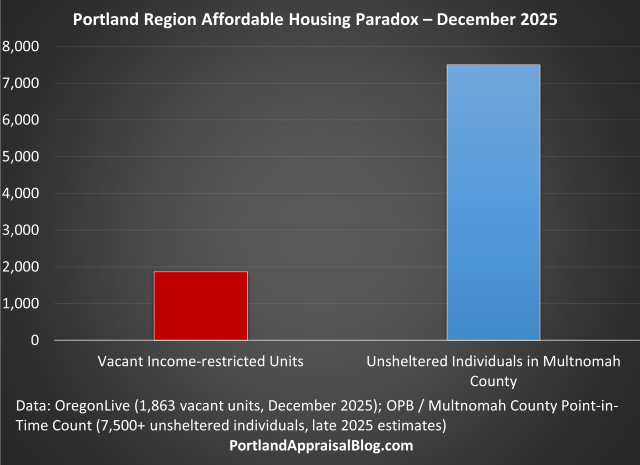
Portland’s affordable housing programs are delivering a classic paradox: policy mechanisms are finally producing new income-restricted units, yet nearly 1,900 completed apartments—representing a 7.4% vacancy rate across the region’s 25,409 subsidized units—sit empty while homelessness continues to climb.

The city’s inclusionary zoning program, which requires or incentivizes developers to reserve a portion of new units for households earning 60% or less of area median income (AMI)—where the FY 2025 median family income for a 4-person household in the Portland-Vancouver-Hillsboro OR-WA MSA is $124,100—has shown measurable improvement in actual unit production after years of refinement. This is a hard-won policy success in a market that has long struggled to integrate affordability into private development.

These gains, however, are being undermined by systemic activation challenges. Home Forward, Multnomah County’s primary administrator of subsidized housing and the Housing Choice Voucher (Section 8) program, faces a $35 million budget shortfall that includes a $14 million cut in federal voucher funding. The agency has paused new voucher issuances, eliminated at least 12 positions, and extended waitlists that already see roughly seven applications for every opening.

Providers cite a combination of administrative delays, rising operational costs, higher post-pandemic eviction rates, and narrowing rent gaps (42% of metro units are now within 10% of market rent) as the main drivers of prolonged vacancies. As Reach Community Development’s executive director noted, “even affordable rents are too high” for many eligible households without deeper subsidies.

Mayor Keith Wilson has explicitly linked these activation failures to the region’s homelessness crisis. Although 890 of a targeted 1,500 new low-barrier shelter beds are now open, many operate at just over 50% occupancy—compared with 87% at existing 24-hour shelters—because permanent housing remains the preferred exit. With more than 7,500 individuals unsheltered in Multnomah County (up over 1,000 since January 2025) and monthly inflows of ~1,400 people outpacing permanent placements of ~1,100, the region continues to see a net increase in homelessness.

Appraisal Implications

These activation failures translate directly into valuation and underwriting risk for professionals across the Portland metro area.

Residential Properties

Inclusionary zoning covenants create deed-restricted comparables that must be segregated from market-rate sales. As the program matures, appraisers in Multnomah, Clackamas, Washington, Columbia, Yamhill, and Clark counties will see a growing volume of these restricted transactions, especially in newer condominium and mixed-use projects—though the highest concentration remains within the City of Portland’s jurisdiction in Multnomah County. With the Q3 2025 median price for detached single-family homes in the region at approximately $600,000—as noted in our Q3 2025 Portland region market update—the gap between market-rate ownership and income-restricted pricing remains stark.

Multifamily and Investment Properties

The 1,863 vacant income-restricted units create an immediate drag on potential gross income and stabilized net operating income (NOI). Projects financed through Low-Income Housing Tax Credits (LIHTC) or subject to inclusionary requirements now face extended lease-up periods—often months rather than weeks—due to public-agency bottlenecks. Recent FHFA increases to 2026 multifamily loan purchase caps may encourage new supply, but activation risks remain a key variable.

Appraisers using the income approach should give heightened scrutiny to:

  • Absorption timelines (extend beyond market-rate norms)
  • Vacancy allowances (increase for policy-induced vacancy)
  • Capitalization rates (higher risk typically justifies higher cap rates)

Lenders and investors underwriting affordable or mixed-income developments must incorporate longer stabilization horizons and potential LIHTC compliance risks into their models.

Market Context

When finished apartments remain offline, the housing-homelessness pipeline stalls, forcing greater reliance on temporary shelter systems even as permanent supply begins to grow.

Bar graph. Data: OregonLive (1,863 vacant units, December 2025); OPB / Multnomah County Point-in-Time Count (7,500+ unsheltered individuals, late 2025 estimates)

Resolving this paradox will require targeted investment in administrative capacity and deeper subsidy layers to match completed units with the households who need them most.

Sources & Further Reading

Decorative text divider

Thanks for reading—I hope you found a useful insight or an unexpected nugget along the way. If you enjoyed the post, please consider subscribing for future updates.

CODA

Are you an agent in Portland and wonder why appraisers always do “x”?

A homeowner with questions about appraiser methodology?

If so, feel free to reach out—I enjoy connecting with market participants across Portland and the surrounding counties, and am always happy to help where I can.

And if you’re in need of appraisal services in Portland or anywhere in the Portland Region, we’d be glad to assist.