
Portland Real Estate Appraisal Brief – Thursday, November 27, 2025: $21M in Unspent Rental Fees Discovered

A recent city review found that Portland has accumulated approximately $21 million in rental-registry fees that were designated to support emergency rental assistance and eviction-prevention programs. During the period in which these funds remained unused, landlords in Multnomah County filed an estimated 800 to 1,200 eviction cases per month, though not all filings result in an eviction order.

Portland Oregon skyline at sunset with Mount Hood in the background and overlay text “$21 Million in Unspent Rental Assistance Funds,” illustrating the impact of housing policy and unspent rental-aid funds on the Portland metro real estate appraisal market.

The rental-registry program requires landlords to pay fees and register units, with the revenue earmarked specifically for tenant-support programs. Poor tracking and administrative delays left the money unspent, even as demand for rental aid remained elevated across the Portland metro area.

Leadership Change and Severance Package

The discovery coincided with the resignation of Portland Housing Bureau Director Helmi Hisserich. Following paid administrative leave, Hisserich received a severance package equal to her full annual salary of approximately $241,000. The city continues to examine how the funds went unused for an extended period.

Appraisal Implications in the Portland Region

Residential Properties (1–4 Units)

The unspent funds have no immediate direct effect on comparable sales selection or adjustment grids for typical single-family or small-multifamily appraisals in the Portland metro area. Broader affordability pressure and eviction volume remain relevant market-condition factors, but no abrupt shift in residential values is likely from this development alone.

Commercial Multifamily and Investor-Owned Properties

If the $21 million is successfully redeployed for rental assistance and eviction defense, occupancy stability in larger apartment properties (5+ units) could improve. Lower economic vacancy risk and reduced turnover expense represent positive influences on net operating income, which in turn support lower capitalization rates and higher valuations for income-producing assets across the region.

Appraisers working on commercial assignments in Multnomah County should monitor city council actions regarding reallocation of these funds in the coming weeks to months.

Homeowners, lenders, realtors, estate planners, and attorneys relying on accurate valuation of investment-grade multifamily residential properties will benefit from understanding how policy execution—or delays—can influence income metrics and risk adjustments in appraisal reports.

Sources & Further Reading

Thanks for reading—I hope you found a useful insight or an unexpected nugget along the way. If you enjoyed the post, please consider subscribing for future updates.

Question: Do you think the $21 million will be disbursed soon, or will it take months before the funds can be used for rental assistance?

CODA

Are you an agent in Portland and wonder why appraisers always do “x”?

A homeowner with questions about income-producing properties?

If so, feel free to reach out—I enjoy connecting with market participants across Portland and the surrounding counties, and am always happy to help where I can.

And if you’re in need of appraisal services in Portland or anywhere in the Portland Region, we’d be glad to assist.
Portland Real Estate Appraisal Brief – Tuesday, November 25, 2025: Oregon Joins $7 Million Proposed Settlement with Greystar Over RealPage Rent-Setting Practices

Oregon and eight other states filed a proposed $7M settlement with Greystar, affecting ~19,000 Portland apartments. Appraisers and buyers are watching for 2026 rent softening and cap rate shifts.

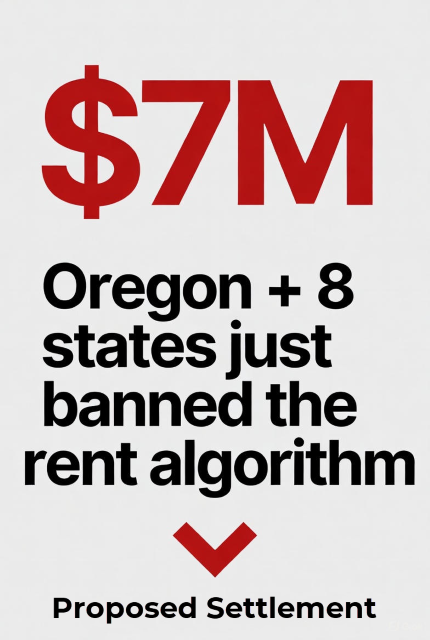
Graphic showing $7 Million dollar proposed settlement involving Oregon and 8 other states.

A coalition of nine states led by Oregon and California has filed a proposed $7 million settlement with Greystar Management Services — the nation’s largest rental housing operator — over allegations that Greystar used RealPage software to illegally coordinate rent pricing across competing properties.

The settlement, if approved by a federal court, would permanently bar Greystar from sharing non-public rent and occupancy data with competitors and from using RealPage’s hyper-local pricing recommendations. A separate DOJ consent decree filed against RealPage itself imposes similar behavioral restrictions and a three-year independent monitor.

Greystar manages approximately 19,000 apartment units in the Portland metro area — roughly 10 % of the region’s multifamily inventory. State investigators have estimated that RealPage-enabled pricing affected roughly one in five multifamily units statewide.

Image of large apartment complex with a "For Rent" sign superimposed.

For homeowners, buyers, agents, and lenders, the most immediate question is whether these enforcement actions will translate into meaningful rent relief in 2026 and beyond.

The Direct Impact on Purchasing Power

A renter currently paying a $200 “algorithm premium” (the difference between market rent and coordinated rent loses $2,400 annually that could otherwise go toward a down payment.

Even a modest 5–8 % softening in rents after these settlements would return $110–$176 per month to the typical household, equating to $4,000–$10,600 in additional savings over three to five years.

What Appraisers Are Watching in 2026

  1. Cap rate movement on institutional-grade (50+ unit) apartment buildings
  2. Total scheduled gross revenue trends at properties previously managed with revenue-management software

If rents soften and risk premiums rise, cap rates will widen first on larger assets. That pressure eventually flows through to gross rent multipliers (GRMs) on 1–4 unit residential income properties — either compressing GRMs if sale prices adjust faster than rents, or temporarily expanding them if prices lag.

We likely won’t see clear signals until mid-2026, but the direction of travel will matter for every appraisal involving the income approach in the region.

Bottom Line

Combined with new multifamily supply now entering the pipeline, these twin enforcement actions represent the strongest downward pressure on algorithmic rent growth Portland has seen since the pandemic began.

Sources & Further Reading

For broader quarterly context on inventory, pricing, and market segmentation trends in the Portland region, see our most recent Q3 2025 Market Update.

Decorative text border banner before outro and coda.

Thanks for reading—I hope you found a useful insight or an unexpected nugget along the way. If you enjoyed the post, please consider subscribing for future updates.

Question: Do you think we’ll see any meaningful slowdown in rent increases in the Portland area?

CODA

Are you an agent in Portland and wonder why appraisers always do “x”?

A homeowner with questions about appraisal contingencies, GRMs, or valuation delays?

If so, feel free to reach out—I enjoy connecting with market participants across Portland and the surrounding counties, and am always happy to help where I can.

And if you’re in need of appraisal services in Portland or anywhere in the Portland Region, we’d be glad to assist.