Appraisal Deep Dive: External Obsolescence in Hillsboro — Residential Market Response to Intel’s 2024–2025 Workforce Reductions

Hillsboro’s residential market responded to Intel’s 2024–2025 layoffs with clear external obsolescence—condominium and attached resale segments showed steepest price declines and longest marketing times. Original RMLS analysis.

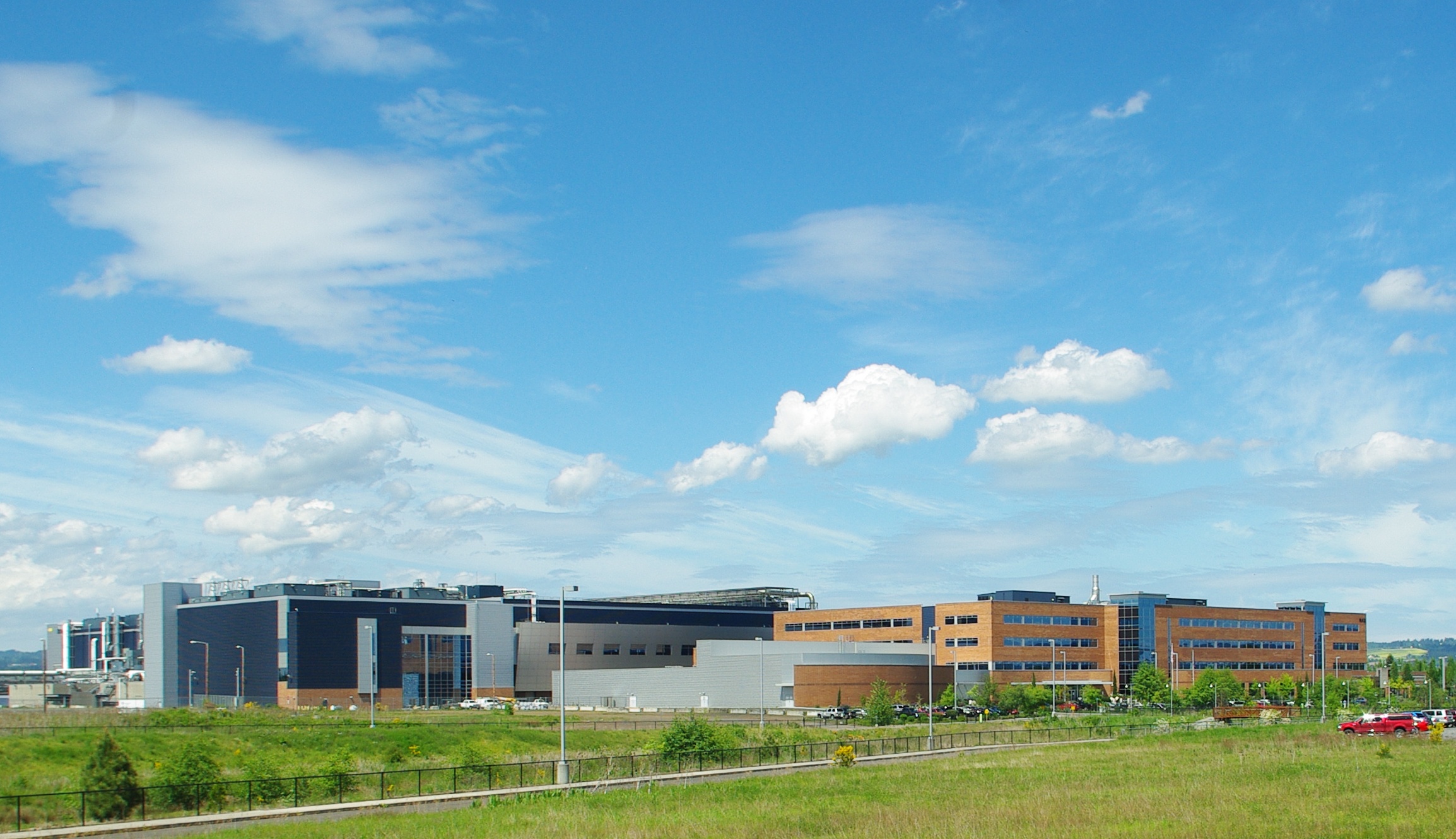
Intel's Gordon Moore Park at Ronler Acres campus in Hillsboro, Oregon, showing the scale of semiconductor facilities central to local employment and residential market dynamics
Intel’s Gordon Moore Park at Ronler Acres—the largest campus in Hillsboro and primary site impacted by 2024–2025 workforce reductions.
Photo: M.O. Stevens via Wikimedia Commons (CC BY 3.0)

Hillsboro has long been synonymous with high-wage technology employment, anchored by Intel’s extensive campus network. When a dominant employer undergoes significant workforce reduction, the ripple effect can manifest as external obsolescence in the surrounding residential market—reduced buyer demand, extended marketing periods, and downward pressure on realized prices, particularly in segments most tied to that employment base.

Between late 2024 and the end of 2025, Intel eliminated more than 4,400 positions in Oregon, with the vast majority concentrated in Hillsboro facilities. This represented a roughly 20% contraction from peak local headcount. The timeline provides clear inflection points for analyzing market reaction.

Intel Oregon Workforce Reduction Timeline (Hillsboro-Focused)

  • October 2024: Approximately 1,300 positions eliminated (separations beginning November 2024).
  • July 2025: Roughly 2,400 additional positions cut across Ronler Acres, Jones Farm, Hawthorn Farm, and Aloha sites.
  • November 2025: Further 669 roles removed, bringing the 2025 total above 3,100.
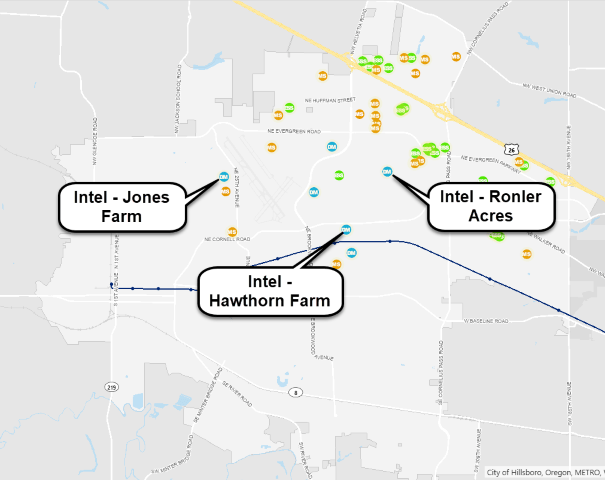
Map of Hillsboro Oregon semiconductor cluster showing Intel Ronler Acres, Jones Farm, and Hawthorn Farm campuses alongside related industry sites, highlighting employment concentration affecting nearby residential values.
Semiconductor business cluster in Hillsboro, Oregon, illustrating the concentration of Intel campuses (Ronler Acres, Jones Farm, Hawthorn Farm) amid supplier and partner facilities—the geographic core of the employment shock.
Via Hillsboro GIS
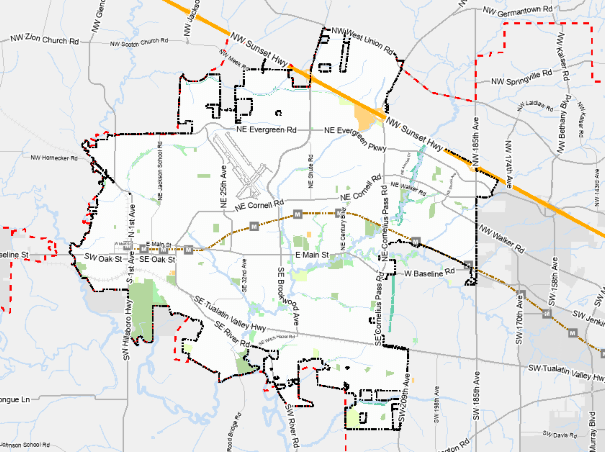
Approximate Hillsboro city limits boundary used for RMLS closed-sales analysis (detached, attached, and condominium properties, 2023–2025).
Via Hillsboro GIS

Annual Market Summary (Hillsboro Closed Sales, 2023–2025)

TypeYear# of SalesAvg PriceAvg PPSFAvg CDOMSP/OLP %
Condo202390$366,533$2992599.12%
202473$361,835$3163797.66%
202588$335,105$2896694.89%
Attach.2023208$465,801$3053199.02%
2024272$477,344$2985198.00%
2025281$455,479$2877296.83%
Detach.2023732$589,096$3143998.52%
2024757$603,627$3254898.32%
2025783$586,434$3136097.39%
Annual market summary for Hillsboro closed sales (all property types, including new construction, 2023–2025). Overall averages reflect relative price stability across the period.
Data: RMLS | Portland Appraisal Blog

Data reflects single-family residential class properties within Hillsboro city limits (detached homes, attached townhomes/rowhomes, and condominiums).

Price Trends Reveal a Split Market
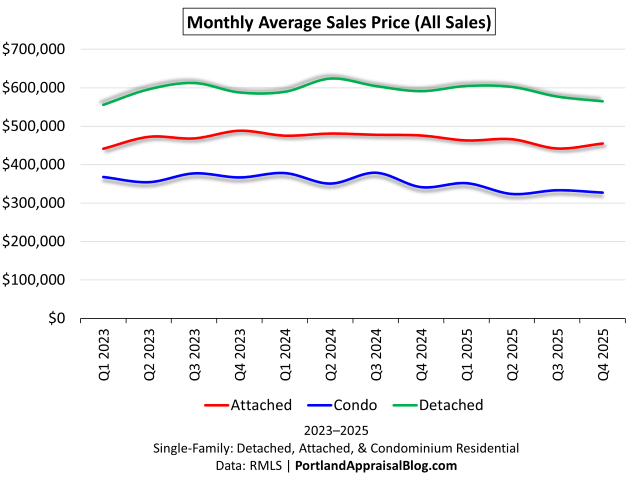
Line chart showing quarterly average sales price trends for condominium, attached, and detached properties in Hillsboro Oregon from 2023 through 2025, illustrating segment-specific softening.
Quarterly average close price trends in Hillsboro (all closed sales, 2023–2025). Detached properties maintained relative stability longest, while condominium and attached segments showed earlier and steeper declines.
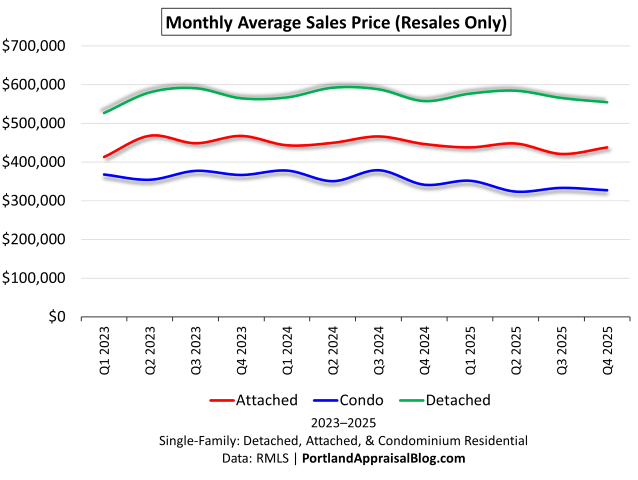
Line chart comparing quarterly average sales price for resale-only condominium, attached, and detached homes in Hillsboro Oregon 2023–2025, highlighting greater price pressure on existing properties.
Quarterly average close price trends in Hillsboro (resale properties only, excluding new construction). Removing builder sales unmasks deeper weakness in existing detached and attached stock.

Some local year-end commentary described Hillsboro values as generally stable, citing modest average price gains and balanced overall inventory; this matches the annual market summary table above. However, if you peel back the onion a different picture emerges. The apparent stability reflects the continued delivery of new-construction projects—many planned and entitled well before Intel’s workforce reductions began. When new-construction sales are excluded, existing condominium and attached resale properties show consistent price declines and significantly longer marketing periods—evidence that the employment shock has already exerted measurable external obsolescence on resale stock. The broader market averages may feel the full effect in 2026 and beyond as pre-layoff development pipelines clear.

Type2023 Avg Close2024 Avg Close2025 Avg Close2025 vs 2023 Change2025 Avg CDOMSP/OLP 2025
Condo$366,533$361,835$335,105–8.6%66 days94.89%
Attach.$449,270$452,930$435,573–3.0%56 days96.22%
Detach.$568,134$578,012$570,170+0.4%50 days97.37%
Resale-only trends reveal clearer softening, particularly in condominium and attached segments.
Data: RMLS | Portland Appraisal Blog

The Textbook Signal: Rising Cumulative Days on Market

Perhaps the clearest indicator of external obsolescence is the extension of marketing periods. Prolonged days on market with little to no price premium is a hallmark response to localized employment contraction.
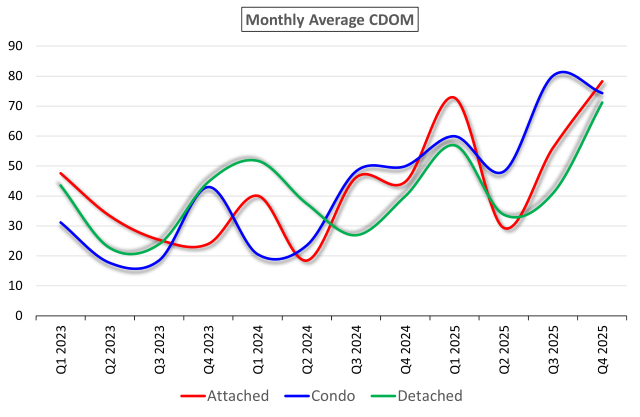
Line chart of quarterly average cumulative days on market for resale condominium, attached, and detached properties in Hillsboro Oregon 2023–2025, demonstrating progressive market-time extension tied to employment disruption.
Quarterly average cumulative days on market (resale properties only, Q1 2023–Q4 2025). Condominium resale led the increase, followed closely by attached; detached resale joined the upward trend decisively in late 2025.

The extension of marketing periods in resale properties offers one of the clearest indicators of external obsolescence. Condominium resale led the trend with sharp increases beginning in mid-2024, followed closely by attached resale. Detached resale, initially more resilient, joined the upward trajectory decisively in late 2025. By Q4 2025, average cumulative days on market across all three resale segments converged in the 74–83 day range—a dramatic shift from the 20–40 day norms prevalent in 2023.

Key CDOM Inflection Points (Resale Properties)

TypeAvg CDOM Q4 2024Avg CDOM Q4 2025Increase
Condominium50 days74 days+48%
Attached61 days83 days+36%
Detached48 days78 days+63%
Average cumulative days on market for resale properties: Q4 2024 vs. Q4 2025 comparison, highlighting the sharpest extensions.
Data: RMLS | Portland Appraisal Blog

The near-convergence at 74–83 days by year-end 2025 represents a dramatic shift from pre-2024 norms, when most segments averaged 20–40 days.

Individual Sale Behavior: No Premium for Extended Marketing Time

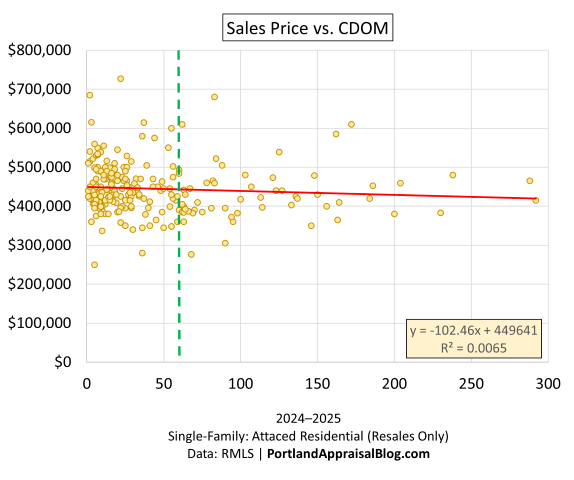
Scatter analysis of 2024–2025 closed sales reinforces the aggregate trend.
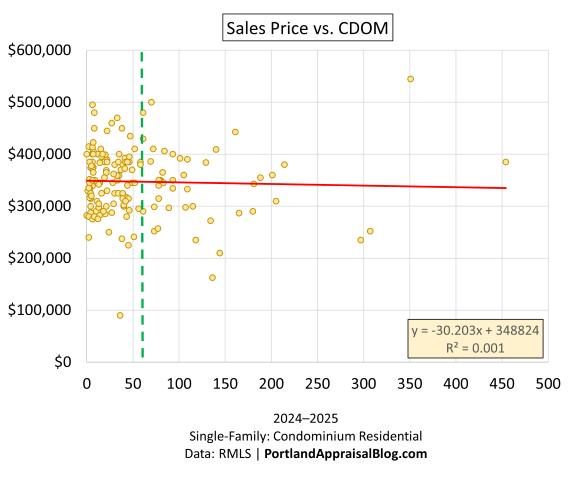
Scatterplot of sales price versus cumulative days on market for Hillsboro Oregon condominium closings 2024–2025, showing flat relationship and numerous long-market-time sales with no price premium.
Sales price vs. cumulative days on market—Hillsboro condominium sales, 2024–2025. Flat trend line and long rightward tail illustrate absence of price compensation for prolonged marketing periods. Vertical dashed line at 60 days highlights extended-market properties.
Scatterplot of sales price versus cumulative days on market for resale attached townhome and rowhome sales in Hillsboro Oregon 2024–2025, revealing motivated pricing behavior in existing stock.
Sales price vs. cumulative days on market—Hillsboro attached resale properties only, 2024–2025. Similar flat relationship and extended tail once new-construction sales are removed. Vertical dashed line at 60 days.

Both distributions exhibit essentially zero correlation between longer marketing time and higher achieved price—a buyer’s market signal where sellers concede on price rather than wait.

Upper-Tier Detached Vulnerability

Year# of ResalesAvg Resale Price# of New ConAvg New Con Price% New Con
202324$1,006,57317$981,11141%
202424$964,68528$969,00454%
202535$954,78128$901,58244%
Total83$972,59273$945,68747%
Hillsboro detached sales priced $800,000 and above (2023–2025), separated by resale and new construction. Resale and new-construction prices trend lower while sheer new-construction volume helps support aggregates, leading to an impression of overall market stability.
Data: RMLS | Portland Appraisal Blog

Even within the more resilient detached segment, properties priced $800,000 and above—often appealing to higher-compensated technology professionals—displayed noticeable softening. Resale upper-tier homes closed at lower average prices in 2025 ($955,000) than in prior years, while new-construction sales in this bracket experienced even sharper erosion, averaging $902,000 in 2025—an 8.1% decline from the 2023 figure.

Appraiser Perspective: Practical Implications

The data presents several direct challenges in current Hillsboro residential appraisals:

  • Comparable selection becomes more complex when pre-layoff and post-layoff sales coexist. Appraisers must prioritize recent closings and apply verifiable market condition (time) adjustments, particularly for condominium and attached resale comps.
  • Reconciliation weighting should favor sales with similar motivation profiles; distressed or relocation-driven transactions carry greater weight in segments showing extended CDOM.
  • Market condition (time) adjustments are warranted when comparable sales bracket the layoff timeline. Sales closing before mid-2024 often reflect stronger demand and may require negative adjustments when applied to current assignments to account for subsequent market erosion; more recent closings in condominium and attached resale segments typically need little or no adjustment, while pre-layoff comps may warrant downward support in reconciliation.
  • New vs. resale distinction is critical in attached and upper-tier detached appraisals. Builder sales frequently achieve high sale-to-list ratios through incentives and concessions that are not always reflected in the recorded price, which can distort aggregate trends and make the overall market appear more stable than the resale segment suggests. Generally, appraisers compare new to new and resale to resale. The danger zone arises when comparing a 2–3 year-old near-new resale home to an actual new-construction sale; extensive efforts should be made to verify whether recent new-construction transactions included substantial concessions or favorable financing terms.

New construction accounted for 27.8% of all Hillsboro closed sales from 2023–2025—a notably high share that remained steady year-over-year. These deliveries largely reflect projects planned and entitled before Intel’s workforce reductions began. As that pre-layoff pipeline clears in the coming years, overall market averages may more closely mirror the resale trends observed here.

Lenders, homeowners, and real estate professionals active in Hillsboro should recognize that proximity to the semiconductor corridor no longer commands the same location premium it once did—at least in denser and higher-priced segments. The Portland Appraisal Blog will monitor how the tapering new-construction pipeline shapes broader metrics in 2026 and beyond.

Sources & Further Reading

Thanks for reading—I hope you found a useful insight or an unexpected nugget along the way. If you enjoyed the post, please consider subscribing for future updates.

CODA

Are you an agent in Portland who wonders why appraisers always do “x”?

A homeowner with questions about appraiser methodology?

If so, feel free to reach out—I enjoy connecting with market participants across Portland and the surrounding counties, and am always happy to help where I can.

And if you’re in need of appraisal services in Portland or anywhere in the Portland Region, we’d be glad to assist.
Appraisal Deep Dive: The Ritz-Carlton Residences, Portland — Market Resistance and the Principle of Conformity in Downtown Condominiums (2023–2025)

The Ritz-Carlton Residences Portland closed only 11 of 132 units in 2024–2025 at an average $274,000 reduction from original list, illustrating external obsolescence and violation of the principle of conformity in downtown Portland’s soft condo market.

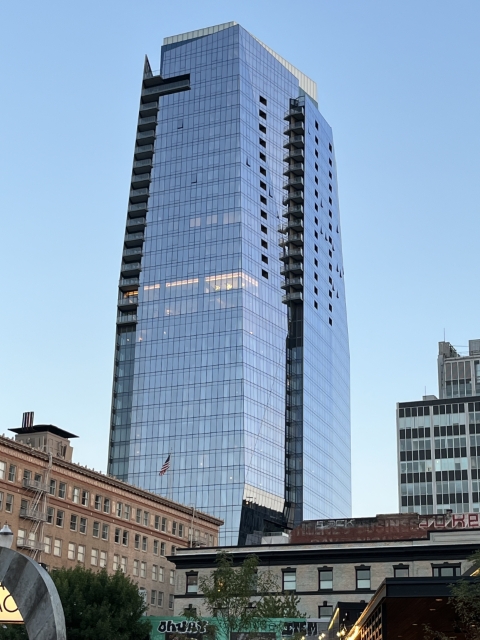
Block 216 tower, home to The Ritz-Carlton, Portland hotel and the Ritz-Carlton Residences condominiums, downtown Portland Oregon
Block 216 (The Ritz-Carlton, Portland hotel and Ritz-Carlton Residences) viewed from West Burnside Street, Portland, Oregon.
Photo: Steven Walling via Wikimedia Commons (CC BY 2.0)

As 2025 draws to a close, Block 216—Portland’s tallest residential tower at 460 feet and 35 stories—stands as a prominent feature of the downtown skyline. Completed in 2023–2024, the mixed-use project includes The Ritz-Carlton, Portland hotel on the lower floors and 132 branded luxury condominiums above, marketed as the Ritz-Carlton Residences, Portland.

Launched with considerable optimism for a post-pandemic downtown revival, the residences were positioned as the pinnacle of urban luxury living—complete with Ritz-Carlton service access, premium finishes, and panoramic views. Original list prices ranged from $850,000 to $7,850,000.

Yet the market response has been markedly different. As of December 31, 2025, only 11 units have closed. The original developer transferred the unsold inventory to the lender via deed in lieu of foreclosure in summer 2025, and Christie’s International Real Estate Evergreen was appointed exclusive brokerage in December 2025, with significant price reductions (starting at 50%) scheduled for January 2026.

This appraisal deep dive examines the project’s sales and listing history through RMLS data, placing it within the broader context of the Portland Downtown condominium market and highlighting key valuation principles brought into sharp relief.

Timeline of Key Developments

  • 2019–2023: Block 216 construction and pre-sales period. Residences marketed under Ritz-Carlton branding license as ultra-luxury product with hotel amenity access.
  • 2024: Tower completion and public launch of condominium sales under LUXE Forbes Global Properties. Phased marketing begins.
  • Late 2023–early 2025: Eleven closings recorded in RMLS, eight of which show 0 days on market (indicative of off-market or exclusive arrangements).
  • Summer 2025: Developer executes deed in lieu of foreclosure, transferring bulk unsold inventory to lender Ready Capital—a project-level transaction, not individual buyer foreclosures. Public records confirm the hotel portions of Block 216 transferred to a lender REO entity in July 2025.
  • December 2025: Christie’s International Real Estate Evergreen appointed exclusive brokerage; major price repositioning announced for January 2026.

The Portland Downtown Condominium Market: A Soft Backdrop

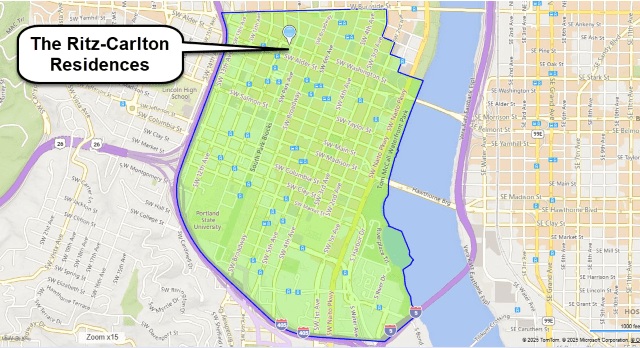
The Ritz-Carlton Residences are located in the City of Portland’s “Portland Downtown” neighborhood—the central area immediately south of the Pearl District, encompassing the West End and cultural district around Pioneer Courthouse Square and the South Park Blocks.

Map of Portland Downtown neighborhood boundary showing location of Block 216 and The Ritz-Carlton Residences Portland
The Ritz-Carlton Residences, Portland (Block 216) within the City of Portland’s “Portland Downtown” neighborhood boundary, immediately south of the Pearl District.
Map via Bing Maps

This area offers exceptional walkability and proximity to cultural institutions, but the condominium market has remained soft for years. From 2022–2025, 482 condominium sales closed in the neighborhood at an average price of $407,358 and $372 per square foot. Units averaged 1,109 square feet in size, with an average year built of 1982 and average monthly HOA fees of $784.

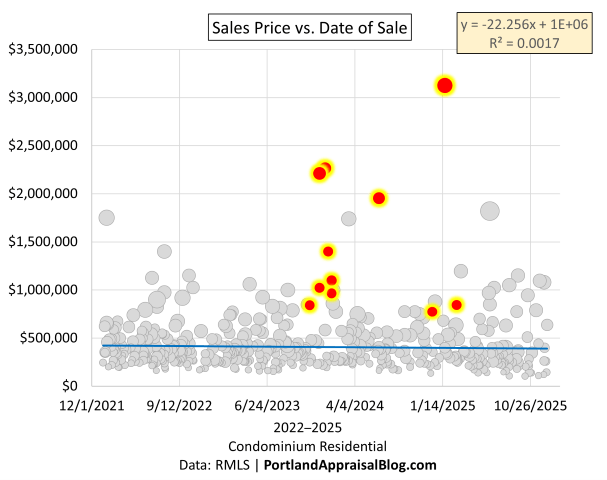
The scatterplot below illustrates the price distribution over time:

Scatterplot showing condominium sales prices over time in Portland Downtown neighborhood with points sized by total square feet and Ritz-Carlton Residences sales highlighted as outliers above the main cluster.
Sales Price vs. Date of Sale for condominiums in Portland’s Downtown neighborhood (2021–2025). All points are sized proportionally by total square feet. Gray dots represent all other sales; colored dots are the 11 closed sales at the Ritz-Carlton Residences, Portland. The Ritz units closed well above the neighborhood norm.

Sales prices have shown remarkable stability—remaining largely in the $200,000–$1.2 million range, with the historical high (prior to Block 216) at $3.065 million from a 2017 transaction. This stagnation reflects persistent oversupply and slow absorption in the urban core.

The table below quantifies the contrast between the neighborhood and the Ritz-Carlton Residences:

MetricPortland Downtown (482 sales)Ritz-Carlton (11 sales)Insight
Avg Close Price$407,358$1,500,364Ritz closed at 3.7× the neighborhood average.
Avg PPSF$372.27$1,052.73Ritz realized 2.8× higher PPSF—still far above neighborhood norm.
SP/OLP %93.29%84.48%Ritz required significantly larger price reductions from original list to close.
Avg Year Built19822023Ritz is brand-new vs. 40+ year-old neighborhood average.
Avg Total SF1,1091,363Ritz units larger on average.
Avg HOA Monthly$784$2,402Ritz HOA 3× higher—significant carrying cost difference.
Avg CDOM11425Skewed by Ritz exclusives; real public marketing time much longer.
Data: RMLS | Portland Appraisal Blog

The Ritz-Carlton Residences: Pricing Premise vs. Market Reality

Of the 132 total residences, 71 distinct units were publicly marketed in phases—full release of floors 21–23 (the “entry-level” tiers) and selective listings on higher floors. These 71 units generated 105 separate listing records in RMLS, with a median of 145 days per active spell and many accumulating 400+ cumulative days across repeated expirations and re-lists.

Only 11 closings were recorded:

  • Average sold price $1,500,364 (average reduction of $274,000 from original list price per unit).
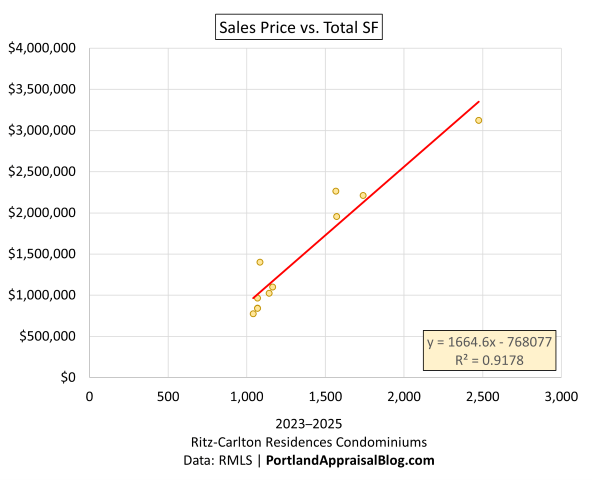
  • Average PPSF $1,053 (marginal trend from regression ~$1,665).

These closings occurred between late 2023 and February 2025, with no additional sales recorded in the remainder of the year.

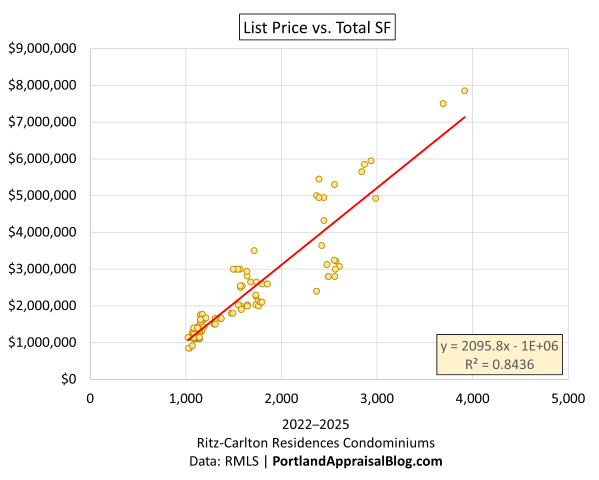
The developer’s original pricing was highly disciplined and size-driven:

Scatterplot of list price versus total square feet for marketed Ritz-Carlton Residences Portland units showing tight linear correlation.
List Price vs. Total Square Feet for the 71 marketed units at the Ritz-Carlton Residences, Portland (2022–2025). Trend implies ~$2,096 per square foot.

The closed sales followed a similar pattern but at a lower level:

Scatterplot of sales price versus total square feet for closed Ritz-Carlton Residences Portland units showing consistent reduction from original pricing premise.
Sales Price vs. Total Square Feet for the 11 closed sales at the Ritz-Carlton Residences, Portland (~$1,665 marginal PPSF trend, average realized $1,053/psf).

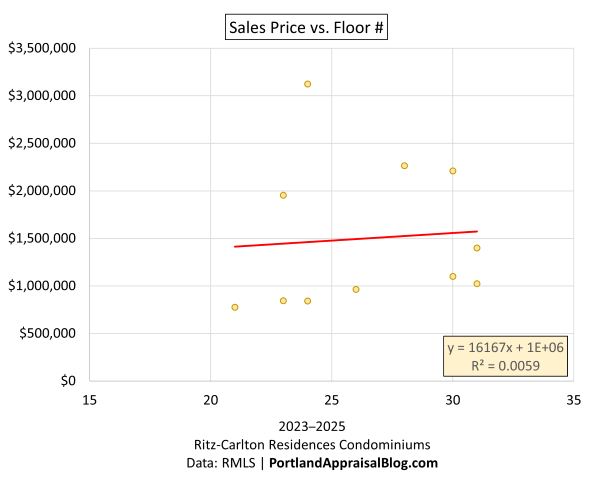
Among the 11 closed sales (primarily on floors 21–31), no discernible premium for higher floors was observed in realized prices:

Scatterplot showing no correlation between sales price and floor level in closed Ritz-Carlton Residences Portland sales.
Sales Price vs. Floor Number for the 11 closed sales at the Ritz-Carlton Residences, Portland (floors 21–31). R² near zero—no contributory value observed for higher floors in current data; upper floors remain unsold.

Notably, eight of the 11 closings showed 0 days on market—likely off-market or exclusive arrangements. The publicly marketed units faced far greater resistance.

The Inclusionary Housing Obligation and Additional External Pressure

Portland’s Inclusionary Housing program requires new residential developments of 20 or more units to either include affordable units or pay a fee-in-lieu. For Block 216, the developer initially proposed 26 on-site affordable units during the entitlement phase but switched to the fee option in 2023.

On-site inclusion proved functionally challenging: even with restricted sale prices, the project’s elevated monthly HOA dues (averaging $2,402 across closed sales) and luxury service model would likely exceed income qualifications for targeted buyers. The calculated fee-in-lieu obligation totaled approximately $7.8 million (base plus interest) and was due December 31, 2025.

Following the summer 2025 deed-in-lieu transfer to lender Ready Capital, uncertainty remains regarding collection of this amount. As of the post date, it is unknown whether the fee has been paid. If unpaid, it would represent an additional external factor appraisers must consider—a financial encumbrance separate from the physical improvements that may influence marketability and value reconciliation for both unsold inventory and existing ownerships.

Appraiser Perspective: The Principle of Conformity and External Obsolescence

The original pricing strategy for the Ritz-Carlton Residences appears to have been calibrated to the Pearl District rather than the property’s actual location in Portland Downtown. The Pearl has demonstrated a proven ceiling around $7 million for top-tier condominiums, as detailed in an earlier Portland Appraisal Blog post analyzing that market over the past decade. In contrast, the highest condominium sale in the Portland Downtown neighborhood prior to Block 216 was $3.065 million in 2017.

By listing units up to $7.85 million, the developer effectively positioned the project outside the neighborhood’s historical range of conformity—a principle of appraisal theory that holds value is maximized when a property aligns with prevailing market expectations in its location. The resulting resistance illustrates how site-specific external factors can override new construction, branding, and amenity premiums.

This pricing strategy mirrors a common challenge appraisers encounter when reviewing sale transactions or proposed listings: comparable sales selected from superior or more established submarkets to support an optimistic value conclusion. The uniform price reductions required on closed sales (average $274,000 reduction from original list price per unit) and prolonged adverse listing history on the unsold inventory further demonstrate concentrated external obsolescence within an already challenged submarket.

Outlook and Implications for Owners and Lenders

The January 2026 price repositioning may improve absorption at levels more aligned with neighborhood norms. However, the influx of discounted intra-building comparable sales could create reconciliation challenges for appraisals of the existing 11 ownerships—particularly the eight early exclusive buyers who closed near original asks.

Lenders and owners of recently purchased units should monitor upcoming sales closely, as distressed marketing conditions on remaining inventory can influence market value indications even for arms-length prior transactions.

For developers and lenders contemplating future high-rise condominium projects in the urban core, the Block 216 experience underscores the importance of grounding pricing premises in location-specific comparable data rather than aspirational benchmarks from adjacent submarkets.

Sources & Further Reading

  • Christie’s International Real Estate Evergreen appointment and price repositioning announcement: Press Release
  • Ready Capital secures ownership via deed in lieu (summer 2025): Investor Relations News
  • KGW coverage of price reductions and brokerage change: Article
  • Willamette Week on lender taking possession: Article
  • Street Roots on inclusionary housing fee and deadline: Article
  • Portland Inclusionary Housing Program overview and requirements: City of Portland
  • Block 216 hotel unit ownership transfer (July 2025): Multnomah County Property Records (search Account P727368)
  • The Portland Pearl District Condo Market – The Last 10 Years (2015–2024): Portland Appraisal Blog

Decorative text divider.

Thanks for reading—I hope you found a useful insight or an unexpected nugget along the way. If you enjoyed the post, please consider subscribing for future updates.

CODA

Are you an agent in Portland who wonders why appraisers always do “x”?

A homeowner with questions about appraiser methodology?

If so, feel free to reach out—I enjoy connecting with market participants across Portland and the surrounding counties, and am always happy to help where I can.

And if you’re in need of appraisal services in Portland or anywhere in the Portland Region, we’d be glad to assist.