
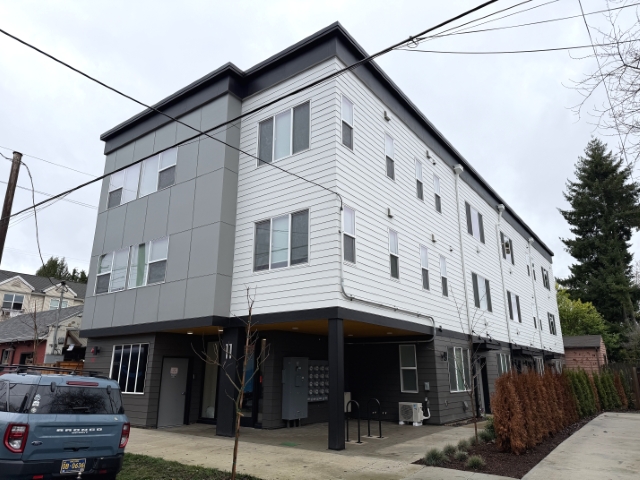
11 NE 55th Ave, Portland, Oregon – December 2025
Photo: Abdur Abdul-Malik, Certified Residential Appraiser
New Statewide Model Zoning Code for Middle Housing
Oregon’s Land Conservation and Development Commission unanimously adopted new rules under the Oregon Housing Needs Analysis (OHNA) framework on December 4, 2025, establishing a statewide model zoning code to accelerate housing production in cities that underperform relative to peers. The amendments build on prior middle housing reforms by moving away from strict unit counts per building toward form-based regulation—controlling height, footprint, lot coverage, and floor area ratios instead.
In practice, the model code re-legalizes neighborhood-scale apartment buildings (typically three to four stories) that have long been prohibited in low-density residential zones. It permits duplexes, triplexes, fourplexes, townhouses, and cottage clusters outright, with bonuses such as additional height or reduced courtyard sizes when projects include accessible units or deeper affordability. Parking requirements are significantly reduced or eliminated for many of these housing types.
Affected cities—primarily Oregon’s larger municipalities, including Portland, Beaverton, Gresham, Hillsboro, and others in the metro area—must align zoning with the model code if they fail to meet production targets, though implementation timelines vary by jurisdiction and can extend several years.
Appraisal Implications
Residential Properties
These rules expand as-of-right development options on residential lots, particularly corner or larger parcels in single-family zones. Highest-and-best-use analyses may now reflect stronger redevelopment potential for small multifamily or middle housing types in cities subject to the model code.
Although the model code removes unit-count caps, form-based limits on height, coverage, and floor area ratio keep development firmly neighborhood-scale—typically supporting 6–12 units on a standard lot, not the higher densities seen in multi-dwelling zones. While larger projects, such as a 16-unit building, are now more feasible, it is important to remember they remain a different undertaking: they involve more complex regulatory review, commercial-grade construction requirements, specialized financing, and contractor expertise that many local rehabbers and small builders are not equipped to handle. Market activity will likely continue to favor rehabilitation of existing homes alongside gradual small-scale infill.
New construction of even single-family homes remains a regular occurrence in Portland despite years of higher density allowances—often with an ADU added. Many builders are primarily set up for that work and not much else. While residential appraisers need to be mindful of what is possible with the new zoning allowances, they must analyze what the market is actually doing.
Income-Producing and Multifamily Properties
Form-based standards and reduced parking mandates lower barriers to feasible small apartment or townhouse projects. Affordability and accessibility bonuses provide quantifiable density incentives that investors can underwrite with greater certainty. Over time, this may broaden comparable selection for emerging middle housing product.
Market Context
The statewide model code aligns with recent local efforts to facilitate missing-middle and infill development. It complements initiatives such as Portland’s easing of code for single-exit four-story apartments and the city’s temporary system development charge exemption for new housing units (2025–2028).
These changes simply remove long-standing barriers to the creation of small-scale apartment buildings in cities that previously had hostile zoning laws for such structures. It does not mean they will sprout on every street, but we may gradually begin to see more of them where it makes economic and market sense.
Sources & Further Reading
- Oregon’s new OHNA model code enabling neighborhood apartments: Sightline Institute analysis
- Full OHNA rules packet and model code details: Oregon DLCD official document
- Portland Eases Code for Single-Exit Four-Story Apartments: PortlandAppraisalBlog
- Portland’s Temporary SDC Exemption for New Housing Units (2025–2028): PortlandAppraisalBlog

Thanks for reading—I hope you found a useful insight or an unexpected nugget along the way. If you enjoyed the post, please consider subscribing for future updates.
CODA
Are you an agent in Portland and wonder why appraisers always do “x”?
A homeowner with questions about appraiser methodology?
If so, feel free to reach out—I enjoy connecting with market participants across Portland and the surrounding counties, and am always happy to help where I can.
And if you’re in need of appraisal services in Portland or anywhere in the Portland Region, we’d be glad to assist.
 Portland Appraisal Blog