Portland Real Estate Appraisal Brief – Thursday, January 8, 2026: Investment Value and Value-in-Use at Willamette Falls — The Tumwata Village Acquisition

The Confederated Tribes of Grand Ronde’s $15.25 million 2019 acquisition of the contaminated former Blue Heron mill site at Willamette Falls exemplifies investment value and value-in-use, enabling a highest and best use shift stalled under prior ownership.

Willamette Falls viewed from the former Blue Heron Paper Mill site in Oregon City, Oregon, showing cascading waters and obsolete industrial structures along the riverfront.
Willamette Falls in full cascade, with the former Blue Heron Paper Mill site in the midground. The dramatic natural setting contrasts sharply with decades of industrial obsolescence on the ~22-acre riverfront parcel.
Photo: Abdur Abdul-Malik, Portland Appraisal Blog (CC BY-SA 4.0)

The former Blue Heron Paper Mill site at Willamette Falls in Oregon City has long exemplified the valuation challenges posed by contaminated industrial brownfields. After the mill’s 2011 closure and subsequent bankruptcy, the ~22-acre riverfront parcel endured years of vacancy, burdened by functional obsolescence, deferred maintenance, and significant environmental liabilities that deterred conventional market participants.

In August 2019, the Confederated Tribes of Grand Ronde acquired the property for a recorded $15.25 million. This transaction stands out for appraisers as a clear illustration of investment value—the worth of a property to a particular purchaser based on individual motivations—and value-in-use, where non-economic factors such as cultural and ancestral significance justify a substantial premium over typical market indicators.
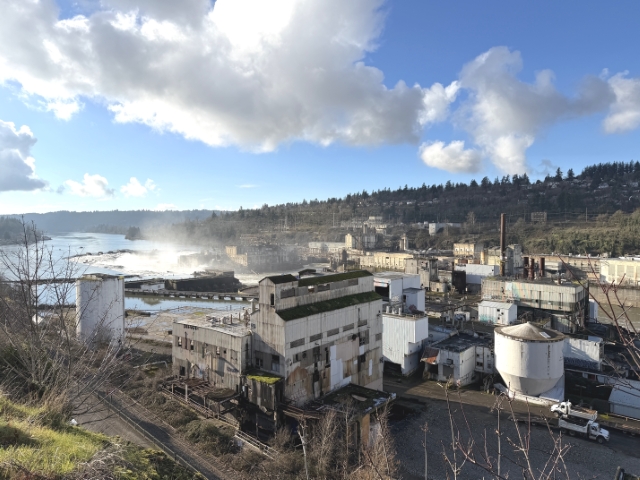
Wide view of the obsolete Blue Heron Paper Mill buildings at Willamette Falls in Oregon City, highlighting industrial decay against the natural river setting.
Panoramic view of the former Blue Heron mill complex along the Willamette River, with falls mist visible on the left. The sprawling structures illustrate extensive functional and external obsolescence following more than a decade of vacancy.
Photo: Abdur Abdul-Malik, Portland Appraisal Blog (CC BY-SA 4.0)

Site History and Market Perception

The property’s ownership and valuation history underscores the stagnation under conventional private ownership:

YearEventRecorded Price / RMV
2000Acquired by Blue Heron Paper Company from Smurfit Newsprint Corp.$2.5 million
2011Mill closure and Chapter 11 bankruptcy filing
2014Bankruptcy court sale to private developer (Falls Legacy LLC)$2.2 million
2018–2019Clackamas County Real Market Value (pre-sale, per contemporaneous reporting)~$2.9 million (improvements minimal)
August 2019Acquired by Confederated Tribes of Grand Ronde$15.25 million
Recent yearsClackamas County Real Market Value (post-acquisition)~$3.6–$4.3 million (land-focused)
2021–2024Phased demolition and remediation (approximately 40% of structures removed by 2024)
RecentOregon City master plan approval (GLUA240002)
Key ownership and valuation milestones for the ~22-acre former Blue Heron mill site, derived from Clackamas County public records and contemporaneous reporting. The lack of nominal appreciation from 2000 to 2014, followed by the substantial premium in 2019, highlights the impact of buyer-specific motivations.
Graffiti-covered rail barrier framing contaminated and obsolete waterfront infrastructure at the former Blue Heron mill site in Oregon City.
Foreground view across derelict waterfront infrastructure at the former Blue Heron site, framed by graffiti-covered rail elements. The image captures visible signs of prolonged obsolescence and inaccessibility.
Photo: Abdur Abdul-Malik, Portland Appraisal Blog (CC BY-SA 4.0)
Close-up of contaminated concrete infrastructure at the former Blue Heron Paper Mill brownfield site near Willamette Falls, Oregon City.
Detailed view of cracked concrete pads and obsolete industrial remnants in the site’s foreground basin area. Such conditions exemplify brownfield liabilities common in post-industrial valuation.
Photo: Abdur Abdul-Malik, Portland Appraisal Blog (CC BY-SA 4.0)

Appraisal Implications—Investment Value and Value-in-Use

The $15.25 million purchase price—nearly seven times the 2014 bankruptcy sale and well above the assessor’s reported Real Market Value immediately preceding the transaction—reflects investment value driven by the Tribe’s profound cultural connection to Willamette Falls, a sacred ancestral homeland and traditional fishing ground. This non-economic value-in-use enabled the Tribe to overcome remediation and holding-cost barriers that had stalled private redevelopment efforts for years.

Appraisers reconciling such sales must distinguish investment value (or value-in-use) from market value derived from arms-length transactions among typical participants. Limited comparable sales for culturally significant or heavily contaminated riverfront parcels often require significant adjustments for buyer motivation, extraordinary assumptions regarding cleanup feasibility, and bracketing with more conventional industrial land comps.

This situation parallels a more recent Portland case explored on this blog: the 1803 Fund’s adaptive reuse plans for historic grain silos along the Willamette River. In both instances, a buyer with specific motivation recognized potential in a functionally obsolete industrial asset that had deterred conventional market participants—ultimately enabling a highest and best use shift through targeted redevelopment.

Close-up of decayed industrial buildings with graffiti and moss at the former Blue Heron site in Oregon City, illustrating functional obsolescence.
Intimate perspective on remaining mill buildings, showing moss-covered roofs, rust, broken windows, and heavy graffiti—clear evidence of functional obsolescence after years of vacancy.
Photo: Abdur Abdul-Malik, Portland Appraisal Blog (CC BY-SA 4.0)

Current Progress and the Tumwata Village Vision

Recent site visits confirm active transformation: demolition equipment, including excavators, is visibly engaged in clearing remaining structures.

Phased demolition began in 2021, with multiple rounds completed by 2024 removing approximately 40% of the former mill buildings. Remediation continues in coordination with state and federal environmental agencies.

A major fire in January 2025 destroyed one of the larger remaining buildings on the site (the former mill’s three-story structure). The incident, ruled arson and unrelated to demolition activities, did not delay the overall redevelopment timeline. Progress has continued steadily, as evidenced by recent infrastructure planning and the current state of the property.

Renamed Tumwata Village, the redevelopment proposes a mixed‑use cultural district that weaves together public access trails, ecological restoration of the riverbank and lagoon, tribal gathering spaces, and a modest mix of commercial and hospitality uses—all grounded in the site’s ancestral significance. By prioritizing riverfront restoration and new trail connections, the plan could open up rare land‑based vantage points of Willamette Falls, a natural landmark that today is mostly viewed from commercial boat tours or distant overlooks. If fully realized, the transformation would support the Confederated Tribes of Grand Ronde in cultural reclamation and long‑term stewardship, while giving Oregon City and the broader public renewed access to a stretch of the falls long closed off by industrial operations.

Oregon City’s recent approval of the master plan (GLUA240002) formalizes this highest and best use shift from interim speculative hold to culturally driven redevelopment.

Readers interested in detailed conceptual plans and site renderings can review the Tribe’s 2022 design report.
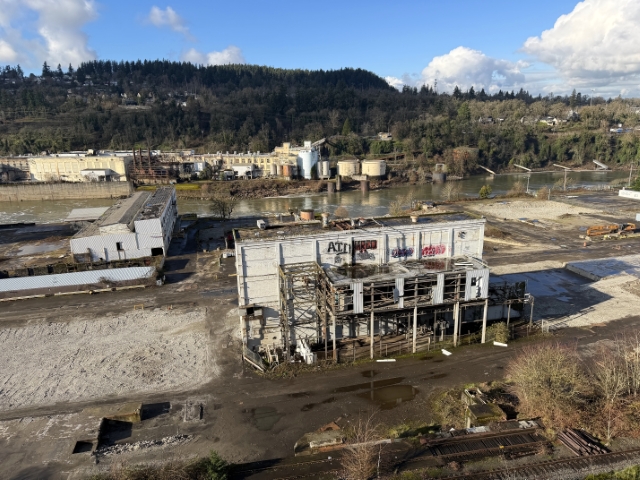
Active demolition and site clearance with excavator at the former Blue Heron mill property in Oregon City, showing progress toward redevelopment.
Mid-demolition scene at the site, with construction equipment including an excavator and partially cleared areas visible. Ongoing remediation phases demonstrate the reversal of obsolescence through active transformation.
Photo: Abdur Abdul-Malik, Portland Appraisal Blog (CC BY-SA 4.0)
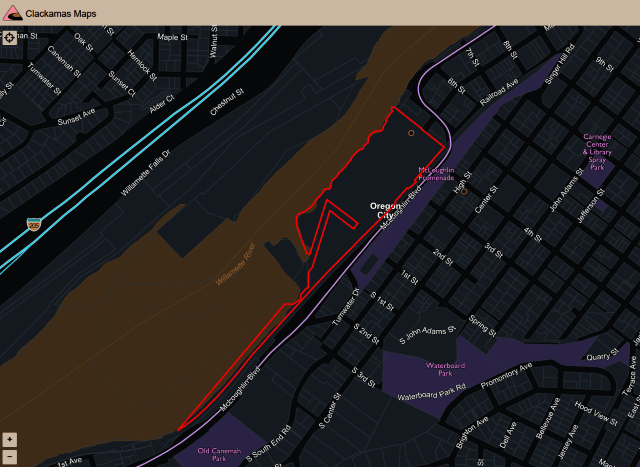
Clackamas County GIS map showing the ~22-acre riverfront parcel of the former Blue Heron Paper Mill site at Willamette Falls in Oregon City.
Clackamas County GIS overview of the ~22-acre former Blue Heron mill site (red outline), illustrating its extensive Willamette River frontage and proximity to the falls. The contiguous parcel configuration supports comprehensive redevelopment potential.
Source: Clackamas County Maps.

Takeaway

The Tumwata Village acquisition serves as a compelling case study in investment value and value-in-use. When a purchaser’s motivations—here rooted in cultural reclamation—align with a property’s unique attributes, transaction prices can far exceed indicators derived from conventional market behavior. Appraisers must remain alert to these distinctions, employing careful reconciliation techniques and appropriate adjustments when comparable data is limited.

Ultimately, the project illustrates how buyer-specific utility can reverse long-standing obsolescence, shifting a site’s highest and best use in ways the open market alone could not achieve. If realized, the vision promises not only tribal stewardship of ancestral lands but also broader public access to one of Oregon’s most iconic natural features—offering land-based and proximate views of Willamette Falls where few currently exist.

Sources & Further Reading

Decorative text divider

Thanks for reading—I hope you found a useful insight or an unexpected nugget along the way. If you enjoyed the post, please consider subscribing for future updates.

CODA

Are you an agent in Portland who wonders why appraisers always do “x”?

A homeowner with questions about appraiser methodology?

If so, feel free to reach out—I enjoy connecting with market participants across Portland and the surrounding counties, and am always happy to help where I can.

And if you’re in need of appraisal services in Portland or anywhere in the Portland Region, we’d be glad to assist.

Portland Real Estate Appraisal Brief – Sunday, December 21, 2025: Barbur Apartments Groundbreaking Highlights Plottage Value

$79M Barbur Apartments groundbreaking in SW Portland, with $27M from the city, illustrates plottage as parcel assemblage enables 150-unit affordable housing in a market area averaging $691,000 for ownership.

Street signs at SW Capitol Hill Rd and SW Barbur Blvd marking the location of the Barbur Apartments affordable housing development in Portland.
The Barbur Apartments site sits at the prominent intersection of SW Barbur Blvd and SW Capitol Hill Rd.
Photo: Portland Appraisal Blog

Barbur Apartments Groundbreaking

Groundbreaking began in mid-December 2025 on the Barbur Apartments, a 150-unit affordable family housing project at the corner of SW Barbur Blvd and SW Capitol Hill Rd in Portland’s Hillsdale/Multnomah Village area.

Developed by Innovative Housing, Inc., the complex will have one three-story building and two four-story buildings, bringing the total unit count to 150. With one unit reserved for an onsite manager, 149 units will be income-restricted, with many configured as larger two- to four-bedroom layouts for immigrant and refugee families—alongside amenities such as a courtyard and community spaces. Completion is anticipated in Fall 2027.

The project has an estimated total development cost of approximately $79.4 million, with the Portland Housing Bureau contributing about $27.3 million alongside regional Metro Housing Bond funds, federal sources, and Portland Clean Energy Community Benefits Fund dollars for energy efficiency.

The project emphasizes transit access along the Barbur corridor. Approved plans include approximately 45 on-site parking spaces—a low ratio of roughly 0.3 spaces per unit that reflects the transit-oriented design.

Appraisal Implications: Plottage and Highest-and-Best-Use Shift

The site’s redevelopment offers a clear illustration of plottage—the added value created when contiguous parcels are assembled into a larger, more viable development parcel.

Four separate tax lots totaling approximately 2.19 acres were acquired together in February 2025 for just under $6 million. Individually, the parcels supported lower-intensity uses limited by size, zoning, and existing improvements.

Annotated Portland Maps aerial showing four assembled tax lots for Barbur Apartments affordable housing project in SW Portland, with labels for demolished home, former commercial building, and nearby Safeway.
Aerial view of the Barbur Apartments site from Portland Maps, showing the four assembled tax lots (outlined in red, totaling approximately 2.19 acres). Labels highlight the demolished single-family home parcel, the former Barbur Blvd Rentals commercial building, and the Safeway shopping center across the street.
Image: Portland Maps

One parcel previously contained a 1927-built single-family home of approximately 2,336 square feet. Never listed on the open market, the house exhibited functional obsolescence relative to the corridor’s evolving highest and best use and was rapidly demolished.

Cleared and fenced parcel at Barbur Apartments site in SW Portland after demolition of 1927-built single-family home.
View of one of the assembled parcels in December 2025. The 1927-built single-family home that once stood here has been fully demolished, illustrating its functional obsolescence as the site shifts to higher-density residential use.
Photo: Portland Appraisal Blog

An adjacent commercial strip—formerly Barbur Blvd Rentals—remains standing but is now fenced within the secured construction zone.

The former Barbur Blvd Rentals commercial building, still standing as of December 2025, forms part of the assemblage.
Photo: Portland Appraisal Blog

Combined, these parcels unlock a scale and density that individual lots could not support, demonstrating classic plottage principles in a transit-oriented location.

Directly across Barbur Blvd, there is a large Safeway complex.

Safeway grocery store and shopping center across SW Barbur Blvd from the Barbur Apartments development in Portland.
The Safeway shopping center opposite the Barbur Apartments site—a major convenience for future residents.
Photo: Portland Appraisal Blog

This Safeway has an impressive open-access parking garage underneath the store. The center’s covered and surface parking serves as a major existing amenity. Given the Barbur Apartments’ family-oriented unit mix and limited on-site stalls, residents and guests may increasingly rely on this convenient private lot for overflow. A recent visit to the garage mid-morning showed a nearly full garage. It’s possible daytime use of the garage may skyrocket once the apartment complex is built—a dynamic worth monitoring as occupancy begins in 2027.

Busy ground-level covered parking under Safeway across from Barbur Apartments site in SW Portland on a typical weekday morning.
Ground-level covered parking beneath the Safeway store, photographed on a Friday morning in December 2025. With only about 45 on-site stalls planned for the 150-unit project, this existing private amenity may see increased use by residents and guests for overflow parking.
Photo: Portland Appraisal Blog

Market Context

In the immediate Hillsdale and Multnomah Village neighborhoods, closed sales from 2024–2025 reflect sustained demand amid limited affordability.

Type# of SalesAvg Close PriceAvg PPSFAvg Total SFAvg CDOM
Detached351$750k$3422,31350 days
Condo78$445k$3211,38268 days
Attached13$581k$3281,84649 days
Total442$691k$3382,13553 days
Source: RMLS closed sales data for Hillsdale and Multnomah Village neighborhoods, 2024–2025. Figures rounded for readability.
Data: RMLS | Portland Appraisal Blog

Detached homes dominated activity with 351 sales at an average of $750,000 and brisk 50-day market times. Condominiums—the most accessible ownership segment by volume—averaged $445,000 across 78 sales, though with noticeably longer absorption (68 days CDOM). While attached homes (such as townhomes) represent a small segment of the market with only 13 transactions, they averaged $581,000—likely reflecting more recent construction (average year built 2010) and associated premiums.

These figures across all segments highlight significant ownership barriers in the submarket, reinforcing the role of regulated rental projects like Barbur Apartments for lower-income and larger families.

This assemblage aligns with broader efforts to expand housing supply through density and public investment, including recent regulatory reforms aimed at reviving Portland development.

Sources & Further Reading

Thanks for reading—I hope you found a useful insight or an unexpected nugget along the way. If you enjoyed the post, please consider subscribing for future updates.

CODA

Are you an agent in Portland who wonders why appraisers always do “x”?

A homeowner with questions about appraiser methodology?

If so, feel free to reach out—I enjoy connecting with market participants across Portland and the surrounding counties, and am always happy to help where I can.

And if you’re in need of appraisal services in Portland or anywhere in the Portland Region, we’d be glad to assist.