Appraisers don’t create the market—we measure it. Much like reporting the weather, our role is to analyze conditions, not control them. Oregon’s new 7‑hour anti‑bias CE requirement reinforces accountability, ensuring appraisal reports remain fair, transparent, and free from unintended influences.
Starting January 1, 2026, every licensed appraiser in Oregon must complete a 7‑hour course on Valuation Bias and Fair Housing Laws and Regulations, followed by at least 4 hours every subsequent two‑year renewal cycle. The mandate (OAR 161‑010‑0010, amended July 2025) does not increase total continuing education hours—Oregon still requires 28 hours per cycle—but carves out dedicated time for bias and fair‑housing training.
The goal is straightforward: strengthen appraisers’ ability to recognize and eliminate unconscious bias in comparable selection, adjustments, and reporting. For homeowners, realtors, attorneys, and lenders in the Portland metro, this means clearer documentation in appraisal reports, making it easier to understand and challenge valuation decisions.
Why This Training Matters for Everyday Appraisals
Bias most often shows up in the judgment calls appraisers make every day—choosing which sales to include or exclude, deciding whether an adjustment is warranted, or how large it should be.
Under USPAP, appraisers are not required to make any specific adjustment. What USPAP does require is that the analysis be credible, adequately supported, clearly explained, and never misleading. It also explicitly prohibits bias of any kind.
This new training reinforces those obligations with practical tools and case studies, so reports become even more transparent and defensible.
Practical Takeaways for Homeowners, Realtors, and Lenders
Expect slightly longer, more detailed appraisal reports starting in 2026—especially around comparable selection and adjustment rationale.
Over‑improved properties (e.g., high‑end renovations in modest subdivisions) will still be adjusted to market evidence, but the reasoning will be spelled out more explicitly.
Rebuttals and reconsideration of value requests should become easier to evaluate because the appraiser’s decision path will be clearer.
Appraisers don’t set market value—we measure it. Clearer documentation simply helps everyone see the measurement process more accurately.
Addressing Common Challenges
One frequent point of tension arises with over‑improved properties. Homeowners may expect comps from upscale areas, but market evidence must guide adjustments. Recent lawsuits have spotlighted these disconnects between owner expectations and data‑driven conclusions, underscoring the need for explicit explanations.
The training won’t alter core appraisal standards, but it will equip appraisers to better articulate their rationale, strengthening rebuttal packages and fostering trust.
The Bigger Picture for Portland Metro Professionals
Again, appraisers don’t create the market—we report it. We are a lot like Al Roker, who reports the weather, not make it! This new requirement promotes accountability, ensuring reports are fair, accurate, and free from unintended influences.
In a region like the Portland metro, where diverse neighborhoods drive varied valuation dynamics, clearer processes benefit everyone involved in transactions. For those who’ve navigated over‑improvement appraisals, the added transparency could smooth future interactions. Sharing experiences helps refine practices across the industry.
For current market context on inventory and pricing trends affecting comp selection in the Portland region, see our Q3 2025 Market Update.
Thanks for reading—I hope you found a useful insight or an unexpected nugget along the way. If you enjoyed the post, please consider subscribing for future updates.
Question: Do you think the new training requirement will have a material impact on valuation disputes?
CODA
Are you an agent in Portland and wonder why appraisers always do “x”?
A homeowner with questions about appraisal contingencies, comp selection, or reconsiderations of value?
If so, feel free to reach out—I enjoy connecting with market participants across Portland and the surrounding counties, and am always happy to help where I can.
And if you’re in need of appraisal services in Portland or anywhere in the Portland Region, we’d be glad to assist.
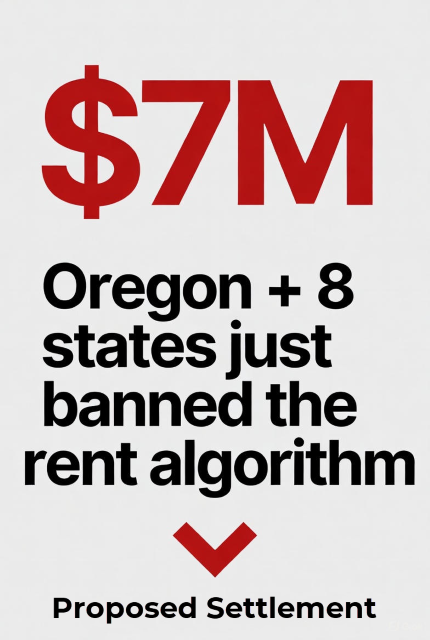
Oregon and eight other states filed a proposed $7M settlement with Greystar, affecting ~19,000 Portland apartments. Appraisers and buyers are watching for 2026 rent softening and cap rate shifts.
A coalition of nine states led by Oregon and California has filed a proposed $7 million settlement with Greystar Management Services — the nation’s largest rental housing operator — over allegations that Greystar used RealPage software to illegally coordinate rent pricing across competing properties.
The settlement, if approved by a federal court, would permanently bar Greystar from sharing non-public rent and occupancy data with competitors and from using RealPage’s hyper-local pricing recommendations. A separate DOJ consent decree filed against RealPage itself imposes similar behavioral restrictions and a three-year independent monitor.
Greystar manages approximately 19,000 apartment units in the Portland metro area — roughly 10 % of the region’s multifamily inventory. State investigators have estimated that RealPage-enabled pricing affected roughly one in five multifamily units statewide.
For homeowners, buyers, agents, and lenders, the most immediate question is whether these enforcement actions will translate into meaningful rent relief in 2026 and beyond.
The Direct Impact on Purchasing Power
A renter currently paying a $200 “algorithm premium” (the difference between market rent and coordinated rent loses $2,400 annually that could otherwise go toward a down payment.
Even a modest 5–8 % softening in rents after these settlements would return $110–$176 per month to the typical household, equating to $4,000–$10,600 in additional savings over three to five years.
What Appraisers Are Watching in 2026
Cap rate movement on institutional-grade (50+ unit) apartment buildings
Total scheduled gross revenue trends at properties previously managed with revenue-management software
If rents soften and risk premiums rise, cap rates will widen first on larger assets. That pressure eventually flows through to gross rent multipliers (GRMs) on 1–4 unit residential income properties — either compressing GRMs if sale prices adjust faster than rents, or temporarily expanding them if prices lag.
We likely won’t see clear signals until mid-2026, but the direction of travel will matter for every appraisal involving the income approach in the region.
Bottom Line
Combined with new multifamily supply now entering the pipeline, these twin enforcement actions represent the strongest downward pressure on algorithmic rent growth Portland has seen since the pandemic began.
Sources & Further Reading
Beaverton Valley Times coverage of the Greystar settlement
For broader quarterly context on inventory, pricing, and market segmentation trends in the Portland region, see our most recent Q3 2025 Market Update.
Thanks for reading—I hope you found a useful insight or an unexpected nugget along the way. If you enjoyed the post, please consider subscribing for future updates.
Question: Do you think we’ll see any meaningful slowdown in rent increases in the Portland area?
CODA
Are you an agent in Portland and wonder why appraisers always do “x”?
A homeowner with questions about appraisal contingencies, GRMs, or valuation delays?
If so, feel free to reach out—I enjoy connecting with market participants across Portland and the surrounding counties, and am always happy to help where I can.
And if you’re in need of appraisal services in Portland or anywhere in the Portland Region, we’d be glad to assist.
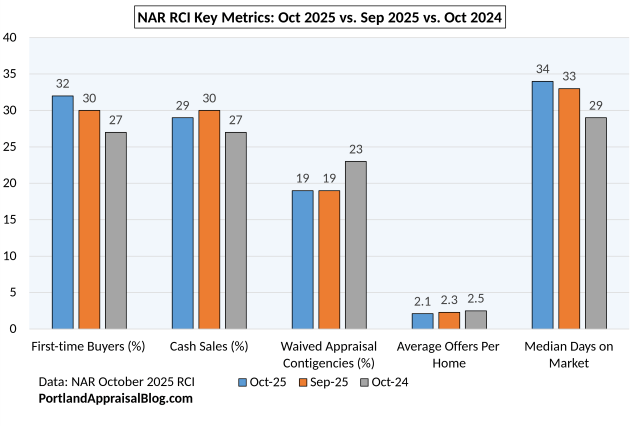
NAR October 2025 RCI: First-time buyers at 32%, DOM at 34 days, and 19% waived appraisals in Portland metro. Insights for realtors and homeowners on comp stability and market shifts.
The National Association of REALTORS® (NAR) has released its October 2025 REALTORS® Confidence Index (RCI), revealing a market with subtle shifts that Portland metro real estate professionals should monitor closely. First-time buyers climbed to 32% of transactions, supported by growing inventory and modestly lower rates, though overall confidence dipped—with only 17% of REALTORS® expecting year-over-year buyer traffic increases in the next three months, and 16% for sellers. Cash sales remained steady at 29%, while homes received an average of 2.1 offers, and 19% sold above list price.
For appraisers in the Portland area, these trends suggest more stable comparable sales (comps), but they also highlight persistent risks from contingencies, with 19% of buyers waiving appraisals and 6% of delayed settlements linked to valuation issues. This creates opportunities for thorough, defensible reports that address local market segmentation.
The RCI: A National Pulse with Local Relevance
The RCI draws from a survey of approximately 1,800 REALTORS® conducted November 1–16, 2025, focusing on buyer and seller activity, financing, contingencies, and sentiment. Unlike local MLS data such as RMLS, which tracks completed transactions, the RCI captures forward-looking expectations. In the Portland metro, including Vancouver, WA, combining these insights ensures appraisals reflect both anticipated trends and on-the-ground realities, particularly in cross-border markets.
Key Market Indicators Shaping Appraisals
October’s data points to a gradual easing:
Median Days on Market (DOM): 34 days (up from 33 in September 2025 and 29 in October 2024).
First-Time Buyers: 32% of transactions (up from 30% in September 2025 and 27% in October 2024), signaling stronger entry-level demand.
Cash Sales: 29% (down slightly from 30% in September 2025, up from 27% in October 2024).
Distressed Sales: 2% (unchanged from prior months).
While days on market are up year over year, the time homes are spending on market is not excessive. There is a bit more time for negotiations. I go into detail about rising days on market in my Portland Region Q3 2025 Market Update.
Buyer Shifts and Contingency Considerations
Buyers are navigating a slightly less competitive landscape, which influences appraisal timelines and risks:
20% waived inspection contingencies (flat from September 2025).
19% waived appraisal contingencies (flat from September 2025, down from 23% in October 2024)—a trend that eases renegotiation pressures for Portland appraisers.
5% completed purchases via virtual tours only (unchanged).
82% of purchases occurred in suburban, small town, rural, or resort areas (down from 87% in September 2025).
In Multnomah County and Vancouver, WA, this suburban preference reshapes comp pools, emphasizing the need for carefully defined competitive areas—location matters!
Seller Dynamics: Fewer Offers, More Scrutiny
Sellers are adjusting to softer demand, with implications for pricing and close processes:
Average offers per home: 2.1 (down from 2.3 in September 2025 and 2.5 in October 2024).
19% sold above list price (down from 21% in September 2025, flat from October 2024).
2% sold to iBuyers (up from 1% in September 2025).
Median time to close: 30 days (unchanged).
7% of contracts terminated (up from 6% in September 2025).
14% experienced delayed settlements (unchanged).
For realtors and lenders in the Portland metro, rising terminations underscore the importance of appraisals backed by solid, verifiable comps. As I detailed in my Portland Region Q3 2025 Market Update, the sales price to original list price ratio has been declining.
Outlook: Tempered Optimism and Suburban Focus
REALTOR® confidence softened amid these changes:
17% anticipate buyer traffic growth year over year in the next three months (down from 20% in September 2025).
16% expect seller traffic increases (down from 19% in September 2025).
29% of buyers prioritized work-from-home features (down from 34% in September 2025).
This aligns with the Portland Region’s ongoing suburban migration, impacting comp selection in Clackamas and Washington Counties. Homeowners and attorneys preparing for transactions should carefully read reports to verify they incorporate these broader sentiment shifts.
Implications for Portland Metro Valuations
The RCI’s blend of buyer gains and fading enthusiasm points to a transitional market: enhanced first-time activity promotes equitable pricing, but elevated terminations (7%) reveal gaps in expectations. For further details, explore the full report here, the main RCI page, or the existing-home sales tie-in. See also my Portland Region Q3 2025 Market Update.
Thanks for reading—I hope you found a useful insight or an unexpected nugget along the way. If you enjoyed the post, please consider subscribing for future updates.
Question: Do you think lower mortgage rates will propel the market to new heights?
CODA
Are you an agent in Portland or Clackamas County and wonder why appraisers always do “x”?
A homeowner in Lake Oswego with questions about appraisal contingencies or valuation delays?
If so, feel free to reach out—I enjoy connecting with market participants across Portland and the surrounding counties, and am always happy to help where I can.
And if you’re in need of appraisal services in Portland or Clackamas County, we’d be glad to assist.
The year 2025 is rapidly yielding to 2026. In the blink of an eye, we’ll be more than halfway through this decade and sliding toward the 2030s! With that in mind, let’s examine how the single-family detached home market performed in Q3 2025 (July through September). The data reveals a market split in two—one stable, one shifting—lending itself to a Dickensian interpretation of A Tale of Two Markets.
DATA HOUSEKEEPING
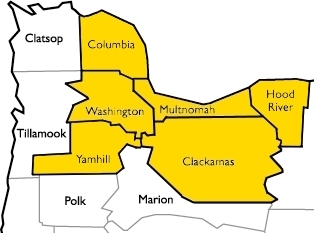
Let’s define the Portland Region as the following six counties: Columbia, Clackamas, Hood River, Multnomah, Washington, and Yamhill. These counties are either contiguous with Multnomah (Portland’s home county) or closely tied to its housing ecosystem.
All data in this post reflects open-market sales—properties listed in RMLS, the primary multiple listing service for the Portland Region. The dataset was cleaned using custom tools developed by the blog author to correct misclassifications and remove non-representative entries (e.g., land or condo sales mistakenly listed as single-family).
Importantly, SNL (“Sold Not Listed”) entries—off-market transactions later entered into RMLS—have been excluded to maintain consistency and transparency.
Before diving into the Q3 2025 market data, here’s a quick overview of the major sections covered in this post. Each county-level breakdown is linked below for easy navigation, along with the regional summary that sets the stage:
The Portland Region’s single-family detached market in Q3 2025 showed signs of quiet resilience. While headlines focused on interest rates and builder pullbacks, the overall market held steady across most metrics:
📊 Key Highlights
Total Sales Volume: Up slightly from $3.21B to $3.24B (+1.08%)—a modest gain that reflects stable demand despite macro headwinds.
Average Price: Rose 0.54% to $692,778, while median price held flat at $600,000—suggesting price discipline and a balanced mix of sales.
SP/OLP Ratio: Dropped from 97.77% to 96.94%—buyers negotiated slightly more, but sellers still held firm.
DOM (Days on Market): Increased 13.25% to nearly 52 days—buyers are taking longer to commit, especially in higher price tiers.
Average PPSF: Virtually unchanged at $322—indicating stable valuation per square foot across the region.
Lot Size & Age: Average lot size grew slightly (+1.61%), while average age of homes increased by 3.43%—a subtle shift toward older inventory.
New Construction: Fell 25%—a sharp decline that reflects builder caution and financing constraints.
Distressed Sales: REOs ticked up slightly (+3.45%), while short sales declined—still a negligible share of the market.
🧭 Appraisal Insight
Despite longer exposure times and a notable drop in new construction, the Portland Region’s single-family market in Q3 2025 continues to behave like a stabilized asset class. Pricing remains anchored to fundamentals—location, size, and condition—rather than speculation or distress.
The flat median price and steady price-per-square-foot suggest that buyers and sellers are still operating within a shared valuation framework. In other words, the market hasn’t lost its pricing logic.
While exposure time isn’t generally a selection criterion for appraisers, it’s a signal—one that reflects buyer confidence, seller patience, and the pace of negotiation. In a market like this, it’s not volatility that drives value shifts—it’s nuance.
🏘️ A Tale of Two Markets: Core vs. Luxury in Q3 2025
Beneath the surface of Portland’s stabilized housing market lies a quiet divergence, one that’s been building over the past year. The aggregate metrics may suggest balance, but when you split the market by price tier, a more nuanced story emerges.
🏠 Core Market (< $1M)
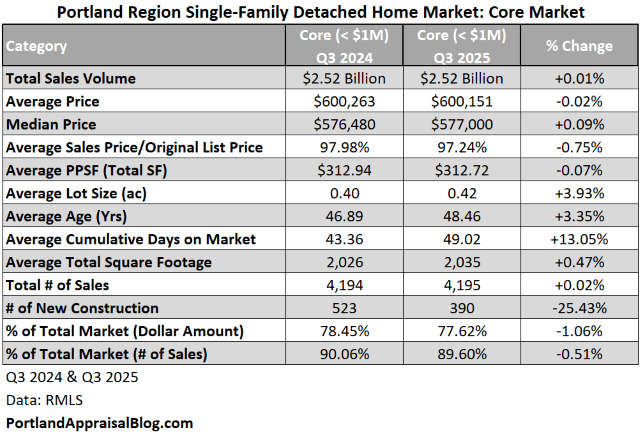
The core market, which accounts for nearly 90% of all sales, remained remarkably steady in Q3 2025. Median price nudged up slightly, and average price dipped by a fraction, suggesting a high volume of mid-range transactions with tight pricing discipline. Buyers in this segment are cautious but active, and sellers are adjusting expectations without capitulating.
SP/OLP Ratio: Down just 0.75%—still strong at 97.24%
DOM: Up from ~43 to ~49 days—slower pace, but not sluggish
New Construction: Down 25%—a notable retreat, especially in Washington and Clackamas counties
The core market is behaving like a durable middle class—resilient, price-aware, and responsive to financing conditions.
🏠 Luxury Market (≥ $1M)
Before diving into the luxury segment, a quick note on definitions: For this analysis, we’re defining “luxury” as any sale at or above $1 million. It’s a useful threshold for tracking market behavior, but it’s not a perfect proxy for architectural prestige or lifestyle appeal.
Some acreage properties cross the $1 million mark based on land value alone, even if the homes themselves wouldn’t be considered luxurious in terms of design or finish. And it’s true, $1 million doesn’t hold the same purchasing power it once did. Today, it might afford a modest home in a sought-after area or a larger property with dated features in a more remote location.
This segmentation allows us to observe buyer psychology, pricing trends, and listing exposure time across different tiers. It’s a tool for analysis, not a judgment of quality or taste.
The luxury segment tells a different story. While total sales volume rose a little more than 5%, average price dipped slightly and exposure time jumped from ~69 to ~77 days. Buyers at the top end are more deliberate, and sellers are conceding more ground.
SP/OLP Ratio: Dropped 1.56% to 94.37%—a wider negotiation gap
PPSF: Down nearly 0.9%—suggesting softer valuation per square foot
New Construction: Fell 20%—from 45 to 36 units. Builders are pulling back, and luxury inventory is increasingly composed of legacy stock.
Lot Size & Age: Slightly smaller lots and older homes—less new inventory, more carryover from prior cycles
The luxury market remains active but is undergoing a period of careful assessment. Buyers are selective, and sellers are adjusting their strategies. This segment is characterized by patience, not panic.
Let’s dive into the Portland Region with some visuals before we examine each county individually.
SALES VOLUME
The following is a treemap of sales volume in the Portland Region for Q3 2025. Each block represents a county, scaled by its share of total transactions—not dollar volume:
In Q3 2025, the Portland Region’s housing activity was overwhelmingly concentrated in three counties: Multnomah, Washington, and Clackamas. Together, they accounted for over 91% of all single-family home sales, forming the backbone of the regional market.
Multnomah: Led in transaction count, driven by dense housing stock and steady turnover
Washington: Showed strong suburban demand and a mix of core and upper-tier activity
Clackamas: Balanced volume with price diversity, including notable luxury sales
The remaining counties—Yamhill, Columbia, and Hood River—played supporting roles, with smaller volumes and more rural dynamics.
This bar chart compares monthly single-family sales across Q3 2024 and Q3 2025. While July and August saw slight year-over-year declines, September posted a modest rebound, rising from 1,339 to 1,450 sales.:
Note: The y-axis starts at 1,000 to allow better examination of monthly differences.
SALES PRICE
This bar chart compares monthly average sales prices for single-family homes in the Portland Region across Q3 2024 and Q3 2025. The story it tells is one of stability with subtle movement:
Note: The y-axis starts at $660,000 to allow better examination of monthly differences.
July: $688K → $690K
August: $688K → $699K
September: $691K → $689K
While monthly average prices nudged up and down across the quarter, the net result is a tiny bump of just 0.54% year-over-year. That’s not volatility—it’s equilibrium.
NEW CONSTRUCTION
This chart shows how new construction sales fit into the broader single-family market across Q3 2025. While total monthly sales hovered between 1,450 and 1,635 units, new construction consistently made up a small fraction of that activity:
July: 145 new builds out of 1,635 total sales (~8.9%)
August: 159 out of 1,597 (~10%)
September: 122 out of 1,450 (~8.4%)
New construction represented roughly 9% of all single-family sales in Q3 2025. That’s a modest but meaningful slice—enough to influence comps and buyer expectations, but not dominant. Most buyers were engaging with resale inventory, and most appraisals will reflect that reality.
This chart compares new construction sales across the individual counties in Q3 2024 vs. Q3 2025. The trend is clear: new builds are down almost everywhere:
Washington County: Down from 280 to 245 sales—still the leader, but pulling back
Clackamas County: Dropped from 127 to 114—modest decline, but still active
Multnomah County: Fell sharply from 91 to 47—nearly a 50% reduction
Yamhill County: Down from 67 to just 18—builder activity nearly stalled
Columbia County: Slipped from 3 to 2 sales—still minimal, but not absent
Hood River County: Zero new construction sales in Q3 2025 (same as last year)
Builder retreat is widespread, but not absolute. Even Columbia managed a couple of closings. The broader trend, however, is clear: new construction is shrinking, and resale inventory is doing the heavy lifting.
CUMULATIVE DAYS ON MARKET
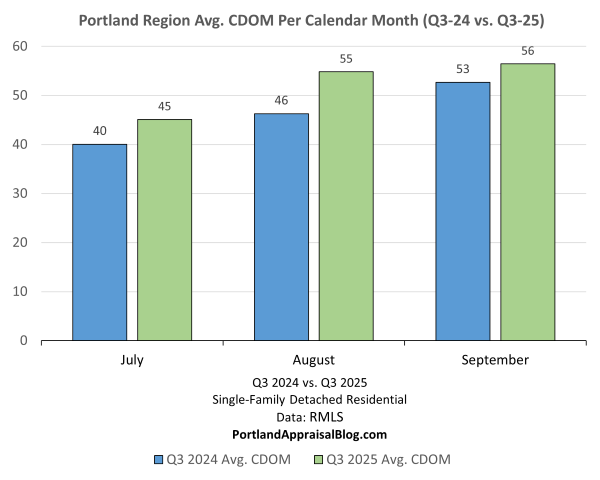
This chart tracks average Cumulative Days on Market (CDOM) for single-family homes in the Portland Region across July, August, and September—comparing Q3 2024 to Q3 2025. The trend is subtle but consistent, homes are taking slightly longer to sell:
July: 40 → 45 days
August: 46 → 55 days
September: 53 → 56 days
The sales cycle is stretching, but not stalling. A 5–6 day increase per month suggests buyers are more deliberate, and sellers are adjusting expectations. This isn’t a freeze—it’s a pause. For appraisers, longer CDOM doesn’t disqualify comps, but it does signal a shift in market tempo worth noting in commentary.
MISC STATS
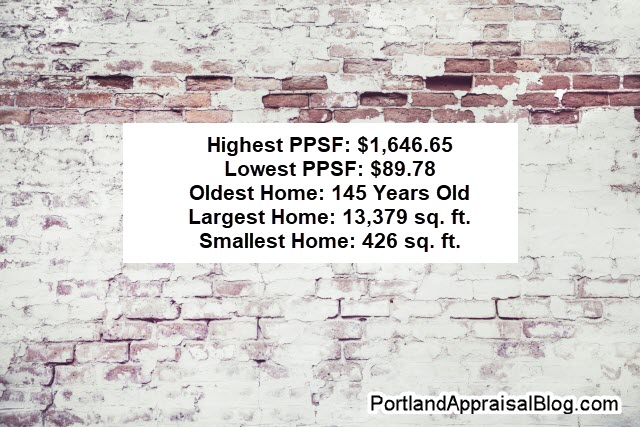
Before concluding our overview of the Portland Region as a whole, let’s look at some miscellaneous stats:
The crown for highest price per square foot in the Portland Region during Q3 2025—at $1,646.65/SF—belongs to a lakefront property on Oswego Lake. The home sold for $8,500,000, spans 5,162 sq. ft., and includes four bedrooms, six full bathrooms, and one half bath on a 0.26-acre lot. Photos of the property are currently available online and may be viewed here.
The lowest price per square foot was a fixer in Willamina, Oregon (Yamhill County). This 119-year-old home measures 2,005 sq. ft. on a 0.12-acre lot. Photos of the property are currently available online and may be viewed here.
The oldest home to sell in Q3 2025 was a 145-year-old residence in Portland’s Homestead neighborhood. It features three bedrooms, one-and-a-half bathrooms, and is 1,608 sq. ft. Photos of the property are currently available online and may be viewed here.
The largest home sold during Q3 2025 was a sprawling 13,379 sq. ft. estate in West Linn, Oregon, set on 20.18 acres beside the Oregon Golf Club. The home itself was massive—but even more impressive, it came with a shop building that was larger than the house. The property sold for $6,500,000 after 299 days on market. An exterior photo of the property may be viewed here.
The smallest home to sell was a 426 sq. ft. cabin in Scappoose, Oregon, nestled on 1.4 acres. Photos of the cozy property are currently available online and may be viewed here.
Let’s wrap up this post with a quick look at the six individual counties that make up the Portland Region. We’ll examine them in order of largest to smallest number of sales.
Multnomah County Q3 2025 Stats
Multnomah County contains most of the City of Portland. (Very tiny portions of the City of Portland are located in Clackamas and Washington counties.) The following table summarizes important metrics for Multnomah County:
Multnomah County posted 1,768 single-family sales in Q3 2025, up slightly from 1,719 the year prior. Total sales volume rose to $1.13 billion, a 3.9% increase year-over-year. The average sales price nudged up to $637K, while the median price settled at $555K. Key trends:
CDOM increased from 40 to 45 days, signaling a slightly slower sales rhythm.
Average lot sizes shrank, down 7.2%, reflecting tighter urban parcels.
New construction dropped sharply, from 91 to just 47 sales—a 48% decline.
The core market (< $1M) remained dominant, accounting for 91% of sales and 81% of dollar volume. Prices were flat, with the average holding at $564K, and CDOM rising from 37 to 42 days.
The luxury market (≥ $1M) grew in volume, with 159 sales (up 14%) and $218 million in total sales (up 13%). Despite the growth, the average price dipped slightly to $1.37 million, down about $100,000 from the prior year. CDOM edged up to 79 days, roughly two days longer than in Q3 2024.
Luxury homes also came with significantly larger lots. In Q3 2025, the average lot size for luxury properties was about 0.75 acres, compared to 0.23 acres for homes in the core market segment.
Washington County Q3 2025 Stats
Washington County contains many properties with a Portland address that are outside official city limits and are under county control. The following table summarizes important metrics for Washington County:
Washington County recorded 1,349 single-family sales in Q3 2025, down slightly from 1,395 the year prior. Total sales volume fell 6.3% to $924 million, and the average price declined to $685K, down about $22K from Q3 2024.
CDOM jumped from 43 to 54 days—a notable slowdown in buyer urgency.
Average lot size shrank by over 34%, reflecting denser development patterns.
New construction dipped from 280 to 245 sales, but still represents a major share of activity.
Despite the dip in volume, Washington County remains a hub for new builds. The following map highlights active clusters:
In the core market (< $1M), Q3 2025 saw 1,254 sales, down slightly from 1,270 in Q3 2024. Total sales volume fell to $797 million, down from $819 million the year prior. The average price slipped to $636K, about $9K lower than Q3 2024. CDOM rose from 43 to 54 days, and average lot size tightened from 0.26 to 0.23 acres.
The luxury market (≥ $1M) contracted more sharply. Q3 2025 recorded 95 sales, down from 125 in Q3 2024, with total volume falling to $127 million, compared to $167 million last year—a 24% drop. The average price held steady at $1.33M, but CDOM rose significantly, from 47 to 61 days. Lot sizes also dropped, from 3.5 acres to 2.1 acres, suggesting fewer estate-style properties and more high-end infill.
Clackamas County Q3 2025 Stats
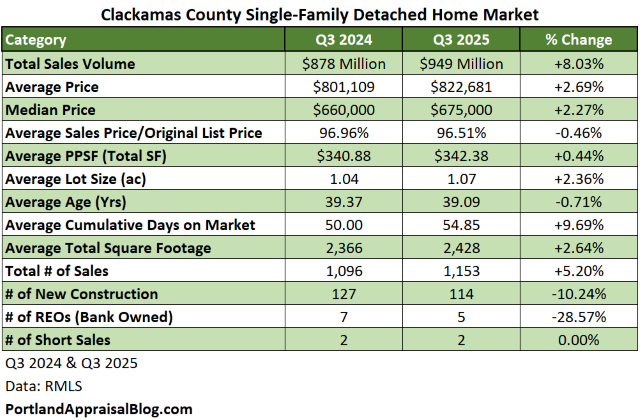
Clackamas County, while comprised of some urban cities, has many rural portions and houses on acreage lots. Commercial and hobby farming is common throughout the county. The following table summarizes important metrics for Clackamas County:
Clackamas County posted 1,153 single-family sales in Q3 2025, up from 1,096 in Q3 2024. Total sales volume rose 8% to $949 million, and the average price increased to $823K, up about $22K year-over-year.
CDOM rose from 50 to 55 days, indicating a modest slowdown in buyer urgency.
Average total square footage increased by 2.6%, suggesting a slight shift toward larger homes.
New construction declined, with 114 sales, down about 10% from the 127 recorded in Q3 2024.
In the core market (< $1M), Q3 2025 saw 954 sales, up from 919 in Q3 2024. Total volume rose to $613 million, compared to $578 million the year prior. The average price increased 2.2% to $642K, and CDOM rose from 46 to 51 days.
The luxury market (≥ $1M) also expanded. Q3 2025 recorded 199 sales, up from 177 in Q3 2024, with total volume reaching $336 million, up from $300 million. The average price dipped slightly to $1.69M, and CDOM held steady at around 72 days.
Yamhill County Q3 2025 Stats
Yamhill County is known for its wineries and other agricultural products. The following table summarizes important metrics for Yamhill County:
Yamhill County recorded 248 single-family sales in Q3 2025, down from 298 in Q3 2024. Total sales volume fell 15% to $151 million, though the average price rose slightly to $607K, up about $10K year-over-year.
CDOM held steady, dipping slightly from 68 to 66.5 days.
Average PPSF increased by 1.7%, reaching $311/SF.
New construction dropped sharply, with just 18 sales, down from 67 last year.
In the core market (< $1M), Q3 2025 saw 226 sales, down from 279 in Q3 2024. Total volume fell to $120 million, compared to $151 million the year prior. The average price declined to $530K, a 2% dip from Q3 2024, and median price dropped from $510K to $481K.
The luxury market (≥ $1M) grew modestly in volume but softened in pricing. Q3 2025 recorded 22 sales, up from 19 in Q3 2024, with total volume rising to $30.7 million, up from $27.5 million. However, the average price fell to $1.40M, down from $1.45M the year prior—a 3.5% decline. The median price rose slightly, from $1.23M to $1.24M, but CDOM surged from 111 to 182 days, suggesting longer marketing times and slower absorption for high-end listings.
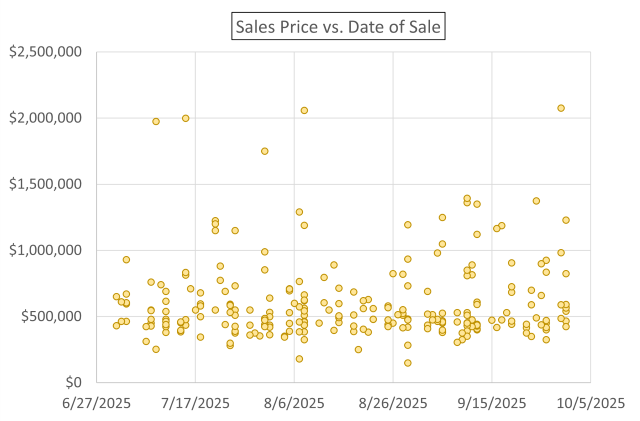
The following is a visual snapshot of the Yamhill market:
Each yellow dot represents a closed sale. While most transactions clustered below the $800K mark, a few high-end sales pushed past $2 million, underscoring the county’s growing luxury presence—even as overall volume declined.
Columbia County Q3 2025 Stats
While this county is 688 square miles it only has a population of approximately 54,000 people. The county is known for timber and wood products. The following table summarizes important metrics for Columbia County:
Columbia County recorded 128 single-family sales in Q3 2025, up from 114 in Q3 2024. Total sales volume rose 10.8% to $63 million, even as the average price dipped slightly to $492K, down about $7K year-over-year.
Average PPSF jumped 10.6%, reaching $293/SF—a notable gain for a rural market.
CDOM held steady, rising just one day to 63.
New construction remained minimal, with just 2 sales, down from 3 last year.
In the core market (< $1M), Q3 2025 saw 127 sales, up from 114 in Q3 2024. Total volume rose to $61.9 million, up from $56.9 million. The average price declined to $487K, a 2.3% dip, and median price slipped from $474K to $470K.
The luxury market (≥ $1M) made a rare appearance. Q3 2025 included one sale at $1.13 million, marking a shift from zero luxury closings in Q3 2024. The home sold at 94% of its original list price, with a lot size over 4 acres and 3,297 sq. ft. of living area.
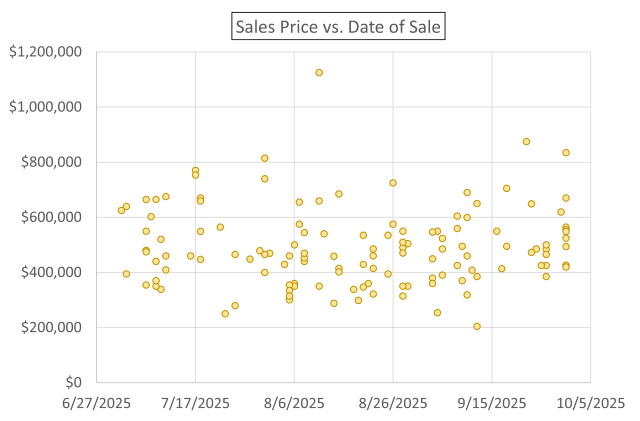
The following is a visual snapshot of the Columbia market:
Each yellow dot represents a closed sale. Most transactions clustered below the $600K mark, with a single outlier crossing the $1 million threshold—Columbia’s lone luxury sale for the quarter.
Hood River County Q3 2025 Stats
Hood River is the second smallest county in Oregon by area at 533 square miles. The population is estimated to be about 24,000 people. This county is known for its fruit products and outdoor recreational activities.
Hood River County recorded 36 single-family sales in Q3 2025, up a single sale from Q3 2024. Total sales volume rose 24% to $31.2 million, driven by a surge in high-end activity. The average price jumped to $867K, up 20.6% year-over-year.
Average PPSF rose 7.2%, reaching $426/SF.
CDOM increased from 47 to 59 days, reflecting slower absorption.
Average home size expanded by 16%, now over 2,140 sq. ft. on average.
In the core market (< $1M), Q3 2025 saw 25 sales, down from 32 in Q3 2024. Total volume fell to $17.2 million, compared to $20.9 million the year prior. The average price rose to $689K, a 5.4% increase, while median price dipped slightly from $685K to $675K.
The luxury market (≥ $1M) surged. Q3 2025 recorded 11 sales, up from just 3 in Q3 2024, with total volume tripling to $14 million, up from $4.23 million. Despite the volume spike, the average price declined to $1.27M, down from $1.42M last year. Median price also fell, from $1.36M to $1.13M, and CDOM ballooned from 20 to 74 days, suggesting slower turnover despite increased activity.
The following is a visual snapshot of the Hood River market:
Each purple dot represents a closed sale. Most transactions clustered below $1.5 million, with a single outlier near $2 million in mid-July—highlighting the county’s expanding but volatile luxury tier.
That completes our look at the Portland Region Q3 2025 single-family market!
Thanks for reading—I hope you found a useful insight or an unexpected nugget along the way. If you enjoyed the post, please consider subscribing for future updates.
Question: Do you think Q4 2025 will follow the same trajectory, or will it outperform Q4 2024?
CODA
Are you an agent and wonder why appraisers always do “x”?
A homeowner with questions about appraisal terminology or methodology?
If so, feel free to reach out—I enjoy connecting with market participants and am always happy to help where I can.
And if you’re in need of appraisal services, we’d be glad to assist.
Are you an agent in Portland who wonders why appraisers always do “x”?
A homeowner with questions about appraiser methodology?
If so, feel free to reach out—I enjoy connecting with market participants across Portland and the surrounding counties, and am always happy to help where I can.
And if you’re in need of appraisal services in Portland or anywhere in the Portland Region, we’d be glad to assist.


















 Portland Appraisal Blog