Portland Real Estate Appraisal Brief – Sunday, December 7, 2025: Affordable Housing Paradox – 1,863 Vacant Units Amid Record Need

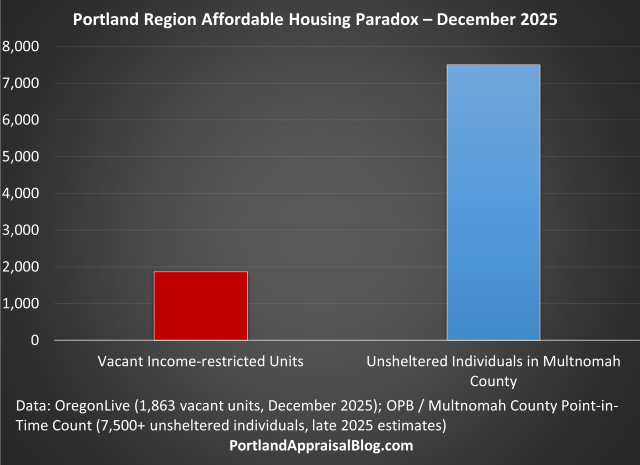
Portland’s inclusionary zoning is producing units, but 1,863 income-restricted apartments remain vacant amid funding cuts and administrative delays—creating measurable valuation risk for residential and multifamily professionals.

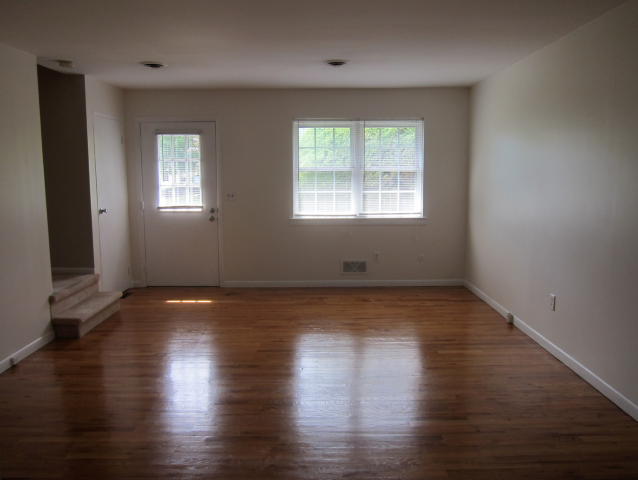
Empty interior of a newly completed or income-restricted apartment unit in the Portland metro area, illustrating persistent vacancies in affordable housing relevant to real estate appraisal and valuation.
Empty interior of an income-restricted apartment unit in Portland, symbolizing the region’s persistent vacancies in affordable housing programs
Via Canva Pro

Policy Wins Collide With Activation Barriers

Portland’s affordable housing programs are delivering a classic paradox: policy mechanisms are finally producing new income-restricted units, yet nearly 1,900 completed apartments—representing a 7.4% vacancy rate across the region’s 25,409 subsidized units—sit empty while homelessness continues to climb.

The city’s inclusionary zoning program, which requires or incentivizes developers to reserve a portion of new units for households earning 60% or less of area median income (AMI)—where the FY 2025 median family income for a 4-person household in the Portland-Vancouver-Hillsboro OR-WA MSA is $124,100—has shown measurable improvement in actual unit production after years of refinement. This is a hard-won policy success in a market that has long struggled to integrate affordability into private development.

These gains, however, are being undermined by systemic activation challenges. Home Forward, Multnomah County’s primary administrator of subsidized housing and the Housing Choice Voucher (Section 8) program, faces a $35 million budget shortfall that includes a $14 million cut in federal voucher funding. The agency has paused new voucher issuances, eliminated at least 12 positions, and extended waitlists that already see roughly seven applications for every opening.

Providers cite a combination of administrative delays, rising operational costs, higher post-pandemic eviction rates, and narrowing rent gaps (42% of metro units are now within 10% of market rent) as the main drivers of prolonged vacancies. As Reach Community Development’s executive director noted, “even affordable rents are too high” for many eligible households without deeper subsidies.

Mayor Keith Wilson has explicitly linked these activation failures to the region’s homelessness crisis. Although 890 of a targeted 1,500 new low-barrier shelter beds are now open, many operate at just over 50% occupancy—compared with 87% at existing 24-hour shelters—because permanent housing remains the preferred exit. With more than 7,500 individuals unsheltered in Multnomah County (up over 1,000 since January 2025) and monthly inflows of ~1,400 people outpacing permanent placements of ~1,100, the region continues to see a net increase in homelessness.

Appraisal Implications

These activation failures translate directly into valuation and underwriting risk for professionals across the Portland metro area.

Residential Properties

Inclusionary zoning covenants create deed-restricted comparables that must be segregated from market-rate sales. As the program matures, appraisers in Multnomah, Clackamas, Washington, Columbia, Yamhill, and Clark counties will see a growing volume of these restricted transactions, especially in newer condominium and mixed-use projects—though the highest concentration remains within the City of Portland’s jurisdiction in Multnomah County. With the Q3 2025 median price for detached single-family homes in the region at approximately $600,000—as noted in our Q3 2025 Portland region market update—the gap between market-rate ownership and income-restricted pricing remains stark.

Multifamily and Investment Properties

The 1,863 vacant income-restricted units create an immediate drag on potential gross income and stabilized net operating income (NOI). Projects financed through Low-Income Housing Tax Credits (LIHTC) or subject to inclusionary requirements now face extended lease-up periods—often months rather than weeks—due to public-agency bottlenecks. Recent FHFA increases to 2026 multifamily loan purchase caps may encourage new supply, but activation risks remain a key variable.

Appraisers using the income approach should give heightened scrutiny to:

  • Absorption timelines (extend beyond market-rate norms)
  • Vacancy allowances (increase for policy-induced vacancy)
  • Capitalization rates (higher risk typically justifies higher cap rates)

Lenders and investors underwriting affordable or mixed-income developments must incorporate longer stabilization horizons and potential LIHTC compliance risks into their models.

Market Context

When finished apartments remain offline, the housing-homelessness pipeline stalls, forcing greater reliance on temporary shelter systems even as permanent supply begins to grow.

Bar graph. Data: OregonLive (1,863 vacant units, December 2025); OPB / Multnomah County Point-in-Time Count (7,500+ unsheltered individuals, late 2025 estimates)

Resolving this paradox will require targeted investment in administrative capacity and deeper subsidy layers to match completed units with the households who need them most.

Sources & Further Reading

Decorative text divider

Thanks for reading—I hope you found a useful insight or an unexpected nugget along the way. If you enjoyed the post, please consider subscribing for future updates.

CODA

Are you an agent in Portland and wonder why appraisers always do “x”?

A homeowner with questions about appraiser methodology?

If so, feel free to reach out—I enjoy connecting with market participants across Portland and the surrounding counties, and am always happy to help where I can.

And if you’re in need of appraisal services in Portland or anywhere in the Portland Region, we’d be glad to assist.
Portland Real Estate Appraisal Brief – Saturday, December 6, 2025: Portland Eases Code for Single-Exit Four-Story Apartments

Portland’s code now allows single-exit stairwell apartments, raising the maximum unit count on infill lots and posing a compliance challenge for Portland Certified Residential Appraisers.

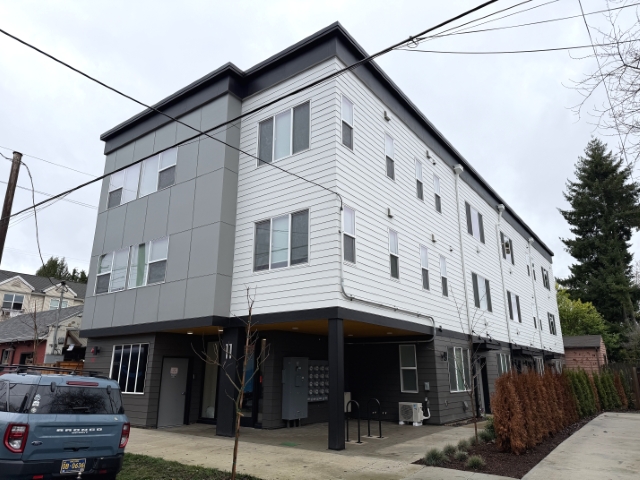
New three-story, 16-unit multifamily on 5,000 sq ft CM2 lot at 11 NE 55th Ave, Portland, exemplifying H&BU shifts in RM1/RM2 transitional zones post-single-exit stairwell guidelines.
Three-story, 16-unit apartment building on a 5,000 sq ft lot—an early example of the infill density now fully achievable in Portland’s RM1 and RM2 zones under current zoning and the 2025 single-exit stairwell provisions
11 NE 55th Ave, Portland, Oregon – December 2025
Photo: Abdur Abdul-Malik, Certified Residential Appraiser

Easing Regulatory Barriers to Mid-Rise Infill

The City of Portland’s Bureau of Development Services, in coordination with Portland Fire & Rescue, approved a final Building Code Guide (BCG 25–10) on October 22, 2025, that permits single-exit stairwells in certain apartment buildings up to four stories in height. This guide implements a provision already adopted within the 2025 Oregon Structural Specialty Code (OSSC), removing a significant regulatory barrier that often rendered mid-rise infill housing financially and physically impractical on constrained urban lots throughout the Portland metro area.

This code clarification aligns Portland with the practices of progressive code adopters, including Seattle and various international jurisdictions, which have successfully and safely utilized single-stair designs for decades. The change is particularly relevant for infill sites—common in Portland’s established neighborhoods—where lot width or depth previously made the mandatory two-stairwell design economically unfeasible.

The economic advantage is substantial: traditional two-stair designs can consume 13–16% of the total floor area for circulation (stairs and hallways). A single-stair “point access block” can reduce circulation space to as little as 6.5% of the floor area, effectively converting otherwise unusable common space into leasable or saleable residential square footage. The push to allow this type of construction illuminates the entangled intersection between safety, housing affordability, and building codes at a national level. This efficiency boost is key to making medium-density projects feasible in high-cost urban environments. The new allowance is expected to have a greater impact on Multi-Dwelling (RM) zones than on the R2.5–R20 zones, where unit counts are generally capped at six.

Appraisal Implications for Real Estate Valuation

The finalization of single-exit guidelines has direct implications for certified residential appraisers (CRs), lenders, and real estate professionals in the Portland region.

Multifamily Development and the CR 4-Unit Limit

The new guideline creates a direct compliance challenge for CRs. CRs are restricted to appraising residential properties containing four or fewer units.

The 16-unit apartment building at 11 NE 55th Ave provides a perfect case study: it is constructed on a 5,000 sq. ft. lot, which is a standard lot size for Portland. While this specific site is zoned CM2 (Commercial Mixed Use 2), it is a very common setup in transitional zones like RM1 or RM2 and makes for a warning of the complexities residential appraisers will now face on an increasing number of sites throughout the City of Portland. A comprehensive and thorough highest and best use analysis (H&BU) will be even more paramount for CRs going forward.

The Land Sale vs. Home Sale Trap (The H&BU Pitfall):

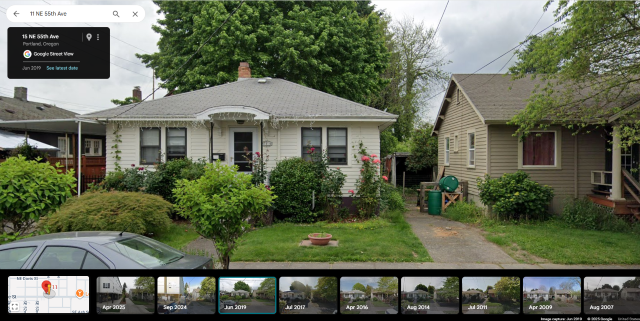
Here is what existed on the site prior:

Former single-family home at 11 NE 55th Ave in Portland’s CM2 zone, demolished to make way for a four-story, 16-unit apartment building on a 5,000 sq ft lot. Google Street View – circa 2021.
Single-family residence formerly at 11 NE 55th Ave (CM2 zone) prior to demolition and redevelopment into 16-unit multifamily
Portland, Oregon – circa 2019 (Google Street View archive)
Photo: Google Street View (public domain)

Note the home to the right of the subject. That neighboring home has RM2 zoning and still exists to this day. For the sake of illustration, let’s pretend the subject itself was located in the same RM2 zone. (The problem would also exist if it were in the RM1 zone.) I have always been wary of appraising properties in RM1 and RM2 zones due to the potential of unit density exceeding my license scope. However, in some select areas, a careful highest and best use analysis shows four units or less is still the market preference, or perhaps the only options feasible. Constructing an apartment building like the subject in an RM1 or RM2 zone was more difficult prior to the recent zoning change. A residential appraiser viewing the subject’s original home could easily come to the conclusion that the H&BU is still residential, as that conforms to the next door property. However, the financial data proves the site’s H&BU shifted long ago:

  1. Negative Value: The original house effectively had negative value, as the developer purchased the site for $650,000 in early 2024, intending only to demolish the structure and build up.
  2. Land Value: The $650,000 purchase price was solely a land sale based on the potential to build high density—a potential maximized by the single-stair allowance.
  3. The New H&BU: The resulting 16-unit asset, listed at over $3.3 million, confirms the H&BU is a multifamily property that requires a Certified General (CG) Appraiser.
Aerial view of cleared 5,000-square-foot lot at 11 NE 55th Ave, Portland, Oregon, in 2025, after demolition of former single-family home and prior to construction of three-story, 16-unit apartment building enabled by Portland’s 2025 single-exit stairwell guidelines
Vacant 5,000 sq. ft. lot at 11 NE 55th Ave following demolition, awaiting construction of new three-story apartment building
Portland, Oregon – 2025 (Google Earth aerial)
Imagery ©2025 Google, Map data ©2025
  • Pro Forma Income: Because the building is new and actively offering rental concessions (e.g., free rent) to tenants, the listing’s financial figures are projected (pro forma). It has a Projected Gross Annual Income of $256,005 and a Pro Forma Cap Rate of 5.17%—financial metrics based on achieving full market rents and directly tied to the single-stair design’s efficiency. Appraising such a property requires a lease-up analysis and would necessitate a Certified General Appraiser to determine both the As-Is and As-Stabilized values.
  • Risk Area (RM1 & RM2): The greatest risk for CRs lies in Transitional Multi-Dwelling zones (like RM1 or RM2). These zones can get complicated quickly, and the single-stair allowance now pushes the practical development cap far beyond the CR’s 4-unit limit, even on small parcels.
  • Required Due Diligence: CRs must perform careful due diligence when analyzing the H&BU of transitional or infill parcels. If the H&BU conclusion is a multi-unit property exceeding four units, the assignment falls outside the scope of a CR license, and the assignment must be transferred to a Certified General Appraiser.

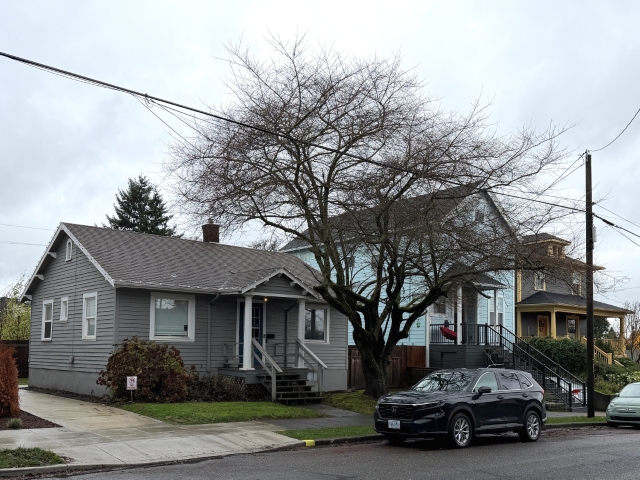
This apartment building on the street (made possible by the single-stair allowance) has now greatly complicated any future appraisals for the adjacent home. The adjacent home sits on a lot the same size (5,000 sq. ft.).

Single-family home on 5,000 sq ft RM2-zoned lot immediately adjacent to new three-story, 16-unit multifamily building at 11 NE 55th Ave, Portland — illustrating highest-and-best-use risk for Certified Residential appraisers in transitional RM1/RM2 zones, December 2025
Adjacent single-family home on a matching 5,000 sq ft lot zoned RM2—identical in size to the 11 NE 55th Ave site now redeveloped with a three-story, 16-unit apartment building
NE 55th Ave (North Tabor), Portland, Oregon – December 2025
Photo: Abdur Abdul-Malik, Certified Residential Appraiser

An appraisal on this home would now need to take into account the potential to remove the dwelling and place a 16-unit apartment building on the site. The apartment building next door, even though in a different zoning, proved that such a structure is physically possible on a 5,000 sq. ft. lot. Now, with the zoning law change, such a structure is also much more likely to be greenlit following a formal review by the planning department. Even if all the structures on this street were residential homes, a CR can no longer assume four units or less is the H&BU if the zoning is RM1 or RM2.

Density Rules Every Portland Appraiser Needs Tattooed on Their Forearm

In most of Portland’s multi-dwelling zones (RM1–RM4 and RX) there is no maximum density—only minimums. The City’s own table spells it out clearly:

ZoneMaximum DensityMinimum Density (base)
RM1None1 unit per 2,500 sf
RM2None1 unit per 1,450 sf
RM3None1 unit per 1,000 sf
RM4None1 unit per 1,000 sf
RXNone1 unit per 500 sf
RMP1 per 1,500 sf (bonus to 1 per 1,000 sf)1 per 1,875 sf
Source: City of Portland Bureau of Development Services – Density and Lot Dimensions in Multi-Dwelling Zones (09/27/2024)

On a typical 5,000 sq ft lot with no overlays:

  • RM1 → minimum 2 units, no upper limit
  • RM2 → minimum 3–4 units, no upper limit

Highest-and-Best-Use Reality Check for Certified Residential Appraisers

Unless a site in RM1, RM2, RM3, RM4, or RX has obvious, insurmountable physical or regulatory constraints (steep topography, protected trees requiring preservation, environmental overlay zones, landslide hazard, historic designation, or similar), a credible H&BU analysis can no longer conclude that single-family, duplex, triplex, or fourplex development is the concluded use without first testing a multifamily pro forma that likely exceeds four units.

Doing so risks an incomplete analysis and, more critically, completing a valuation that falls outside the Certified Residential license scope.

Appraisers: be careful!

Land Value and Investment Properties

The zoning change also directly affects land value and the as-completed project feasibility by allowing for a more efficient and profitable building design. This local regulatory shift also aligns with supporting federal policy, such as the Federal Housing Finance Agency (FHFA) increasing the combined volume cap for Fannie Mae and Freddie Mac’s multifamily loan purchases to $176 billion for 2026.

Market Context

Portland continues to grapple with a housing shortage, making any code modification that reduces hard construction barriers on infill parcels a necessary and impactful step. The North Tabor neighborhood where this property is located is appealing for investors, characterized by an urban-suburban mix and a high proportion of renters. This demographic composition and investor demand underscores the high asking price for turnkey rental assets like the new construction apartment building in our case study.

For lenders, realtors, estate planners, and attorneys, it is crucial to recognize that the appraisal of these new single-stair buildings will require a deep understanding of the regulatory context. Appraisers must accurately reflect the specific size, unit count, and advanced fire-safety features required by the Building Code Guide 25–10 to ensure a credible valuation and appropriate comparable selection.

Sources & Further Reading

Thanks for reading—I hope you found a useful insight or an unexpected nugget along the way. If you enjoyed the post, please consider subscribing for future updates.

CODA

Are you an agent in Portland and wonder why appraisers always do “x”?

A homeowner, lawyer, or estate planner with questions about appraiser methodology?

If so, feel free to reach out—I enjoy connecting with market participants across Portland and the surrounding counties, and am always happy to help where I can.

And if you’re in need of appraisal services in Portland or anywhere in the Portland Region, we’d be glad to assist.

Portland Real Estate Appraisal Brief – Friday, December 5, 2025: FHFA Raises 2026 Multifamily Loan Purchase Caps

The FHFA raised the 2026 multifamily loan purchase caps for Fannie Mae and Freddie Mac to $176 billion, a move that supports financing and affects property valuations in the Portland metro area.

Contemporary mid-rise multifamily apartment building in the Portland, Oregon metro area, relevant to FHFA’s 2026 $176 billion combined Fannie Mae/Freddie Mac loan purchase caps.
Modern multifamily building in Portland
Stock photo via Canva Pro

FHFA Announces $176 Billion in 2026 Multifamily Loan Purchase Caps

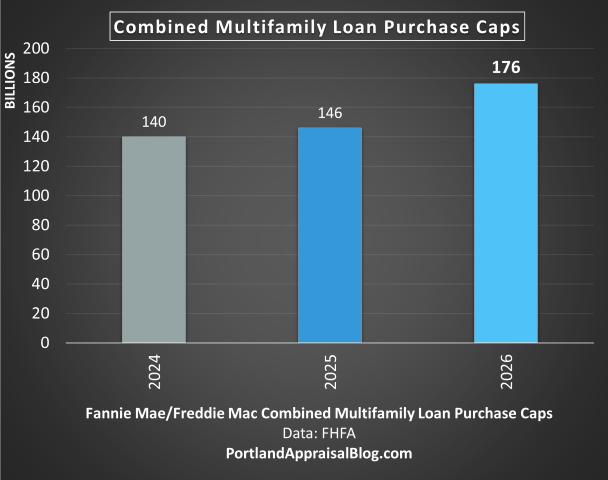
The Federal Housing Finance Agency (FHFA), regulator of Fannie Mae and Freddie Mac (the Enterprises), has set the annual multifamily loan purchase caps for 2026 at $88 billion for each Enterprise, resulting in a combined total of $176 billion in financing capacity. This figure represents a robust increase of more than 20% from the $73 billion cap per Enterprise in 2025. The expanded capacity is intended to maintain liquidity in the multifamily market, especially as lending activity is projected to stabilize and as older loans mature, requiring refinancing.

For perspective, the combined cap was $140 billion in 2024 ($70 billion each) and $146 billion in 2025 ($73 billion each). The nearly $30 billion increase between 2025 and 2026 is a strong signal of anticipated market strength.

The FHFA confirmed that the caps are a floor, not a ceiling. FHFA Director William J. Pulte stated the agency will monitor lending activity throughout the year and has the discretion to increase the caps further if warranted by market conditions, but will not reduce them—a policy designed to prevent disruption in rental housing finance.

Crucially, the mission-driven focus remains a key mandate: at least 50% of the Enterprises’ multifamily loan purchases must qualify as mission-driven affordable housing.

Bar chart showing combined Fannie Mae and Freddie Mac multifamily loan purchase caps increasing from $140 billion in 2024 to $176 billion in 2026, relevant to Portland metro residential and small multifamily property valuations.
FHFA multifamily loan purchase caps for Fannie Mae and Freddie Mac
Data: FHFA | Chart: PortlandAppraisalBlog.com

Mission-Driven Focus and Exemptions

The FHFA has maintained specific provisions to support underserved segments of the market:

  • Workforce Housing Exemption: Loans financing workforce housing—properties with rent or income restrictions for at least 10 years or the loan term, typically targeting tenants earning 80% to 120% of area median income (AMI)—are exempt from the volume caps and count fully toward the mission-driven threshold if at least 20% of units meet affordability criteria.
  • Affordability Requirements: The mission-driven criteria also include properties with regulatory agreements (e.g., Low-Income Housing Tax Credit/LIHTC), those in rural areas, and financing for small-scale affordable units in high-cost or cost-burdened markets. The FHFA has also recently complemented these purchase limits by doubling the annual LIHTC investment cap to $2 billion per Enterprise, which could accelerate multifamily construction starts in 2026.

This commitment to affordability ensures that a substantial portion of the capital is directed toward maintaining and increasing the supply of rental housing for lower- and moderate-income residents, a critical need nationwide and across the Portland region.

Appraisal and Valuation Implications for the Portland Region

The increased national lending capacity for multifamily properties has subtle yet important implications for certified residential and commercial appraisers, as well as the homeowners, lenders, and investors they serve across the Portland–Vancouver metro area.

Residential Properties (1–4 Units)

For residential stakeholders, the robust federal support for multifamily lending indirectly influences the single-family market. By increasing the capital flow for new and existing rental properties, the FHFA action helps stabilize the rental supply, which in turn can ease demand pressure that might otherwise shift to single-family inventory in high-demand areas.

In Oregon and Washington counties, including Multnomah, Washington, and Clark, this broader stability aids in appraising the smaller, 2–4 unit residential income properties often financed through conventional Fannie Mae/Freddie Mac channels. Appraisers should note that in the income approach, the assurance of strong capital markets for rental housing—particularly those properties meeting workforce housing needs—provides a stabilizing factor for Gross Rent Multipliers (GRMs) and capitalization rates used in valuation. This financing stability offers a necessary counterbalance to the volatility introduced by local regulations, such as Oregon’s statewide rent increase limits (set at 9.5% for 2026) and Portland’s mandatory relocation assistance policies (triggered by a 10% rent increase or higher). Crucially, the 9.5% state cap means the state maximum increase does not automatically trigger the significant financial liability of relocation assistance within Portland city limits.

Commercial / Multifamily (5+ Units)

For the commercial and investment real estate segment, which includes properties with five or more units, the increased $176 billion cap is a clear positive. It reinforces the Enterprises as a reliable, deep source of capital in the Portland–Vancouver corridor, where investment sales have been concentrated in Vancouver, Milwaukie, and Hillsboro/Beaverton submarkets.

Appraisers valuing these assets should incorporate the following:

  • Cap Rate Stability: The strong financing capacity acts as a floor, limiting upward pressure on capitalization rates that might otherwise result from tighter credit conditions.
  • Workforce Housing Marketability: The explicit cap exemption for workforce housing loans is highly relevant. Appraisers must consider a property’s potential eligibility for this favorable financing when assessing its highest and best use and marketability, especially in submarkets facing high rent growth or in communities like those in Cowlitz and Skamania counties where mission-driven initiatives promote long-term affordability.
  • Market Context: The assurance of this funding stream is timely, as the Portland metro multifamily market currently faces an elevated vacancy rate (ranging from approximately 5.5% to 7.5%, with higher rates for luxury Class A units) due to a wave of recent new deliveries. However, the pipeline is slowing significantly (new construction starts down over 50%), suggesting this capital will be available precisely as the market rebalances and conditions tighten.

Market Context

The FHFA’s decision to increase the combined cap to $176 billion is broadly supported by industry groups like the Mortgage Bankers Association (MBA) and the National Association of Home Builders (NAHB). This federal framework is expected to bolster the long-term rental stability that is crucial for the Portland metro area. The increased lending capacity comes at a pivotal time, mitigating the risk of a future housing shortage that could result from the current dramatic slowdown in new development across the region. The decision aligns the national financial framework with the local market’s need for capital, particularly for mission-driven and workforce housing, which remains a consistent demand factor for appraisers to consider.

Sources & Further Reading

Thanks for reading—I hope you found a useful insight or an unexpected nugget along the way. If you enjoyed the post, please consider subscribing for future updates.

CODA

Are you an agent in Portland and wonder why appraisers always do “x”?

A homeowner, lawyer, or estate planner with questions about appraiser methodology?

If so, feel free to reach out—I enjoy connecting with market participants across Portland and the surrounding counties, and am always happy to help where I can.

And if you’re in need of appraisal services in Portland or anywhere in the Portland Region, we’d be glad to assist.
Appraisal Video Short: Portland Housing Market Q3 2025

Portland metro single-family market—Q3 2025 in under 60 seconds:

→ Full Q3 2025 market report

CODA

Are you an agent in Portland and wonder why appraisers always do “x”?

A homeowner with questions about appraiser methodology?

If so, feel free to reach out—I enjoy connecting with market participants across Portland and the surrounding counties, and am always happy to help where I can.

And if you’re in need of appraisal services in Portland or anywhere in the Portland Region, we’d be glad to assist.

The 2024 Portland Region Manufactured Housing Market in Review

Manufactured homes on owned land in the Portland Region posted modest gains in 2024 amid tight supply. This review covers sales volume, pricing adjustments, and key valuation factors unique to this segment.

Photo by Jimmy Woo
Via Unsplash

We are wrapping up our annual reviews of the various housing segments in the Portland, Oregon region with a consideration of manufactured homes. We will restrict our attention to manufactured homes permanently affixed to land that is also owned by the same party. This means we are excluding classic mobile home parks where the owner of the mobile home must pay a lease/lot rental fee.

If you missed the previous annual reviews covering single-family detached homes, condominiums, and attached homes, you may click this link.

Let’s define the Portland Region as the following six counties: Columbia, Clackamas, Hood River, Multnomah, Washington, and Yamhill—essentially all counties contiguous with Portland’s home county of Multnomah, plus Yamhill.

Image of Portland Region counties.

DATA HOUSEKEEPING

The information in this post will be based on properties that sold on the open market, defined as listed in RMLS, the primary multiple listing service for the Portland Region. The data was parsed with tools created by the blog author to weed out/correct, among other things, listing errors and misclassifications (e.g. manufactured homes hiding in other categories, such as the detached category). RMLS has a listing category, SNL, Sold Not Listed, that allows agents to put properties that were sold off market into the database. Those properties have been excluded from the following analyses.

WHAT IS A MANUFACTURED HOME?

Images via Wikimedia Commons: Image 1; Image 2

The U.S. Department of Housing and Urban Development provides the following definition and conditions for FHA mortgage insurance:

Manufactured Housing is a Structure that is transportable in one or more sections.

To be eligible for FHA mortgage insurance as a Single Family Title II Mortgage, all Manufactured Housing must:
• be designed as a one-family dwelling;
• have a floor area of not less than 400 square feet;
• have the HUD Certification Label affixed or have obtained a letter of label verification issued on behalf of HUD, evidencing the house was constructed on or after June 15, 1976, in compliance with the Federal Manufactured Home Construction and Safety Standards;
• be classified as real estate (but need not be treated as real estate for purposes of state taxation);
• be built and remain on a permanent chassis;
• be designed to be used as a dwelling with a permanent foundation built in accordance with the Permanent Foundations Guide for Manufactured Housing (PFGMH); and
• have been directly transported from the manufacturer or the dealership to the site.

The definition comes from the HUD manual (4000.1) and helps to differentiate manufactured homes from other type of prefabricated housing, such as modular homes or tiny homes. Fannie Mae essentially follows the HUD definition. Once a manufactured home is brought to the site, they state in their Selling Guide:

The towing hitch, wheels, and axles must be removed. The dwelling must assume the characteristics of site-built housing.

The manufactured home must be attached to a permanent foundation system in accordance with the manufacturer’s requirements for anchoring, support, stability, and maintenance.

The foundation system must be appropriate for the soil conditions for the site and meet local and state codes.

The manufactured home must be permanently connected to a septic tank or sewage system, and to other utilities in accordance with local and state requirements.

Manufactured homes are built in a factory and must meet the minimum guidelines established by HUD. While modular homes are also built in a factory in sections, they are not meant to movable beyond the initial transportation from the factory and have their final construction and assembly at the site and are placed on a permanent foundation. Modular homes have more stringent guidelines and building codes and are more expensive as a result.

Tiny homes, are just that, tiny. They usually don’t meet the minimum square footage requirements for manufactured homes and are often left in a transportable state; that is, they are relatively easy to move to another location. (Not a plus for collateral underwriting.) While there may be state or local ordinances, there are no federal guidelines for them and they are generally considered personal property. Getting them financed through typical mortgage channels is very difficult to nigh impossible.

So, to recap: we consider manufactured homes to be factory-built one-family dwellings that meet HUD guidelines and are permanently affixed to the land and the land must be under the same ownership. To be eligible for general financing, the manufactured home must have been built on or after June 15, 1976. The RMLS database does have a few properties in the manufactured category that were constructed before the cutoff date; those properties, while not meeting the modern requirements for manufactured housing, have been left in the dataset. Often they are not financeable, but they usually convey to the buyer the right to put a replacement manufactured dwelling or single-family home. That can be important, as there are some land parcels (mostly farmland) with zoning that does not allow residential use outright and will only permit an exception dwelling if the site has had continuous residential use (grandfathering the use in). That old manufactured home on a site could make a world of difference in the property value of an acreage lot!

Okay, so that was a lengthy preamble, let’s dive into some stats!

Portland Region 2024 Manufactured Homes Overview

The following table compares 2024 with 2023:

Total dollar sales volume dropped about 9% in 2024 but this is largely a function of the total number of sales declining about 11%. Looking at the composition of sales for each year, 2024 had manufactured homes nearly the same size and age as 2023, but on lots about a half acre smaller. This points to a slightly stronger year per unit sold in 2024, which is reflected in higher average prices, median prices, and price per square foot.

New construction was only 1% of the market and bank repossessions were steady each year and represented less than 3% of the market.

Let’s dive into the rest of the data with some visuals.

SALES VOLUME

The following is a treemap of manufactured home sales volume in the Portland Region for the year 2024:

Clackamas County had almost twice as many manufactured home sales than the next largest county. This is not surprising as Clackamas County is 1,868 sq. mi. and has a lot of farming activity. The second largest county by sales volume, Yamhill, is also known for its rural areas and extensive agriculture.

Sales followed a bell curve (with October being the exception); the market generally peaked during the summer months:

As the following graph shows, 2023 beat 2024 in sales volume eight out twelve months:

SALES PRICE

Prices were fairly level for most of the year:

2023 and 2024 were very close in average prices each month:

CUMULATIVE DAYS ON MARKET

The average cumulative days on market was about two months for the entire year of 2024. Marketing time varied erratically, with no pronounced seasonality pattern:

While the average marketing time in 2024 was only up about 3 days compared to 2023, some months sharply diverged from each other. Variation like this is to be expected when the dataset is so small each year:

HOUSING SUPPLY

Housing supply tracks how long would it take the market to exhaust all available inventory at the current rate of absorption. For most of 2024 the months of housing supply for manufactured homes was above 4 months:

2024 was significantly above 2023 in months of housing supply during the spring and summer months, while 2023 was higher in the fall:

MISC STATS

Before concluding our overview of the Portland Region as a whole, let’s look at some miscellaneous stats:

The highest price for a manufactured home in 2024 is shared by two properties. A manufactured home in Estacada, Oregon and one in Newberg, Oregon. Both closed for $1,125,000.

The home in Estacada was built in 1998, sits on 19.8 acres, and is 1,976 sq. ft. The property has outbuildings. Photos of the home are currently available online and may be viewed here.

The home in Newberg was built in 1981, has a 9.4-acre lot, and is 1,920 sq. ft. The manufactured home was in average shape. The principal component of value for this home was the dividable lot (three parcels). After the sale the manufactured home sold again in 2025, this time for only $595,000 and the lot was only 2.5 acres. Photos of the home are currently available online and may be viewed here.

The least expensive manufactured home in 2024 was a property in Clatskanie, Oregon, which is in Columbia County. The property sold for $143,000. This was an older manufactured home that predates the HUD cutoff date and therefore could not be financed and closed as a cash sale. The home sits on a 1.58-acre lot and is only 744 sq. ft. The structure looks like it is at the end of its useful life, so this was essentially a land sale. Photos of the home are currently available online and may be viewed here.

The most expensive ZIP code for manufactured homes in 2024 was 97132. This area takes in parts of Newberg. While only 4 sales occurred in 2024, the average price was about $741,000:

The ZIP code with the highest volume of sales was 97038:

This ZIP code is in Clackamas County and covers nearly 131 sq. mi. A total of 27 manufactured home sales occurred in this ZIP code in 2024.

A manufactured home in Sandy, Oregon with an 80-acre lot took the crown for the largest site in 2024. The home is a newer unit, with a manufacture date of 2021. The home is 1,836 sq. ft. and has quality interior upgrades. The site appears to be a former tree farm. While not the most expensive sale of the year, this manufactured home did rank #5 on the list! Photos of the home are currently available online and may be viewed here.

The largest manufactured home to sell in 2024 was a property in Dayton, Oregon, which is in Yamhill County. The unit was 2,813 sq. ft. and was manufactured in 2007. The home sits on a 5-acre lot. Given the average size for a manufactured home in 2024 was a little over 1,600 sq. ft., this one would be considered quite spacious. (Photos of the home are currently available online and may be viewed here.) The following histogram shows the distribution of square footage for manufactured homes in 2024:

Approximately 84% of all manufactured homes sold in 2024 are under 1,950 sq. ft.

Let’s wrap up this post with a quick look at the individual counties comprising the Portland Region.

Multnomah County 2024 Stats

Multnomah County contains most of the City of Portland. A sliver of the City of Portland is located in Clackamas and Washington counties. The following table summarizes important metrics for Multnomah County:

Multnomah County saw a nearly 6% drop in the sales volume dollar amount. The total number of sales dropped almost 19%; the reason the sales volume dollar amount did not drop more is due to the average size of the units sold increasing as well as the lot size. Marketing time increased almost 27%. The new construction and distressed categories had almost no activity.

Washington County 2024 Stats

Washington County contains many properties with a Portland address that are outside official city limits and are under county control. The following table summarizes important metrics for Washington County:

The total sales volume dollar amount increased by over 13% thanks, in part, to a 27% increase in the total number of sales. The reason the sales volume dollar amount did not climb higher is due to smaller units selling on smaller lots. There were no distressed sales or new construction in 2024.

Clackamas County 2024 Stats

Clackamas County, due to being a large and mostly rural county, has the most activity for manufactured homes in the Portland Region. The following table summarizes important metrics for Clackamas County:

The Clackamas manufactured home sales volume dollar amount was down about 20% in 2024. This tracks the decrease in total sales (-22%). Average prices were slightly up, but so was the average total square footage of homes selling. The one-acre drop in average lot size does not appear to have had a substantial impact on average prices. There were two new construction units in 2024 and just one distressed sale.

Yamhill County 2024 Stats

Yamhill County is known for its wineries and other agricultural products. Due to its rural areas, Yamhill had the second highest number of manufactured home sales. The following table summarizes important metrics for Yamhill County:

The total sales volume dollar amount was flat year over year. There was little change in the number of homes sold. Average prices rose nearly 3% despite smaller units on smaller lots for 2024. This indicates manufactured homes had a stronger year overall compared to 2023. There was no new construction activity and only a couple of distressed sales in 2024.

Columbia County 2024 Stats

This county is 688 square miles but only has a population of approximately 54,000 people. Due to it mostly rural nature, Columbia County came in third for the total number of manufactured home sales. The following table summarizes important metrics for Columbia County:

Total sales volume dollar amount changed only 2.4% and there was almost no change in the size of the average manufactured home. Average prices rose 12% but that may be partially attributed to a nearly 61% increase in average lot size.

Hood River County 2024 Stats

Hood River is the second smallest county in Oregon by area at 533 square miles. The population is estimated to be about 24,000 people. With such a sparse population it is no surprise this county had little activity.

There was a 33% drop in the sales volume dollar amount, but that almost mirrors the 25% decline in the total number of sales. The average size of the units did not meaningfully change, but the average lot size dropped 21%, which likely contributed to the sharper decline of the sales volume dollar amount.

That wraps up our look at the Portland Region 2024 manufactured home market!

Thank you for reading the post! I hope you found some useful or interesting nugget of information. Please consider subscribing.

Question: Do you think 2025 will see the number of manufactured home sales rebound or will high interest rates keep a clamp on the market?

CODA

Are you an agent and wonder why appraisers always do “x”? Are you a homeowner who received a report and has one or two questions about appraisal terminology or methodology? If so, please feel free to contact me. I enjoy interacting with various market participants and am always happy to help out where I can! And if you are in need of any appraisal services, feel free to reach out to us!