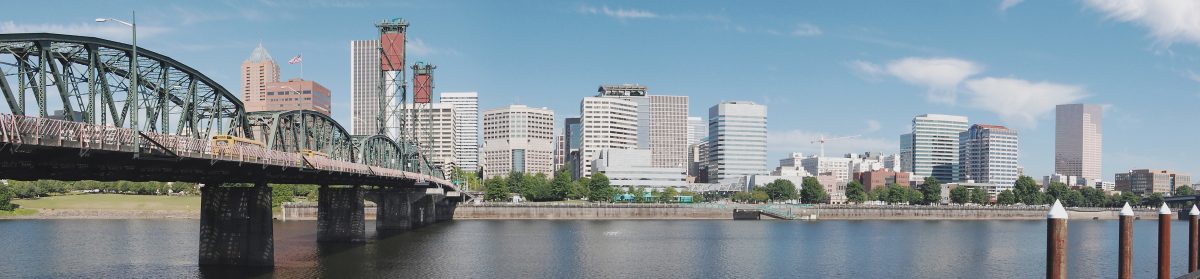

Photo: Portland Appraisal Blog (CC BY-SA 4.0)
The 1803 Fund, backed by a generous $400 million pledge from Phil and Penny Knight and launched in 2023, has unveiled detailed plans for the adaptive reuse of Portland’s historic grain silos on the Willamette River’s east bank.
Located immediately east of the Moda Center in the Rose Quarter, the former Louis Dreyfus grain terminal forms the centerpiece of the three-acre Albina Riverside site. Renderings released December 2, 2025, show the iconic concrete silos fully retained and integrated into a new public waterfront cultural hub featuring galleries, event spaces, mass-timber pavilions, basketball courts, and terraced steps to the river.
Adjacent parcels along North Russell Street, known as The Low End, will introduce mixed-use development including affordable housing and commercial spaces, emphasizing pathways to community ownership.

(Custom Bing Map: December 2025)
Project Details and Restorative Goals
Architects AD—WO, MALL, and Wayside Studio have designed the silo conversion to preserve the structures’ industrial character while creating usable public spaces. Clusters of silos will be consolidated to form larger interior volumes for exhibitions and events, wrapped by outdoor terraces and overlooks.
The broader initiative addresses historic displacement in the lower Albina district through place-based economic strategies. Given the sites’ current industrial/mixed-use and absence of existing residents, beneficiary targeting employs legally compliant models—such as community-owned REIT shares prioritized for residents of the historic Albina area and descendants of displaced families—similar to Portland’s established N/NE Housing Preference Policy.
Market History & Appraisal Perspective
The valuation history of the former Louis Dreyfus grain terminal (now Albina Riverside) at 900 N. Thunderbird Way is a stark illustration of how industrial obsolescence can collide with urban redevelopment potential.
The Silo Valuation Saga
In 2013, the Louis Dreyfus Co. reportedly invested $21.5 million to modernize the facility for state-of-the-art grain loading. Yet, only six years later in 2019, the site sold for a mere $164,000—a figure that was lower than the median price of a two-bedroom home in Gresham at the time.
From an appraisal standpoint, this plummet was a textbook case of functional obsolescence. The terminal’s utility was crippled when Union Pacific ceased rail service to the facility, concluding that the tracks on the property no longer met modern engineering and safety guidelines. Without functioning rail, a grain elevator’s ability to move commodities evaporates, leaving behind a massive, specialized liability.
However, the site’s location at the east end of the Steel Bridge provided a unique baseline of value. Even when its industrial utility stalled, the property remained fully leased, generating approximately $325,000 in annual revenue. A significant portion of this income came from Lamar Advertising, which operates the city’s largest billboard on the silos’ exterior. This signage is a local icon, once famously proclaiming “Amazon.com wouldn’t fit here” before shifting to its current Portland Timbers branding.

Photo: Portland Appraisal Blog (CC BY-SA 4.0)
The property’s rebound began in 2021 when it sold for $2.9 million, and it was most recently listed for $6.5 million. This trajectory represents a total shift in Highest and Best Use. The market value is no longer tied to its “broken” industrial infrastructure, but rather to its potential as a 3-acre cultural anchor. With the 1803 Fund’s recent $70 million regional acquisition, the silos are being reclassified from an obsolete terminal to a cornerstone of “impact infrastructure.”
The Low End and the Power of Plottage
The 1803 Fund’s acquisition extends beyond the silos to include approximately 20 tax lots in an area historically known as The Low End, along the western edge of Russell Street. This area makes up about 7 acres. In appraisal, this is a masterclass in plottage—the increase in value realized by assembling smaller, disparate parcels into one cohesive master plan. By creating a 7-acre “blank canvas,” the fund has enabled a scale of development that the individual lots could never support on their own.
One factor currently suppressing the unimproved value of The Low End parcels is the presence of documented soil contamination. In industrial appraisal, these are often treated as “brownfields.” The 1803 Fund’s ability to absorb these remediation costs—estimated to be a multi-million dollar undertaking—is a key part of their $700 million economic impact projection. By cleaning these 20 tax lots, they aren’t just improving their own land; they are removing a significant environmental stigma that has capped property values in lower Albina for a generation.
In total, the fund now controls roughly 10 acres of land, split between the two sites.
The RMLS Data and Zoning Hurdles
From a residential appraisal perspective, this project is a “market starter” rather than a displacement. A review of RMLS data confirms zero closed residential sales within this core footprint for years, reinforcing its long-standing non-residential character.
The Russell Street parcels in The Low End benefit from flexible EX (Central Employment) zoning, which already permits a variety of mixed-use developments. The centerpiece of the project—the 16-story hotel—is planned for the grain silo site itself. This site is currently zoned General Industrial 1 (IG1), an “Industrial Sanctuary” designation. The 1803 Fund’s plan to place a high-density hospitality and arts complex here will require a significant rezone, making this a major test case for Portland’s willingness to pivot its waterfront from industrial heritage to civic future.
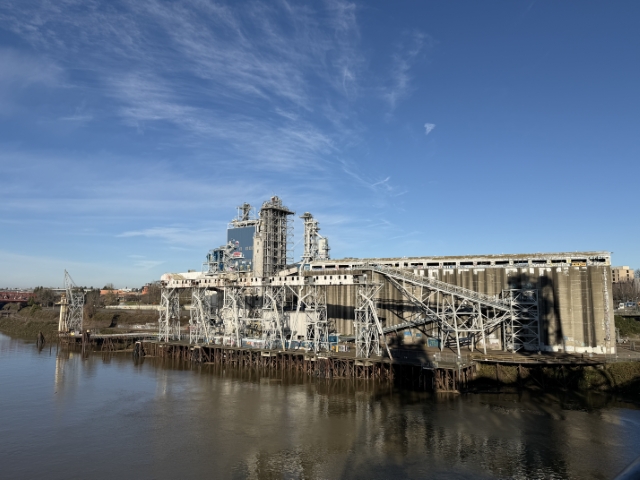
Photo: Portland Appraisal Blog (CC BY-SA 4.0)
Takeaway
New public amenities and mixed-use housing will introduce net-new ownership opportunities in a transit-rich, close-in location currently lacking for-sale residential product. This transformation may support amenity-driven value uplift in adjacent neighborhoods such as Eliot and Boise.

Photo: Portland Appraisal Blog (CC BY-SA 4.0)
Planning and permitting continue, with construction anticipated in coming years. Portland Appraisal Blog will continue to monitor progress of the project.
Sources & Further Reading
- 1803 Fund Albina Riverside project overview and renderings: OPB article
- Historic context and community vision: The Skanner coverage
- Valuation & 2019 Sale ($164k): Willamette Week
- Grain Silo $6.5M listing: Willamette Week
- Billboard & Lease Revenue ($325k/yr): Oregon Business
- Silo Master Plan (Hotel, Art Shed, Basketball Shed): Dezeen
- Grain silo current zoning: Portland Maps
- General Industrial 1 (IG1), zoning description: Portland Maps
- Central Employment (EX), zoning description: Portland Maps
- Brownfields discussion: Portland.gov

Thanks for reading—I hope you found a useful insight or an unexpected nugget along the way. If you enjoyed the post, please consider subscribing for future updates.
CODA
Are you an agent in Portland who wonders why appraisers always do “x”?
A homeowner with questions about appraiser methodology?
If so, feel free to reach out—I enjoy connecting with market participants across Portland and the surrounding counties, and am always happy to help where I can.
And if you’re in need of appraisal services in Portland or anywhere in the Portland Region, we’d be glad to assist.
 Portland Appraisal Blog


