Portland Real Estate Appraisal Brief – Friday, December 5, 2025: FHFA Raises 2026 Multifamily Loan Purchase Caps

The FHFA raised the 2026 multifamily loan purchase caps for Fannie Mae and Freddie Mac to $176 billion, a move that supports financing and affects property valuations in the Portland metro area.

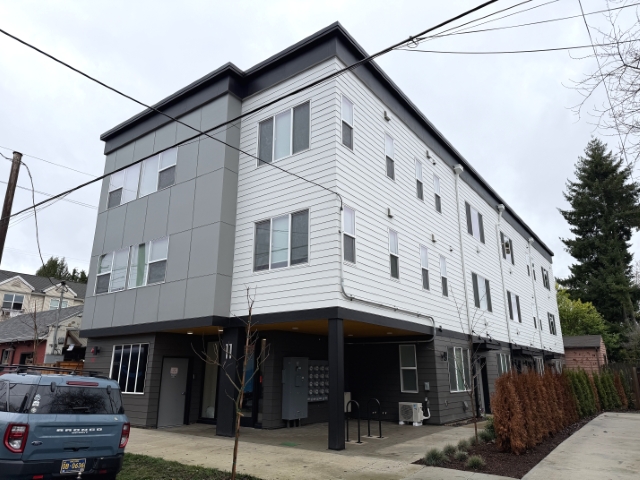
Contemporary mid-rise multifamily apartment building in the Portland, Oregon metro area, relevant to FHFA’s 2026 $176 billion combined Fannie Mae/Freddie Mac loan purchase caps.
Modern multifamily building in Portland
Stock photo via Canva Pro

FHFA Announces $176 Billion in 2026 Multifamily Loan Purchase Caps

The Federal Housing Finance Agency (FHFA), regulator of Fannie Mae and Freddie Mac (the Enterprises), has set the annual multifamily loan purchase caps for 2026 at $88 billion for each Enterprise, resulting in a combined total of $176 billion in financing capacity. This figure represents a robust increase of more than 20% from the $73 billion cap per Enterprise in 2025. The expanded capacity is intended to maintain liquidity in the multifamily market, especially as lending activity is projected to stabilize and as older loans mature, requiring refinancing.

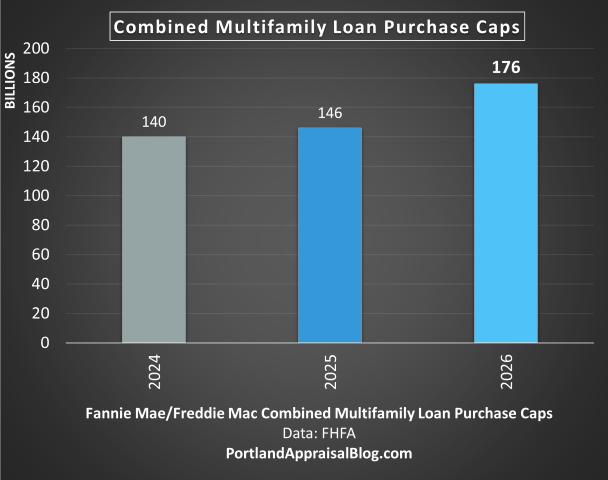
For perspective, the combined cap was $140 billion in 2024 ($70 billion each) and $146 billion in 2025 ($73 billion each). The nearly $30 billion increase between 2025 and 2026 is a strong signal of anticipated market strength.

The FHFA confirmed that the caps are a floor, not a ceiling. FHFA Director William J. Pulte stated the agency will monitor lending activity throughout the year and has the discretion to increase the caps further if warranted by market conditions, but will not reduce them—a policy designed to prevent disruption in rental housing finance.

Crucially, the mission-driven focus remains a key mandate: at least 50% of the Enterprises’ multifamily loan purchases must qualify as mission-driven affordable housing.

Bar chart showing combined Fannie Mae and Freddie Mac multifamily loan purchase caps increasing from $140 billion in 2024 to $176 billion in 2026, relevant to Portland metro residential and small multifamily property valuations.
FHFA multifamily loan purchase caps for Fannie Mae and Freddie Mac
Data: FHFA | Chart: PortlandAppraisalBlog.com

Mission-Driven Focus and Exemptions

The FHFA has maintained specific provisions to support underserved segments of the market:

  • Workforce Housing Exemption: Loans financing workforce housing—properties with rent or income restrictions for at least 10 years or the loan term, typically targeting tenants earning 80% to 120% of area median income (AMI)—are exempt from the volume caps and count fully toward the mission-driven threshold if at least 20% of units meet affordability criteria.
  • Affordability Requirements: The mission-driven criteria also include properties with regulatory agreements (e.g., Low-Income Housing Tax Credit/LIHTC), those in rural areas, and financing for small-scale affordable units in high-cost or cost-burdened markets. The FHFA has also recently complemented these purchase limits by doubling the annual LIHTC investment cap to $2 billion per Enterprise, which could accelerate multifamily construction starts in 2026.

This commitment to affordability ensures that a substantial portion of the capital is directed toward maintaining and increasing the supply of rental housing for lower- and moderate-income residents, a critical need nationwide and across the Portland region.

Appraisal and Valuation Implications for the Portland Region

The increased national lending capacity for multifamily properties has subtle yet important implications for certified residential and commercial appraisers, as well as the homeowners, lenders, and investors they serve across the Portland–Vancouver metro area.

Residential Properties (1–4 Units)

For residential stakeholders, the robust federal support for multifamily lending indirectly influences the single-family market. By increasing the capital flow for new and existing rental properties, the FHFA action helps stabilize the rental supply, which in turn can ease demand pressure that might otherwise shift to single-family inventory in high-demand areas.

In Oregon and Washington counties, including Multnomah, Washington, and Clark, this broader stability aids in appraising the smaller, 2–4 unit residential income properties often financed through conventional Fannie Mae/Freddie Mac channels. Appraisers should note that in the income approach, the assurance of strong capital markets for rental housing—particularly those properties meeting workforce housing needs—provides a stabilizing factor for Gross Rent Multipliers (GRMs) and capitalization rates used in valuation. This financing stability offers a necessary counterbalance to the volatility introduced by local regulations, such as Oregon’s statewide rent increase limits (set at 9.5% for 2026) and Portland’s mandatory relocation assistance policies (triggered by a 10% rent increase or higher). Crucially, the 9.5% state cap means the state maximum increase does not automatically trigger the significant financial liability of relocation assistance within Portland city limits.

Commercial / Multifamily (5+ Units)

For the commercial and investment real estate segment, which includes properties with five or more units, the increased $176 billion cap is a clear positive. It reinforces the Enterprises as a reliable, deep source of capital in the Portland–Vancouver corridor, where investment sales have been concentrated in Vancouver, Milwaukie, and Hillsboro/Beaverton submarkets.

Appraisers valuing these assets should incorporate the following:

  • Cap Rate Stability: The strong financing capacity acts as a floor, limiting upward pressure on capitalization rates that might otherwise result from tighter credit conditions.
  • Workforce Housing Marketability: The explicit cap exemption for workforce housing loans is highly relevant. Appraisers must consider a property’s potential eligibility for this favorable financing when assessing its highest and best use and marketability, especially in submarkets facing high rent growth or in communities like those in Cowlitz and Skamania counties where mission-driven initiatives promote long-term affordability.
  • Market Context: The assurance of this funding stream is timely, as the Portland metro multifamily market currently faces an elevated vacancy rate (ranging from approximately 5.5% to 7.5%, with higher rates for luxury Class A units) due to a wave of recent new deliveries. However, the pipeline is slowing significantly (new construction starts down over 50%), suggesting this capital will be available precisely as the market rebalances and conditions tighten.

Market Context

The FHFA’s decision to increase the combined cap to $176 billion is broadly supported by industry groups like the Mortgage Bankers Association (MBA) and the National Association of Home Builders (NAHB). This federal framework is expected to bolster the long-term rental stability that is crucial for the Portland metro area. The increased lending capacity comes at a pivotal time, mitigating the risk of a future housing shortage that could result from the current dramatic slowdown in new development across the region. The decision aligns the national financial framework with the local market’s need for capital, particularly for mission-driven and workforce housing, which remains a consistent demand factor for appraisers to consider.

Sources & Further Reading

Thanks for reading—I hope you found a useful insight or an unexpected nugget along the way. If you enjoyed the post, please consider subscribing for future updates.

CODA

Are you an agent in Portland and wonder why appraisers always do “x”?

A homeowner, lawyer, or estate planner with questions about appraiser methodology?

If so, feel free to reach out—I enjoy connecting with market participants across Portland and the surrounding counties, and am always happy to help where I can.

And if you’re in need of appraisal services in Portland or anywhere in the Portland Region, we’d be glad to assist.
Portland Real Estate Appraisal Brief – Thursday, December 4, 2025: National Home Sales Show Modest October Increases

National existing-home sales rose 1.2% and pending sales rose 1.9% in October 2025, providing context for Portland metro appraisers amid elevated regional prices.

Portland Oregon skyline at dusk with NAR Existing-Home Sales & Pending Sales October 2025 Report banner – context for national housing trends and Portland metro appraisals
Portland Oregon skyline at dusk.
Photo: Razvan Orendovici via Wikimedia Commons (CC BY 2.0)

National Home Sales Overview

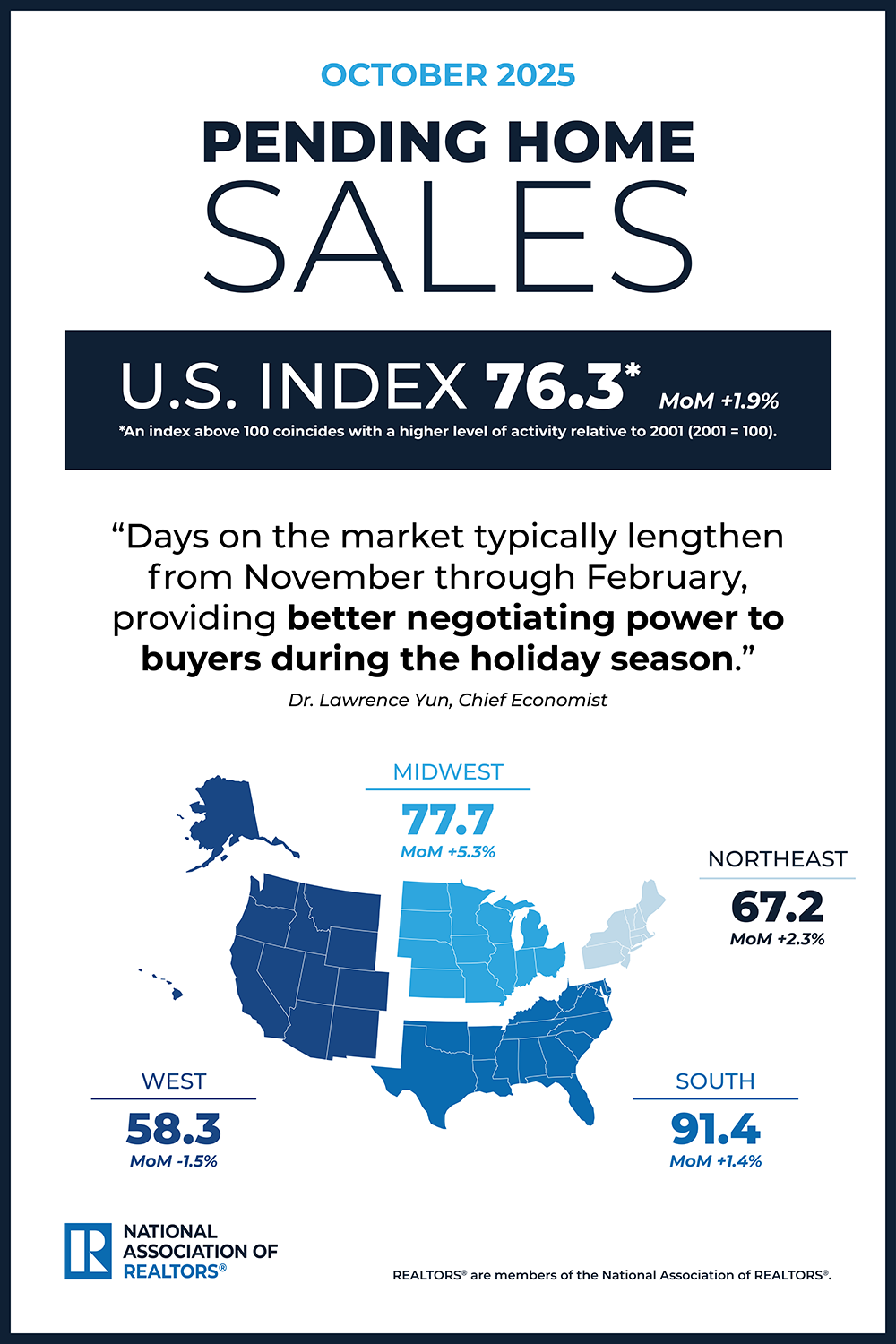
In October 2025, pending home sales across the U.S. rose 1.9% from September, reflecting a modest uptick in contract signings amid lower average mortgage rates(6.25%) for a 30-year fixed loan. Year-over-year, however, pending sales edged down by 0.4%. This monthly gain marks a continuation of buyer activity amid fluctuating economic signals.

Existing-home sales also increased, climbing 1.2% month-over-month to a seasonally adjusted annual rate of 4.10 million units. On a year-over-year basis, existing sales were up 1.7%, with single-family homes comprising the bulk at 3.71 million units annually. Condominium and co-op sales contributed 390,000 units, showing stronger monthly growth at 5.4%.

The national median existing-home price stood at $415,200 in October, representing a 2.1% increase from the previous year. Single-family homes had a median price of $420,600, while condos and co-ops were at $363,700. These price levels underscore ongoing affordability challenges in certain markets.

NAR Pending Home Sales Index October 2025 infographic – national pending sales rose 1.9% month-over-month with regional breakdowns and Portland Oregon metro market context
NAR Pending Home Sales Snapshot – October 2025
Infographic courtesy National Association of REALTORS®

Regional Variations & Inventory

Regionally, pending home sales showed mixed results. The Midwest led with a 5.3% monthly increase and a 0.9% year-over-year gain, attributed to better affordability. The South followed with a 1.4% monthly rise and a 2.0% annual increase. The Northeast gained 2.3% month-over-month but declined 1.0% year-over-year. In contrast, the West saw a 1.5% monthly decrease and a 7.0% annual drop, highlighting price pressures in higher-cost areas.

For existing-home sales, the Midwest again outperformed with a 5.3% monthly increase to 990,000 units annually, up 2.1% year-over-year. The South edged up 0.5% monthly to 1.86 million units, with a 2.8% annual gain. The Northeast held steady monthly at 490,000 units but rose 4.3% year-over-year. The West declined 1.3% monthly to 760,000 units, down 2.6% annually. Median prices varied regionally, with the Northeast at $503,700 (up 6.5% year-over-year), Midwest at $319,500 (up 4.6%), South at $362,300 (up 0.3%), and West at $628,500 (up 0.1%).

NAR Existing-Home Sales October 2025 infographic – national median price $415,200, 4.4 months supply, regional sales and price trends relevant to Portland metro residential appraisals
NAR Existing-Home Sales Housing Snapshot – October 2025
Infographic courtesy National Association of REALTORS®

Inventory and Market Conditions

Total housing inventory dipped slightly to 1.52 million units in October, down 0.7% from September but up 10.9% from the prior year. This equates to a 4.4 months’ supply at the current sales pace, a minor decrease from September’s 4.5 months but an improvement from 4.1 months a year ago. These figures indicate a gradual easing in supply constraints nationally.

NAR Chief Economist Lawrence Yun noted that sales advanced despite external factors, with buyers responding to lower mortgage rates averaging 6.25% for a 30-year fixed loan. He emphasized regional disparities, with the Midwest and South benefiting from more affordable inventory, while the Northeast and West face supply shortages and elevated prices. Yun also highlighted decelerating rents potentially aiding inflation control and supporting further rate cuts by the Federal Reserve.

Implications for the Portland Region

These national trends offer context for stakeholders in the Portland metro area, where market dynamics may echo Western region challenges such as higher prices and softer sales growth. For perspective, the median close price for single-family detached residential properties in the Portland region held at $600,000 through Q3 2025. While this is significantly above the national October median of $415,200, it is slightly below the broader West region’s October median of $628,500, suggesting Portland is performing comparably on price relative to its regional peers. For detailed local metrics through September, refer to our Portland region Q3 2025 market update.

Sources & Further Reading

Thanks for reading—I hope you found a useful insight or an unexpected nugget along the way. If you enjoyed the post, please consider subscribing for future updates.

CODA

Are you an agent in Portland and wonder why appraisers always do “x”?

A homeowner with questions about appraiser methodology?

If so, feel free to reach out—I enjoy connecting with market participants across Portland and the surrounding counties, and am always happy to help where I can.

And if you’re in need of appraisal services in Portland or anywhere in the Portland Region, we’d be glad to assist.

Portland Real Estate Appraisal Brief – Wednesday, December 3, 2025: FHFA Raises 2026 Conforming Loan Limit to $832,750

FHFA raises the 2026 conforming loan limit to $832,750. In Q3 2025 alone, 99 Portland-area sales (70 conventionally financed) closed $806,501–$832,750 and will now avoid jumbo status.

Picture of Constitution Center (400 7th Street SW, Washington, D.C.) – headquarters of the Federal Housing Finance Agency (FHFA).
Constitution Center (400 7th Street SW, Washington, D.C.) – headquarters of the Federal Housing Finance Agency (FHFA).
Photo: Ajay Suresh via Wikimedia Commons (CC BY 2.0)

FHFA Announces 2026 Conforming Loan Limit Adjustments

The Federal Housing Finance Agency (FHFA) has released its annual conforming loan limit values for 2026, effective January 1 for mortgages acquired by Fannie Mae and Freddie Mac. The baseline limit for one-unit properties increases to $832,750 — up $26,250 from the 2025 figure of $806,500 — reflecting a 3.26% rise in the national House Price Index from the third quarter of 2024 to the third quarter of 2025.

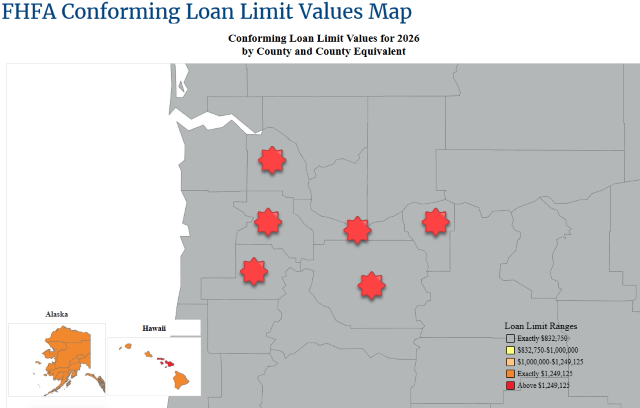
All counties in Oregon and the Portland-Vancouver-Hillsboro MSA remain at the baseline limit; no high-cost ceiling applies in our region.

FHFA Interactive Map

Appraisal Implications for the Portland Region

In Q3 2025 alone, 99 residential properties in the six-county region closed between $806,501 and $832,750. Of those, 70 were financed conventionally — transactions that would have required jumbo terms in 2025 but will now stay fully conforming in 2026.

Across the full quarter (4,682 total SFR detached-class closings):

  • 85.48 % (4,002 sales) closed under $900,000
  • Only 14.52 % (680 sales) closed at or above $900,000
  • The single busiest upper-tier band was $800,000 – $899,999 with 367 sales

Market Context from Q3 2025 Actual Sales

Price Band# of Sales% of Total MarketAvg Close PriceAvg CDOM
$800k– $899k3677.84 %$847,31351 days
$806,501 – $832,750992.11 %$820,86449 days
≥ $900k68014.52 %≈ $1,340,000+72+ days

For appraisers, lenders, realtors, estate planners, and attorneys, the 2026’s higher limit removes friction from one of the region’s most active price segments and keeps 85+% of transactions comfortably conforming.

Sources & Further Reading

Thanks for reading—I hope you found a useful insight or an unexpected nugget along the way. If you enjoyed the post, please consider subscribing for future updates.

CODA

Are you an agent in Portland and wonder why appraisers always do “x”?

A homeowner with questions about appraiser methodology?

If so, feel free to reach out—I enjoy connecting with market participants across Portland and the surrounding counties, and am always happy to help where I can.

And if you’re in need of appraisal services in Portland or anywhere in the Portland Region, we’d be glad to assist.
Portland Real Estate Appraisal Brief – Tuesday, December 2, 2025: HUD Rule Changes Prompt Lawsuit by Oregon and Washington

Oregon and Washington are among 20 states suing HUD over rule changes to the Continuum of Care grant program, which could cut millions in Portland housing funds.

Picture of HUD headquarters building.
HUD Headquarters
Via Wikimedia Commons

Federal Housing Funding Rule Faces Regional Legal Challenge

A coalition of approximately 20 states, including Oregon and Washington, has filed a lawsuit against the U.S. Department of Housing and Urban Development (HUD) over recent, sweeping changes to the $3.9 billion federal Continuum of Care (CoC) grant program. This legal action, filed on November 25, 2025, challenges a dramatic overhaul of funding priorities and conditions for the primary federal initiative supporting homelessness assistance.

The CoC program historically allocated nearly 90% of its funding to permanent housing solutions, a strategy known as “Housing First.” The new HUD Notice of Funding Opportunity (NOFO) for Fiscal Year 2026, however, drastically reduces the maximum funding available for permanent supportive housing to 30%, risking the displacement of an estimated 170,000 households nationwide. For the Portland region, this shift is especially critical, as Oregon alone stands to lose approximately $39 million in federal housing support, a figure cited by the Oregon Department of Justice. Washington State, which receives about $120 million annually in CoC grants, sees a substantial portion flow to its counties bordering the Portland metro area, including Clark County.

State attorneys general argue that HUD violated Congressional intent and the Administrative Procedure Act by imposing abrupt and sweeping changes without proper public rulemaking, as detailed in the official press release from the Washington State Attorney General. Beyond the funding cuts, the lawsuit cites new controversial conditions, including requirements for providers to mandate services as a precondition to housing and penalize jurisdictions that do not enforce strict anti-camping bans—policies that conflict with current practices in many Pacific Northwest cities. The national scope of the lawsuit underscores the destabilizing nature of the change.

Appraisal Implications

For certified residential appraisers working in the Portland metro area—encompassing counties like Multnomah, Washington, and Clackamas in Oregon, and Clark in Washington—the outcome of this lawsuit has material, though indirect, implications for property valuations, especially in the affordable and multifamily housing sectors.

Residential Properties

While CoC funds do not typically subsidize owner-occupied single-family homes, the potential displacement of tenants from permanent supportive housing could put additional strain on the already-tight rental market.

  • Supply and Demand Pressure: The loss of federally funded permanent supportive housing units means hundreds, if not thousands, of vulnerable residents in the region could be forced to seek alternative, unsubsidized rental housing. This influx of demand would further reduce the availability of affordable rental stock and could indirectly increase overall market rents for entry-level apartments. Higher rents, in turn, can put upward pressure on the price of smaller, owner-occupied starter homes as the rent-to-own cost dynamic shifts.
  • Neighborhood Stability: Appraisers must remain attuned to shifts in neighborhood stability and market dynamics. A rapid increase in unsheltered homelessness—which local leaders contend is a likely outcome of these funding cuts—can affect neighborhood marketability and, consequently, perceived value in nearby residential areas.
Tents along a city right-of-way. HUD’s homelessness-prevention programs aim to reduce street camping by stabilizing at-risk households

Commercial / Multifamily

The most direct impact is felt within the multifamily and commercial properties designed for social services and affordable housing.

  • Valuation of Supportive Housing Assets: Appraising existing permanent supportive housing (PSH) properties, often structured as low-income housing tax credit (LIHTC) assets or specialized nonprofit facilities, is directly tied to their funding stream. A loss or severe reduction in the reliable federal CoC operating subsidies introduces significant risk to the financial stability of these projects. Appraisers must consider:
    • Net Operating Income (NOI) Volatility: The immediate uncertainty regarding project renewal grants makes the NOI for these specialized assets highly volatile. This increased risk translates to a higher capitalization rate (Cap Rate) being applied by investors, which lowers the overall valuation of the property.
    • Highest and Best Use: A sudden and substantial policy change could force a re-evaluation of a PSH property’s Highest and Best Use if the specialized funding model is deemed permanently unviable. While unlikely to lead to immediate conversion, the risk of a future shift to conventional market-rate housing should be noted, particularly for properties nearing the end of their affordability period.

Market Context

The regional housing market operates with razor-thin margins for affordability. The Portland metro area, which includes Multnomah, Clackamas, and Washington counties, has already approved significant local measures, such as the Metro Supportive Housing Services Measure, to address the crisis. However, these local funds are intended to supplement, not fully replace, federal support. Washington State’s Clark County, which is also part of the Vancouver-Portland metro area, relies heavily on the federal structure to support its local Continuum of Care grants.

The pending lawsuit highlights the deep interdependency between federal policy, local funding initiatives, and the stability of the housing market in the Pacific Northwest. Real estate professionals—including lenders, estate planners, and realtors—must closely monitor the legal proceedings, as the outcome will dictate the long-term viability of a substantial portion of the region’s dedicated affordable and supportive housing supply.

Sources & Further Reading

Thanks for reading—I hope you found a useful insight or an unexpected nugget along the way. If you enjoyed the post, please consider subscribing for future updates.

Question: Do you think this lawsuit will be resolved soon, or will it drag on for most of the year?

CODA

Are you an agent in Portland and wonder why appraisers always do “x”?

A homeowner with questions about multifamily income properties, GRMs, or income calculations?

If so, feel free to reach out—I enjoy connecting with market participants across Portland and the surrounding counties, and am always happy to help where I can.

And if you’re in need of appraisal services in Portland or anywhere in the Portland Region, we’d be glad to assist.

Appraisal Video Short: Portland Housing Market Q3 2025

Portland metro single-family market—Q3 2025 in under 60 seconds:

→ Full Q3 2025 market report

CODA

Are you an agent in Portland and wonder why appraisers always do “x”?

A homeowner with questions about appraiser methodology?

If so, feel free to reach out—I enjoy connecting with market participants across Portland and the surrounding counties, and am always happy to help where I can.

And if you’re in need of appraisal services in Portland or anywhere in the Portland Region, we’d be glad to assist.