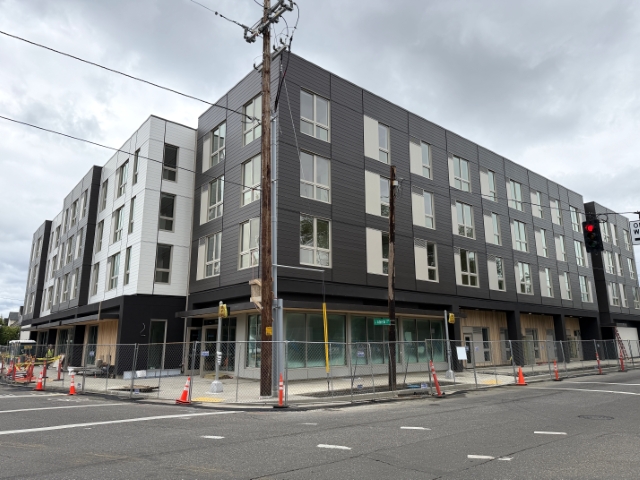
Photo: Abdur Abdul-Malik (March 2026), Portland Appraisal Blog
The Strong Family Apartments rise at the corner of N Alberta Street and N Williams Avenue in North Portland’s Humboldt neighborhood—a site long held by the Strong family, whose roots reflect the deep history of Black homeownership and community life in N/NE Portland. For decades, the property remained a modest home surrounded by open grassy land across multiple tax lots. In 2019, the Portland Housing Bureau acquired the site for land banking, and in 2024 transferred title to Strong AA Limited Partnership—a partnership led by Community Development Partners and Self Enhancement, Inc.—to deliver a 75‑unit affordable multifamily community.
True to the project’s name, the development is intentionally family‑oriented and contains no studios. The unit mix includes 21 one‑bedrooms, 32 two‑bedrooms, and 22 three‑bedrooms, with rents restricted at 30% and 60% of area median income. Eleven units are deeply affordable at ≤30% AMI, and the project prioritizes the City’s N/NE Preference Policy for households displaced by past urban renewal and gentrification in North and Northeast Portland. With 54 family‑sized units, the building fills a gap in a neighborhood where market‑rate options have become increasingly out of reach for moderate‑income families.
From an appraisal perspective, the site tells a clear story. Assemblage of multiple parcels into a unified 0.96‑acre lot unlocked plottage value and enabled a highest‑and‑best‑use shift to family‑oriented multifamily housing in the CM2 zone—a designation with no parking minimums and incentives for dense, transit‑supported development along key corridors. The redevelopment transforms a historically underutilized corner into a long‑term community asset governed by a 99‑year affordability agreement.
This post examines the project through that lens: how zoning, public‑private tools, and assemblage shaped feasibility; how restricted‑use valuation differs from market‑rate ownership in Humboldt; and what the Strong Family Apartments reveal about affordability, displacement, and redevelopment in Portland’s evolving N/NE housing landscape.
Site History, Project Details & Zoning
The Strong Family Apartments occupy a prominent corner at N Alberta Street and N Williams Avenue in North Portland’s Humboldt neighborhood. For decades, the property remained under long‑term ownership by the Strong family, whose generational roots reflect the deep history of Black families in N/NE Portland. Prior to redevelopment, the site consisted of multiple smaller tax lots totaling nearly one acre, largely underutilized as open grassy land surrounding a modest single‑family home—clearly visible in 2019 archival Street View and aerial imagery. In CM2 zoning, a medium‑scale commercial mixed‑use designation intended for transit‑served corridors, a single‑family home on such a large combined parcel represented significant underutilization. The zone supports mid‑rise multifamily buildings rather than detached homes, with no parking minimums and height allowances of 45 feet (up to 75 feet with bonuses).

Source: Google Street View
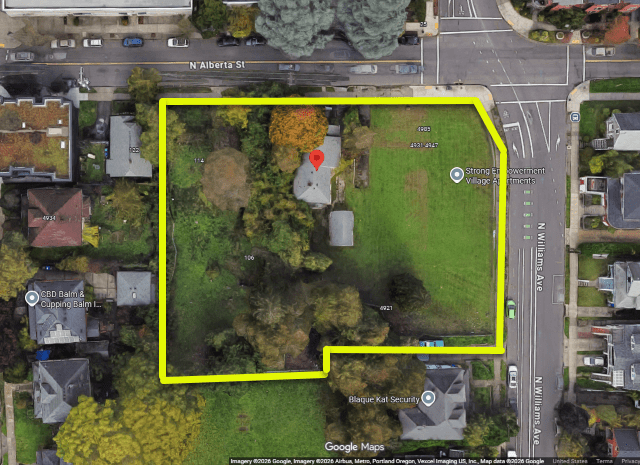
Source: Google Maps
In 2019, the Strong family privately sold the property to the Portland Housing Bureau (PHB) for land banking, bypassing any open‑market listing. This acquisition aligned with PHB’s strategy to preserve sites for community‑benefit affordable housing in historically impacted N/NE neighborhoods. The property remained in land bank status until 2024, when City Council Ordinance 191817 authorized transfer of the site to Strong AA Limited Partnership, a private ownership entity formed by Community Development Partners (CDP), the project’s developer, and Self Enhancement, Inc. (SEI), the nonprofit service partner. In this structure, an SEI affiliate serves as the Managing General Partner, a CDP affiliate serves as the Administrative General Partner, and a private tax‑credit investor holds the Limited Partner interest (approximately 99.99%). This arrangement is typical for Low‑Income Housing Tax Credit (LIHTC) developments, the federal program that finances most affordable rental housing in the United States. Under LIHTC, private investors receive a dollar‑for‑dollar reduction in federal tax liability in exchange for investing equity into qualified affordable housing projects, which allows units to rent below market rates. In this structure, the investor provides equity, Community Development Partners oversees development and compliance, and Self Enhancement, Inc. leads resident services and long‑term community engagement.
The project’s financing layers reflect the complexity typical of affordable multifamily development. Approximately $14.2 million came from PHB (including a $11.4 million cash-flow share loan from the 2023 Metro Housing Bond allocation and Interstate Corridor Urban Renewal Area tax-increment financing), supplemented by Portland Clean Energy Fund grants, Oregon Housing and Community Services low-income housing tax credits, and additional contributions. The development remains privately owned and operated, with Guardian Management overseeing leasing and SEI providing resident services. A 99‑year regulatory agreement with PHB mandates long‑term affordability, adherence to the N/NE Preference Policy, and other public‑benefit requirements.
The development delivers 75 rental units across one‑, two‑, and three‑bedroom floor plans, with all rents restricted for households earning 30% or 60% of area median income (AMI). Eleven units are deeply affordable at ≤30% AMI, prioritizing families with the highest need. The table below summarizes the mix and representative rent levels.
| Bedrooms | Number of Units | AMI Level | Estimated Rent Range |
|---|---|---|---|
| 1 Bedroom | 21 | ≤30% and ≤60% AMI | ~$656 (30% AMI 1BR example) |
| 2 Bedroom | 32 | ≤30% and ≤60% AMI | ~$1,195–$1,215 (45% AMI 2BR example) |
| 3 Bedroom | 22 | ≤30% and ≤60% AMI | ~$905 (30% AMI 3BR example) |
Rents are not subsidized (no project‑based vouchers); residents pay the full restricted amount plus electricity, while the landlord covers water and trash. The mix emphasizes family households, with the N/NE Preference Policy prioritizing those displaced from the area.
Amenities include a large central courtyard with a private playground and nature‑inspired play features, indoor bike parking and storage, on‑site laundry, a community room and kitchen, and resident services focused on youth education, employment support, and family stability. The building targets Earth Advantage Platinum certification for energy efficiency, solar readiness, and a tight building envelope.
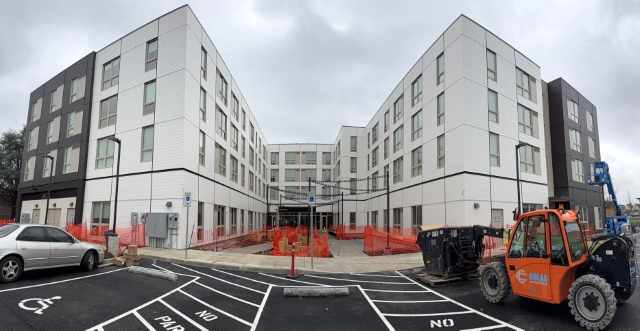
Photo: Abdur Abdul-Malik (March 2026), Portland Appraisal Blog
Construction began in late 2024 after financing closed in August 2024. Completion is expected in Spring 2026, with leasing to follow. The timeline—from 2019 acquisition through multiple funding layers, permitting, and construction—reflects the typical duration and complexity of affordable multifamily development in Portland.
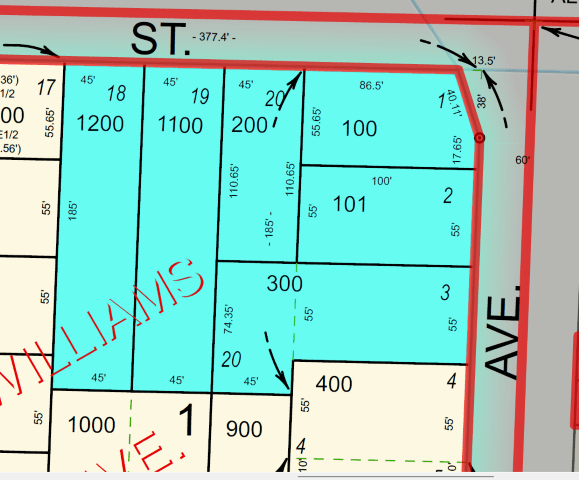
The CM2 zoning directly supported the site’s highest and best use. Multifamily residential is a primary permitted use on transit‑served corridors, with no parking requirement and incentives for density. Assemblage of the multiple lots into a single 0.96‑acre parcel enabled the scale, layout, and family‑oriented amenities that a single‑family home on fragmented parcels could never achieve.
Source: Portland Maps
Neighborhood Context — Humboldt Market & Amenities
Humboldt is a compact, vibrant inner North/Northeast Portland neighborhood centered around the Alberta–Williams corridor. With a Walk Score of 89 (“Very Walkable”) and a Bike Score of 100 (“Biker’s Paradise”), most daily needs can be met on foot or by bike, supported by a Transit Score of 53 and frequent bus service along N Williams, N Vancouver, and N Killingsworth, plus proximity to the MAX Yellow Line. The area blends long‑standing community roots with ongoing revitalization, anchored by the Alberta Arts District’s murals, galleries, indie shops, cafés, restaurants, and the long‑running Last Thursday street events.
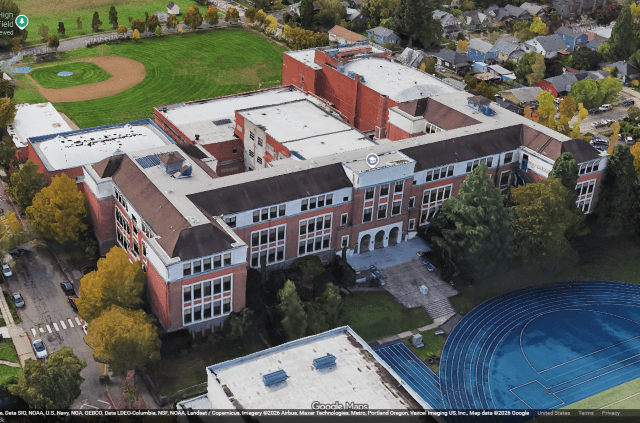
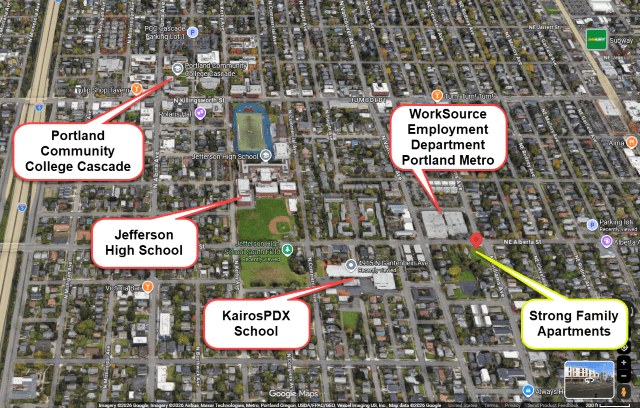
Education and youth resources form a strong neighborhood backbone. Jefferson High School—with its full‑size football field, track, and community programming—sits within Humboldt boundaries and is walkable or bikeable from the Strong site. Nearby KairosPDX, a public charter school focused on culturally responsive education, and Portland Community College Cascade, just north of the neighborhood, add depth through early‑learning programs, K–8 support, and college‑level career and transfer pathways. Together, these institutions reinforce the project’s family‑oriented design and align with the N/NE Preference Policy’s emphasis on retaining generational ties for households with a historical connection to the area.
Source: Google Maps

Photo: Abdur Abdul-Malik (March 2026), Portland Appraisal Blog
Employment access is unusually strong for a neighborhood‑scale project. The WorkSource Oregon center (State of Oregon Employment Department Portland Metro office) sits directly across N Williams Avenue from the Strong site. The facility provides job search assistance, training referrals, career counseling, unemployment support, and connections to workforce programs—resources that complement SEI’s on‑site youth and employment services and enhance the project’s location externalities for income‑restricted families.
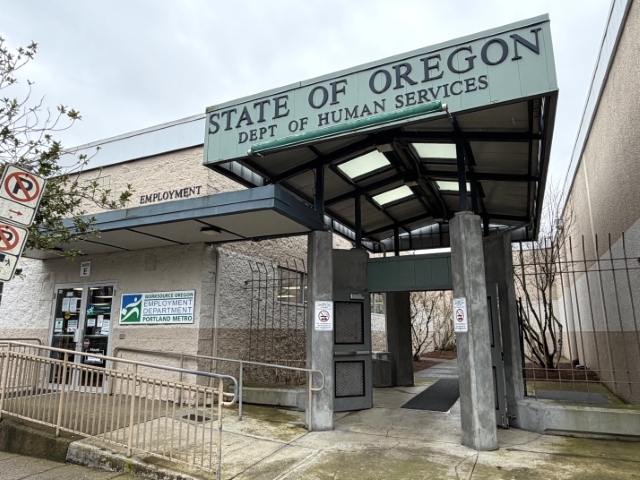
Photo: Abdur Abdul-Malik (March 2026), Portland Appraisal Blog
Grocery access is a modest tradeoff. Unlike some recent Portland affordable developments with immediate adjacency to major grocers (e.g., Trader Joe’s at HollywoodHUB or Safeway at Barbur Apartments), Humboldt lacks a full‑service chain supermarket within its boundaries or within a short walk of the Strong site. The nearest practical options are New Seasons Market on N Williams Avenue (~0.8 miles south, 15–20 minute walk or 5-minute bike ride along protected lanes) and Safeway (~0.8 miles northeast). Delivery services (Instacart, New Seasons own platform, etc.) are widely available, and insulated bags, cargo bikes, or e-assist options mitigate summer heat or load-carrying challenges. The Safeway route involves crossing the major arterial NE Martin Luther King Jr Blvd, making it less preferable for walking. This pattern aligns with the corridor’s multimodal design and the project’s minimal parking program (15 EV-ready shared spaces).
The neighborhood reflects a long history of community change, with significant gentrification pressures, a high renter share (49% per the City of Portland’s 2023 neighborhood demographic profile), and rising ownership costs. These dynamics underscore the importance of restricted affordable family housing in a corridor where market‑rate ownership has become increasingly out of reach for moderate‑income households.
Source: Google Maps
Data & Analysis — Humboldt’s Owned Market in Contrast
Understanding the context for the Strong Family Apartments requires examining Humboldt’s recent open‑market ownership landscape. This analysis uses RMLS data for 1–3 bedroom SFR‑class transactions (detached, condo, and attached) from 2024 through year‑to‑date 2026—the period that best reflects current market conditions. All figures represent descriptive statistics from the full set of qualifying sales; no sampling or modeling is involved.
The Portland Appraisal Blog Affordability Index (PABAI) measures how the average home close price compares to what a household at a given income level can qualify for under standard lending assumptions (HUD median MSA income, 20% down payment, and a 28% debt‑to‑income ratio for principal, interest, taxes, and insurance). A PABAI of 100 means the market is exactly affordable at that income level (current HUD median MSA income is $124,100 for a family of four in the Portland metro area) . Values above 100 indicate excess qualifying capacity (more affordable), while values below 100 indicate a shortfall (strained affordability). Full methodology and the interpretation scale are available on the PABAI explainer page.
| PABAI Range | Interpretation |
|---|---|
| 120+ | Strongly Affordable |
| 100–119 | Moderately Affordable |
| 80–99 | Strained |
| Below 80 | Severely Constrained |
The PABAI is recalibrated here to a 60% AMI benchmark ($74,460 maximum income for a four‑person household), aligning with the majority of Strong’s units.
Humboldt 1–3 Bedroom Sales by Property Type (60% AMI Benchmark)
| Property Type | Avg Beds | Avg Close Price | Avg PABAI (60% AMI) | Affordable Sales (out of total) |
|---|---|---|---|---|
| Detached | 2.74 | $533,738 | 55.20 | 0 / 38 |
| Condo | 1.98 | $387,939 | 70.28 | 1 / 49* |
| Attached | 2.57 | $488,357 | 56.97 | 0 / 7 |
Detached Homes: The Traditional Family Segment
Detached homes—typically older (average build year 1940), larger (1,933 SF average), and more likely to include garages (0.61 average spaces)—represent the traditional family‑oriented housing stock most comparable to Strong’s 2–3 bedroom units. In this segment, the PABAI falls to a severely constrained 55.20, with zero of the 38 transactions qualifying as affordable for a 60% AMI household. This reflects the substantial income gap required to purchase family‑sized homes in Humboldt under standard qualification criteria.
Condos: Relatively Less Constrained, but Not for Families
Newer condos (average build year 2010, 1,006 SF average, minimal garage access) show a higher average PABAI of 70.28, indicating somewhat less affordability pressure relative to detached homes. However, the coverage is extremely limited: only one qualifying sale in the 1–3 bedroom range, plus two additional qualifying studio units when the dataset is expanded. All three affordable transactions were 0–1 bedroom units—none were family‑sized.
Attached Homes: Low Volume, Same Constraints
The attached segment contains only seven transactions, which reflects the full universe of attached 1–3 bedroom sales in Humboldt during this period. While the volume is low, these are all open‑market transactions, and the affordability pattern mirrors the broader constraints seen in the detached and condo segments. The average PABAI of 56.97 and zero qualifying sales reinforce the limited feasibility of ownership for 60% AMI households in this format.
Affordability Coverage and Market Implications
Across the full set of 94 open‑market 1–3 bedroom transactions in Humboldt, only one sale qualified as affordable at the 60% AMI benchmark—a coverage rate of 1.06%. Expanding the dataset to include studio condos increases the total to 96 transactions and three qualifying sales, raising the coverage rate to roughly 3%. All three affordable units were 0–1 bedroom condos; none were in the 2–3 bedroom range that aligns with Strong’s 54 family‑sized units. This pattern highlights a structural mismatch between Humboldt’s ownership inventory and the needs of 60% AMI households. Family‑sized homes—whether detached, attached, or larger condos—are effectively absent from the affordable ownership landscape, and even the most attainable options are limited to small, entry‑level condos. In this context, the Strong Family Apartments fill a critical gap by providing long‑term, income‑restricted, family‑oriented housing in a corridor where market‑rate ownership has become unattainable for moderate‑income households.
Plottage, Highest and Best Use, and Long‑Term Stability
Plottage and Assemblage Value
The site’s primary value driver is plottage—the incremental value created by combining multiple smaller tax lots into a single unified 0.96‑acre parcel. Prior to redevelopment, the Strong family’s holdings consisted of several fragmented lots occupied by a modest single‑family home and large areas of open grass, a clear underutilization in CM2 zoning, which is intended for medium‑scale mixed‑use and multifamily development along transit corridors.
Assemblage into one unified tax lot unlocked the development potential that individual parcels could not support. The combined footprint enabled a 75‑unit building with a central courtyard, family‑oriented amenities, on‑site services, and efficient circulation—elements that would have been infeasible or uneconomic on scattered lots. This is a textbook example of how public‑private coordination (PHB land banking and subsequent transfer) and zoning incentives (no parking minimums, height and floor-area ratio allowances) convert fragmented, low‑intensity land into a higher and better use.
Highest and Best Use Shift
Before redevelopment, the site’s highest and best use was not continued single‑family residential. While CM2 permits residential uses, the zone’s intent and incentives clearly favor denser multifamily or mixed‑use development on corridors like N Williams Avenue. Maintaining a single‑family home on nearly one acre represented a substantial underutilization of land value in an area with strong multimodal access and ongoing reinvestment.
The realized use—75 income‑restricted family units with courtyard amenities, bike parking, and resident services—aligns directly with CM2’s purpose. The project maximizes allowable density while securing long‑term affordability through a 99‑year regulatory agreement with PHB. The shift from low‑intensity residential to medium‑scale multifamily was made possible by assemblage, zoning compliance, and layered public financing.
Location Externalities
The Alberta/Williams corridor provides unusually strong positive externalities for income‑restricted households. WorkSource Oregon sits directly across N Williams Avenue, offering employment services, training referrals, and career support. Jefferson High School, KairosPDX, and PCC Cascade are all within a short walk or bike ride, creating a cluster of educational and youth‑focused resources. The corridor’s multimodal strengths—protected bike lanes, frequent transit, and walkable amenities—reinforce the project’s feasibility and support absorption for the target demographic.
Income Growth Retention and Long‑Term Stability
A defining feature of the project is tenant stability. Under federal LIHTC rules (the Next Available Unit Rule), households are not required to move out if their income rises after initial qualification. The 99‑year PHB regulatory agreement further ensures long‑term affordability, compliance, and adherence to the N/NE Preference Policy.
This structure supports upward mobility without displacement, stabilizes families over time, and aligns with anti‑displacement goals in N/NE Portland. By allowing residents to remain as their incomes grow, the project promotes continuity rather than churn—an important distinction in a corridor where market‑rate rents and ownership costs have escalated beyond reach for many moderate‑income households.
Takeaways
The Strong Family Apartments illustrate how targeted redevelopment can convert long‑term underutilization into meaningful community benefit. Through assemblage of multiple tax lots into a unified 0.96‑acre parcel, the site shifted from a modest single‑family home with expansive open space to a 75‑unit, family‑oriented affordable multifamily community. The project prioritizes the N/NE Preference Policy and incorporates a central courtyard, playground space, and SEI‑led youth, employment, and family‑stability services.
From an appraisal perspective, the development underscores the role of plottage in unlocking highest and best use. Combining fragmented parcels enabled the scale, density, and site planning required for medium‑scale multifamily in CM2 zoning, where incentives favor transit‑supported housing over low‑intensity residential. The result is a long‑term community asset serving moderate‑income families in a corridor where market‑rate ownership remains unattainable for many.
Long‑term stability is reinforced through the 99‑year affordability covenant and LIHTC’s income‑growth retention rules, which allow households to remain in place as earnings rise. This structure supports upward mobility without displacement and aligns with anti‑displacement goals in N/NE Portland.
In a neighborhood shaped by historical and ongoing pressures on housing access, the Strong Family Apartments demonstrate how zoning, public‑private coordination, and intentional design can preserve community ties while delivering durable affordability.
Sources & Further Reading
- North/Northeast Preference Policy: City of Portland
- CM2 Zoning: Portland Maps
- Metro Housing Bond: City of Portland
- The Strong Building Overview: City of Portland
- Strong Family Apartments Begin Construction: City of Portland
- City Council Ordinance: 191817
- Humboldt Home Ownership Rate: City of Portland
- Community Development Partners: Strong Family Project
- Self Enhancement Inc: History
- Earth Advantage: Building Certifications
- Walk Score: Humboldt
- Last Thursday: Street Events
- hollywoodHUB Apartments: PortlandAppraisalBlog
- Barbur Apartments: PortlandAppraisalBlog
- Portland-Vancouver-Hillsboro, OR-WA MSA: HUD Median Income
- The Portland Appraisal Blog Affordability Index: PABAI

Thanks for reading—I hope you found a useful insight or an unexpected nugget along the way. If you enjoyed the post, please consider subscribing for future updates.
CODA
Are you an agent in Portland who wonders why appraisers always do “x”?
A homeowner with questions about appraiser methodology?
If so, feel free to reach out—I enjoy connecting with market participants across Portland and the surrounding counties, and am always happy to help where I can.
And if you’re in need of appraisal services in Portland or anywhere in the Portland Region, we’d be glad to assist.

 Portland Appraisal Blog