Portland Region Housing Affordability Snapshot – Rates Dip to 6.47% (June 18, 2026)

At today’s 6.47% mortgage rate, the monthly principal‑and‑interest payment on a Q1 2026 Portland Region median-priced detached home ($580,000) with 20% down is $2,924, up from $2,776 at February’s low. Lifetime interest rises to $588,513, and repricing all Q1 loans at today’s rate adds $148M in regional interest.

What Happened This Week

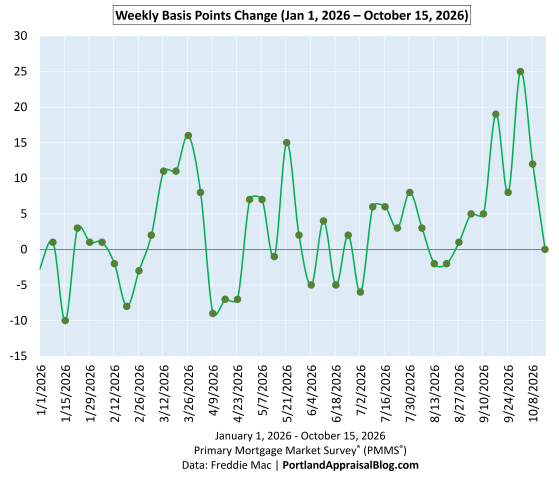
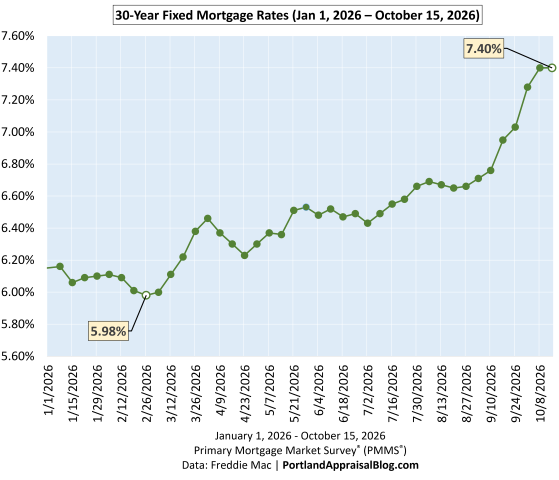
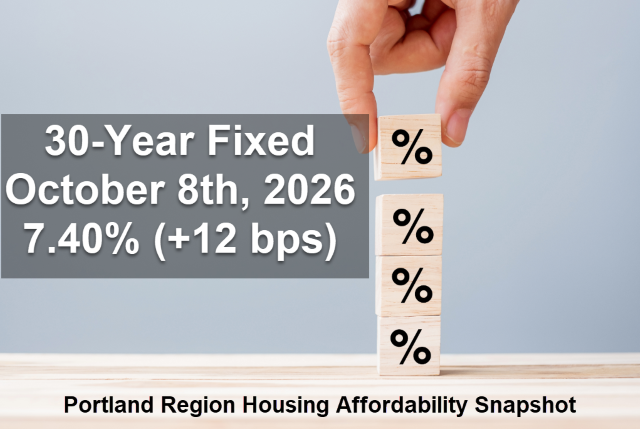
Mortgage rates moved lower this week, with the 30‑year fixed dipping to 6.47%, a 5‑basis‑point decline from last week’s 6.52%. The broader 2026 pattern remains intact: rates bottomed on March 5th, surged through early April, eased briefly, and then turned upward again on April 23rd. Over the past month, rates have been oscillating in a narrow range near the year‑to‑date highs, and this week’s pullback simply nudges us off the ceiling rather than signaling a meaningful shift in trend.

Affordability improves only marginally at these levels. A 5 bps decline provides some relief, but monthly payments remain near their highest point of the year, and qualifying thresholds are still significantly above their early‑March lows. As the charts below show, today’s rate sits just under the recent ceiling of the year‑to‑date range, and the PABAI continues to reflect the persistent affordability pressure facing buyers across the Portland Region.

Mortgage Rate Context

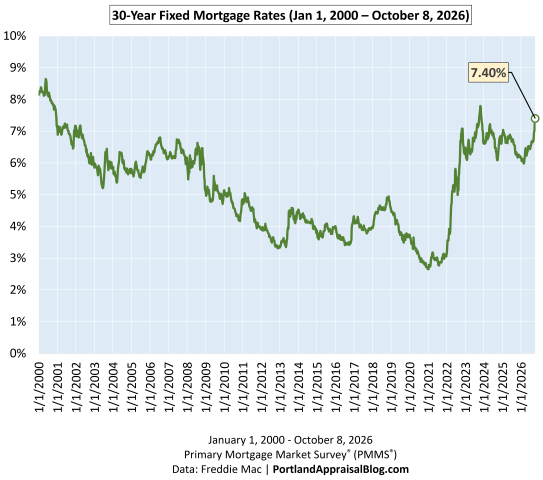
Long‑Run View (Since 2000)
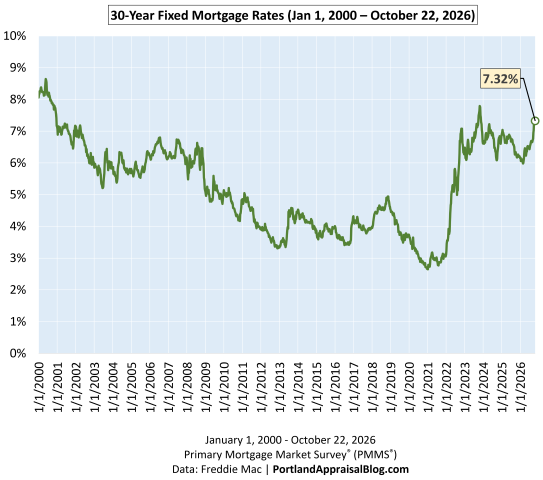
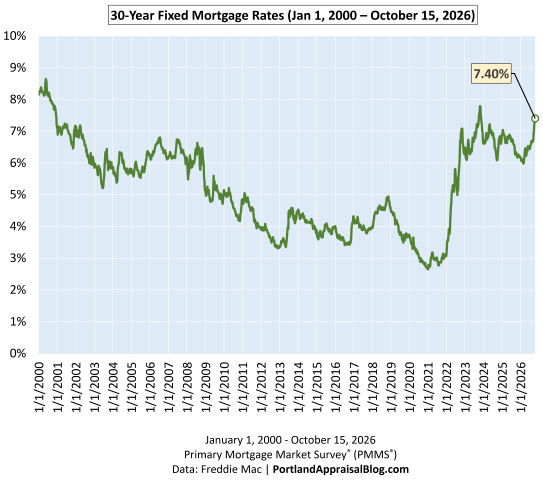
The long‑run chart shows how today’s rate fits into a 25‑year history of mortgage cycles. The early 2000s sat in the 6–8% range, the post‑Great Recession era brought a decade of unusually low rates, and the pandemic period pushed borrowing costs to historic lows. Years after leaving that ultra‑low‑rate environment, the market continues to adjust to more difficult financing constraints, and today’s 6.47% reflects that ongoing shift. Even with this week’s modest decline, rates remain elevated in a long‑term context, and the broader affordability landscape remains shaped by the same structural pressures highlighted in the medium‑run and short‑run views.

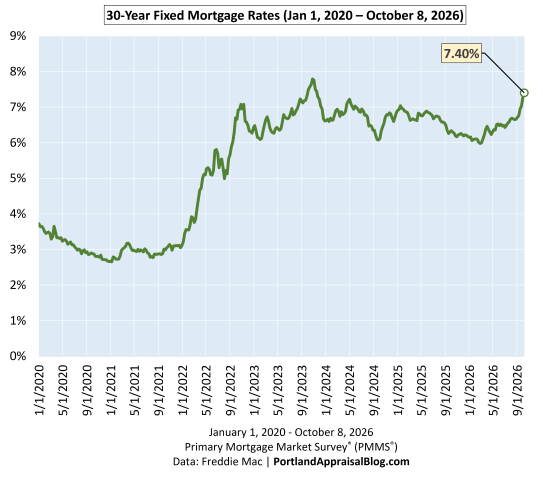
Medium‑Run View (Since COVID)
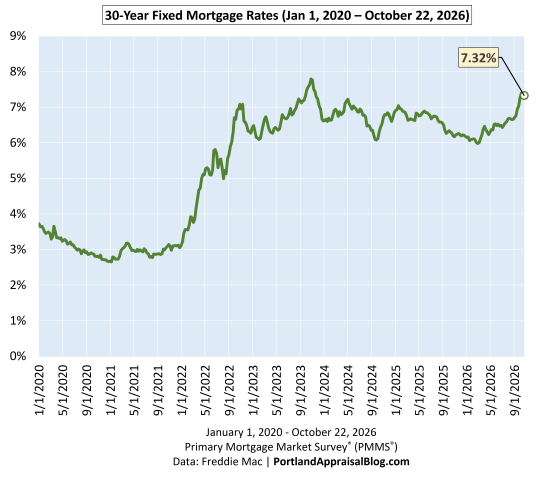
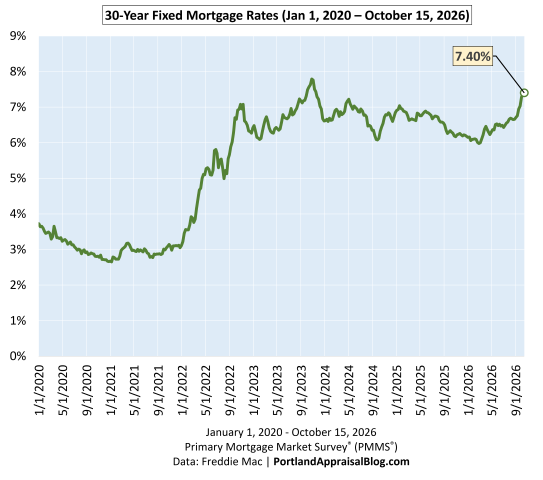
The COVID‑era chart highlights the dramatic rate compression of 2020–2021, the rapid surge of 2022, and the choppy plateau that has defined the past two years. Rates have been oscillating between roughly 6% and 7% since mid‑2023, and today’s 6.47% sits near the middle of that band. Volatility has cooled compared to 2022, but the medium‑run trend remains one of elevated and persistent borrowing costs, with the market continuing to adjust to structurally higher financing conditions across the Portland Region.

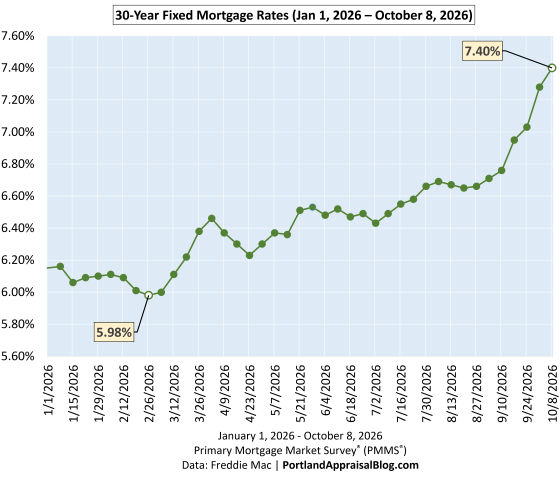
Short‑Run View (2026 YTD)
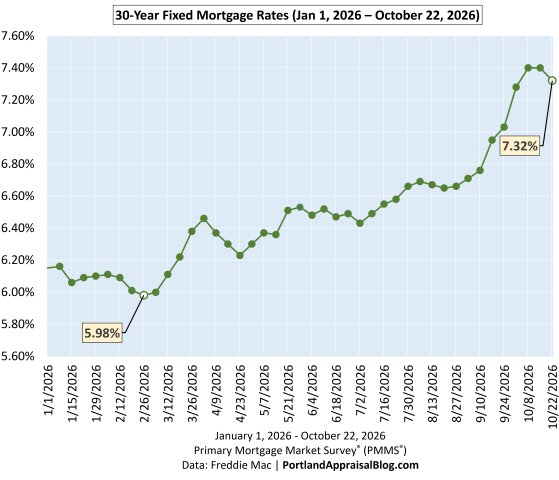
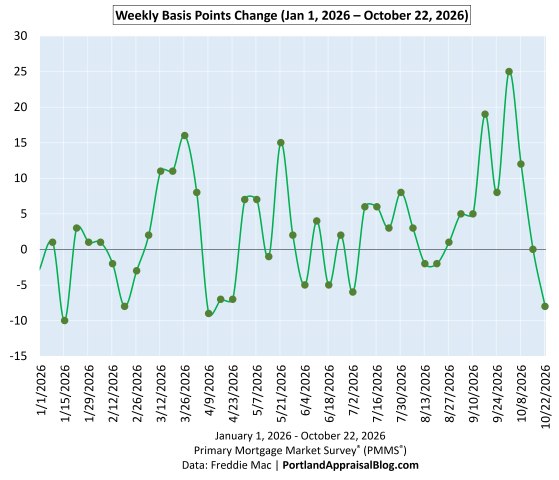
The year‑to‑date chart shows the full shape of the 2026 cycle: a clear bottom at 5.98% on February 26th, a sharp rise into early April, a brief cooldown, and a renewed climb that pushed rates to 6.53% in late May—the highest level of the year. This week’s reading of 6.47% brings us slightly off that peak, but affordability remains near its weakest point of 2026. This short‑run pattern is the most relevant for buyers today, as it directly shapes monthly payments and qualifying power across the Portland Region.

Portland Appraisal Blog Affordability Index (PABAI)

What PABAI Measures

The Portland Appraisal Blog Affordability Index (PABAI) measures how the average home close price compares to what a median‑income household can qualify for under standard lending assumptions (HUD Portland‑Vancouver‑Hillsboro MSA median income, 20% down, and a 28% DTI for principal, interest, taxes, insurance, and HOA dues).

Unlike national affordability indices, PABAI is built from actual RMLS transactions—all 3,349 detached sales for the Portland Region in Q1 2026—which allows for far more precise, locally grounded insights into Portland‑area affordability than any national model can provide.

A PABAI of 100 means the market is exactly affordable at that income level (the Q1 2026 HUD median MSA income was $124,100 for a family of four). Values above 100 indicate excess qualifying capacity (more affordable), while values below 100 indicate a shortfall (strained affordability). Full methodology and the interpretation scale are available on the PABAI explainer page.

PABAI RangeInterpretation
120+Strongly Affordable
100–119Moderately Affordable
80–99Strained
Below 80Severely Constrained

Q1 2026: Actual vs. Constant‑Rate Affordability
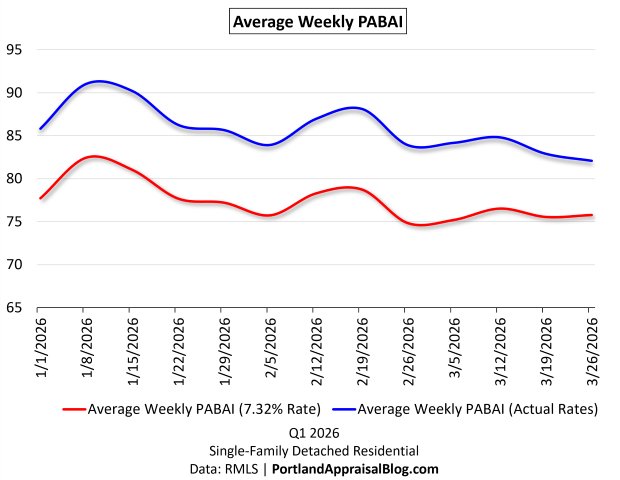
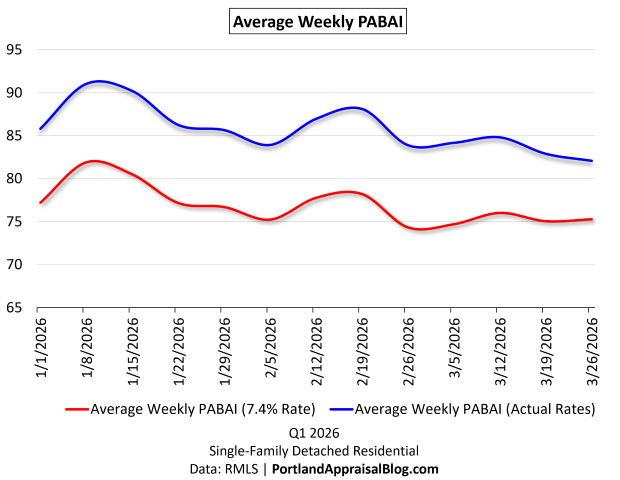
The Q1 chart compares two versions of PABAI: one using actual weekly mortgage rates, and one using today’s rate (6.47%) as a constant. Because the constant‑rate line uses a rate near the top of the 2026 range, it naturally sits below the actual‑rate line for most of the quarter. That part isn’t the story.

The key insight is the size and behavior of the gap between the two lines. Early in the quarter, actual rates were meaningfully lower than today’s 6.47% level, giving buyers more qualifying power than a flat‑rate environment would suggest. But as rates climbed through March and into April, the two lines began to converge—a visual confirmation of how persistent rate increases eroded affordability heading into spring. Today’s 6.47% rate keeps the constant‑rate line very close to the actual‑rate line at the end of Q1, reflecting the tightening affordability conditions that carried into mid‑ and late‑spring across the Portland Region.

Structural Unaffordability and the Seasonal Pattern

Detached homes in the Portland Region remain structurally unaffordable to a household earning the HUD median MSA income. PABAI has been below 100 for years, and Q1 2026 continues that pattern. What the chart makes clear is that winter remains the best window for buyers on tight qualifying budgets: affordability improves when rates soften and seasonal pricing cools. As spring approaches, both rates and prices firm up, and affordability reliably compresses.

With the 30‑year fixed now sitting near the highest levels of 2026, the convergence of the two PABAI lines at the end of the quarter reflects the same reality: rising rates have pushed qualifying costs to their weakest point of the year, and the early‑year affordability advantage has largely evaporated. Today’s 6.47% reading keeps affordability firmly in the strained range, underscoring how sensitive the market remains to even small rate movements.

Affordability Snapshot (This Week)

Q1 2026 Affordability Recomputed at Today’s Rate

The table below shows how Q1 2026 affordability metrics change when all 3,349 detached sales are recalculated at this week’s 6.47% rate. This is the clearest way to see how rising rates reshape qualifying power, housing burden, and the share of homes accessible to a median‑income household.

Because today’s rate sits near the top of the 2026 range, the recomputed metrics show a meaningful deterioration in affordability relative to the actual Q1 environment. Required income rises, housing burden increases, and the number of homes affordable to a median‑income household falls sharply—a direct reflection of how even small rate increases compound at elevated levels in the Portland Region.

MetricActual Q1 2026Recomputed at Today’s RateChange
Average PABAI80.4778.14−2.33
Required income (28% ratio)~154,226~158,813+2.97%
Median‑income shortfall24.28%27.97%+3.69 pts
Avg monthly mortgage pmt$4,174.36$4,297.24+$122.88
Avg housing burden (DTI)40.36%41.55%+1.19 pts
# of Affordable homes738618−120 homes
% of homes affordable22.00%18.45%−3.55 pts
Single-family Detached | Q1 2026
HUD Portland‑Vancouver‑Hillsboro MSA median income: $124,100
Data: RMLS (3,349 observations) | PortlandAppraisalBlog.com

How Rising Rates Reshape Affordability

Taken together, these metrics show how quickly affordability erodes when rates rise into the mid‑6% range. The drop in Average PABAI from 80.47 to 78.14 may look modest at first glance, but it represents a meaningful tightening of qualifying power across the entire detached market. Required income rises to roughly $158,800, widening the gap between what a median‑income household earns and what the market demands. That shortfall now approaches 28%, a reminder that the typical Portland household remains well outside traditional affordability thresholds defined in the PABAI framework.

The payment side tells the same story. Recomputing Q1 sales at today’s 6.47% rate pushes the average monthly mortgage obligation up by about $123, which may seem incremental on a monthly basis but compounds sharply over a 30‑year horizon. More importantly, the higher rate pushes the average front‑end DTI from 40.36% to 41.55%, a level that would be considered stretched even in more forgiving underwriting environments. These shifts are not abstract; they directly shape who can buy, what they can buy, and how competitive they can be in the Portland Region.

The Buyer‑Side Impact

The most visible consequence of these changes is the shrinking pool of homes accessible to a median‑income household. Under actual Q1 2026 rates, 738 detached homes were affordable; at today’s 6.47% rate, that number falls to 618. In percentage terms, the share of the market within reach drops from 22.0% to 18.45%—a loss of more than three and a half percentage points in a single recalculation. This is the practical expression of rising rates: fewer viable options, tighter qualifying margins, and a market that becomes increasingly selective about who can participate in the Portland Region.

For buyers, the experience varies by circumstance but the direction is the same. Households with limited flexibility feel the tightening most acutely, as even small rate movements can eliminate entire segments of the market. Move‑up buyers face a widening payment gap between their current home and the next one, making the trade‑up calculus more difficult unless equity is substantial. Cash buyers, by contrast, gain relative leverage as financed demand thins—though that advantage is uneven across price tiers.

Across all buyer types, the message is consistent: rising rates are reshaping the market in real time, and the affordability landscape at a 6.47% mortgage rate is meaningfully different from the one buyers faced just a few months ago. The shift is incremental week to week, but cumulative in effect—a defining feature of today’s strained affordability environment.

The Seller‑Side Impact

Rising rates don’t just reshape the buyer experience—they influence seller outcomes as well. In the Q1 2026 detached market, cumulative days on market (CDOM) increased 11.27%, and the current rate environment suggests that upward pressure on market times may persist. As affordability tightens and the pool of qualified buyers shrinks, homes that would have moved quickly in a lower‑rate environment may begin to sit longer, particularly in segments where pricing is already stretched.

Today’s 6.47% rate keeps financing conditions near the most challenging levels of 2026, reinforcing the same dynamic: fewer qualified buyers, more selective demand, and a market where pricing precision matters. This doesn’t imply an abrupt market slowdown, but it does mean sellers should expect a more deliberate buyer pool and prepare for longer market times—especially in higher‑priced tiers where rate sensitivity is most acute.

TIP: Total Interest Paid — Why Small Rate Moves Matter

Total Interest Paid (TIP) is one of the clearest ways to understand how mortgage rates shape long‑run affordability. While buyers shop based on monthly payment, the lifetime cost of borrowing moves far more dramatically than the payment itself. Even small rate changes can add—or remove—tens of thousands of dollars in interest over the life of a loan.

At today’s 6.47% rate, the lifetime interest on a standard Portland‑area purchase sits far above the levels buyers saw during the pandemic and meaningfully higher than the early‑March lows of this year. The difference between a 5.98% environment and a 6.47% environment may feel subtle on a monthly basis, but over 30 years it compounds into a substantial increase in total repayment—the kind of shift that materially affects long‑run household finances in the Portland Region.

This is why TIP matters: it captures the hidden cost of rising rates. Buyers feel the payment, but the long‑run financial burden is embedded in the interest curve. As the charts below show, the 2026 rate path has pushed TIP to some of the highest levels of the year, even as the monthly payment has moved more gradually. The cumulative effect is what reshapes affordability—a dynamic that becomes especially clear when comparing TIP across different rate scenarios.

2026 YTD Total Interest Paid

Note: The y-axis starts at $500,000 to allow better examination of monthly differences.

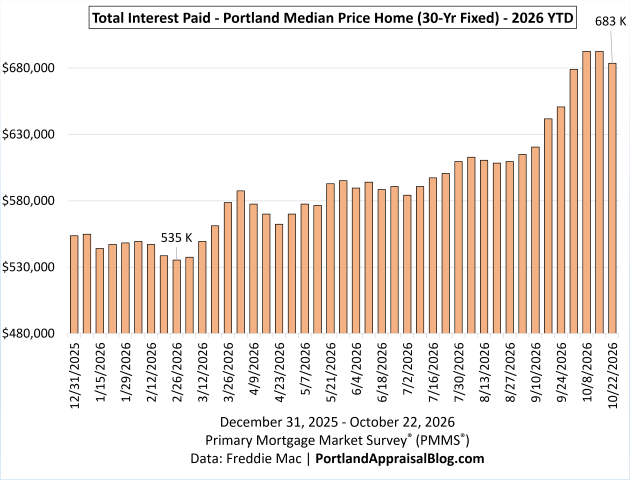
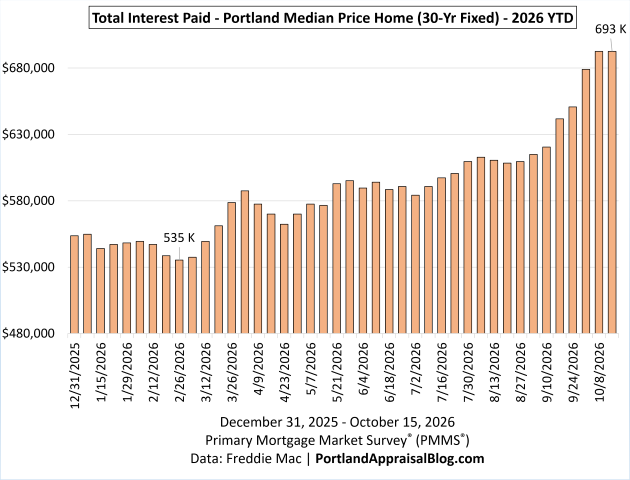
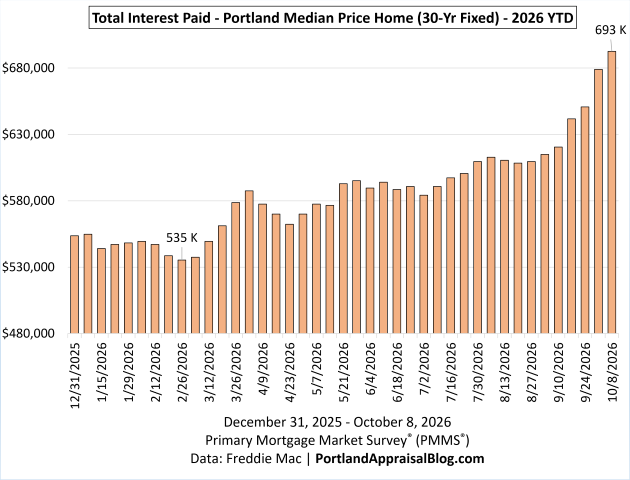
The 2026 YTD TIP chart shows how sharply lifetime borrowing costs have moved as rates climbed through the first half of the year. These calculations are based on the total interest a buyer would pay on the Q1 2026 Portland median‑priced home of $580,000, assuming a 20% down payment and applying the rate effective in each week. This isolates the impact of rate movements alone, holding price and loan structure constant.

The low point came on February 26th, when a 5.98% mortgage rate produced a total interest burden of $535,342. As rates rose through March and into late May, TIP increased steadily, reaching a year‑to‑date high of $595,104 at the 6.53% rate on May 28th—nearly a $60,000 increase in lifetime interest in just three months, driven entirely by rate movement.

This week’s 6.47% rate pulls TIP down slightly from last week’s level: the total interest burden at today’s rate is $588,513, a modest improvement but still among the highest readings of the year. The shape of the chart makes the pattern unmistakable—at today’s price levels, even small rate changes translate into large long‑run cost differences. Buyers feel the monthly payment, but the lifetime interest curve is where the true financial impact of rising rates becomes visible, especially when comparing TIP across different rate environments.

TIP per $1 Borrowed

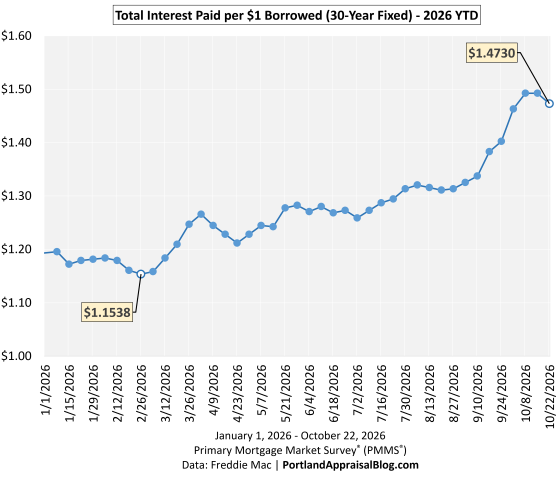
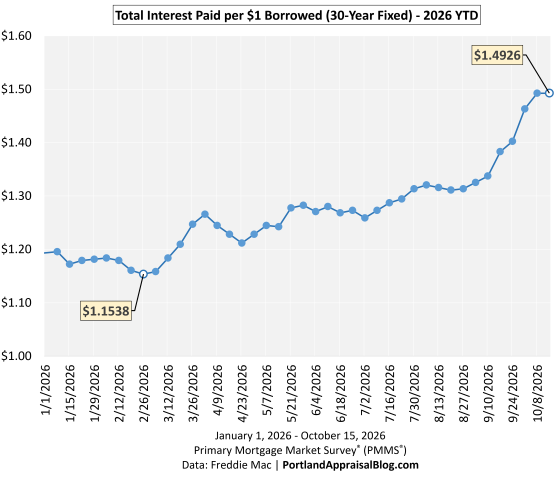
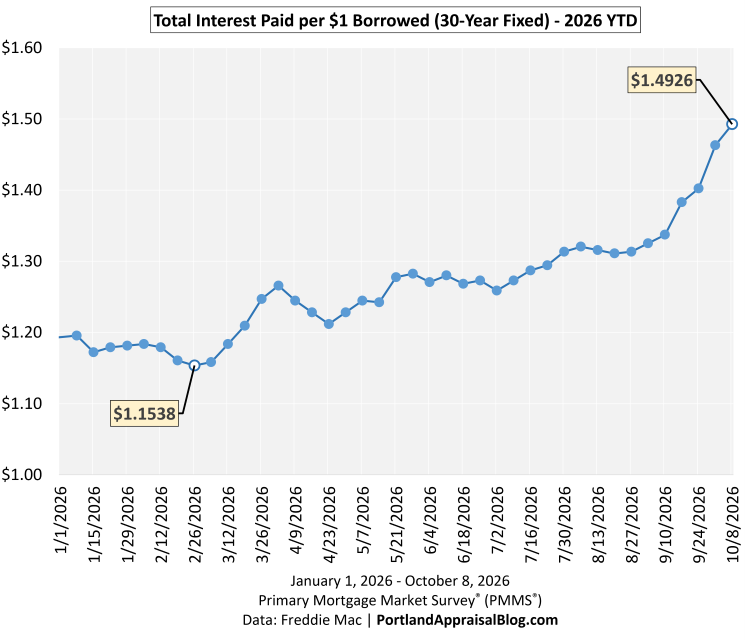
The TIP‑per‑$1 chart shows how much interest a buyer pays for every dollar borrowed at different mortgage rates. This is the clearest way to visualize the rate sensitivity of long‑run borrowing costs. At the year‑to‑date low of 5.98%, each dollar borrowed generated about $1.1538 in interest over the life of the loan. As rates climbed through the spring, that figure rose steadily, reaching $1.2826 at the late‑May peak of 6.53%.

Today’s 6.47% rate places the cost at $1.2683 per $1 borrowed, a slight improvement from last week but still near the highest levels of the year. The line makes the pattern clear: once rates move into the mid‑6% range, each additional uptick adds meaningfully more lifetime interest—a dynamic that becomes especially clear when comparing rate environments side by side.

Regional Interest Delta (RID)

The Regional Interest Delta (RID) models how much total lifetime interest the Portland Region’s Q1 detached‑home buyers would collectively pay when mortgage rates shift. To keep the metric consistent, RID assumes that all 3,349 Q1 detached sales were financed under standard 20%‑down, 30‑year conventional underwriting, even though the actual dataset includes cash purchases and loans under FHA, VA, jumbo, and other programs. Rates are matched to each home’s close date to reflect the real timing of rate movements, but individual buyers may have locked slightly different rates depending on their specific loan terms. This approach provides a clean, apples‑to‑apples way to measure how rate changes affect the region’s total interest burden.

ScenarioRateTotal Lifetime InterestRID
Actual Q1 2026 PipelineActual rate matched to close date$2,091,901,976
Modeled at Today’s Rate6.47%$2,240,052,110+$148,150,134
Single-family Detached | Q1 2026
Data: RMLS (3,349 observations) | PortlandAppraisalBlog.com

Using those actual matched rates, the region’s Q1 2026 pipeline will generate $2,091,901,976 in lifetime interest. Recomputing the same loans at today’s 6.47% rate increases the total to $2,240,052,110. The difference—the RID—is $148,150,134 in additional lifetime interest.

To put that number in perspective: $152 million is the cost of hollywoodHUB, a 222‑unit affordable housing development in Portland. A single rate shift—applied across one quarter’s mortgage activity—creates a lifetime interest delta on the scale of building an entire affordable housing project from the ground up. Today’s RID comes in just below that benchmark, but still represents a nine‑figure increase in long‑run borrowing costs driven solely by rate movement.

RID makes the scale of rate changes unmistakable. What looks like a modest shift at the household level becomes a region‑wide financial impact when applied across thousands of loans—a reminder of how sensitive the Portland market remains to even small movements in the 30‑year fixed.

Payment Delta

The Payment Delta shows how monthly affordability shifts as mortgage rates move. Using the Q1 2026 Portland median‑priced home of $580,000 with a 20% down payment, the monthly principal‑and‑interest payment changes meaningfully even with small rate movements.

DateRateMonthly P&I
Feb 26, 20265.98%$2,775.95
May 28, 20266.53%$2,941.96
Jun 18, 20266.47%$2,923.65
Monthly payment for home using median Q1 2026 price ($580,000) and 20% down.
Primary Mortgage Market Survey® (PMMS®)
Data: Freddie Mac | PortlandAppraisalBlog.com

From the YTD low to the late‑May peak, the monthly payment increased by $166, and today’s payment remains $148 higher than the February low.

While the Payment Delta is smaller in scale than the lifetime interest changes shown in TIP and RID, it is the number buyers feel most immediately. For households shopping at the lower end of the market, even a $150‑range shift can meaningfully affect qualifying ratios, required down payment, or even which housing types remain viable—such as moving from detached homes to attached or condos. These adjustments often matter more for affordability‑sensitive buyers than for the broader market.

Closing Thoughts

The story of this week is straightforward: mortgage rates remain elevated, and the effects are visible across every major affordability metric. The PABAI continues to signal structural strain for median‑income households, and the recalculated Q1 data shows how even modest rate movements reshape qualifying power, monthly payments, and the share of homes within reach. The TIP and RID visuals make the pattern clear: higher rates don’t just affect individual buyers—they reshape the long‑run financial burden carried across the entire region.

For buyers, the takeaway is that financing conditions remain tight as we move into early summer. Winter continues to offer the best affordability window, but today’s rate environment means households on the margin feel pressure sooner and more sharply than in prior years. Even a $150‑range shift in the Payment Delta can influence qualifying ratios, required down payment, or which housing types remain viable—including whether buyers need to consider attached homes or condos instead of detached options.

For sellers, the implications are more subtle but no less real. The Q1 2026 detached market saw CDOM rise more than 11%, and the current rate backdrop suggests that upward pressure on market times may persist. A smaller pool of qualified buyers and higher monthly payments can translate into longer exposure, especially for homes priced aggressively or positioned in segments where affordability is already stretched. Pricing discipline and realistic expectations matter more in this environment than they did during the ultra‑low‑rate era.

As always, the Portland market adapts—sometimes quickly, sometimes reluctantly—but the direction of travel is clear. Higher rates are reshaping both sides of the transaction, and the early summer of 2026 is operating under some of the most constrained financing conditions we’ve seen this year.

Sources & Further Reading

All data presented in this weekly mortgage rate update is based on the Q1 2026 detached homes segment. The data is sourced directly from RMLS and has been subjected to rigorous cleaning and validation processes to ensure reliability for detached single-family residential analysis in the six-county Portland Region. The trends, comparisons, and commentary are the result of original appraisal expertise and independent analysis—not aggregated from secondary sources or news summaries.

Coda

Thanks for reading—I hope you found a useful insight or an unexpected nugget along the way. If you enjoyed the post, please consider subscribing for future updates.

Are you an agent in Portland who wonders why appraisers always do “x”?

A homeowner with questions about appraiser methodology?

If so, feel free to reach out—I enjoy connecting with market participants across Portland and the surrounding counties, and am always happy to help where I can.

And if you’re in need of appraisal services in Portland or anywhere in the Portland Region, we’d be glad to assist.

Portland Region Housing Affordability Snapshot – Rates Climb to 6.52% (June 11, 2026)

At today’s 6.52% mortgage rate, the monthly principal‑and‑interest payment on a Q1 2026 Portland Region median-priced detached home ($580,000) with 20% down is $2,939, up from $2,776 at February’s low. Lifetime interest rises to $594,004, and repricing all Q1 loans at today’s rate adds $169M in regional interest.

What Happened This Week

Mortgage rates inched higher this week, with the 30‑year fixed rising to 6.52%, up 4 bps from last week and now sitting just 1 basis point below the year‑to‑date high. The broader 2026 pattern remains unchanged: rates bottomed on March 5th, surged through early April, cooled briefly, and then turned upward again on April 23rd. With this week’s move, we are effectively back at the top of the 2026 range, and the spring cooldown remains firmly behind us.

Affordability continues to deteriorate at these elevated levels. Even a modest 4 bps increase carries weight when rates are this high, and monthly payments remain near their most challenging point of the year. As the charts below show, today’s rate sits right against the ceiling of the year‑to‑date range, and the PABAI reflects the compounding affordability pressure facing buyers across the Portland Region .

Mortgage Rate Context

Long‑Run View (Since 2000)

The long‑run chart shows how today’s rate fits into a 25‑year history of mortgage cycles. The early 2000s sat in the 6–8% range, the post‑Great Recession era brought a decade of unusually low rates, and the pandemic period pushed borrowing costs to historic lows. Years after leaving that ultra‑low‑rate environment, the market continues to adjust to more difficult financing constraints, and today’s 6.52% reflects that ongoing shift.

Medium‑Run View (Since COVID)

The COVID‑era chart highlights the dramatic rate compression of 2020–2021, the rapid surge of 2022, and the choppy plateau that has defined the past two years. Rates have been oscillating between roughly 6% and 7% since mid‑2023, and today’s 6.52% sits near the upper half of that band. Volatility has cooled compared to 2022, but the medium‑run trend remains one of elevated and persistent borrowing costs.

Short‑Run View (2026 YTD)

The year‑to‑date chart shows the full shape of the 2026 cycle: a clear bottom at 5.98% on February 26th, a sharp rise into early April, a brief cooldown, and a renewed climb that pushed rates to 6.53% in late May—the highest level of the year. This week’s reading of 6.52% keeps us essentially at that peak, and affordability remains near its weakest point of 2026. This short‑run pattern is the most relevant for buyers today, as it directly shapes monthly payments and qualifying power.

Portland Appraisal Blog Affordability Index (PABAI)

What PABAI Measures

The Portland Appraisal Blog Affordability Index (PABAI) measures how the average home close price compares to what a median‑income household can qualify for under standard lending assumptions (HUD Portland‑Vancouver‑Hillsboro MSA median income, 20% down, and a 28% DTI for principal, interest, taxes, insurance, and HOA dues).

Unlike national affordability indices, PABAI is built from actual RMLS transactions—all 3,349 detached sales for the Portland Region in Q1 2026—which allows for far more precise, locally grounded insights into Portland‑area affordability than any national model can provide.

A PABAI of 100 means the market is exactly affordable at that income level (the Q1 2026 HUD median MSA income was $124,100 for a family of four). Values above 100 indicate excess qualifying capacity (more affordable), while values below 100 indicate a shortfall (strained affordability). Full methodology and the interpretation scale are available on the PABAI explainer page.

PABAI RangeInterpretation
120+Strongly Affordable
100–119Moderately Affordable
80–99Strained
Below 80Severely Constrained

Q1 2026: Actual vs. Constant‑Rate Affordability

The Q1 chart compares two versions of PABAI: one using actual weekly mortgage rates, and one using today’s rate (6.52%) as a constant. Because the constant‑rate line uses a rate near the top of the 2026 range, it naturally sits below the actual‑rate line for most of the quarter. That part isn’t the story.

The key insight is the size and behavior of the gap between the two lines. Early in the quarter, actual rates were meaningfully lower than today’s rate, giving buyers more qualifying power than a flat‑rate environment would suggest. But as rates climbed through March and into April, the two lines began to converge—a visual confirmation of how persistent rate increases eroded affordability heading into spring. Today’s 6.52% rate keeps the constant‑rate line very close to the actual‑rate line at the end of Q1, reflecting the tightening affordability conditions that carried into mid‑ and late‑spring.

Structural Unaffordability and the Seasonal Pattern

Detached homes in the Portland Region remain structurally unaffordable to a household earning the HUD median MSA income. PABAI has been below 100 for years, and Q1 2026 continues that pattern. What the chart makes clear is that winter remains the best window for buyers on tight qualifying budgets: affordability improves when rates soften and seasonal pricing cools. As spring approaches, both rates and prices firm up, and affordability reliably compresses.

With the 30‑year fixed now sitting near the highest levels of 2026, the convergence of the two PABAI lines at the end of the quarter reflects the same reality: rising rates have pushed qualifying costs to their weakest point of the year, and the early‑year affordability advantage has largely evaporated.

Affordability Snapshot (This Week)

Q1 2026 Affordability Recomputed at Today’s Rate

The table below shows how Q1 2026 affordability metrics change when all 3,349 detached sales are recalculated at this week’s 6.52% rate. This is the clearest way to see how rising rates reshape qualifying power, housing burden, and the share of homes accessible to a median‑income household.

Because today’s rate sits near the top of the 2026 range, the recomputed metrics show a meaningful deterioration in affordability relative to the actual Q1 environment. Required income rises, housing burden increases, and the number of homes affordable to a median‑income household falls sharply — a direct reflection of how even small rate increases compound at elevated levels.

MetricActual Q1 2026Recomputed at Today’s RateChange
Average PABAI80.4777.83−2.64
Required income (28% ratio)~154,226~159,457+3.39%
Median‑income shortfall24.28%28.49%+4.21 pts
Avg monthly mortgage pmt$4,174.36$4,314.58+$140.22
Avg housing burden (DTI)40.36%41.72%+1.36 pts
# of Affordable homes738599−139 homes
% of homes affordable22.0%17.9%−4.1 pts
Single-family Detached | Q1 2026
HUD Portland‑Vancouver‑Hillsboro MSA median income: $124,100
Data: RMLS (3,349 observations) | PortlandAppraisalBlog.com

How Rising Rates Reshape Affordability

Taken together, these metrics show how quickly affordability erodes when rates rise into the mid‑6% range. The drop in Average PABAI from 80.47 to 77.83 may look modest at first glance, but it represents a meaningful tightening of qualifying power across the entire detached market. Required income rises to roughly $159,500, widening the gap between what a median‑income household earns and what the market demands. That shortfall now approaches 28.5%, a reminder that the typical Portland household remains well outside traditional affordability thresholds.

The payment side tells the same story. Recomputing Q1 sales at today’s rate pushes the average monthly mortgage obligation up by about $140, which may seem incremental on a monthly basis but compounds sharply over a 30‑year horizon. More importantly, the higher rate pushes the average front‑end DTI from 40.36% to 41.72%, a level that would be considered stretched even in more forgiving underwriting environments. These shifts are not abstract; they directly shape who can buy, what they can buy, and how competitive they can be.

The Buyer‑Side Impact

The most visible consequence of these changes is the shrinking pool of homes accessible to a median‑income household. Under actual Q1 2026 rates, 738 detached homes were affordable; at today’s rate, that number falls to 599. In percentage terms, the share of the market within reach drops from 22.0% to 17.9%—a loss of just over four percentage points in a single recalculation. This is the practical expression of rising rates: fewer viable options, tighter qualifying margins, and a market that becomes increasingly selective about who can participate.

For buyers, the experience varies by circumstance but the direction is the same. Households with limited flexibility feel the tightening most acutely, as even small rate movements can eliminate entire segments of the market. Move‑up buyers face a widening payment gap between their current home and the next one, making the trade‑up calculus more difficult unless equity is substantial. Cash buyers, by contrast, gain relative leverage as financed demand thins—though that advantage is uneven across price tiers.

Across all buyer types, the message is consistent: rising rates are reshaping the market in real time, and the affordability landscape at a 6.52% mortgage rate is meaningfully different from the one buyers faced just a few months ago.

The Seller‑Side Impact

Rising rates don’t just reshape the buyer experience — they influence seller outcomes as well. In the 2025 detached market, cumulative days on market (CDOM) increased 11.09%, and the current rate environment suggests that upward pressure on market times may persist. As affordability tightens and the pool of qualified buyers shrinks, homes that would have moved quickly in a lower‑rate environment may begin to sit longer, particularly in segments where pricing is already stretched. This doesn’t imply an abrupt market shutdown, but it does mean sellers need to price with greater precision and expect a more selective buyer pool as 2026 progresses.

TIP: Total Interest Paid — Why Small Rate Moves Matter

Total Interest Paid (TIP) is one of the clearest ways to understand how mortgage rates shape long‑run affordability. While buyers shop based on monthly payment, the lifetime cost of borrowing moves far more dramatically than the payment itself. Even small rate changes can add—or remove—tens of thousands of dollars in interest over the life of a loan.

At today’s 6.52% rate, the lifetime interest on a standard Portland‑area purchase sits far above the levels buyers saw during the pandemic and meaningfully higher than the early‑March lows of this year. The difference between a 5.98% environment and a 6.52% environment may feel subtle on a monthly basis, but over 30 years it compounds into a substantial increase in total repayment.

This is why TIP matters: it captures the hidden cost of rising rates. Buyers feel the payment, but the long‑run financial burden is embedded in the interest curve. As the charts below show, the 2026 rate path has pushed TIP to some of the highest levels of the year, even as the monthly payment has moved more gradually.

2026 YTD Total Interest Paid

The 2026 YTD TIP chart shows how sharply lifetime borrowing costs have moved as rates climbed through the first half of the year. These calculations are based on the total interest a buyer would pay on the Q1 2026 Portland median‑priced home of $580,000, assuming a 20% down payment and applying the rate effective in each week. This isolates the impact of rate movements alone, holding price and loan structure constant.

The low point came on February 26th, when a 5.98% mortgage rate produced a total interest burden of $535,342. As rates rose through March and into late May, TIP increased steadily, reaching a year‑to‑date high of $595,104 at the 6.53% rate on May 28th. That’s nearly a $60,000 increase in lifetime interest in just three months, driven entirely by rate movement.

This week’s 6.52% rate nudges TIP slightly off the peak, by a single basis point: the total interest burden at today’s rate is $594,004. The shape of the chart makes the pattern unmistakable—at today’s price levels, even small rate changes translate into large long‑run cost differences. Buyers feel the monthly payment, but the lifetime interest curve is where the true financial impact of rising rates becomes visible.

TIP per $1 Borrowed

The TIP‑per‑$1 chart shows how much interest a buyer pays for every dollar borrowed at different mortgage rates. This is the clearest way to visualize the rate sensitivity of long‑run borrowing costs. At the year‑to‑date low of 5.98%, each dollar borrowed generated about $1.15 in interest over the life of the loan. As rates climbed through the spring, that figure rose steadily, reaching $1.2826 at the late‑May peak of 6.53%. Today’s 6.52% rate places the cost at $1.2802 per $1 borrowed, only slightly below the YTD high.

Regional Interest Delta (RID)

The Regional Interest Delta (RID) models how much total lifetime interest the Portland Region’s Q1 detached‑home buyers would collectively pay when mortgage rates shift. To keep the metric consistent, RID assumes that all 3,349 Q1 detached sales were financed under standard 20%‑down, 30‑year conventional underwriting, even though the actual dataset includes cash purchases and loans under FHA, VA, jumbo, and other programs. Rates are matched to each home’s close date to reflect the real timing of rate movements, but individual buyers may have locked slightly different rates depending on their specific loan terms. This approach provides a clean, apples‑to‑apples way to measure how rate changes affect the region’s total interest burden.

ScenarioRateTotal Lifetime InterestRID
Actual Q1 2026 PipelineActual rate matched to close date$2,091,901,976
Modeled at Today’s Rate6.52%$2,260,954,353+$169,052,377
Single-family Detached | Q1 2026
Data: RMLS (3,349 observations) | PortlandAppraisalBlog.com

Using those actual matched rates, the region’s Q1 2026 pipeline will generate $2,091,901,976 in lifetime interest. Recomputing the same loans at today’s 6.52% rate increases the total to $2,260,954,353. The difference—the RID—is $169,052,377 in additional lifetime interest.

To put that number in perspective: $152 million is the cost of hollywoodHUB, a 222‑unit affordable housing development in Portland. A single rate shift—applied across one quarter’s mortgage activity—creates a lifetime interest delta more than building an entire affordable housing project from the ground up.

RID makes the scale of rate movements unmistakable. What looks like a modest rate change at the household level becomes a nine‑figure regional impact when applied across thousands of loans.

Payment Delta

The Payment Delta shows how monthly affordability shifts as mortgage rates move. Using the Q1 2026 Portland median‑priced home of $580,000 with a 20% down payment, the monthly principal‑and‑interest payment changes meaningfully even with small rate movements.

DateRateMonthly P&I
Feb 26, 20265.98%$2,775.95
May 28, 20266.53%$2,941.96
Jun 11, 20266.52%$2,938.90
Monthly payment for home using median Q1 2026 price ($580,000) and 20% down.
Primary Mortgage Market Survey® (PMMS®)
Data: Freddie Mac | PortlandAppraisalBlog.com

From the YTD low to the late‑May peak, the monthly payment increased by $166, and today’s payment remains $163 higher than the February low.

While the Payment Delta is smaller in scale than the lifetime interest changes shown in TIP and RID, it is the number buyers feel most immediately. For households shopping at the lower end of the market, even a $150–$175 shift can meaningfully affect qualifying ratios, required down payment, or even which housing types remain viable—such as moving from detached homes to attached or condos. These adjustments often matter more for affordability‑sensitive buyers than for the broader market.

Closing Thoughts

The story of this week is straightforward: mortgage rates remain elevated, and the effects are visible across every major affordability metric. The PABAI continues to signal structural strain for median‑income households, and the recalculated Q1 data shows how even modest rate movements reshape qualifying power, monthly payments, and the share of homes within reach. The TIP and RID visuals make the pattern clear: higher rates don’t just affect individual buyers—they reshape the long‑run financial burden carried across the entire region.

For buyers, the takeaway is that financing conditions remain tight as we move into early summer. Winter continues to offer the best affordability window, but today’s rate environment means households on the margin feel pressure sooner and more sharply than in prior years. Even a $150–$175 shift in the Payment Delta can influence qualifying ratios, required down payment, or which housing types remain viable.

For sellers, the implications are more subtle but no less real. Last year’s detached market saw CDOM rise more than 11%, and the current rate backdrop suggests that upward pressure on market times may persist. A smaller pool of qualified buyers and higher monthly payments can translate into longer exposure, especially for homes priced aggressively or positioned in segments where affordability is already stretched. Pricing discipline and realistic expectations matter more in this environment than they did during the ultra‑low‑rate era.

As always, the Portland market adapts—sometimes quickly, sometimes reluctantly—but the direction of travel is clear. Higher rates are reshaping both sides of the transaction, and the early summer of 2026 is operating under some of the most constrained financing conditions we’ve seen this year.

Sources & Further Reading

All data presented in this weekly mortgage rate update is based on the Q1 2026 detached homes segment. The data is sourced directly from RMLS and has been subjected to rigorous cleaning and validation processes to ensure reliability for detached single-family residential analysis in the six-county Portland Region. The trends, comparisons, and commentary are the result of original appraisal expertise and independent analysis—not aggregated from secondary sources or news summaries.

Coda

Thanks for reading—I hope you found a useful insight or an unexpected nugget along the way. If you enjoyed the post, please consider subscribing for future updates.

Are you an agent in Portland who wonders why appraisers always do “x”?

A homeowner with questions about appraiser methodology?

If so, feel free to reach out—I enjoy connecting with market participants across Portland and the surrounding counties, and am always happy to help where I can.

And if you’re in need of appraisal services in Portland or anywhere in the Portland Region, we’d be glad to assist.

Portland Region Housing Affordability Snapshot – Rates Dip to 6.48% (June 4, 2026)

At today’s 6.48% mortgage rate, the monthly principal‑and‑interest payment on a Q1 2026 Portland Region median-priced detached home ($580,000) with 20% down is $2,926, up from $2,776 at February’s low. Lifetime interest rises to $589,610, and repricing all Q1 loans at today’s rate adds $152M in regional interest.

What Happened This Week

Mortgage rates eased slightly this week, with the 30‑year fixed slipping to 6.48% from last week’s 6.53%. It’s only a five‑basis‑point move, but it breaks the late‑May surge that pushed rates to their highest level of 2026. The broader pattern remains intact: rates bottomed at 5.98% on February 26th, climbed steadily through March, spiked sharply into early April, and then oscillated in a tight band before pushing to new highs in late May. Today’s reading pulls us just off the peak, but we’re still operating near the top of the year‑to‑date range.

Affordability remains strained despite the modest improvement. Monthly payments are still far above their late‑February lows, and qualifying costs remain among the toughest of the year. As the charts below show, today’s rate sits only a hair below last week’s high, and the PABAI continues to reflect a challenging affordability environment for the Portland Region as we move into June.

Mortgage Rate Context

Long‑Run View (Since 2000)

The long‑run chart shows how today’s rate fits into a 25‑year history of mortgage cycles. The early 2000s sat in the 6–8% range, the post‑Great Recession era brought a decade of unusually low rates, and the pandemic period pushed borrowing costs to historic lows. Years after leaving that ultra‑low‑rate environment, the market continues to adjust to more difficult financing constraints, and today’s 6.48% reflects that ongoing shift.

Medium‑Run View (Since COVID)

The COVID‑era chart highlights the dramatic rate compression of 2020–2021, the rapid surge of 2022, and the choppy plateau that has defined the past two years. Rates have been oscillating between roughly 6% and 7% since mid‑2023, and today’s 6.48% sits near the middle of that band. Volatility has cooled compared to 2022, but the medium‑run trend remains one of elevated and persistent borrowing costs.

Short‑Run View (2026 YTD)

The year‑to‑date chart shows the full shape of the 2026 cycle: a clear bottom at 5.98% on February 26th, a sharp rise into early April, a brief cooldown, and a renewed climb that pushed rates to 6.53% last week—the highest level of the year. This week’s dip to 6.48% pulls us slightly off that peak, but affordability remains near its weakest point of 2026. This short‑run pattern is the most relevant for buyers today, as it directly shapes monthly payments and qualifying power.

Portland Appraisal Blog Affordability Index (PABAI)

What PABAI Measures

The Portland Appraisal Blog Affordability Index (PABAI) measures how the average home close price compares to what a median‑income household can qualify for under standard lending assumptions (HUD Portland‑Vancouver‑Hillsboro MSA median income, 20% down, and a 28% DTI for principal, interest, taxes, insurance, and HOA dues).

Unlike national affordability indices, PABAI is built from actual RMLS transactions—all 3,349 detached sales for the Portland Region in Q1 2026—which allows for far more precise, locally grounded insights into Portland‑area affordability than any national model can provide.

A PABAI of 100 means the market is exactly affordable at that income level (the Q1 2026 HUD median MSA income was $124,100 for a family of four). Values above 100 indicate excess qualifying capacity (more affordable), while values below 100 indicate a shortfall (strained affordability). Full methodology and the interpretation scale are available on the PABAI explainer page.

PABAI RangeInterpretation
120+Strongly Affordable
100–119Moderately Affordable
80–99Strained
Below 80Severely Constrained

Q1 2026: Actual vs. Constant‑Rate Affordability

The Q1 chart compares two versions of PABAI: one using actual weekly mortgage rates, and one using today’s rate (6.48%) as a constant. Because the constant‑rate line uses a rate near the top of the 2026 range, it naturally sits below the actual‑rate line for most of the quarter. That part isn’t the story.

The key insight is the size and behavior of the gap between the two lines. Early in the quarter, actual rates were meaningfully lower than today’s rate, giving buyers more qualifying power than a flat‑rate environment would suggest. But as rates climbed through March and into April, the two lines began to converge—a visual confirmation of how persistent rate increases eroded affordability heading into spring. Today’s 6.48% rate keeps the constant‑rate line close to the actual‑rate line at the end of Q1, reflecting the tightening affordability conditions that carried into mid to late spring.

Structural Unaffordability and the Seasonal Pattern

Detached homes in the Portland Region remain structurally unaffordable to a household earning the HUD median MSA income. PABAI has been below 100 for years, and Q1 2026 continues that pattern. What the chart makes clear is that winter remains the best window for buyers on tight qualifying budgets: affordability improves when rates soften and seasonal pricing cools. As spring approaches, both rates and prices firm up, and affordability reliably compresses.

With the 30‑year fixed now sitting near the highest levels of 2026, the convergence of the two PABAI lines at the end of the quarter reflects the same reality: rising rates have pushed qualifying costs to their weakest point of the year, and the early‑year affordability advantage has largely evaporated.

Affordability Snapshot (This Week)

Q1 2026 Affordability Recomputed at Today’s Rate

The table below shows how Q1 2026 affordability metrics change when all 3,349 detached sales are recalculated at this week’s 6.48% rate. This is the clearest way to see how rising rates reshape qualifying power, housing burden, and the share of homes accessible to a median‑income household.

CategoryActual Q1 2026Recomputed at Today’s RateChange
Average PABAI80.4778.08-2.39
Required income (28% ratio)~$154,219~158,934+3.06%
Median-income shortfall24.3%28.07%+3.77 pts
Average monthly mortgage payment$4,174.06$4,300.40+$126.34
Average Housing burden (DTI)40.36%41.58%+1.22 pts
Affordable homes738611-127 homes
Share of homes affordable22.0%18.24%-3.76 pts
Single-family Detached | Q1 2026
HUD Portland‑Vancouver‑Hillsboro MSA median income: $124,100
Data: RMLS (3,349 observations) | PortlandAppraisalBlog.com

How Rising Rates Reshape Affordability

Taken together, these metrics show how quickly affordability erodes when rates rise into the mid‑6% range. The drop in Average PABAI from 80.47 to 78.08 may look modest at first glance, but it represents a meaningful tightening of qualifying power across the entire detached market. Required income rises to nearly $159,000, widening the gap between what a median‑income household earns and what the market demands. That shortfall now exceeds 28%, a reminder that the typical Portland household remains well outside traditional affordability thresholds.

The payment side tells the same story. Recomputing Q1 sales at today’s rate pushes the average monthly mortgage obligation up by roughly $126, which may seem incremental on a monthly basis but compounds sharply over a 30‑year horizon. More importantly, the higher rate pushes the average front‑end DTI from 40.36% to 41.58%, a level that would be considered stretched even in more forgiving underwriting environments. These shifts are not abstract; they directly shape who can buy, what they can buy, and how competitive they can be.

The Buyer‑Side Impact

The most visible consequence of these changes is the shrinking pool of homes accessible to a median‑income household. Under actual Q1 2026 rates, 738 detached homes were affordable; at today’s rate, that number falls to 611. In percentage terms, the share of the market within reach drops from 22.0% to 18.24%—a loss of nearly four percentage points in a single recalculation. This is the practical expression of rising rates: fewer viable options, tighter qualifying margins, and a market that becomes increasingly selective about who can participate.

For buyers, the experience varies by circumstance but the direction is the same. Households with limited flexibility feel the tightening most acutely, as even small rate movements can eliminate entire segments of the market. Move‑up buyers face a widening payment gap between their current home and the next one, making the trade‑up calculus more difficult unless equity is substantial. Cash buyers, by contrast, gain relative leverage as financed demand thins—though that advantage is uneven across price tiers.

Across all buyer types, the message is consistent: rising rates are reshaping the market in real time, and the affordability landscape at a 6.48% mortgage rate is meaningfully different from the one buyers faced just a few months ago.

The Seller‑Side Impact

Rising rates don’t just reshape the buyer experience—they influence seller outcomes as well. In the 2025 detached market, cumulative days on market (CDOM) increased 11.09%, and the current rate environment suggests that upward pressure on market times may persist. As affordability tightens and the pool of qualified buyers shrinks, homes that would have moved quickly in a lower‑rate environment may begin to sit longer, particularly in segments where pricing is already stretched. This doesn’t imply an abrupt market shutdown, but it does mean sellers need to price with greater precision and expect a more selective buyer pool as 2026 progresses.

TIP: Total Interest Paid — Why Small Rate Moves Matter

Total Interest Paid (TIP) is one of the clearest ways to understand how mortgage rates shape long‑run affordability. While buyers shop based on monthly payment, the lifetime cost of borrowing moves far more dramatically than the payment itself. Even small rate changes can add—or remove—tens of thousands of dollars in interest over the life of a loan.

At today’s 6.48% rate, the lifetime interest on a standard Portland‑area purchase sits far above the levels buyers saw during the pandemic and meaningfully higher than the early‑March lows of this year. The difference between a 5.98% environment and a 6.48% environment may feel subtle on a monthly basis, but over 30 years it compounds into a substantial increase in total repayment.

This is why TIP matters: it captures the hidden cost of rising rates. Buyers feel the payment, but the long‑run financial burden is embedded in the interest curve. As the charts below show, the 2026 rate path has pushed TIP to some of the highest levels for the year, even as the monthly payment has moved more gradually.

2026 YTD Total Interest Paid

The 2026 YTD TIP chart shows how sharply lifetime borrowing costs have moved as rates climbed through the first half of the year. These calculations are based on the total interest a buyer would pay on the Q1 2026 Portland median‑priced home of $580,000, assuming a 20% down payment and applying the rate effective in each week. This isolates the impact of rate movements alone, holding price and loan structure constant.

The low point came on February 26th, when a 5.98% mortgage rate produced a total interest burden of $535,342. As rates rose through March and into late May, TIP increased steadily, reaching a year‑to‑date high of $595,104 at the 6.53% rate on May 28th. That’s nearly a $60,000 increase in lifetime interest in just three months, driven entirely by rate movement.

This week’s 6.48% rate pulls TIP slightly off the peak, but only marginally: the total interest burden at today’s rate is $589,610. The shape of the chart makes the pattern unmistakable—at today’s price levels, even small rate changes translate into large long‑run cost differences. Buyers feel the monthly payment, but the lifetime interest curve is where the true financial impact of rising rates becomes visible.

TIP per $1 Borrowed

The TIP‑per‑$1 chart shows how much interest a buyer pays for every dollar borrowed at different mortgage rates. This is the clearest way to visualize the rate sensitivity of long‑run borrowing costs. At the year‑to‑date low of 5.98%, each dollar borrowed generated about $1.15 in interest over the life of the loan. As rates climbed through the spring, that figure rose steadily, reaching $1.28 at the late‑May peak of 6.53%. Today’s 6.48% rate places the cost at $1.27 per $1 borrowed, only slightly below the YTD high.

Regional Interest Delta (RID)

The Regional Interest Delta (RID) models how much total lifetime interest the Portland Region’s Q1 detached‑home buyers would collectively pay when mortgage rates shift. To keep the metric consistent, RID assumes that all 3,349 Q1 detached sales were financed under standard 20%‑down, 30‑year conventional underwriting, even though the actual dataset includes cash purchases and loans under FHA, VA, jumbo, and other programs. Rates are matched to each home’s close date to reflect the real timing of rate movements, but individual buyers may have locked slightly different rates depending on their specific loan terms. This approach provides a clean, apples‑to‑apples way to measure how rate changes affect the region’s total interest burden.

ScenarioRateTotal Lifetime InterestRID
Actual Q1 2026 PipelineActual rate matched to close date$2,091,901,976
Modeled at Today’s Rate6.48%$2,244,228,907+$152,326,931
Single-family Detached | Q1 2026
Data: RMLS (3,349 observations) | PortlandAppraisalBlog.com

Using those actual matched rates, the region’s Q1 2026 pipeline will generate $2,091,901,976 in lifetime interest. Recomputing the same loans at today’s 6.48% rate increases the total to $2,244,228,907. The difference—the RID—is $152,326,931 in additional lifetime interest.

To put that number in perspective: $152 million is the cost of hollywoodHUB, a 222‑unit affordable housing development in Portland. A single rate shift—applied across one quarter’s mortgage activity—creates a lifetime interest delta equivalent to building an entire affordable housing project from the ground up.

RID makes the scale of rate movements unmistakable. What looks like a modest rate change at the household level becomes a nine‑figure regional impact when applied across thousands of loans.

Payment Delta

The Payment Delta shows how monthly affordability shifts as mortgage rates move. Using the Q1 2026 Portland median‑priced home of $580,000 with a 20% down payment, the monthly principal‑and‑interest payment changes meaningfully even with small rate movements.

DateRateMonthly P&I
Feb 26, 20265.98%$2,775.95
May 28, 20266.53%$2,941.96
Jun 4, 20266.48%$2,926.70
Monthly payment for home using median Q1 2026 price ($580,000) and 20% down.
Primary Mortgage Market Survey® (PMMS®)
Data: Freddie Mac | PortlandAppraisalBlog.com

From the YTD low to the late‑May peak, the monthly payment increased by $166, and today’s payment remains $151 higher than the February low.

While the Payment Delta is smaller in scale than the lifetime interest changes shown in TIP and RID, it is the number buyers feel most immediately. For households shopping at the lower end of the market, even a $150–$175 shift can meaningfully affect qualifying ratios, required down payment, or even which housing types remain viable—such as moving from detached homes to attached or condos. These adjustments often matter more for affordability‑sensitive buyers than for the broader market.

Closing Thoughts

The story of this week is straightforward: mortgage rates remain elevated, and the effects are visible across every major affordability metric. The PABAI continues to signal structural strain for median‑income households, and the recalculated Q1 data shows how even modest rate movements reshape qualifying power, monthly payments, and the share of homes within reach. The TIP and RID visuals make the pattern clear: higher rates don’t just affect individual buyers—they reshape the long‑run financial burden carried across the entire region.

For buyers, the takeaway is that financing conditions remain tight as we move into early summer. Winter continues to offer the best affordability window, but today’s rate environment means households on the margin feel pressure sooner and more sharply than in prior years. Even a $150–$175 shift in the Payment Delta can influence qualifying ratios, required down payment, or which housing types remain viable.

For sellers, the implications are more subtle but no less real. Last year’s detached market saw CDOM rise more than 11%, and the current rate backdrop suggests that upward pressure on market times may persist. A smaller pool of qualified buyers and higher monthly payments can translate into longer exposure, especially for homes priced aggressively or positioned in segments where affordability is already stretched. Pricing discipline and realistic expectations matter more in this environment than they did during the ultra‑low‑rate era.

As always, the Portland market adapts—sometimes quickly, sometimes reluctantly—but the direction of travel is clear. Higher rates are reshaping both sides of the transaction, and the early summer of 2026 is operating under some of the most constrained financing conditions we’ve seen this year.

Sources & Further Reading

All data presented in this weekly mortgage rate update is based on the Q1 2026 detached homes segment. The data is sourced directly from RMLS and has been subjected to rigorous cleaning and validation processes to ensure reliability for detached single-family residential analysis in the six-county Portland Region. The trends, comparisons, and commentary are the result of original appraisal expertise and independent analysis—not aggregated from secondary sources or news summaries.

Coda

Thanks for reading—I hope you found a useful insight or an unexpected nugget along the way. If you enjoyed the post, please consider subscribing for future updates.

Are you an agent in Portland who wonders why appraisers always do “x”?

A homeowner with questions about appraiser methodology?

If so, feel free to reach out—I enjoy connecting with market participants across Portland and the surrounding counties, and am always happy to help where I can.

And if you’re in need of appraisal services in Portland or anywhere in the Portland Region, we’d be glad to assist.

Portland Region Housing Affordability Snapshot – Rates Rise to 6.53% (May 28, 2026)

With the 30‑year fixed rising to a 2026 high of 6.53% on May 28, structural affordability in the Portland region declined across every PABAI metric. This rate peak directly raised monthly payments and required incomes, squeezing 141 homes out of reach within the Q1 detached housing dataset for median-income households.

What Happened This Week

Mortgage rates climbed again this week to 6.53%, marking the third straight weekly increase. The broader 2026 pattern is now clear: rates bottomed on March 5th, surged sharply through early April, cooled briefly, and then reversed course on April 23rd. With this week’s move, we are now sitting at the highest 30‑year fixed rate of the year, and the spring cooldown is definitively over.

Affordability has deteriorated in step with these increases. Monthly payments are now higher than at any point in 2026, and the upward pressure on rates has pushed qualifying costs well above their early‑March lows. As the charts below show, today’s rate sits at the top of the year‑to‑date range, and the PABAI reflects a worsening affordability trend for the Portland Region as we move deeper into the spring market.

Mortgage Rate Context

Long‑Run View (Since 2000)

The long‑run chart shows how today’s rate fits into a 25‑year history of mortgage cycles. The early 2000s sat in the 6–8% range, the post‑Great Recession era brought a decade of unusually low rates, and the pandemic period pushed borrowing costs to historic lows. Years after leaving that ultra‑low‑rate environment, the market continues to adjust to more difficult financing constraints, and today’s 6.53% reflects that ongoing shift.

Medium‑Run View (Since COVID)

The COVID‑era chart highlights the dramatic rate compression of 2020–2021, the rapid surge of 2022, and the choppy plateau that has defined the past two years. Rates have been oscillating between roughly 6% and 7% since mid‑2023, and the recent climb places today’s rate near the upper end of that band. Volatility has cooled compared to 2022, but the medium‑run trend remains one of elevated and persistent borrowing costs.

Short‑Run View (2026 YTD)

The year‑to‑date chart shows the full shape of the 2026 cycle: a clear bottom on March 5th, a sharp rise into early April, a brief cooldown, and a reversal beginning April 23rd. With this week’s increase, the 30‑year fixed now sits at its highest level of the year, and the upward pressure has pushed affordability to its weakest point of 2026. This short‑run pattern is the most relevant for buyers today, as it directly shapes monthly payments and qualifying power.

Portland Appraisal Blog Affordability Index (PABAI)

What PABAI Measures

The Portland Appraisal Blog Affordability Index (PABAI) measures how the average home close price compares to what a median‑income household can qualify for under standard lending assumptions (HUD Portland‑Vancouver‑Hillsboro MSA median income, 20% down, and a 28% DTI for principal, interest, taxes, insurance, and HOA dues).

Unlike national affordability indices, PABAI is built from actual RMLS transactions—all 3,349 detached sales for the Portland Region in Q1 2026—which allows for far more precise, locally grounded insights into Portland‑area affordability than any national model can provide.

A PABAI of 100 means the market is exactly affordable at that income level (the Q1 2026 HUD median MSA income was $124,100 for a family of four). Values above 100 indicate excess qualifying capacity (more affordable), while values below 100 indicate a shortfall (strained affordability). Full methodology and the interpretation scale are available on the PABAI explainer page.

PABAI RangeInterpretation
120+Strongly Affordable
100–119Moderately Affordable
80–99Strained
Below 80Severely Constrained

Q1 2026: Actual vs. Constant‑Rate Affordability

The Q1 chart compares two versions of PABAI: one using actual weekly mortgage rates, and one using the current rate (6.53%) as a constant. Because the constant‑rate line uses the highest rate of the year, it naturally sits below the actual‑rate line for most of the quarter. That part isn’t the story.

The key insight is the size of the gap between the two lines. Early in the quarter, actual rates were meaningfully lower than the current rate (YTD high), giving buyers more qualifying power than a flat‑rate environment would suggest. But as rates climbed through March and into April, the two lines began to converge—a visual confirmation of how persistent rate increases have eroded affordability heading into spring.

Structural Unaffordability and the Seasonal Pattern

Detached homes in the Portland region remain structurally unaffordable to a household earning the HUD median MSA income. PABAI has been below 100 for years, and Q1 2026 continues that pattern. What the chart makes clear is that winter remains the best window for buyers on tight qualifying budgets: affordability improves when rates soften and seasonal pricing cools. As spring approaches, both rates and prices firm up, and affordability reliably compresses.

With the 30‑year fixed now at its highest level of 2026, the convergence of the two PABAI lines at the end of the quarter reflects the same reality: rising rates have pushed qualifying costs to their weakest point of the year.

Affordability Snapshot (This Week)

Q1 2026 Affordability Recomputed at Today’s Rate

The table below shows how Q1 2026 affordability metrics change when all 3,349 detached sales are recalculated at this week’s 6.53% rate. This is the clearest way to see how rising rates reshape qualifying power, housing burden, and the share of homes accessible to a median‑income household.

MetricActual Q1 2026Recomputed at Today’s RateChange
Average PABAI80.4777.77−2.70
Required income (28% ratio)~$154,219~$159,579+3.48%
Median‑income shortfall24.3%28.59%+4.29 pts
Average monthly mortgage payment$4,174.06$4,317.75+$143.69
Housing burden (DTI)40.36%41.75%+1.39 pts
Affordable homes738597−141 homes
Share of homes affordable22.0%17.8%−4.2 pts
Single-family Detached | Q1 2026
HUD Portland‑Vancouver‑Hillsboro MSA median income: $124,100
Data: RMLS (3,349 observations) | PortlandAppraisalBlog.com

How Rising Rates Reshape Affordability

Taken together, these metrics show how quickly affordability erodes when rates rise into the mid‑6% range. The drop in PABAI from 80.47 to 77.77 may look modest at first glance, but it represents a meaningful tightening of qualifying power across the entire detached market. Required income rises to nearly $160,000, widening the gap between what a median‑income household earns and what the market demands. That shortfall now approaches 29%, a reminder that the typical Portland household is operating well outside traditional affordability thresholds.

The payment side tells the same story. Recomputing Q1 sales at today’s rate pushes the average monthly mortgage obligation up by roughly $144, which may seem incremental on a monthly basis but compounds sharply over a 30‑year horizon. More importantly, the higher rate pushes the average front‑end debt-to-income ratio from 40.36% to 41.75%, a level that would be considered stretched even in more forgiving underwriting environments. These shifts are not abstract; they directly shape who can buy, what they can buy, and how competitive they can be.

The Buyer‑Side Impact

The most visible consequence of these changes is the shrinking pool of homes accessible to a median‑income household. Under actual Q1 2026 rates, 738 detached homes were affordable; at today’s rate, that number falls to 597. In percentage terms, the share of the market within reach drops from 22.0% to 17.8%—a loss of more than four percentage points in a single recalculation. This is the practical expression of rising rates: fewer viable options, tighter qualifying margins, and a market that becomes increasingly selective about who can participate.

For buyers, the experience varies by circumstance but the direction is the same. Households with limited flexibility feel the tightening most acutely, as even small rate movements can eliminate entire segments of the market. Move‑up buyers face a widening payment gap between their current home and the next one, making the trade‑up calculus more difficult unless equity is substantial. Cash buyers, by contrast, gain relative leverage as financed demand thins, though that advantage is uneven across price tiers.

Across all buyer types, the message is consistent: rising rates are reshaping the market in real time, and the affordability landscape at a 6.53% mortgage rate is meaningfully different from the one buyers faced just a few months ago.

The Seller‑Side Impact

Rising rates don’t just reshape the buyer experience—they influence seller outcomes as well. In the 2025 detached market, cumulative days on market (CDOM) increased 11.09%, and the current rate environment suggests that upward pressure on market times may persist. As affordability tightens and the pool of qualified buyers shrinks, homes that would have moved quickly in a lower‑rate environment may begin to sit longer, particularly in segments where pricing is already stretched. This doesn’t imply an abrupt market shutdown, but it does mean sellers need to price with greater precision and expect a more selective buyer pool as 2026 progresses.

Closing Thoughts

The story of this week is straightforward: mortgage rates have climbed to their highest level of 2026, and the effects are visible across every affordability metric. The PABAI continues to signal structural strain for median‑income households, and the recalculated Q1 data shows how even modest rate movements reshape qualifying power, monthly payments, and the share of homes within reach.

For buyers, the takeaway is that financing conditions remain tight and are tightening further as we move deeper into the spring market. Winter continues to offer the best affordability window, but the current rate environment means households on the margin will feel pressure sooner and more sharply than in prior years.

For sellers, the implications are more subtle but no less real. Last year’s detached market saw CDOM rise more than 11%, and the present rate backdrop suggests that trend may persist. A smaller pool of qualified buyers and higher monthly payments can translate into longer market times, especially for homes priced aggressively or positioned in segments where affordability is already stretched. Pricing discipline and realistic expectations matter more in this environment than they did during the ultra‑low‑rate era.

As always, the Portland market adapts—sometimes quickly, sometimes reluctantly—but the direction of travel is clear. Higher rates are reshaping both sides of the transaction, and the spring of 2026 is operating under the most constrained financing conditions we’ve seen this year.

Sources & Further Reading

All data presented in this weekly mortgage rate update is based on the Q1 2026 detached homes segment. The data is sourced directly from RMLS and has been subjected to rigorous cleaning and validation processes to ensure reliability for detached single-family residential analysis in the six-county Portland Region. The trends, comparisons, and commentary are the result of original appraisal expertise and independent analysis—not aggregated from secondary sources or news summaries.

Coda

Thanks for reading—I hope you found a useful insight or an unexpected nugget along the way. If you enjoyed the post, please consider subscribing for future updates.

Are you an agent in Portland who wonders why appraisers always do “x”?

A homeowner with questions about appraiser methodology?

If so, feel free to reach out—I enjoy connecting with market participants across Portland and the surrounding counties, and am always happy to help where I can.

And if you’re in need of appraisal services in Portland or anywhere in the Portland Region, we’d be glad to assist.

Appraisal Brief: Strong Family Apartments – Assemblage, HBU Shift, and Affordability Gap in Humboldt

The Strong Family Apartments transform an underutilized 0.96‑acre site into 75 long‑term affordable family units in Humboldt. With plottage‑enabled density, CM2 zoning, and a 99‑year covenant, the project fills a critical gap in a corridor where only 1%–3% of recent sales were affordable to 60% AMI households.

The Strong Family Apartments at N Alberta St & N Williams Ave in Humboldt, viewed from the intersection. The 4-story building maximizes the assembled 0.96-acre site for 75 restricted affordable family units.
Photo: Abdur Abdul-Malik (March 2026), Portland Appraisal Blog

The Strong Family Apartments rise at the corner of N Alberta Street and N Williams Avenue in North Portland’s Humboldt neighborhood—a site long held by the Strong family, whose roots reflect the deep history of Black homeownership and community life in N/NE Portland. For decades, the property remained a modest home surrounded by open grassy land across multiple tax lots. In 2019, the Portland Housing Bureau acquired the site for land banking, and in 2024 transferred title to Strong AA Limited Partnership—a partnership led by Community Development Partners and Self Enhancement, Inc.—to deliver a 75‑unit affordable multifamily community.

True to the project’s name, the development is intentionally family‑oriented and contains no studios. The unit mix includes 21 one‑bedrooms, 32 two‑bedrooms, and 22 three‑bedrooms, with rents restricted at 30% and 60% of area median income. Eleven units are deeply affordable at ≤30% AMI, and the project prioritizes the City’s N/NE Preference Policy for households displaced by past urban renewal and gentrification in North and Northeast Portland. With 54 family‑sized units, the building fills a gap in a neighborhood where market‑rate options have become increasingly out of reach for moderate‑income families.

From an appraisal perspective, the site tells a clear story. Assemblage of multiple parcels into a unified 0.96‑acre lot unlocked plottage value and enabled a highest‑and‑best‑use shift to family‑oriented multifamily housing in the CM2 zone—a designation with no parking minimums and incentives for dense, transit‑supported development along key corridors. The redevelopment transforms a historically underutilized corner into a long‑term community asset governed by a 99‑year affordability agreement.

This post examines the project through that lens: how zoning, public‑private tools, and assemblage shaped feasibility; how restricted‑use valuation differs from market‑rate ownership in Humboldt; and what the Strong Family Apartments reveal about affordability, displacement, and redevelopment in Portland’s evolving N/NE housing landscape.

Site History, Project Details & Zoning

The Strong Family Apartments occupy a prominent corner at N Alberta Street and N Williams Avenue in North Portland’s Humboldt neighborhood. For decades, the property remained under long‑term ownership by the Strong family, whose generational roots reflect the deep history of Black families in N/NE Portland. Prior to redevelopment, the site consisted of multiple smaller tax lots totaling nearly one acre, largely underutilized as open grassy land surrounding a modest single‑family home—clearly visible in 2019 archival Street View and aerial imagery. In CM2 zoning, a medium‑scale commercial mixed‑use designation intended for transit‑served corridors, a single‑family home on such a large combined parcel represented significant underutilization. The zone supports mid‑rise multifamily buildings rather than detached homes, with no parking minimums and height allowances of 45 feet (up to 75 feet with bonuses).

Archival Google Street View from July 2019 showing the site prior to redevelopment: a modest home surrounded by open grassy land across multiple tax lots.
Source: Google Street View
Aerial view of the Strong Family Apartments site pre-redevelopment, with the yellow outline highlighting the approximate assembled 0.96-acre footprint across multiple tax lots. The modest home and open grassy areas were underutilized prior to unification, enabling the shift to highest and best use as 75 family affordable units.
Source: Google Maps

In 2019, the Strong family privately sold the property to the Portland Housing Bureau (PHB) for land banking, bypassing any open‑market listing. This acquisition aligned with PHB’s strategy to preserve sites for community‑benefit affordable housing in historically impacted N/NE neighborhoods. The property remained in land bank status until 2024, when City Council Ordinance 191817 authorized transfer of the site to Strong AA Limited Partnership, a private ownership entity formed by Community Development Partners (CDP), the project’s developer, and Self Enhancement, Inc. (SEI), the nonprofit service partner. In this structure, an SEI affiliate serves as the Managing General Partner, a CDP affiliate serves as the Administrative General Partner, and a private tax‑credit investor holds the Limited Partner interest (approximately 99.99%). This arrangement is typical for Low‑Income Housing Tax Credit (LIHTC) developments, the federal program that finances most affordable rental housing in the United States. Under LIHTC, private investors receive a dollar‑for‑dollar reduction in federal tax liability in exchange for investing equity into qualified affordable housing projects, which allows units to rent below market rates. In this structure, the investor provides equity, Community Development Partners oversees development and compliance, and Self Enhancement, Inc. leads resident services and long‑term community engagement.

The project’s financing layers reflect the complexity typical of affordable multifamily development. Approximately $14.2 million came from PHB (including a $11.4 million cash-flow share loan from the 2023 Metro Housing Bond allocation and Interstate Corridor Urban Renewal Area tax-increment financing), supplemented by Portland Clean Energy Fund grants, Oregon Housing and Community Services low-income housing tax credits, and additional contributions. The development remains privately owned and operated, with Guardian Management overseeing leasing and SEI providing resident services. A 99‑year regulatory agreement with PHB mandates long‑term affordability, adherence to the N/NE Preference Policy, and other public‑benefit requirements.

The development delivers 75 rental units across one‑, two‑, and three‑bedroom floor plans, with all rents restricted for households earning 30% or 60% of area median income (AMI). Eleven units are deeply affordable at ≤30% AMI, prioritizing families with the highest need. The table below summarizes the mix and representative rent levels.

BedroomsNumber of UnitsAMI LevelEstimated Rent Range
1 Bedroom21≤30% and ≤60% AMI~$656 (30% AMI 1BR example)
2 Bedroom32≤30% and ≤60% AMI~$1,195–$1,215 (45% AMI 2BR example)
3 Bedroom22≤30% and ≤60% AMI~$905 (30% AMI 3BR example)

Rents are not subsidized (no project‑based vouchers); residents pay the full restricted amount plus electricity, while the landlord covers water and trash. The mix emphasizes family households, with the N/NE Preference Policy prioritizing those displaced from the area.

Amenities include a large central courtyard with a private playground and nature‑inspired play features, indoor bike parking and storage, on‑site laundry, a community room and kitchen, and resident services focused on youth education, employment support, and family stability. The building targets Earth Advantage Platinum certification for energy efficiency, solar readiness, and a tight building envelope.

Central courtyard during final construction, prepped for family playground and nature play features.
Photo: Abdur Abdul-Malik (March 2026), Portland Appraisal Blog

Construction began in late 2024 after financing closed in August 2024. Completion is expected in Spring 2026, with leasing to follow. The timeline—from 2019 acquisition through multiple funding layers, permitting, and construction—reflects the typical duration and complexity of affordable multifamily development in Portland.

The CM2 zoning directly supported the site’s highest and best use. Multifamily residential is a primary permitted use on transit‑served corridors, with no parking requirement and incentives for density. Assemblage of the multiple lots into a single 0.96‑acre parcel enabled the scale, layout, and family‑oriented amenities that a single‑family home on fragmented parcels could never achieve.

Portland Maps tax lot overlay showing the multiple original parcels assembled into a single 0.96‑acre unified lot. The combined footprint that enabled density and family amenities.
Source: Portland Maps

Neighborhood Context — Humboldt Market & Amenities

Humboldt is a compact, vibrant inner North/Northeast Portland neighborhood centered around the Alberta–Williams corridor. With a Walk Score of 89 (“Very Walkable”) and a Bike Score of 100 (“Biker’s Paradise”), most daily needs can be met on foot or by bike, supported by a Transit Score of 53 and frequent bus service along N Williams, N Vancouver, and N Killingsworth, plus proximity to the MAX Yellow Line. The area blends long‑standing community roots with ongoing revitalization, anchored by the Alberta Arts District’s murals, galleries, indie shops, cafés, restaurants, and the long‑running Last Thursday street events.

Education and youth resources form a strong neighborhood backbone. Jefferson High School—with its full‑size football field, track, and community programming—sits within Humboldt boundaries and is walkable or bikeable from the Strong site. Nearby KairosPDX, a public charter school focused on culturally responsive education, and Portland Community College Cascade, just north of the neighborhood, add depth through early‑learning programs, K–8 support, and college‑level career and transfer pathways. Together, these institutions reinforce the project’s family‑oriented design and align with the N/NE Preference Policy’s emphasis on retaining generational ties for households with a historical connection to the area.

Jefferson High School in the Humboldt neighborhood, shown with its athletic fields and campus layout as seen in Google Earth. The school sits within walking and biking distance of the Strong Family Apartments.
Source: Google Maps
KairosPDX, a public charter school in Humboldt, serves as a key family and education resource. Its proximity to the Strong Family Apartments supports the project’s family‑oriented design and 54 two‑ and three‑bedroom units, providing walkable access for residents with children.
Photo: Abdur Abdul-Malik (March 2026), Portland Appraisal Blog

Employment access is unusually strong for a neighborhood‑scale project. The WorkSource Oregon center (State of Oregon Employment Department Portland Metro office) sits directly across N Williams Avenue from the Strong site. The facility provides job search assistance, training referrals, career counseling, unemployment support, and connections to workforce programs—resources that complement SEI’s on‑site youth and employment services and enhance the project’s location externalities for income‑restricted families.

WorkSource Oregon center (State of Oregon Employment Department facility) directly across N Williams Avenue from the Strong Family Apartments site. This proximity to state‑supported job search, training, and employment resources enhances location externalities for residents, particularly families prioritized under the N/NE Preference Policy.
Photo: Abdur Abdul-Malik (March 2026), Portland Appraisal Blog

Grocery access is a modest tradeoff. Unlike some recent Portland affordable developments with immediate adjacency to major grocers (e.g., Trader Joe’s at HollywoodHUB or Safeway at Barbur Apartments), Humboldt lacks a full‑service chain supermarket within its boundaries or within a short walk of the Strong site. The nearest practical options are New Seasons Market on N Williams Avenue (~0.8 miles south, 15–20 minute walk or 5-minute bike ride along protected lanes) and Safeway (~0.8 miles northeast). Delivery services (Instacart, New Seasons own platform, etc.) are widely available, and insulated bags, cargo bikes, or e-assist options mitigate summer heat or load-carrying challenges. The Safeway route involves crossing the major arterial NE Martin Luther King Jr Blvd, making it less preferable for walking. This pattern aligns with the corridor’s multimodal design and the project’s minimal parking program (15 EV-ready shared spaces).

The neighborhood reflects a long history of community change, with significant gentrification pressures, a high renter share (49% per the City of Portland’s 2023 neighborhood demographic profile), and rising ownership costs. These dynamics underscore the importance of restricted affordable family housing in a corridor where market‑rate ownership has become increasingly out of reach for moderate‑income households.

Labeled aerial map (Google Maps) of the Strong Family Apartments site (red pin) and surrounding Humboldt neighborhood amenities. Key resources include WorkSource Oregon, Jefferson High School, KairosPDX, and Portland Community College Cascade—all within a short walk or bike ride. This cluster strengthens the project’s location advantages for income‑restricted families.
Source: Google Maps

Data & Analysis — Humboldt’s Owned Market in Contrast

Understanding the context for the Strong Family Apartments requires examining Humboldt’s recent open‑market ownership landscape. This analysis uses RMLS data for 1–3 bedroom SFR‑class transactions (detached, condo, and attached) from 2024 through year‑to‑date 2026—the period that best reflects current market conditions. All figures represent descriptive statistics from the full set of qualifying sales; no sampling or modeling is involved.

The Portland Appraisal Blog Affordability Index (PABAI) measures how the average home close price compares to what a household at a given income level can qualify for under standard lending assumptions (HUD median MSA income, 20% down payment, and a 28% debt‑to‑income ratio for principal, interest, taxes, and insurance). A PABAI of 100 means the market is exactly affordable at that income level (current HUD median MSA income is $124,100 for a family of four in the Portland metro area) . Values above 100 indicate excess qualifying capacity (more affordable), while values below 100 indicate a shortfall (strained affordability). Full methodology and the interpretation scale are available on the PABAI explainer page.

PABAI RangeInterpretation
120+Strongly Affordable
100–119Moderately Affordable
80–99Strained
Below 80Severely Constrained

The PABAI is recalibrated here to a 60% AMI benchmark ($74,460 maximum income for a four‑person household), aligning with the majority of Strong’s units.

Humboldt 1–3 Bedroom Sales by Property Type (60% AMI Benchmark)

Property TypeAvg BedsAvg Close PriceAvg PABAI (60% AMI)Affordable Sales (out of total)
Detached2.74$533,73855.200 / 38
Condo1.98$387,93970.281 / 49*
Attached2.57$488,35756.970 / 7
*Note: Including 0‑bedroom studio condos (outside the 1–3 bedroom focus) adds two additional qualifying sales, bringing the total to three affordable transactions across the full condo dataset. All three were small 0–1 bedroom units (381–510 SF, no garages, prices $165,000–$237,999). No qualifying sales occurred in any 2–3 bedroom units across any property type.

Detached Homes: The Traditional Family Segment

Detached homes—typically older (average build year 1940), larger (1,933 SF average), and more likely to include garages (0.61 average spaces)—represent the traditional family‑oriented housing stock most comparable to Strong’s 2–3 bedroom units. In this segment, the PABAI falls to a severely constrained 55.20, with zero of the 38 transactions qualifying as affordable for a 60% AMI household. This reflects the substantial income gap required to purchase family‑sized homes in Humboldt under standard qualification criteria.

Condos: Relatively Less Constrained, but Not for Families

Newer condos (average build year 2010, 1,006 SF average, minimal garage access) show a higher average PABAI of 70.28, indicating somewhat less affordability pressure relative to detached homes. However, the coverage is extremely limited: only one qualifying sale in the 1–3 bedroom range, plus two additional qualifying studio units when the dataset is expanded. All three affordable transactions were 0–1 bedroom units—none were family‑sized.

Attached Homes: Low Volume, Same Constraints

The attached segment contains only seven transactions, which reflects the full universe of attached 1–3 bedroom sales in Humboldt during this period. While the volume is low, these are all open‑market transactions, and the affordability pattern mirrors the broader constraints seen in the detached and condo segments. The average PABAI of 56.97 and zero qualifying sales reinforce the limited feasibility of ownership for 60% AMI households in this format.

Affordability Coverage and Market Implications

Across the full set of 94 open‑market 1–3 bedroom transactions in Humboldt, only one sale qualified as affordable at the 60% AMI benchmark—a coverage rate of 1.06%. Expanding the dataset to include studio condos increases the total to 96 transactions and three qualifying sales, raising the coverage rate to roughly 3%. All three affordable units were 0–1 bedroom condos; none were in the 2–3 bedroom range that aligns with Strong’s 54 family‑sized units. This pattern highlights a structural mismatch between Humboldt’s ownership inventory and the needs of 60% AMI households. Family‑sized homes—whether detached, attached, or larger condos—are effectively absent from the affordable ownership landscape, and even the most attainable options are limited to small, entry‑level condos. In this context, the Strong Family Apartments fill a critical gap by providing long‑term, income‑restricted, family‑oriented housing in a corridor where market‑rate ownership has become unattainable for moderate‑income households.

Plottage, Highest and Best Use, and Long‑Term Stability

Plottage and Assemblage Value

The site’s primary value driver is plottage—the incremental value created by combining multiple smaller tax lots into a single unified 0.96‑acre parcel. Prior to redevelopment, the Strong family’s holdings consisted of several fragmented lots occupied by a modest single‑family home and large areas of open grass, a clear underutilization in CM2 zoning, which is intended for medium‑scale mixed‑use and multifamily development along transit corridors.

Assemblage into one unified tax lot unlocked the development potential that individual parcels could not support. The combined footprint enabled a 75‑unit building with a central courtyard, family‑oriented amenities, on‑site services, and efficient circulation—elements that would have been infeasible or uneconomic on scattered lots. This is a textbook example of how public‑private coordination (PHB land banking and subsequent transfer) and zoning incentives (no parking minimums, height and floor-area ratio allowances) convert fragmented, low‑intensity land into a higher and better use.

Highest and Best Use Shift

Before redevelopment, the site’s highest and best use was not continued single‑family residential. While CM2 permits residential uses, the zone’s intent and incentives clearly favor denser multifamily or mixed‑use development on corridors like N Williams Avenue. Maintaining a single‑family home on nearly one acre represented a substantial underutilization of land value in an area with strong multimodal access and ongoing reinvestment.

The realized use—75 income‑restricted family units with courtyard amenities, bike parking, and resident services—aligns directly with CM2’s purpose. The project maximizes allowable density while securing long‑term affordability through a 99‑year regulatory agreement with PHB. The shift from low‑intensity residential to medium‑scale multifamily was made possible by assemblage, zoning compliance, and layered public financing.

Location Externalities

The Alberta/Williams corridor provides unusually strong positive externalities for income‑restricted households. WorkSource Oregon sits directly across N Williams Avenue, offering employment services, training referrals, and career support. Jefferson High School, KairosPDX, and PCC Cascade are all within a short walk or bike ride, creating a cluster of educational and youth‑focused resources. The corridor’s multimodal strengths—protected bike lanes, frequent transit, and walkable amenities—reinforce the project’s feasibility and support absorption for the target demographic.

Income Growth Retention and Long‑Term Stability

A defining feature of the project is tenant stability. Under federal LIHTC rules (the Next Available Unit Rule), households are not required to move out if their income rises after initial qualification. The 99‑year PHB regulatory agreement further ensures long‑term affordability, compliance, and adherence to the N/NE Preference Policy.

This structure supports upward mobility without displacement, stabilizes families over time, and aligns with anti‑displacement goals in N/NE Portland. By allowing residents to remain as their incomes grow, the project promotes continuity rather than churn—an important distinction in a corridor where market‑rate rents and ownership costs have escalated beyond reach for many moderate‑income households.

Takeaways

The Strong Family Apartments illustrate how targeted redevelopment can convert long‑term underutilization into meaningful community benefit. Through assemblage of multiple tax lots into a unified 0.96‑acre parcel, the site shifted from a modest single‑family home with expansive open space to a 75‑unit, family‑oriented affordable multifamily community. The project prioritizes the N/NE Preference Policy and incorporates a central courtyard, playground space, and SEI‑led youth, employment, and family‑stability services.

From an appraisal perspective, the development underscores the role of plottage in unlocking highest and best use. Combining fragmented parcels enabled the scale, density, and site planning required for medium‑scale multifamily in CM2 zoning, where incentives favor transit‑supported housing over low‑intensity residential. The result is a long‑term community asset serving moderate‑income families in a corridor where market‑rate ownership remains unattainable for many.

Long‑term stability is reinforced through the 99‑year affordability covenant and LIHTC’s income‑growth retention rules, which allow households to remain in place as earnings rise. This structure supports upward mobility without displacement and aligns with anti‑displacement goals in N/NE Portland.

In a neighborhood shaped by historical and ongoing pressures on housing access, the Strong Family Apartments demonstrate how zoning, public‑private coordination, and intentional design can preserve community ties while delivering durable affordability.

Sources & Further Reading

Thanks for reading—I hope you found a useful insight or an unexpected nugget along the way. If you enjoyed the post, please consider subscribing for future updates.

CODA

Are you an agent in Portland who wonders why appraisers always do “x”?

A homeowner with questions about appraiser methodology?

If so, feel free to reach out—I enjoy connecting with market participants across Portland and the surrounding counties, and am always happy to help where I can.

And if you’re in need of appraisal services in Portland or anywhere in the Portland Region, we’d be glad to assist.