
About Inside PABAI
Inside PABAI is an ongoing series that explores the concepts, assumptions, calculations, and data behind the Portland Appraisal Blog Affordability Index (PABAI). Each article examines a specific component of the framework, explaining what it measures, why it matters, and how it contributes to a deeper understanding of housing affordability in the Portland Region.
The goal of this series is transparency and education. Rather than presenting affordability as a single number, Inside PABAI breaks the model into its individual parts and examines how income, mortgage rates, property taxes, homeowners insurance, HOA dues, financing assumptions, and other factors influence affordability outcomes.
PABAI Framework
The Portland Appraisal Blog Affordability Index (PABAI) is a housing affordability model built from actual closed-sale transactions in the Portland Region. Unlike many affordability measures that rely on a single hypothetical home or simplified payment assumptions (such as principal and interest only), PABAI evaluates affordability at the transaction level using actual sale prices, property taxes, reported HOA dues, estimated homeowners insurance, and mortgage rates matched to each property’s date of close.
The standard published PABAI uses the U.S. Department of Housing and Urban Development (HUD) Portland–Vancouver–Hillsboro Metropolitan Statistical Area (MSA) Median Family Income, a 20% down payment, and a 28% qualifying ratio to provide a consistent affordability benchmark over time. While those assumptions are standardized for comparison purposes, the underlying framework can be recalculated using alternative income levels, qualifying ratios, down-payment assumptions, financing structures, and buyer cohorts.
A more detailed explanation of the methodology, assumptions, and interpretation of PABAI can be found on the explainer page.
What Is Maximum Sustainable Payment?
Maximum Sustainable Payment (MSP) is the maximum monthly housing payment supported by a specified household income and qualifying ratio. It represents a modeled housing payment capacity and serves as one of the foundational building blocks within the PABAI framework.
MSP is calculated using two primary inputs: household income and the qualifying ratio. The resulting figure represents the monthly housing payment a household can support under the specified assumptions before considering the price of any particular home.
For example, a household with a higher income generally supports a larger MSP than a household with a lower income. Likewise, increasing the qualifying ratio increases the portion of income allocated to housing expenses and therefore increases the calculated MSP.
Importantly, MSP is not a home price, loan amount, or affordability index. Instead, it is a payment-capacity measure that establishes the monthly housing budget used in affordability analysis. Once MSP is known, it can be compared to the monthly cost of homeownership to evaluate affordability under a defined set of assumptions.
How Maximum Sustainable Payment Is Calculated
Maximum Sustainable Payment (MSP) is calculated by applying a qualifying ratio to annual household income and converting the result to a monthly amount.
Within the standard published PABAI framework, the income input is the U.S. Department of Housing and Urban Development (HUD) Median Family Income (MFI) for the Portland–Vancouver–Hillsboro Metropolitan Statistical Area (MSA). The qualifying ratio represents the share of gross household income allocated to housing expenses.
For example, if household income increases while the qualifying ratio remains constant, MSP will also increase. Likewise, if the qualifying ratio increases while income remains constant, MSP will increase because a larger portion of income is being allocated to housing expenses.
Because both income and qualifying assumptions can vary, MSP is not a fixed value. It changes over time as income benchmarks change and can be recalculated using different qualifying ratios depending on the analysis being performed. The PABAI framework can model any specified household income.
MSP as a Housing Budget
One way to think about Maximum Sustainable Payment (MSP) is as a monthly housing budget. The MSP represents the maximum recurring housing expense supported by a specified income level and qualifying ratio.
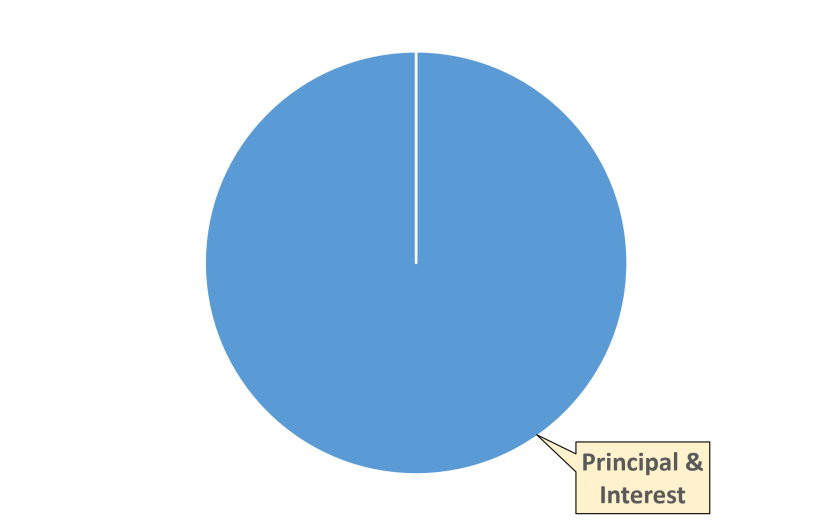
Many housing affordability measures effectively allocate the entire MSP budget to principal and interest. This is understandable, particularly for models covering large geographic areas where obtaining accurate property-tax, homeowners-insurance, HOA, and other recurring housing-cost data would be difficult or impossible at scale.
However, anyone who has purchased a home understands that principal and interest are only one component of the monthly housing obligation.
This is where the PABAI framework takes advantage of transaction-level data. By incorporating actual sale prices, reported property taxes, reported HOA dues, estimated homeowners insurance, and other recurring housing costs, PABAI can allocate housing obligations on a transaction-by-transaction basis and examine how those costs influence affordability outcomes.
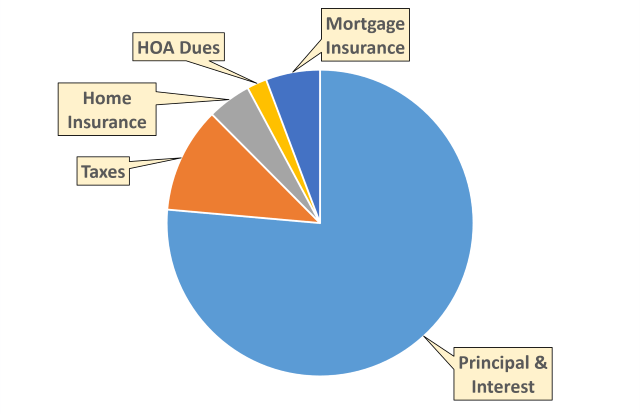
In practice, a home’s monthly housing expense consists of several recurring costs. Principal and interest are typically the largest component, but property taxes, homeowners insurance, HOA dues, and mortgage insurance may also consume portions of the available housing budget. These categories are important because they are commonly considered by mortgage underwriters and can directly affect loan qualification.
The key concept is that the total of all recurring housing expenses must fit within the MSP. If the total monthly housing expense exceeds the MSP, the home is not considered affordable to the reference income under the specified assumptions. In those situations, affordability can generally be restored only through changes such as a larger down payment, lower interest rate, lower housing expenses, higher household income, or simply selecting an alternative, more affordable home.
MSP establishes the budget ceiling. Once a reference income and qualifying ratio are selected, the Maximum Sustainable Payment becomes a fixed mathematical constraint under those assumptions. MSP itself is indifferent to how the payment is allocated among principal and interest, property taxes, homeowners insurance, HOA dues, mortgage insurance, or other recurring housing expenses. However, once those expenses are incorporated into the analysis, they become part of the affordability determination and can significantly alter the affordability conclusion.
The Standard PABAI Benchmark
As discussed previously, the PABAI framework is flexible enough to model affordability using different income levels, qualifying ratios, mortgage terms, down-payment assumptions, and financing structures. However, affordability analyses require a consistent benchmark if they are to be compared across different time periods, markets, and housing segments.
The standard published PABAI benchmark uses the following assumptions:
- HUD Portland–Vancouver–Hillsboro MSA Median Family Income (MFI)
- 28% qualifying ratio
- 20% down payment
- Freddie Mac 30-year fixed mortgage rate matched to the transaction’s closing date
Under the standard benchmark, Maximum Sustainable Payment is calculated as:
The 28% qualifying ratio is based on the long-established 28/36 guideline, which suggests a maximum housing expense-to-income ratio of 28% and a maximum total debt-to-income ratio of 36%. While modern lending standards vary by borrower and loan program, the 28% benchmark provides a consistent and widely recognized reference point for affordability analysis.
The purpose of the standard benchmark is not to represent every borrower or every financing scenario. Rather, it provides a stable reference point that allows affordability conditions to be measured consistently over time. Because the same assumptions are applied across all transactions, changes in affordability can be attributed to changes in income, mortgage rates, housing costs, and market conditions rather than changes in methodology.
Standalone analyses can incorporate sensitivity testing using alternative income assumptions, qualifying ratios, down-payment assumptions, or financing structures.
Historical Maximum Sustainable Payment in the Portland Region
Using the standard PABAI benchmark of HUD Portland–Vancouver–Hillsboro MSA Median Family Income (MFI) and a 28% qualifying ratio, a historical Maximum Sustainable Payment (MSP) series can be calculated for each published HUD income schedule.
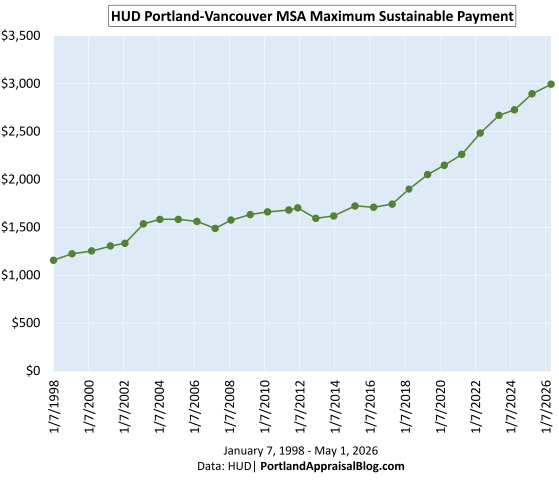
The chart above illustrates how the monthly housing budget supported by the reference household has changed over time. Because MSP is derived directly from income and the qualifying ratio, changes in MSP primarily reflect changes in the underlying HUD Median Family Income estimates.
Between January 1998 and May 2026, the benchmark MSP increased from approximately $1,157 per month to approximately $2,994 per month, reflecting substantial growth in the nominal housing-payment capacity of the reference household over the study period.
Case Study: Applying MSP in Practice
The previous sections established that MSP represents a monthly housing budget for core recurring housing obligations rather than just a principal-and-interest budget. The following transaction demonstrates why that distinction matters.
Consider a detached home in Troutdale that closed on December 5, 2025, for $565,000. At the time of sale, the HUD Portland–Vancouver–Hillsboro MSA Median Family Income was $124,100. Applying the standard 28% qualifying ratio results in a Maximum Sustainable Payment (MSP) of $2,895.67 per month:
Using the Freddie Mac 30-year fixed mortgage rate matched to the date of close (6.19%), many affordability measures would evaluate affordability using principal and interest alone.
Principal and Interest Only
| P&I | Taxes | Insurance | HOA Dues | Mort. Ins | Total |
|---|---|---|---|---|---|
| $2,765.43 | $0.00 | $0.00 | $0.00 | $0.00 | $2,765.43 |
Under this approach, the monthly housing expense is assumed to be $2,765.43. Because this amount falls below the MSP of $2,895.67, the property would generally be classified as affordable.
However, homeownership involves additional recurring obligations beyond principal and interest.
Full Housing Payment (PABAI Framework)
Using the actual reported property taxes and HOA dues associated with the transaction, along with an estimate for homeowners insurance, the modeled monthly housing obligation becomes:
| P&I | Taxes | Insurance | HOA Dues | Mort. Ins | Total |
|---|---|---|---|---|---|
| $2,765.43 | $453.82 | $188.33 | $85.66 | $0.00 | $3,493.24 |
Under the standard PABAI framework, the recurring housing expense totals $3,493.24 per month, exceeding the MSP by $597.57 per month. Under the standard benchmark assumptions, the property is not classified as affordable.
Alternative Financing Scenario: 10% Down Payment
A smaller down payment reduces the upfront cash required to purchase the property but increases the monthly housing obligation.
| P&I | Taxes | Insurance | HOA Dues | Mort. Ins | Total |
|---|---|---|---|---|---|
| $3,111.11 | $453.82 | $188.33 | $85.66 | $233.06 | $4,071.98 |
In this scenario, the higher loan balance increases the principal-and-interest payment, while mortgage insurance creates an additional recurring expense. The resulting monthly housing obligation exceeds the MSP by $1,176.31 per month, further reducing affordability. This example illustrates how the reduced upfront cash requirement associated with a lower down payment can be offset by a higher monthly housing obligation once mortgage insurance is factored in.
The important observation is that the MSP never changes. Once the reference income and qualifying ratio are established (in this case the HUD MFI and a 28% qualifying ratio), the housing budget remains fixed at $2,895.67 per month. What changes is the amount of that budget consumed by the recurring costs associated with homeownership.
Key Takeaways
Maximum Sustainable Payment (MSP) is one of the foundational building blocks within the PABAI framework. While the calculation itself is straightforward, the Troutdale case study demonstrates that affordability outcomes depend not only on the size of the housing budget, but also on how that budget is allocated among the recurring costs of homeownership.
The following points summarize the key concepts discussed in this article:
- Maximum Sustainable Payment (MSP) represents a housing budget, not a mortgage payment. It establishes the maximum recurring housing expense supported by a specified income level and qualifying ratio.
- MSP is a fixed mathematical constraint once the reference income and qualifying ratio are selected. The standard published PABAI benchmark uses HUD Portland–Vancouver–Hillsboro MSA Median Family Income (MFI) and a 28% qualifying ratio.
- Many affordability measures focus primarily on principal and interest. While useful, this approach may not fully reflect the recurring costs associated with homeownership.
- Property taxes, homeowners insurance, HOA dues, and mortgage insurance consume portions of the available housing budget. These expenses are commonly considered by mortgage underwriters and can materially influence affordability outcomes, potentially forcing buyers to make a larger down payment, purchase a less expensive home, or consider a different housing segment.
- The Troutdale case study demonstrates that affordability conclusions can change substantially once recurring housing expenses are incorporated into the analysis. A property that may appear affordable under a principal-and-interest-only approach may not remain affordable when the full cost of ownership is considered.
- The PABAI framework treats affordability as a budget-allocation problem. MSP establishes the budget ceiling, while the recurring costs of homeownership determine how much of that budget is consumed.
Sources & Further Reading
All transactional data presented in this Inside PABAI article is sourced directly from RMLS and has been subjected to a rigorous cleaning and validation process to ensure reliability for single-family residential analysis in the six-county Portland Region. The trends, comparisons, and commentary are the result of original appraisal expertise and independent analysis—not aggregated from secondary sources or news summaries.
- RMLS Data Challenges: Portland Appraisal Blog
- The Portland Region – Six-County Market Area Overview: Portland Appraisal Blog
- Portland Affordability Index – PABAI: A Realistic Housing Qualification Metric for the Portland Region: Portland Appraisal Blog
- Freddie Mac Primary Mortgage Market Survey® (PMMS®): Dataset
- HUD Portland-Vancouver-Hillsboro, OR-WA MSA: Median Family Income
- 28/36 Rule: Fannie Mae
- Mortgage Rates & the Portland Region Housing Market: Portland Appraisal Blog

Coda
Thanks for reading—I hope you found a useful insight or an unexpected nugget along the way. If you enjoyed the post, please consider subscribing for future updates.
Are you an agent in Portland who wonders why appraisers always do “x”?
A homeowner with questions about appraiser methodology?
If so, feel free to reach out—I enjoy connecting with market participants across Portland and the surrounding counties, and am always happy to help where I can.
And if you’re in need of appraisal services in Portland or anywhere in the Portland Region, we’d be glad to assist.
About the Author — Abdur Abdul‑Malik, SRA, ASA
Abdur Abdul‑Malik is the founder, author, and publisher of the Portland Appraisal Blog, where he produces original regional and neighborhood‑level housing analytics for the Portland Region. He is a certified residential appraiser serving Oregon and Washington, drawing on RMLS transaction data, public records, and custom segmentation models he has built.
He developed the Portland Appraisal Blog Affordability Index (PABAI), a payment‑based affordability metric built from actual RMLS sales. PABAI incorporates weekly updates based on the prevailing 30‑year fixed mortgage rate, providing a locally grounded measure of housing affordability across the region.
Learn more → PABAI explainer • mortgage rate series • full author bio


