The 2025 Portland Region Condominium Housing Market in Review

The 2025 Portland Region condo market softened modestly, with median prices down -3.0% to $325,000 and CDOM up +32% to 102 days. Rising HOA dues (+13%) and high rates increased pressure on buyers, while urban Portland dominated 61% of sales. Detailed analysis, histograms, county breakdowns, appraisal insights, and more.

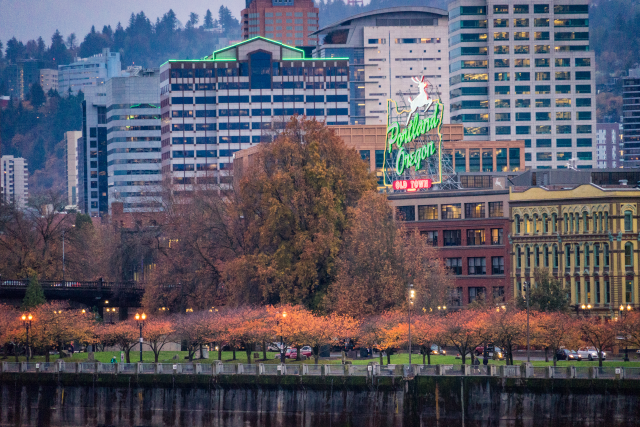
Image of Portland downtown area at dusk with Mt. Hood in the background.
The Portland Skyline at dusk with the majestic Mount Hood in the distance.
Via Canva Pro

The Portland-area condominium market in 2025 continued its multi-year softening trend, with average and median prices down modestly year-over-year.

Higher interest rates remained a persistent constraint on purchasing power, while rising HOA dues in many complexes increased the effective monthly payment burden. These combined pressures made qualification more challenging and prompted greater selectivity among active buyers—some deferred purchases, waited for concessions, or walked from listings with elevated carrying costs.

Despite these headwinds, the condo segment as a whole stayed moderately affordable relative to the HUD MSA median household, and total sales volume declined only modestly year-over-year. The more telling indicators of shifting dynamics were the continued rise in average months of supply and the substantial increase in cumulative days on market—both pointing to reduced urgency and a more buyer-favored environment, particularly in areas with long-term oversupply such as the Pearl District and Portland Downtown neighborhoods .

While the condo market has been battered over the last few years, it continues to function. Units are getting sold—just taking longer—so this is not a story of panic, but one of measured adjustment to sustained challenges.

Table of Contents

Data Housekeeping

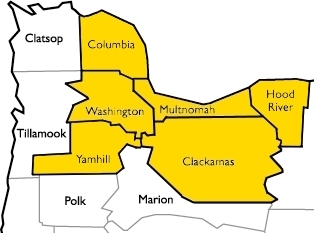
The Portland Region in this update comprises the six Oregon counties of Columbia, Clackamas, Hood River, Multnomah, Washington, and Yamhill. These counties form a contiguous housing ecosystem centered on Portland—Multnomah as the core home county, with the others tightly integrated through commuting patterns, economic ties, and shared market dynamics (e.g., Yamhill’s strong connection via Highway 99W and wine-country adjacency). Beyond Yamhill, the MLS system changes, further distinguishing this six-county area from broader geographic aggregations. For a detailed overview—including county profiles, population data, key value influencers, and why this definition differs from the official seven-county Portland–Vancouver–Hillsboro MSA—see my dedicated page: The Portland Region – Six-County Market Area Overview.
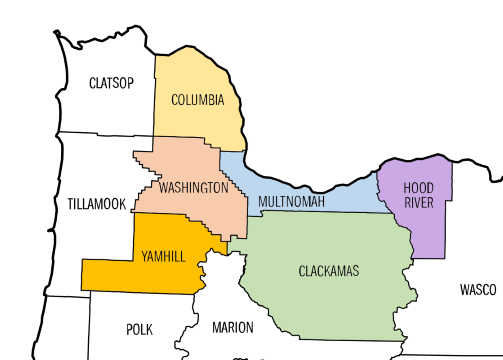
Colored map of the six counties comprising the Portland Region: Clackamas, Columbia, Hood River, Multnomah, Washington, and Yamhill.
The six-county Portland Region
Via SunCatcherStudio

All data is sourced from RMLS and reflects open-market condominium residential sales. SNL (“Sold Not Listed”) entries—off-market transactions entered retroactively—have been excluded to preserve consistency with true market activity.

Since condominium is an ownership type and not necessarily a description of style, a strict examination was made of all other major single-family housing types in RMLS (detached homes, attached homes, and manufactured homes on owned land) and any condominium sales found in those segments were aggregated into this review. All figures underwent standard cleaning to address common RMLS accuracy challenges, including square footage/price typos, incomplete fields, status/date mismatches, and non-representative entries. For a detailed overview of these issues, their impact on market analysis, and mitigation through automated flagging, cross-verification, and manual review, see the dedicated page: RMLS Data Accuracy Challenges.

Portland Region 2025 Overview

2025 saw a continuation of erosion in condo prices, with a substantial increase in the time it takes a condo unit to sell. Higher interest rates and rising HOA dues in many complexes compounded affordability pressures, making monthly payments more burdensome and prompting greater buyer selectivity.

Overall Regional Trends

The table below summarizes key metrics for condominium residential sales in the Portland Region (Columbia, Clackamas, Hood River, Multnomah, Washington, and Yamhill counties) for 2025 compared with 2024.

Category20242025% Change
Total $ Volume$912.4 Million$873.5 Million-4.26%
Average Price$376,101$371,576-1.20%
Median Price$334,900$325,000-2.96%
Avg SP/OLP95.56%94.00%-1.63%
Avg PPSF (TSF)$337.57$325.78-3.49%
Avg HOA Dues$439.75$497.10+13.04%
Avg Age (Yrs)30.9131.67+2.44%
Avg CDOM77.68102.45+31.88%
Avg Total SF1,1331,153+1.79%
Total # of Sales2,4262,351-3.09%
# of New Constr.449385-14.25%
Avg Supply (Mos.)5.626.74+19.82%
# of REOs1424+71.43%
# of Short Sales18+700.00%
Note: The calculated average HOA dues is for units reporting HOA dues (2,271 sales). All other metrics use the full dataset (2,351 sales).
Condominium Residential | 2024 & 2025
Data: RMLS | PortlandAppraisalBlog.com

Key Observations From the Aggregate Data

The 2025 Portland Region condominium market exhibited clear signs of continued softening, though the declines remained gradual and contained rather than abrupt. Buyer leverage increased noticeably compared to 2024, despite persistently elevated interest rates and rising HOA dues that amplified monthly payment pressures. While the segment retained moderate affordability relative to the HUD MSA median household, the combination of these factors contributed to extended marketing times, higher inventory levels, and greater price concessions across many transactions.

  • Average and median sales prices declined modestly year-over-year (-1.2% average to $371,576; -3.0% median to $325,000), reflecting buyer selectivity rather than widespread distress.
  • Price per square foot (PPSF) fell -3.5% to $325.78—a more direct indicator of price erosion in the condo segment, where size distribution is tight and PPSF declines are not driven by compositional shifts toward larger units (as often seen in detached homes).
  • Cumulative days on market (CDOM) increased substantially (+31.9% to 102.45 days average), with the monthly CDOM comparison showing 2025 consistently higher than 2024 in nearly every month—a clear signal of reduced urgency for some and greater qualification difficulty for others, resulting in prolonged exposure for sellers.
  • Months of supply rose +19.8% to 6.74 months average—firmly in buyer-favored territory for most of the year, peaking at 8.91 months in June during softer volume periods.
  • Total sales volume dipped only modestly (-3.1% to 2,351 units)—the decline was concentrated in suburban counties (Washington -7.5%, Clackamas -14%), while Multnomah (Portland core) held relatively steady (+0.65%).
  • New construction volume fell -14.3% to 385 units, almost entirely in Multnomah County (96% share), with suburban new supply dropping sharply (Clackamas -64%, Washington -58%)—limiting fresh inventory and contributing to resale reliance.
  • Average monthly HOA dues rose +13.0% to $497.10—the sharpest annual increase in recent years, with intensity (HOA per SF) highest in urban Multnomah ($0.463/SF) and resort-adjacent Hood River ($0.456/SF), further squeezing affordability from a payment perspective.
  • The market remained heavily urban-concentrated: the City of Portland alone accounted for approximately 61% of regional sales, with the Big Three counties (Multnomah, Washington, Clackamas) representing 98.9% of total volume—underscoring that condo activity is fundamentally a Portland-core story.
  • Persistent long-term oversupply in key urban submarkets (Pearl District, Portland Downtown ) continued to amplify selectivity, while rural counties (Yamhill, Columbia, Hood River) saw negligible activity, consistent with limited demand and condo availability in those areas.

Portland Region Scatter Plots

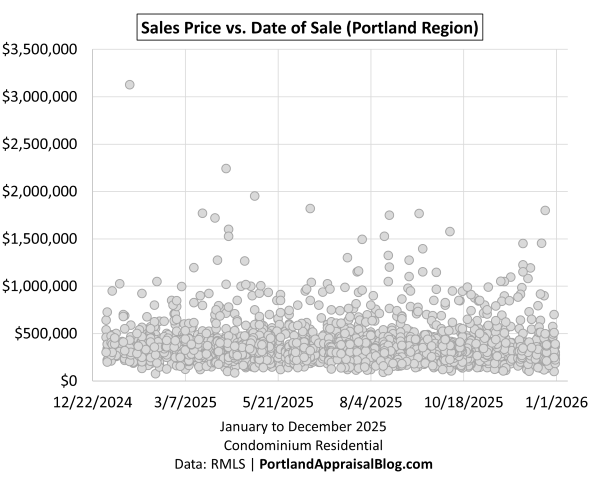
To visualize the distribution of individual condominium sales prices across 2025, the following scatter plots show sales price against date of sale. The first graph displays the full range of transactions, while the second focuses on the $800k or less range.

The full time-series view of sales prices across 2025 reveals a market that remained active throughout the year without any significant upward momentum or late-year collapse.

High-end transactions above $1 million occurred sporadically—a thin but persistent tail reflecting continued demand for premium urban and luxury units—yet these outliers were rare relative to the overall volume. The vast majority of sales clustered well below $800,000, confirming the mid-tier focus of the Portland Region condo market in 2025. The absence of a clear ascending trend across the months aligns with the modest price erosion observed in the aggregate data and underscores how elevated interest rates, rising HOA dues, and buyer selectivity tempered any meaningful appreciation, even as closings continued at a steady pace.

Zooming in on sales priced at $800,000 or less—which account for the overwhelming majority of 2025 transactions—reveals a dense, horizontal band of activity that persisted throughout the year with a noticeable downward momentum:

The core cluster remained concentrated in the $200,000–$600,000 range across all months, reflecting the mid-tier focus that defines the Portland Region condo market. While volume fluctuated seasonally (stronger in spring and summer, softer in fall and winter), prices for the bulk of the market showed a steady gradual decline. This downward drift becomes more evident when viewed through the lens of price per square foot, where the year-long trend reveals consistent softening even within the representative price band.

The time-series view of PPSF across 2025 reveals a clear downward tilt in the fitted trendline, confirming that price per square foot softened steadily over the course of the year.

The dense core of transactions clustered between approximately $200 and $500 PSF for most of the period, with early-2025 sales tending to occupy the higher portion of that band and later sales shifting progressively lower. This gradual erosion in PPSF aligns with the modest decline observed in overall average PPSF (-3.5% year-over-year to $325.78). Unlike detached homes, where PPSF declines can sometimes stem from compositional shifts toward larger units, the tight size distribution in condos makes this PPSF trend a more direct indicator of genuine price softness throughout the market.

Bottom-line Summary

The 2025 Portland Region condominium market reflected a continuation of gradual softening that has characterized the segment in recent years. Prices declined modestly overall, with average and median figures down year-over-year, while time-on-market metrics lengthened substantially and inventory levels rose into clearly buyer-favored territory. Rising HOA dues and persistently high interest rates amplified monthly payment pressures, narrowing buyer pools and increasing selectivity—particularly in complexes with elevated carrying costs. Yet the market remained functional: transactions continued at a steady pace, volume held relatively close to the prior year, and affordability persisted at a moderate level relative to the HUD MSA median household. This was not a collapse, but a measured shift toward conditions favoring buyers, with the most pronounced effects visible in extended marketing times, higher months of supply, and selective pricing behavior across the region.

Sales Volume

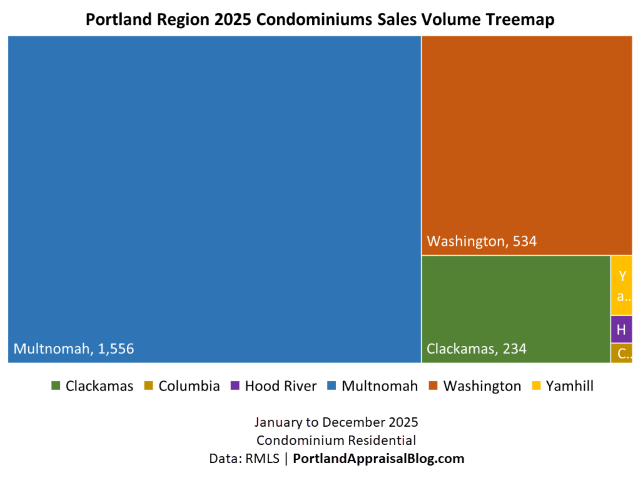
A treemap visualizing the distribution of condominium sales by county in 2025 clearly illustrates the market’s geographic concentration.

The distribution of condo sales volume across the Portland Region in 2025 reveals extreme concentration in the urban core and immediate suburbs, with the three major counties accounting for nearly 99% of all transactions.

Multnomah County—encompassing the City of Portland and its immediate surroundings—dominated with 66.2% of regional sales (1,556 units), underscoring that the metro condo market is fundamentally an urban Portland story. Washington County followed at 22.7% (534 units), while Clackamas County contributed 10.0% (234 units). The remaining three counties (Columbia, Hood River, and Yamhill) combined for just 1.15% of volume (27 units total), reflecting the limited presence of condominium inventory in more rural and outer areas. This geographic skew highlights how condo demand remains anchored to denser, amenity-rich and walkable locations.

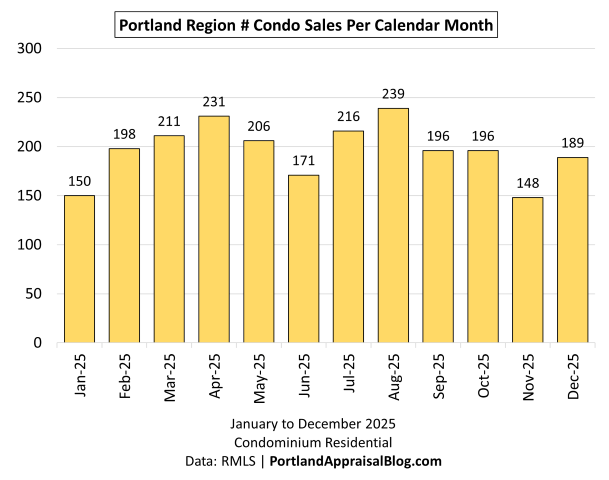
The following bar chart shows monthly sales volume for 2025:
Monthly sales volume in 2025 followed a recognizable seasonal rhythm, though the pattern was somewhat muted compared to more family-driven segments like detached single-family homes.

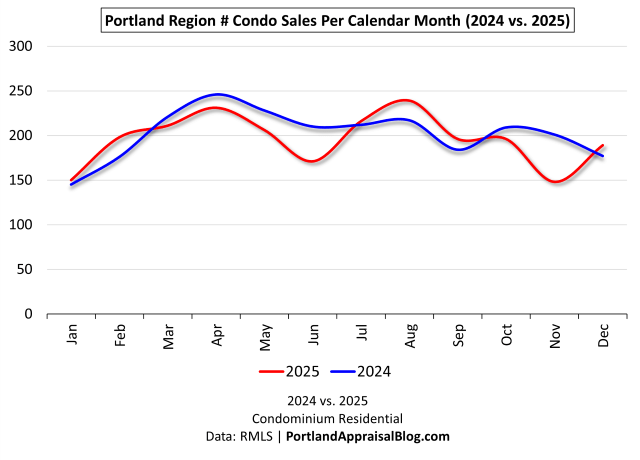
Activity started modestly in January (150 sales), built steadily through spring (peaking at 231 sales in April), and reached the year’s high in August (239 sales)—a classic spring-to-summer strength seen in many residential markets. Volume then tapered noticeably in fall and winter, with November marking the low point (148 sales) before a slight December rebound (189 sales).

The overall monthly range (148–239 sales) reflects a market that remained functional and active year-round, without the sharp seasonal swings or deep troughs often observed in detached homes. This steadier flow is consistent with a buyer base less constrained by school calendars—including singles, young couples, downsizers, and retirees—and underscores that while some affordability pressures and selectivity were present, the condo segment did not experience dramatic seasonal shutdowns.

The line graph below compares monthly sales volume across the twelve months for 2024 and 2025.
The year-over-year comparison of monthly sales volume reveals that 2025 closely tracked the seasonal pattern established in 2024, with no fundamental disruption to the typical residential rhythm, yet the overall level remained slightly lower.

Both years showed a spring buildup (March–April highs), sustained summer activity (July–August), and a fall/winter taper (November lows), consistent with broader market behavior. In 2025, the peak occurred in August (239 sales) rather than April (231), and summer months actually outperformed 2024 in July and August, while the late-year decline was more pronounced in November (148 vs. 201). The net result was a modest 3.1% reduction in total annual sales (2,351 vs. 2,426), indicating a market that continued to function steadily.

Sales Price

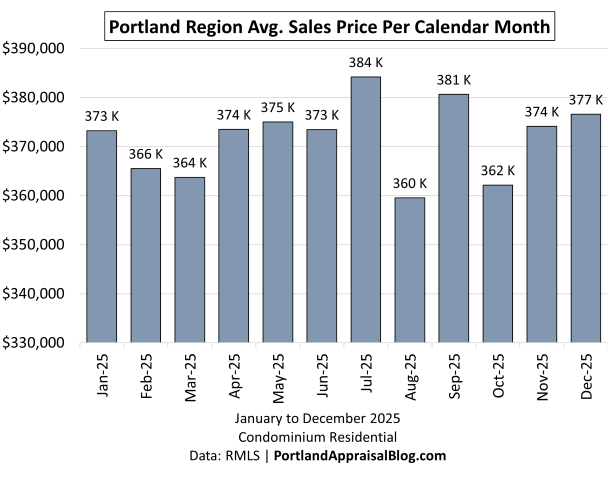
The following bar chart shows average monthly sales price for 2025:
Note: The y-axis starts at $330,000 to allow better examination of monthly differences.

Monthly average sales prices in 2025 remained remarkably stable across the year, fluctuating within a relatively narrow band of approximately $360,000 to $385,000.

The highest monthly average occurred in July ($384,196), while the lowest came in August ($359,556)—coinciding with the year’s peak volume month. Prices trended upwards until July and then trended downwards for the rest of the year. This overall flatness aligns with the modest year-over-year decline in average price (-1.2% to $371,576).

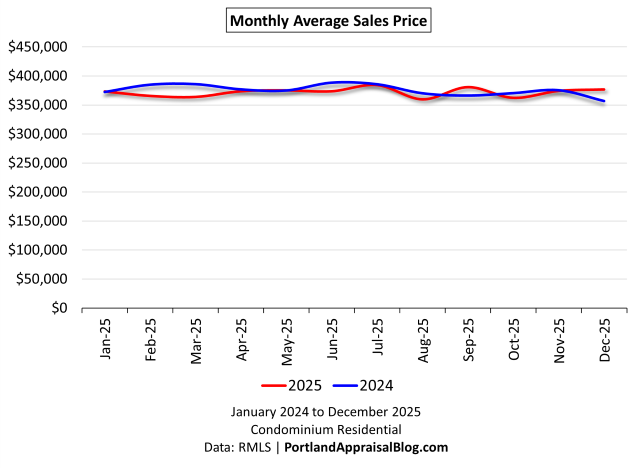
The line graph below compares average monthly sales prices across the twelve months for 2024 and 2025.
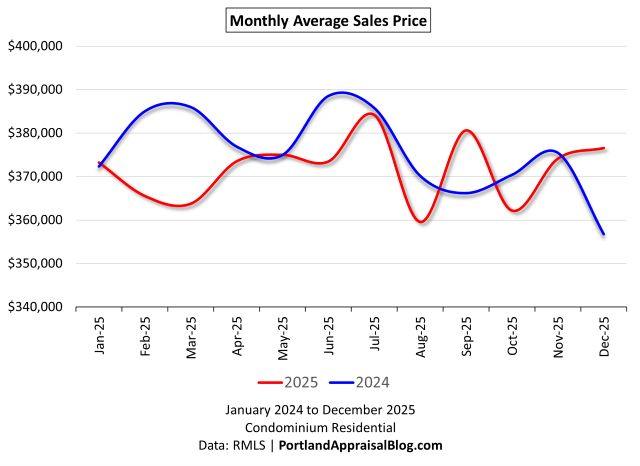
The year-over-year comparison of monthly average sales prices shows 2025 prices tracking closely with 2024 throughout most of the year, with no dramatic divergence or sustained downward break. Zooming in we have:

Note: The y-axis starts at $340,000 to allow better examination of monthly differences.

Both years fluctuated within a similar overall range (roughly $350,000–$390,000), reflecting the condo segment’s relative price stability. Early 2025 prices started near 2024 levels (January slightly higher, February and March lower), held steady through spring and summer (July nearly identical at ~$384,000), and ended the year modestly higher in December ($376,584 vs. $356,771). Noticeable softening appeared in August 2025 ($359,556 vs. $370,187), but the lack of a consistent or accelerating decline across months aligns with the modest overall annual drop (-1.2% average price to $371,576). This pattern reinforces that while buyer selectivity and carrying-cost headwinds were present, the market did not experience sharp or broad-based price erosion relative to the prior year.

New Construction

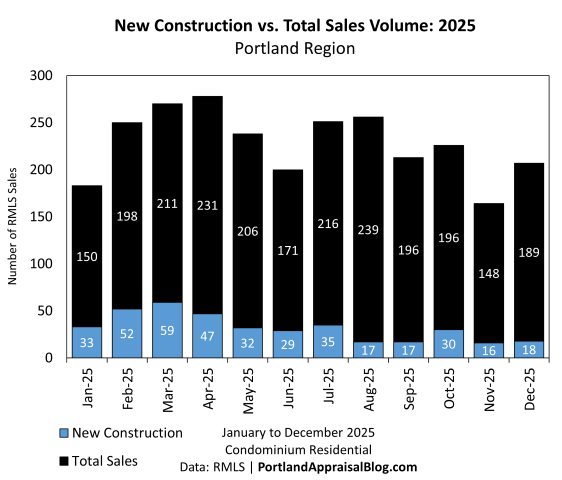
The bar graph below shows monthly total condominium sales for 2025, with new construction volume nested within each bar to illustrate the portion of sales that were newly built.

New construction provided a meaningful but uneven contribution to monthly sales volume in 2025, accounting for 16.4% of total transactions (385 out of 2,351 units) and following a clear seasonal cadence.

The share of new construction peaked in late winter and early spring (February–March ~26–28%), when fresh deliveries aligned with stronger buyer activity. It then declined sharply through summer and early fall (August–September dropping to ~7–9%), reflecting reduced project closings during the year’s highest total volume month (August 239 sales). A modest rebound occurred in late fall (October 15.3%), but the overall pattern shows new supply was front-loaded and tapered significantly in the second half of the year.

This uneven distribution meant resale inventory bore more absorption pressure during peak demand periods. The decline in new construction volume from 2024’s 449 units (-14.3%) limited buyers’ options for fresh supply.

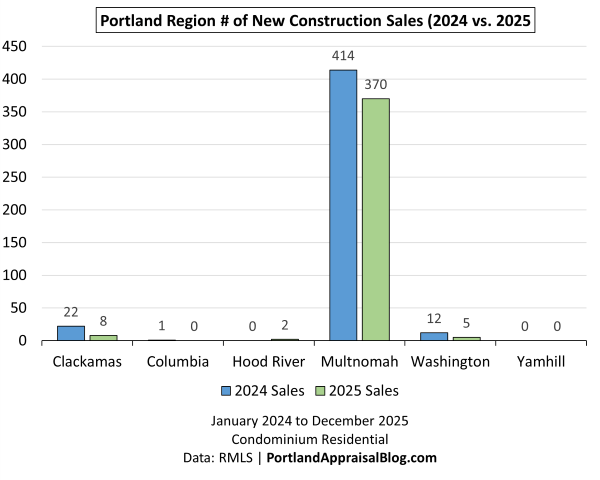
The bar graph below shows the number of new construction closings by county, with side-by-side bars for 2024 and 2025.

New construction activity in 2025 remained overwhelmingly concentrated in Multnomah County, which accounted for 96.1% of all new condo units delivered (370 out of 385 total).

This extreme urban dominance reflects the ongoing focus of new development in Portland’s core and inner neighborhoods, where density, transit access, and demand for urban living support higher-rise and infill projects. Suburban counties saw significantly reduced new supply: Clackamas dropped -63.6% (22 to 8 units), Washington fell -58.3% (12 to 5 units), and Columbia had 1 in 2024 and none in 2025. Hood River contributed a small increase (0 to 2 units), but the absolute number remained negligible, while Yamhill had zero in both years.

The regional decline of -14.3% in new units (from 449 to 385) reduced fresh inventory overall, slightly shifting absorption pressure toward resale stock. Despite fewer new deliveries in 2025, months of supply remained elevated and cumulative days on market increased sharply—indicating that resale softness and buyer selectivity outweighed the limited relief from reduced new supply.

The table below shows new construction sales volume by dollar amount for 2025 compared with 2024.

County2024 $ Amount2025 $ Amount% Change% of Total 2025 $ Amount
Clackamas$8,228,570$4,222,200-48.69%0.48%
Columbia$200,000$0-100.00%0.00%
Hood River$0$1,178,0000.13%
Multnomah$150,445,729$136,647,060-9.17%15.64%
Washington$6,317,967$2,532,998-59.91%0.29%
Yamhill$0$00.00%
Sum$165,192,266$144,580,258-12.48%16.55%
Condominium Residential | 2024 & 2025
Data: RMLS | PortlandAppraisalBlog.com

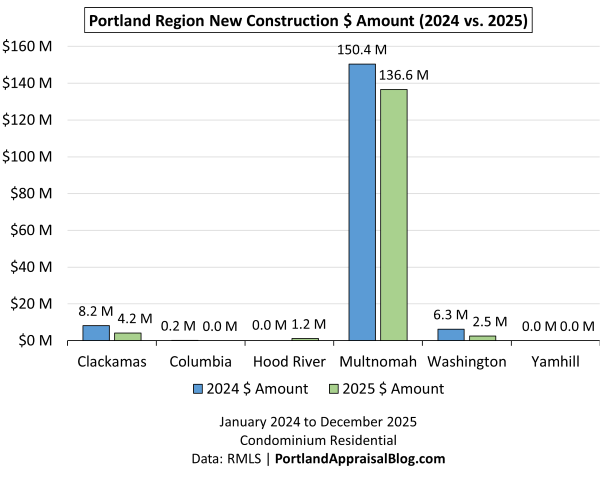
The following double bar chart provides the above information at a glance.

In dollar terms, new construction volume declined 12.5% regionally to $144.6 million in 2025 (from $165.2 million in 2024), reflecting both fewer units delivered and shifts in average pricing among the new supply that did close.

Multnomah County again dominated, accounting for 94.5% of the total new construction value ($136.6 million in 2025, down 9.2% from 2024). This near-total concentration in the urban core mirrors the unit volume pattern and highlights the ongoing focus of new development in Portland’s denser, higher-value neighborhoods. Suburban counties experienced steeper value reductions: Clackamas fell 48.7% ($8.2M to $4.2M), Washington declined 59.9% ($6.3M to $2.5M), and Columbia dropped to zero from $200,000 in 2024. Hood River contributed a small $1.18 million in 2025 (from zero the prior year), while Yamhill remained at zero.

The sharp suburban pullback in new construction dollars limited fresh inventory outside the city, placing additional absorption pressure on existing resale stock.

Cumulative Days on Market

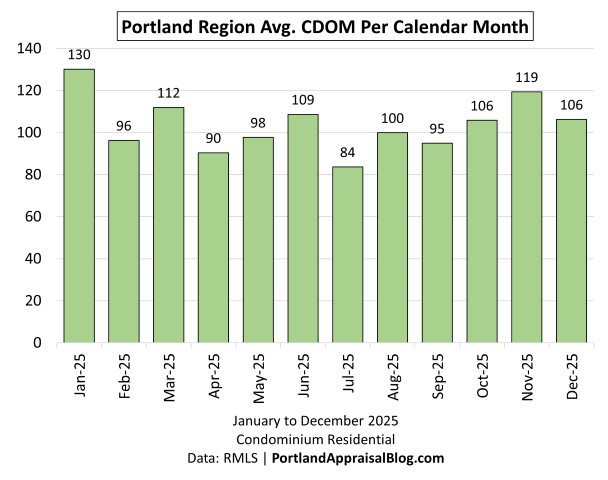
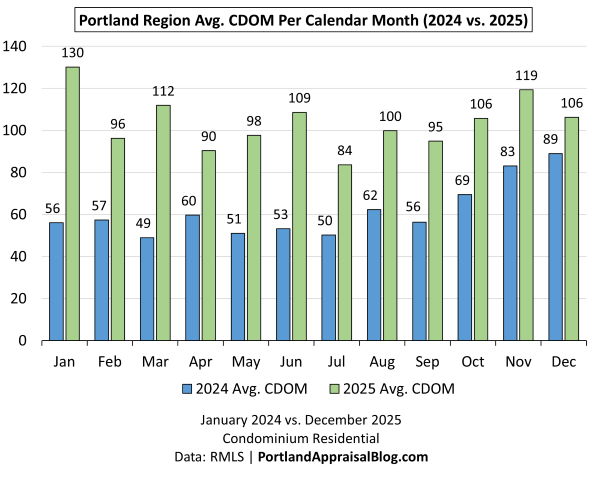
The bar chart below compares average cumulative days on market (CDOM) throughout 2025.
Monthly average cumulative days on market in 2025 followed a seasonal pattern that was both pronounced and persistent, with clear winter highs and summer lows.

CDOM started the year at its peak (January 130.22 days), reflecting slower winter activity, then improved steadily through spring and early summer (April low of 90.41 days, July low of 83.67 days)—coinciding with stronger volume periods. Marketing times lengthened again in late summer and fall (August 99.90, October 105.82, November high of 119.36 days), before easing slightly in December (106.27 days).

The overall range (83–130 days) and sustained elevation (only two months below 90 days) underscore a market where buyer selectivity remained strong year-round. Even during traditionally faster periods, average CDOM stayed well above 2024 levels, contributing to the annual increase of +31.9% to 102.45 days and reflecting the ongoing impact of high interest rates, rising HOA dues, and a more cautious buyer pool.

The bar chart below compares cumulative days on market for 2024 and 2025.
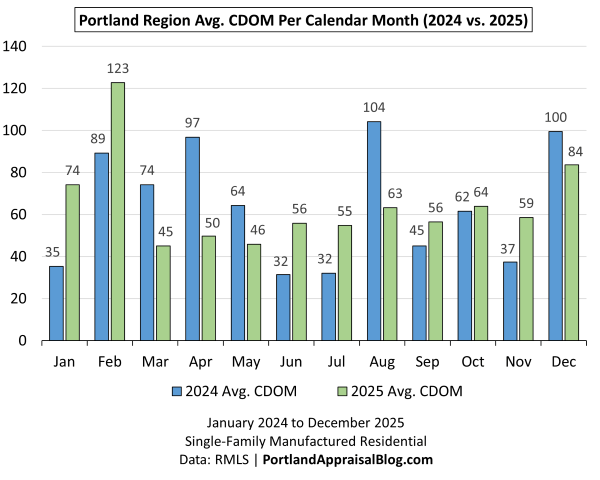
The year-over-year monthly comparison of average cumulative days on market reveals a dramatic and consistent widening of marketing times in 2025 compared to 2024, with increases ranging from 19% to 132% across nearly every month.

In 2024, CDOM remained relatively low and stable (mostly 50–70 days, with a modest rise in fall/winter), reflecting a more balanced market. In 2025, the curve shifted sharply upward: January soared to 130 days (+132% from 56), March reached 112 days (+128% from 49), and even the summer low in July (84 days) was +66% above 2024’s 50 days. Late-year months showed the smallest relative gap (December +19% to 106 days), but the overall elevation persisted. This broad-based increase across the calendar—with no month showing shorter times in 2025—signals significantly reduced buyer urgency and greater qualification difficulty, resulting in prolonged exposure for sellers and a more pronounced buyer-favored environment than in the prior year.

Housing Supply

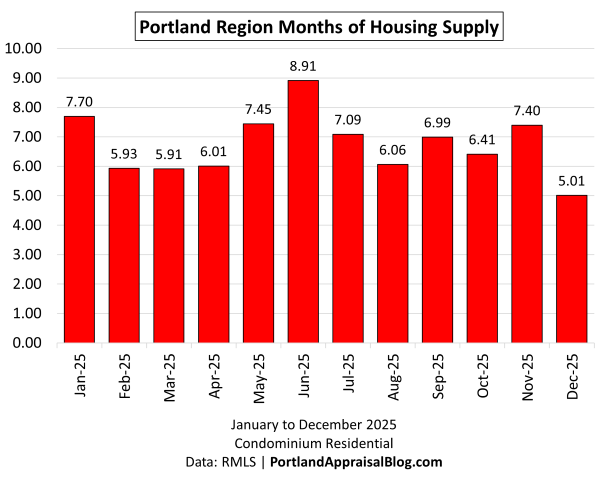
Months of supply (MOS) represents the number of months it would take to absorb current active inventory at the prevailing sales pace, assuming no new listings enter the market. The following bar chart shows MOS by calendar month for 2025:
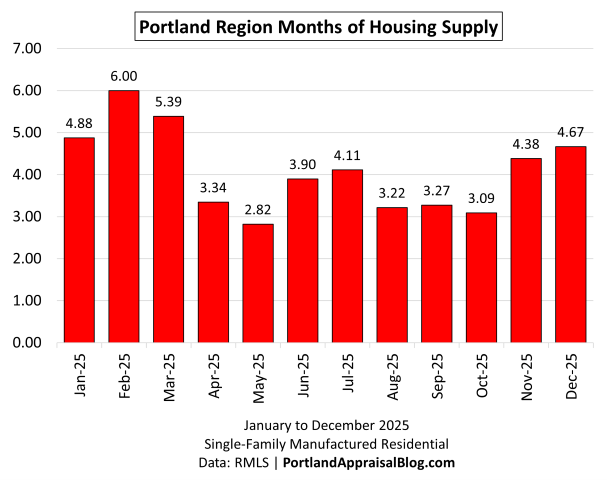
Months of supply in 2025 remained elevated throughout the year, averaging 6.74 months and reflecting a consistently buyer-favored market.

MOS started high in January (7.70 months), dipped slightly in spring (March–April ~5.9–6.0 months) during stronger volume periods, then climbed to a peak in June (8.91 months)—coinciding with the year’s lowest sales volume. Supply eased modestly in late summer (August 6.06 months) but stayed above 6 months in most remaining months, ending the year lower in December (5.01 months) amid year-end closings and listing cancellations.

The sustained elevation (above 6 months in 8 of 12 months) and mid-year peak underscore persistent absorption challenges, even as seasonal volume patterns persisted. This buyer-leaning inventory environment, up +19.8% from 2024’s 5.62 months average, contributed to greater buyer leverage, longer marketing times, and increased pressure on sellers to offer concessions throughout the year.

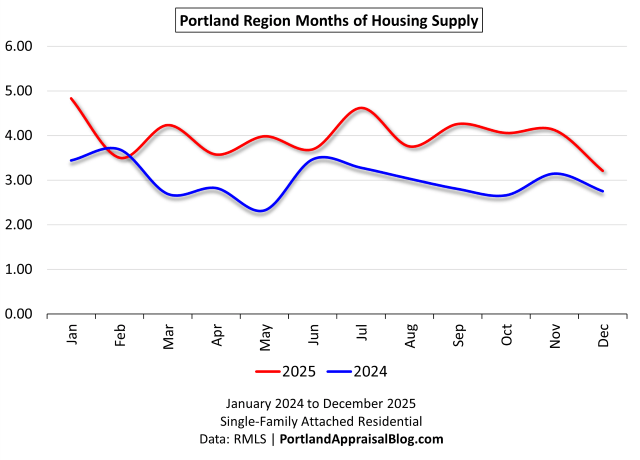
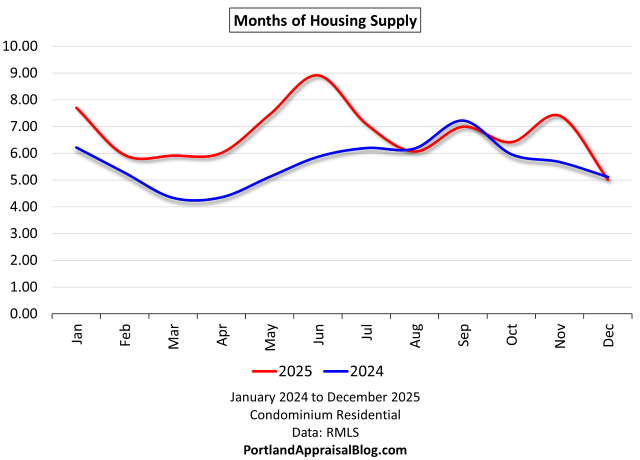
The line graph below compares monthly months of supply for 2024 (blue line) and 2025 (red line), with a full y-axis scale to show true proportional differences:
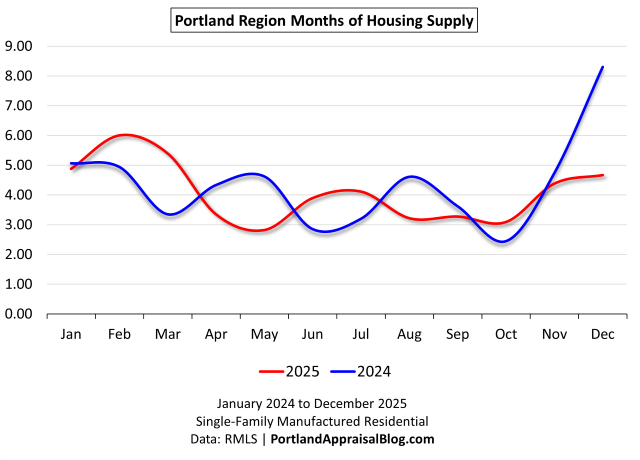
The year-over-year comparison of months of supply shows a clear and consistent upward shift in 2025, with the line remaining above 2024 levels in nearly every month and the annual average rising from 5.62 to 6.74 months (+19.8%).

In 2024, MOS fluctuated in a more balanced range (mostly 4.3–7.2 months), dipping to tighter levels in spring (March–April ~4.3–4.4 months) during stronger absorption periods. In 2025, supply started higher (January 7.70 vs. 6.21), peaked sharply in June (8.91 vs. 5.87), and stayed elevated through most of the year (above 6 months in 8 of 12 months). The only convergence occurred in late summer and December, where 2025 dipped closer to or slightly below 2024 levels (August 6.06 vs. 6.18, September 6.99 vs. 7.22, December 5.01 vs. 5.11).

This persistent elevation in 2025—particularly the mid-year spike—confirms a more buyer-favored inventory environment overall, even with some late-year relief from stronger closings.

HOA Dues

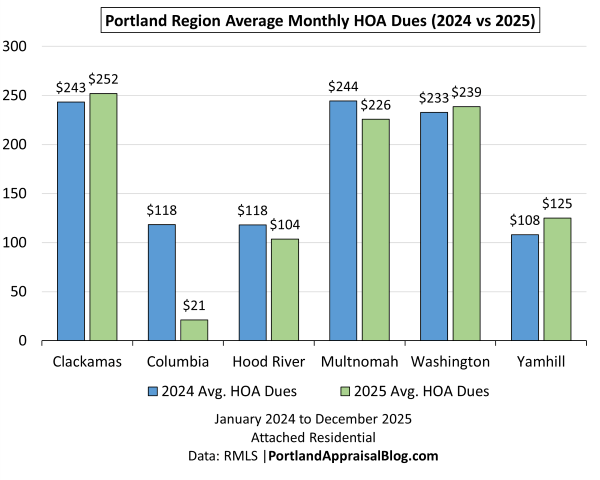
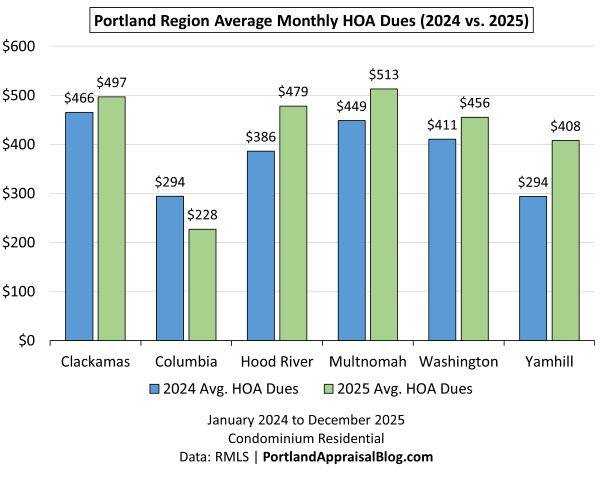
The bar chart below compares average monthly HOA dues (for reporting sales) for 2024 and 2025:

Average monthly HOA dues increased in most counties in 2025, with the regional figure rising 13.0% from $439.75 to $497.10—a sharper annual jump than the more gradual increases observed in 2024.

Multnomah County saw the largest dollar increase (+$64.56 to $513.20, +14.4%), reflecting higher costs in urban high-rise and mid-rise buildings with greater amenity and insurance burdens. Washington County rose +11.0% to $455.74, while Clackamas increased +6.8% to $497.14.

In the smaller counties, reported increases were noted in Hood River (+23.9% to $478.60) and Yamhill (+38.9% to $408.00), while Columbia showed a -22.7% decline to $227.50. These figures should be interpreted cautiously due to the very small sample sizes (5–15 sales per county), where HOA dues are often influenced by factors such as the size of the unit sold, the specific complex’s reserve status, or insurance allocations for that building.

This widespread upward pressure on HOA dues—particularly pronounced in urban and resort-adjacent areas—influenced affordability qualifications from a monthly payment perspective, contributing to the lengthening cumulative days on market.

Histograms

Histograms offer a unique and powerful perspective on the condominium market that traditional summary statistics and bar charts cannot fully capture: they reveal the underlying shape, spread, and clustering of the data, exposing patterns, skewness, tails, and bifurcations that averages and medians alone obscure.

While tables and trend lines show central tendencies and directional changes, histograms display the actual distribution of values—how many sales fall in each price band, how concentrated or dispersed PPSF is, where the bulk of CDOM accumulates, and how HOA dues are skewed. This distributional view highlights market segmentation (e.g., low-dues “winners” vs. high-dues “losers”), buyer selectivity (long tails in CDOM), and pricing dynamics (left shoulders in SP/OLP) in ways that are immediately visible and intuitive. The histograms illustrate these shapes for the 2025 Portland Region condo market, providing deeper insight into the forces driving the observed softening and buyer-favored conditions.

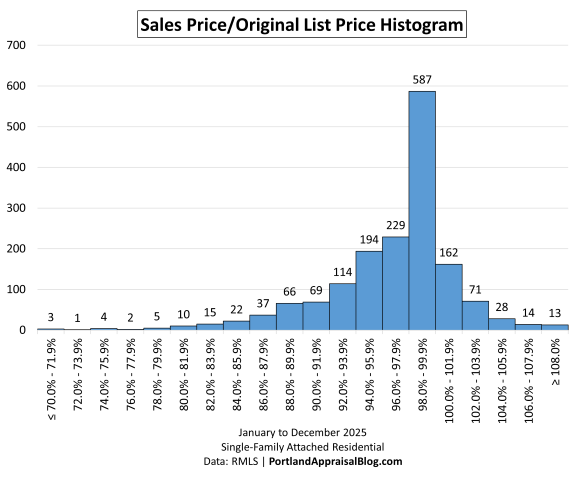
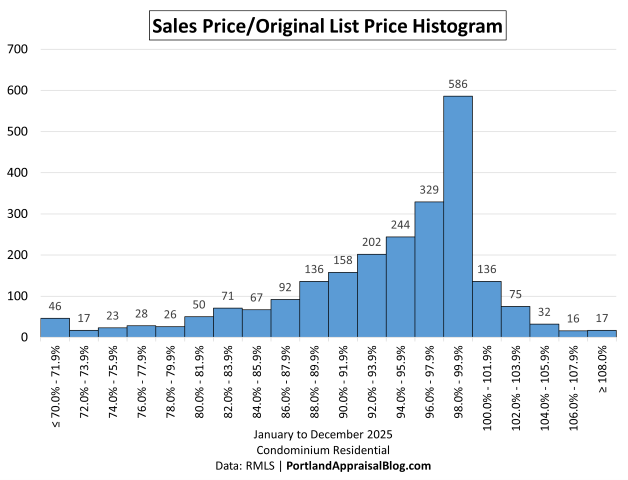
The following histogram shows the distribution of sales price as a percentage of original list price in 2025:
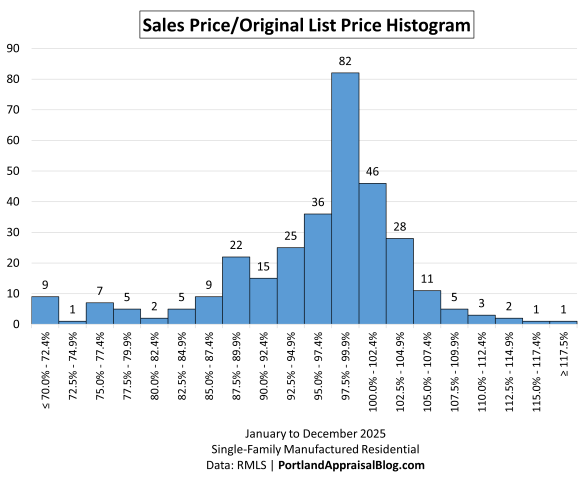
The distribution of sale price as a percentage of original list price in 2025 reveals a market where sellers generally achieved strong realization on well-priced listings, yet a substantial portion required meaningful concessions to close.

The histogram shows a sharp peak in the 98.0%–99.9% bin (586 sales, 24.9% of total), indicating that realistic pricing prevailed and many condos moved efficiently once listed correctly. Nearly a quarter of transactions closed at or very near full original asking—a sign of disciplined seller expectations and solid demand for properly positioned units.

However, the pronounced left shoulder—with nearly half of sales (49.3%) below 96%—is particularly telling. This meaningful volume of transactions highlights buyer leverage in a notable subset of cases, often tied to red flags such as high or rising HOA dues, special assessments, financing hurdles, condition issues, or over-optimistic initial pricing. The thin right tail (only 11.7% at or above 100%) further confirms the scarcity of true bidding wars in the condo segment.

Overall, the shape reflects a buyer-favored but not collapsed market: sellers still commanded close to asking in most cases when priced realistically, but the fat left shoulder underscores condo-specific frictions amplifying negotiation power and concessions.

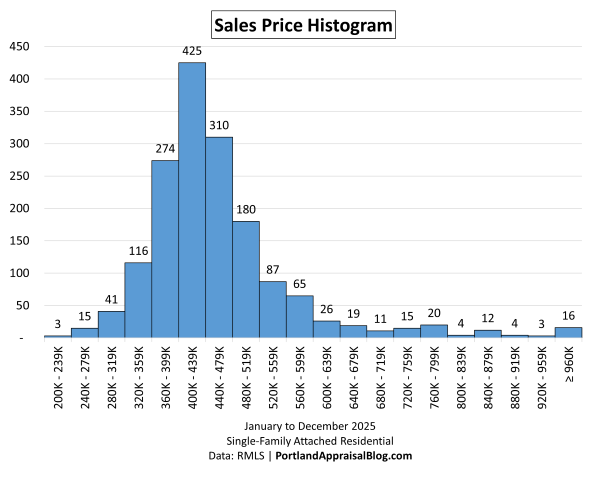
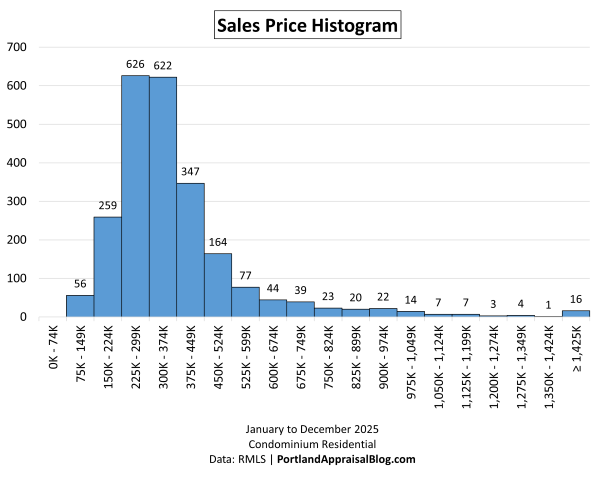
The following histogram shows the distribution of sales prices of condo units in 2025:

The distribution of sales prices in 2025 shows a strongly right-skewed pattern, with the overwhelming majority of transactions concentrated in the mid-tier price bands that define the Portland Region condo market.

The histogram reveals a clear double peak: the highest concentration in the $225,000–under-$300,000 range (626 sales, 26.6% of total), closely followed by $300,000–under-$375,000 (622 sales, 26.5%). Together, these two bins capture more than half of all sales (53.1%), underscoring the dominance of affordable to moderately priced units. The cumulative share below $450,000 reaches 81.2%, confirming that the vast majority of condo activity remained accessible to a broad range of buyers. This mid-tier hump aligns with the typical buyer profile in the region (first-time buyers, downsizers, young couples, and investors seeking entry-level or urban alternatives).

The long but extremely thin right tail (scattered sales at or above $750,000) does indicate the presence of a luxury condo market in the region (mostly in Portland urban core areas). While this segment represents only a small fraction of total volume, it demonstrates that high-end demand persists in select locations with premium features, views, and amenities—even in a year marked by overall softening.

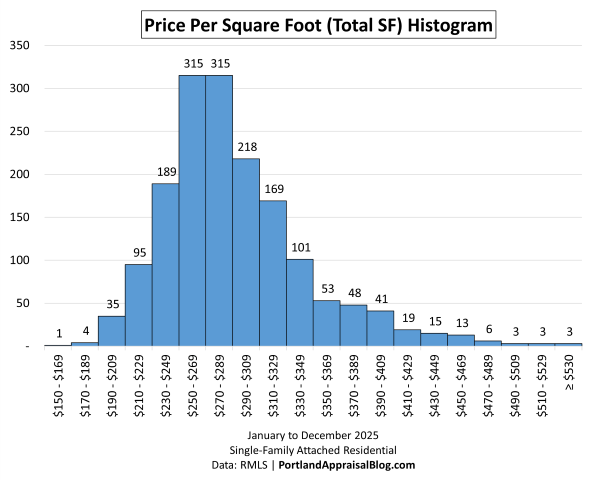
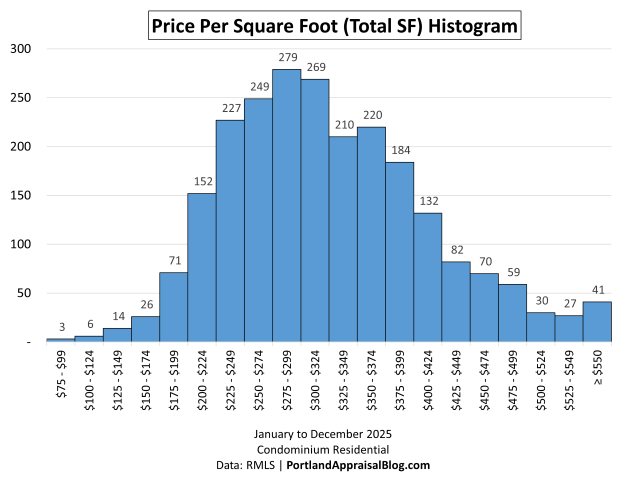
The following histogram shows the distribution of price per square foot for condo units in 2025:

The distribution of price per square foot in 2025 shows a relatively tight, unimodal pattern with a moderate right skew, centered on the mid-to-upper $200s and low $300s.

The histogram peaks in the $275–$299 range (279 sales, 11.9% of total), with strong adjacent bins at $250–$274 (249 sales, 10.6%) and $300–$324 (269 sales, 11.4%). Together, the $250–under-$350 range captures approximately 42.8% of sales, while the cumulative share below $400 PSF reaches 81.2%. This concentrated middle reflects the typical efficiency of mid-tier condos in the Portland Region—units of moderate size (median ~1,000–1,100 SF) in buildings with standard amenities and locations.

The right skew (18.8% at or above $400 PSF, with a thin tail beyond $500) indicates variability driven by premium factors: newer construction, better views, higher-floor locations, superior finishes, or high-demand urban/resort settings. The low-end tail (below $250 PSF, 21.2%) is limited but present, typically corresponding to older or less marketable complexes. Overall, the shape underscores that PPSF in condos is more tightly grouped than in detached homes, with declines in PPSF more directly reflecting price softness rather than size-driven composition changes.

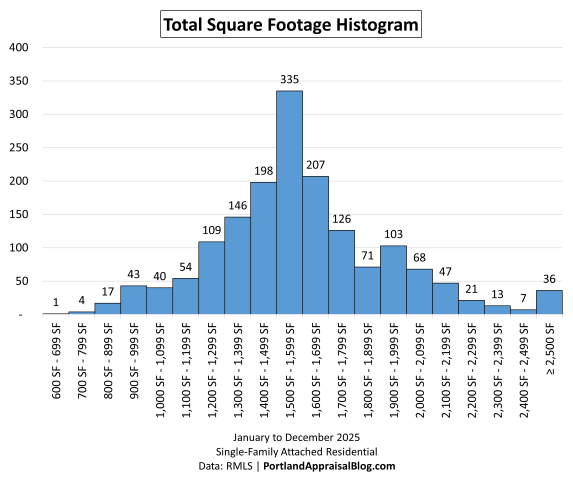
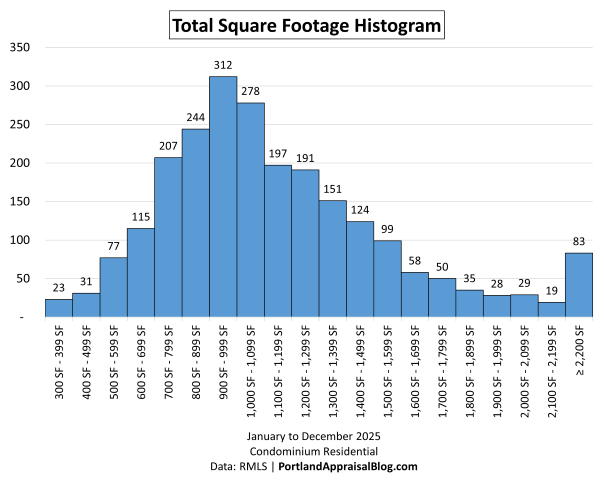
The following histogram shows the distribution of total square footage of condo units in 2025:

The distribution of total square footage in 2025 exhibits a unimodal shape with moderate right skew, centered on the 900–1,100 SF range that typifies the Portland Region condo market.

The histogram peaks at 900–999 SF (312 sales, 13.3% of total), with strong adjacent bins at 800–899 SF (244 sales, 10.4%) and 1,000–1,099 SF (278 sales, 11.8%). Together, the 800–1,199 SF range captures approximately 43.9% of sales, and the cumulative share below 1,300 SF reaches 71.3%. This concentrated middle reflects the typical size profile for the region: compact to mid-sized units (1–2 bedrooms) in garden-style, mid-rise, or older urban buildings, offering efficient living without excessive space.

The moderate right skew (17.1% at or above 1,500 SF, with a thin tail beyond 2,200 SF) indicates variability driven by premium or larger configurations: newer high-rises, townhome-style condos, or combined units in premium locations. The low-end tail (below 800 SF, 19.3%) is present but limited, typically corresponding to studios or micro-units in older complexes. Overall, the tight size distribution underscores why PPSF in condos behaves more directly as a price indicator rather than a function of diminishing returns on incremental square footage (as often seen in detached homes).

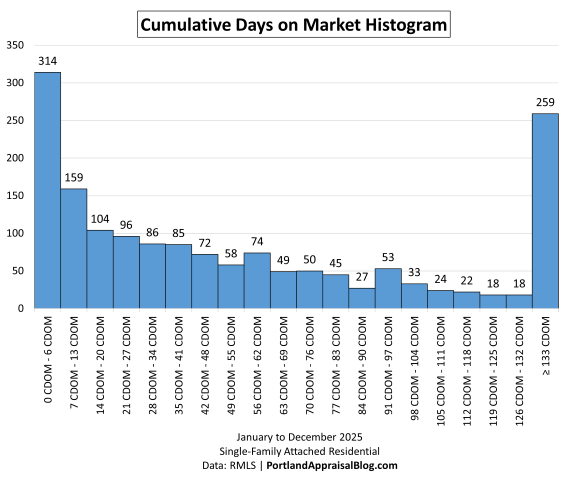
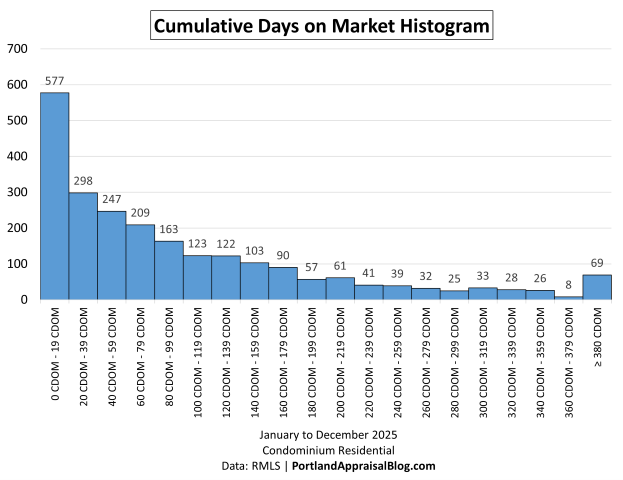
The following histogram shows the distribution of cumulative days on market for condo units in 2025:

The distribution of cumulative days on market (CDOM) in 2025 shows a heavily right-skewed pattern, with a dominant early peak and a long, persistent tail that highlights the market’s buyer-favored nature.

The histogram peaks sharply in the 0–19 day bin (577 sales, 24.5% of total), with strong follow-up in the 20–39 day (298 sales, 12.7%) and 40–59 day (247 sales, 10.5%) bins. Together, sales closing in under 60 days account for approximately 47.7% of transactions, indicating that well-priced units continued to move efficiently even in a softer year. The cumulative share below 100 days reaches 63.6%, showing that a majority of condos sold within roughly three months.

The long right tail, however, is particularly telling: 36.5% of sales exceeded 99 days, 17.8% exceeded 179 days, and 2.9% lingered 380 days or more. This extended exposure—far beyond the regional average of 102.45 days—signals significant buyer selectivity, often tied to red flags such as high or rising HOA dues, special assessments, financing hurdles, condition issues, or overly-optimistic pricing. The presence of a meaningful number of very long-marketing units underscores how carrying-cost pressures, softer demand for luxury units, and reduced urgency amplified concessions and motivation in certain segments.

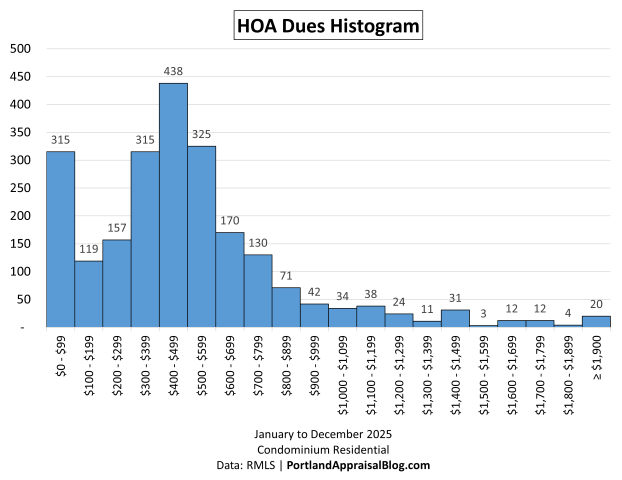
The following histogram shows the distribution of monthly HOA dues for condo units in 2025:

Note: The HOA dues histogram is for units reporting HOA dues (2,271 sales). All other histograms use the full dataset (2,351 sales).

The distribution of monthly HOA dues in 2025 shows a pattern that, while technically unimodal with a peak in the mid-range, is strongly influenced by a prominent low-end cluster that contributes to a near-bimodal appearance and shapes the affordability story.

The histogram peaks in the $400–$499 bin (438 sales, 19.3% of total), with strong adjacent bins at $300–$399 (315 sales, 13.9%) and $500–$599 (325 sales, 14.3%). Together, dues between $300 and under $600 capture approximately 47.5% of sales, while the cumulative share below $600 reaches 73.5%. This concentrated middle corresponds to the most common range for garden-style, mid-rise, and older urban/suburban buildings with standard amenities, reserves, and insurance coverage.

However, the prominent low-end cluster ($0–$299, 26.0% of sales, including a large $0–$99 bin at 13.9%) stands out as a distinct group, creating visual separation and a near-bimodal feel. This low-dues segment—often small infill developments, site condos, or minimal-association properties—represents the clear “winners” in affordability: lower monthly burdens, broader buyer appeal, easier financing, and faster absorption.

The moderate right skew (18.2% between $600 and $999, 8.3% at $1,000 or above, with a thin tail beyond $1,500) highlights variability driven by premium or challenged complexes: newer high-rises with elevators/concierge, resort-adjacent buildings, or older ones with elevated insurance/reserve needs. The low-end cluster ($0–$299, 26.0%) is notable but limited, typically corresponding to small infill developments, site condos, or minimal-association properties where dues remain nominal.

Overall, the shape underscores a clear bifurcation in carrying costs: a large mid-range core that supports broad access and a notable low-end cluster enhancing affordability for many, contrasted with a meaningful tail of higher dues that can constrain buyer pools, extend marketing times, and amplify concessions in affected segments.

Miscellaneous Statistics & Standout Transactions
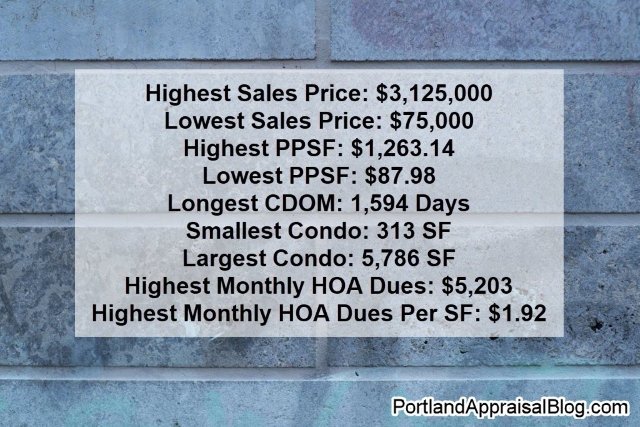
Here are some of the most notable outliers and extremes from the 2025 Portland Region condo market—numbers that illustrate the full range of the data and the extremes buyers and appraisers encounter.

Highest Sales Price: $3,125,000—Penthouse unit at The Ritz-Carlton Residences, Portland (January 2025 sale). This represents an extreme high-water mark in the luxury segment. The current management team has decided that unsold units would be listed with a discount of at least 50%. While this does not necessarily reflect the precise diminution of value for this particular penthouse unit, it does underscore the risk of being among the first buyers into an expensive project—particularly when location-specific factors and market conditions do not fully support the initial pricing expectations. Photos of this property are currently available online.

Lowest Sales Price: $75,000—Ground-floor 1-bedroom, 1-bathroom condo in Beaverton (Washington County). This marks the absolute bottom of the 2025 dataset, typical for smaller, older units in suburban locations with basic amenities. Exterior photos of this property are currently available online.

Highest Price Per Square Foot: $1,263.14—This is the same penthouse unit at the Ritz Carlton that took the crown for highest sales price. That sale represented the extreme of the market in two distinct categories.

Lowest Price Per Square Foot: $87.98—A 1,165 SF 2-bedroom, 1.1-bathroom condo in the Hazelwood neighborhood in Portland. This sale closed at a price that places it at the absolute bottom of PPSF in the 2025 Portland Region condo dataset. Per agent comments and photos, this unit sold as a fixer and closed as a cash sale. Given this unit is ~27.6% of the average price of the Portland Region’s condo market, a sale like this represents an equity building opportunity for the right buyer. Photos of this property are currently available online.

Longest CDOM: 1,594 days—3-bedroom, 4-bathroom townhome-style condo in Portland with a riverfront location and mountain views. This unit’s extended marketing period began with an initial listing in August 2020 at $479,000 and concluded in February 2025 at $405,500—a reduction of approximately 18.3% from original asking. Photos of this property are currently available online.

Smallest Condo: 313 SF—Studio unit in Portland (1920s-era building in the Alphabet District/Nob Hill).This sale represents the smallest unit in the 2025 Portland Region condo dataset—a compact studio in an historic building with walkable access to Powell’s Books, NW 23rd Avenue shops/restaurants, Providence Park, Washington Park, and the Rose Garden. At 313 SF, this transaction typifies the micro-studio segment in older urban buildings, where small size limits functional utility and buyer appeal but offers an entry point for singles, young professionals, or investors. Such units often trade at low absolute prices and PPSF due to space constraints. Photos of this property are currently available online.

Largest Condo: 5,786 SF—Combined 5-bedroom, 4.1-bathroom unit occupying the entire third floor of its building in Portland (West Hills area). This was a resale of a rare merged unit created by combining three individually recorded condo units into a single expansive residence. The layout offers generous single-floor living with city and mountain views, including five dedicated parking spaces, guest parking, and three large storage closets (two combined). The sale closed at $1,040,000 after an original listing price of $1,950,000. The significant discount from original list ($1.95M → $1.04M) illustrates that the combined whole was not valued as greater than the sum of its parts—a reminder that market perception, functional utility, and buyer pool can limit premiums for unusually large or custom configurations in condo settings. The extremely high monthly HOA dues ($5,203) likely contributed to the prolonged marketing and ultimate pricing outcome, underscoring how carrying costs can materially impact marketability and buyer interest in high-end projects. Photos of this property are currently available online.

Highest Monthly HOA Dues: $5,203—The crown for the highest monthly HOA dues is the same property as the largest condo. By merging three units together the previous owner assumed a substantially higher monthly HOA bill. It is technically possible to add walls back in and revert the single unit back to three individual condos.

Highest Monthly HOA Dues Per SF: $1.92/SF—2-bedroom, 2-bathroom unit in Portland (mid-century building in King’s Hill Historic District). This sale closed at $361,500 in cash, with monthly HOA dues of $2,321 (including property taxes). At $1.92 per square foot, this represents the highest HOA intensity in the 2025 Portland Region condo dataset. The elevated dues burden, even at a relatively affordable sales price, illustrates how carrying costs can significantly narrow the buyer pool and create affordability barriers for many potential purchasers. Photos of this property are currently available online.

With the regional aggregate trends, graphs, monthly patterns, histogram analysis, and notable outliers covered, the remainder of this update turns to a county-level breakdown. The following sections present year-over-year comparisons for each of the six counties in the Portland Region—Multnomah, Washington, Clackamas, Yamhill, Columbia, and Hood River. Each county snapshot includes key metrics, commentary on local drivers, and any segment-specific observations that help explain broader regional patterns.

Multnomah County 2025 Stats

Multnomah County, encompassing the City of Portland and its immediate surroundings, dominated the regional condominium market in 2025, accounting for 66.2% of all sales (1,556 units out of 2,351) and serving as the true engine of the regional condo segment.

The table below summarizes key metrics for Multnomah County condominium residential sales in 2025 compared with 2024.

Category20242025% Change
Total $ Volume$605.8 Million$607.8 Million+0.34%
Average Price$391,826$390,618-0.31%
Median Price$335,000$330,000-1.49%
Avg SP/OLP95.23%93.81%-1.50%
Avg PPSF (TSF)$355.03$343.06-3.37%
Avg HOA Dues$448.64$513.20+14.39%
Avg Age (Yrs)30.4331.09+2.17%
Avg CDOM87.11111.67+28.19%
Avg Total SF1,1191,146+2.44%
Total # of Sales1,5461,556+0.65%
# of New Constr.414370-10.63%
# of REOs814+75.00%
# of Short Sales17+600.00%
Note: Average monthly HOA Dues reflects only sales with reported HOA dues (1,496 sales in 2025). All other metrics use the full dataset.
Condominium Residential | 2024 & 2025
Data: RMLS | PortlandAppraisalBlog.com

Multnomah County exhibited relative resilience compared to the regional trend, with sales volume holding steady (+0.65%) and total dollar volume slightly up (+0.34%). Average and median prices softened modestly (-0.31% and -1.49%, respectively), while PPSF declined -3.37% to $343.06—a more direct indicator of price pressure in the condo segment. Cumulative days on market rose +28.2% to 111.67 days average, reflecting increased buyer selectivity amid high interest rates and rising HOA dues (+14.39% to $513.20 average) as well as the presence of luxury condo units that naturally take longer to find qualified buyers. New construction fell -10.6% to 370 units (all in the City of Portland), and distress indicators ticked up (REOs +75%, short sales +600%), though absolute numbers remained small.

The following table shows the geographic distribution of condo sales in Multnomah County:

CityAvg PriceAvg PPSF# of Sales% of Sales
Gresham$249,004$226.82724.63%
Lake Oswego$314,402$256.82483.08%
Portland$400,547$352.181,43191.97%
Troutdale$332,500$226.8420.13%
Wood Village$311,333$242.3130.19%
Avg/Sum$390,618$343.071,556
Condominium Residential | 2025
Data: RMLS | PortlandAppraisalBlog.com

The market’s heavy concentration in Portland city proper (92% of county sales) underscores that Multnomah’s condo activity is fundamentally urban, with suburban pockets (e.g., Gresham, Lake Oswego portion) contributing only marginally.

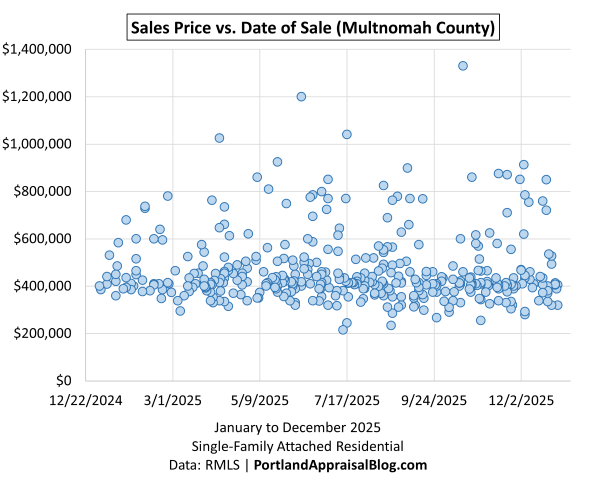
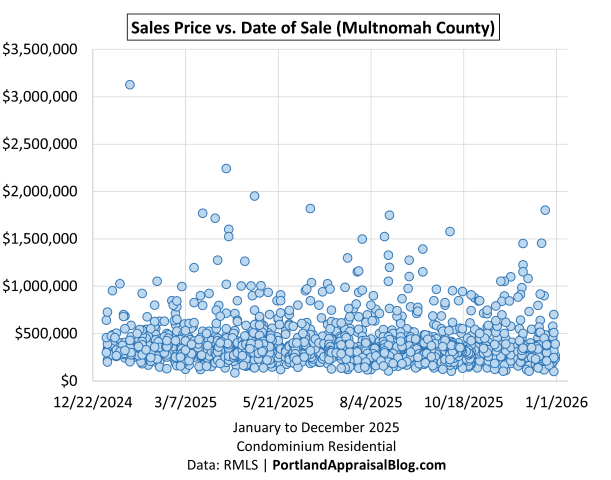
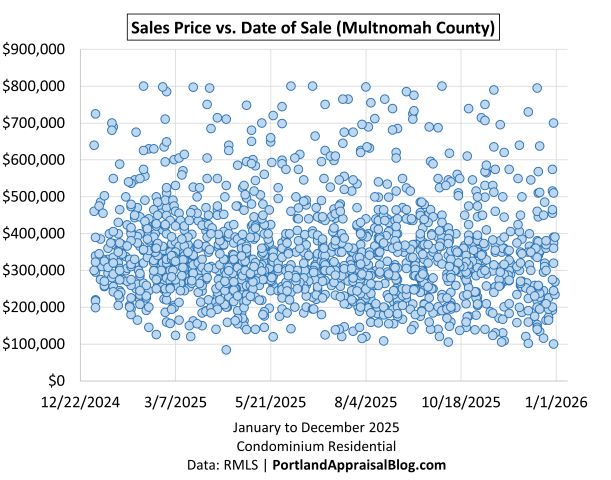
The following is a scatter plot of all Multnomah County condo sales in 2025 (sales price vs. date of sale):
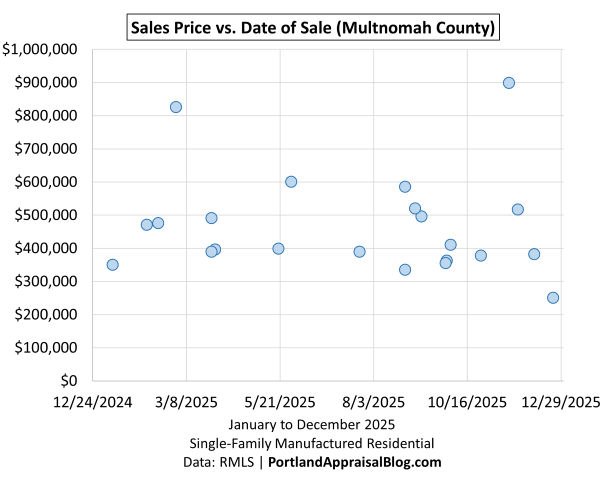
The full time-series view of sales prices in Multnomah County for 2025 shows a market that remained active year-round, with occasional high-end transactions above $1 million scattered throughout the period but representing only a small fraction of total volume. These outliers—primarily in premium urban core locations such as the Pearl District, Downtown, and South Waterfront—demonstrate that luxury demand persisted despite broader softening pressures.

Zooming in on sales priced at $800,000 or less we have:

The $800,000 or less segment accounts for the vast majority of Multnomah County condominium transactions. A dense horizontal band of activity is concentrated in the $200,000–$500,000 range across all months. It is at this scale a pattern of gradually lower prices is evident. The downward tilt of the core band aligns with the modest price declines observed in the aggregate data (-1.49% median, -3.37% PPSF) and reflects how elevated interest rates and rising HOA dues continued to temper upward pricing momentum in the urban core.

Washington County 2025 Stats

Washington County, encompassing suburban areas such as Beaverton, Hillsboro, Tigard, and Tualatin, experienced the sharpest softening among the major counties in 2025, with volume and price declines more pronounced than in Multnomah.

The table below summarizes key metrics for Washington County condominium residential sales in 2025 compared with 2024.

Category20242025% Change
Total $ Volume$189.1 Million$168.8 Million-10.74%
Average Price$327,654$316,025-3.55%
Median Price$325,000$305,000-6.15%
Avg SP/OLP96.60%94.18%-2.50%
Avg PPSF (TSF)$301.48$284.18-5.74%
Avg HOA Dues$410.71$455.74+10.97%
Avg Age (Yrs)30.4131.74+4.37%
Avg CDOM57.0583.10+45.68%
Avg Total SF1,1201,137+1.49%
Total # of Sales577534-7.45%
# of New Constr.125-58.33%
# of REOs37+133.33%
# of Short Sales01
Note: Average monthly HOA Dues reflects only sales with reported HOA dues (524 sales in 2025). All other metrics use the full dataset.
Condominium Residential | 2024 & 2025
Data: RMLS | PortlandAppraisalBlog.com

Washington County showed significant volume pressure (-7.45% sales, -10.74% dollar volume), with median price down -6.15% and PPSF declining -5.74%—steeper than regional and Multnomah figures. Cumulative days on market surged +45.7% to 83.10 days average, indicating prolonged exposure and increased buyer leverage in this suburban market. HOA dues rose +11.0% to $455.74 average, adding to monthly payment burdens. New construction fell sharply -58.3% to just 5 units, further limiting fresh supply. Distress indicators increased (REOs +133%, short sales from 0 to 1), though absolute numbers stayed small.

The following table shows the geographic distribution of condo sales in Washington County:

CityAvg PriceAvg PPSF# of Sales% of Sales
Aloha$310,000$260.9410.19%
Beaverton$300,209$278.9419436.33%
Forest Grove$309,986$295.2771.31%
Hillsboro$336,103$288.199016.85%
King City$233,231$244.20163.00%
Portland$327,032$295.2316831.46%
Sherwood$392,500$282.3950.94%
Tigard$362,840$283.77254.68%
Tualatin$288,613$262.89285.24%
Avg/Sum$316,025$284.18534
Condominium Residential | 2025
Data: RMLS | PortlandAppraisalBlog.com

The county’s condo activity concentrated heavily in Beaverton (36% of sales) and Hillsboro (17%), with Portland mailing-address areas (unincorporated Washington County near the Multnomah line) contributing another 31%. This suburban focus, combined with external pressures such as Intel layoffs in Hillsboro, amplified selectivity and contributed to the county’s more pronounced softening compared to the urban core.

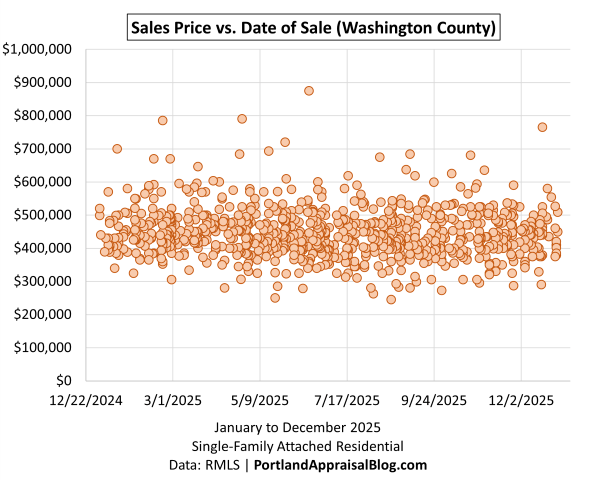
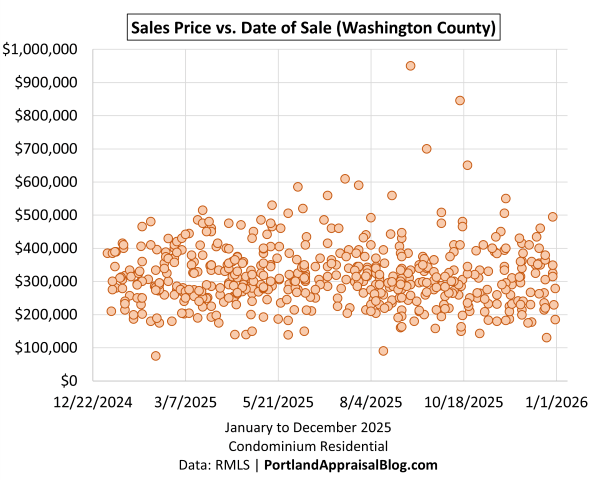
The following is a scatter plot of all Washington County condo sales in 2025 (sales price vs. date of sale):
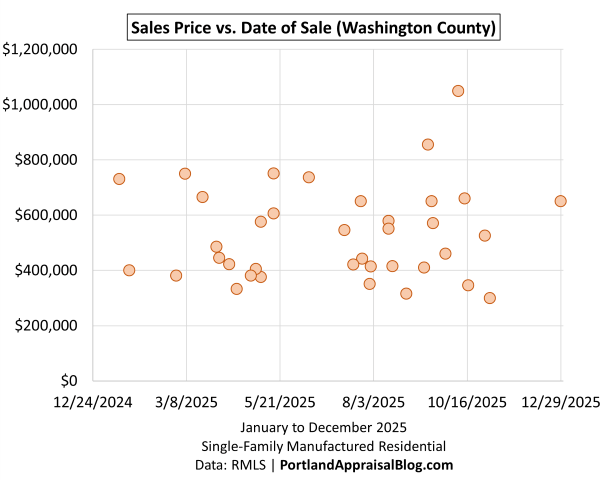
The scatter plot shows a bell curve, gradually rising from January to about July and then declining for the remainder of the year.

Clackamas County 2025 Stats

Clackamas County, covering southern and eastern suburban areas such as Lake Oswego, Oregon City, Milwaukie, West Linn, and Happy Valley, experienced moderate softening in 2025, with more pronounced volume declines than Multnomah but less severe than Washington County.

The table below summarizes key metrics for Clackamas County condominium residential sales in 2025 compared with 2024.

Category20242025% Change
Total $ Volume$106.6 Million$86.22 Million-19.10%
Average Price$391,794$368,456-5.96%
Median Price$350,000$335,000-4.29%
Avg SP/OLP95.24%94.60%-0.68%
Avg PPSF (TSF)$317.90$305.59-3.87%
Avg HOA Dues$465.61$497.14+6.77%
Avg Age (Yrs)34.8235.17+1.00%
Avg CDOM68.6284.77+23.54%
Avg Total SF1,2371,220-1.37%
Total # of Sales272234-13.97%
# of New Constr.228-63.64%
# of REOs330.00%
# of Short Sales00
Note: Average monthly HOA Dues reflects only sales with reported HOA dues (228 sales in 2025). All other metrics use the full dataset.
Condominium Residential | 2024 & 2025
Data: RMLS | PortlandAppraisalBlog.com

Clackamas County saw significant volume pressure (-13.97% sales, -19.10% dollar volume), with median price down -4.29% and PPSF declining -3.87%—declines more pronounced than in Multnomah but less severe than in Washington. Cumulative days on market rose +23.5% to 84.77 days average, indicating increased buyer selectivity in this suburban market. HOA dues increased +6.8% to $497.14 average, adding to monthly payment burdens but rising less sharply than in urban Multnomah. New construction fell -63.6% to just 8 units, further limiting fresh supply. Distress indicators remained stable (REOs flat at 3, short sales zero).

The following table shows the geographic distribution of condo sales in Clackamas County:

CityAvg PriceAvg PPSF# of Sales% of Sales
Happy Valley$363,516$257.12208.55%
Lake Oswego$434,585$336.286728.63%
Milwaukie$341,328$275.833012.82%
Oregon City$339,855$327.15114.70%
West Linn$306,791$268.833715.81%
Wilsonville$369,922$332.323816.24%
Other$336,920$302.853113.25%
Avg/Sum$368,456$305.60234
Condominium Residential | 2025
Data: RMLS | PortlandAppraisalBlog.com

Activity concentrated in premium and mid-tier suburbs: Lake Oswego led with 67 sales (29% of county total) at the highest average price ($434,585) and PPSF ($336.28), followed by Wilsonville, West Linn, Milwaukie, and Happy Valley. Outer and smaller areas (grouped as “Other”) contributed only 31 sales combined, reflecting thinner demand in those locales and contributing to the county’s overall softness.

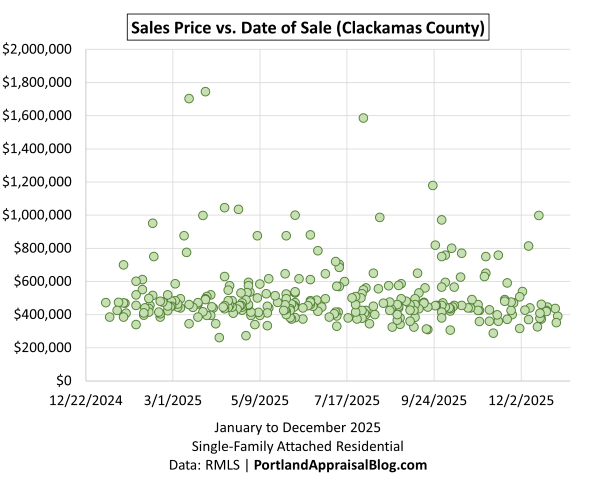
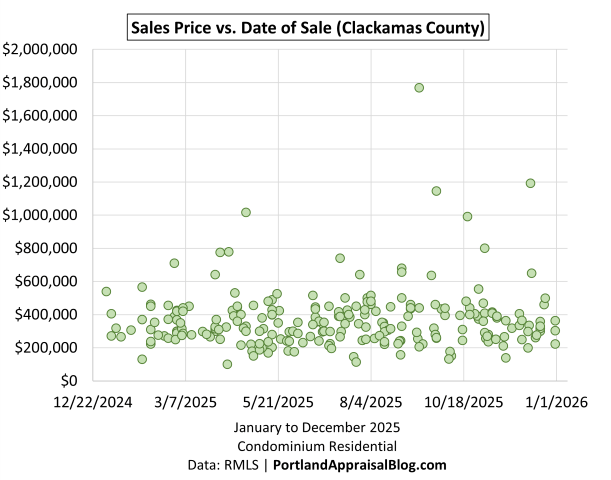
The following is a scatter plot of all Clackamas County condo sales in 2025 (sales price vs. date of sale):
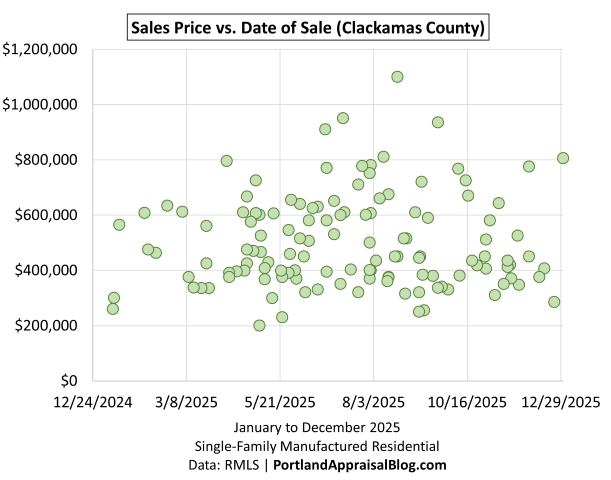
The overwhelming majority of sale occurred in the $200k-$400k band. The graph also shows there is a small luxury condo market present in the county

Yamhill County 2025 Stats

Yamhill County, while more rural, had its condominium activity centered on McMinnville and Newberg. The county remained a very low-volume condominium market in 2025, with only 15 sales representing less than 0.6% of regional activity.

The table below summarizes key metrics for Yamhill County condominium residential sales in 2025 compared with 2024.

Category20242025% Change
Total $ Volume$5.87 Million$5.38 Million-8.36%
Average Price$293,635$358,800+22.19%
Median Price$259,950$340,000+30.79%
Avg SP/OLP96.49%95.27%-1.27%
Avg PPSF (TSF)$271.63$256.67-5.50%
Avg HOA Dues$293.84$408.00+38.85%
Avg Age (Yrs)32.6037.47+14.93%
Avg CDOM54.40120.00+120.59%
Avg Total SF1,0911,415+29.72%
Total # of Sales2015-25.00%
# of New Constr.00
# of REOs00
# of Short Sales00
Note: Average monthly HOA Dues reflects only sales with reported HOA dues (14 sales in 2025). All other metrics use the full dataset.
Condominium Residential | 2024 & 2025
Data: RMLS | PortlandAppraisalBlog.com

Yamhill County experienced a significant volume decline (-25.0% sales, -8.36% dollar volume) on a very small base. Median price increased +30.8% to $340,000 and average price +22.2% to $358,800 (skewed by larger units; PPSF fell -5.5% to $256.67). Cumulative days on market doubled to 120 days average, signaling very low demand and prolonged exposure. HOA dues rose sharply +38.9% to $408 average—the highest relative increase among counties, though starting from a low base. No new construction or distress sales occurred.

The following table shows the geographic distribution of condo sales in Yamhill County:

CityAvg PriceAvg PPSF# of Sales% of Sales
McMinnville$404,400$255.051066.67%
Newberg$267,600$259.93533.33%
Avg/Sum$358,800$256.6815
Condominium Residential | 2025
Data: RMLS | PortlandAppraisalBlog.com

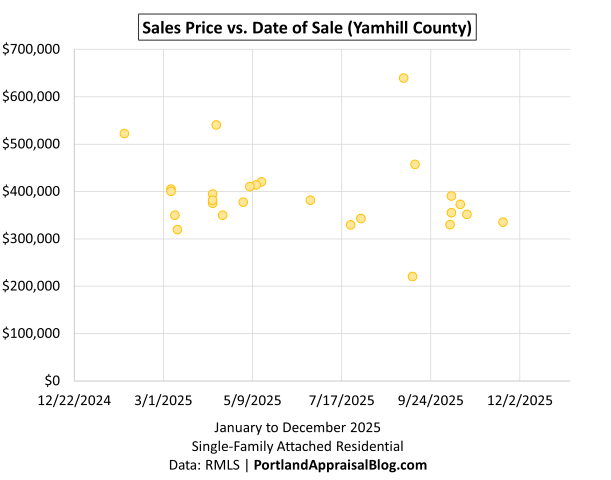
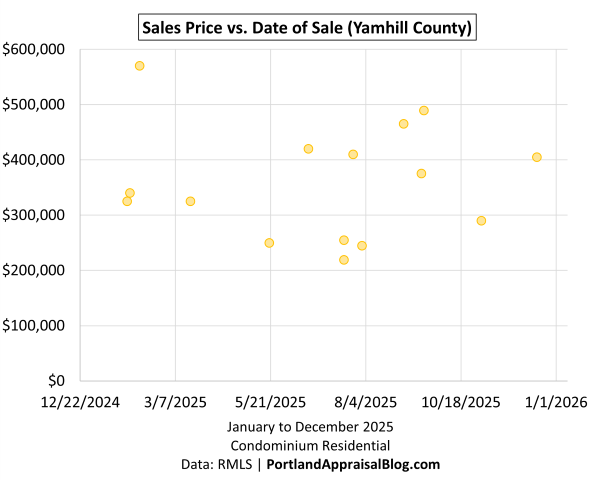
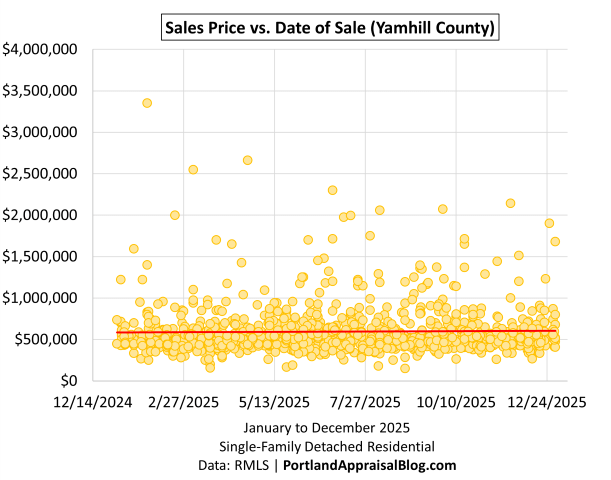
The following is a scatter plot of all Yamhill County condo sales in 2025 (sales price vs. date of sale):
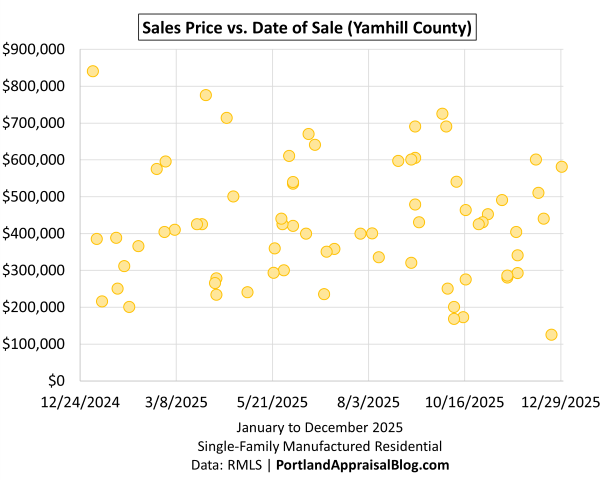
Most activity stayed within $200k-$500k.

Columbia County 2025 Stats

Columbia County, while largely rural does have some activity in the cities of St. Helens and Scappoose. The county remained a very low-volume condominium market in 2025, with only 5 sales representing less than 0.3% of regional activity.

The table below summarizes key metrics for Columbia County condominium residential sales in 2025 compared with 2024.

Category20242025% Change
Total $ Volume$710,000$1.47 Million+107.36%
Average Price$236,667$294,450+24.42%
Median Price$240,000$290,650+21.10%
Avg SP/OLP94.21%97.23%+3.21%
Avg PPSF (TSF)$267.81$267.81-0.00%
Avg HOA Dues$294.33$227.50-22.71%
Avg Age (Yrs)17.3330.00+73.08%
Avg CDOM146.0079.60-45.48%
Avg Total SF9351,100+17.69%
Total # of Sales35+66.67%
# of New Constr.10-100.00%
# of REOs00
# of Short Sales00
Note: Average monthly HOA Dues reflects only sales with reported HOA dues (4 sales in 2025). All other metrics use the full dataset.
Condominium Residential | 2024 & 2025
Data: RMLS | PortlandAppraisalBlog.com

Columbia County saw minimal activity (5 sales, up from 3 in 2024), with all transactions confined to Scappoose and St. Helens. Median price rose +21.1% to $290,650 and average price +24.4% to $294,450 on the small sample, while PPSF remained flat at $267.81. Cumulative days on market improved -45.5% to 79.60 days average, though absolute demand stayed negligible. HOA dues declined -22.7% to $227.50 average (on very small reported cohort). No new construction or distress sales occurred in 2025.

These figures should be interpreted cautiously due to the extremely low volume—a single transaction can materially shift averages. Overall, Columbia County reflects the sparse nature of condominium inventory in largely rural counties.

The following table shows the geographic distribution of condo sales in Columbia County:

CityAvg PriceAvg PPSF# of Sales% of Sales
Scappoose$310,125$286.45240.00%
St. Helens$284,000$255.40360.00%
Avg/Sum$294,450$267.825
Condominium Residential | 2025
Data: RMLS | PortlandAppraisalBlog.com

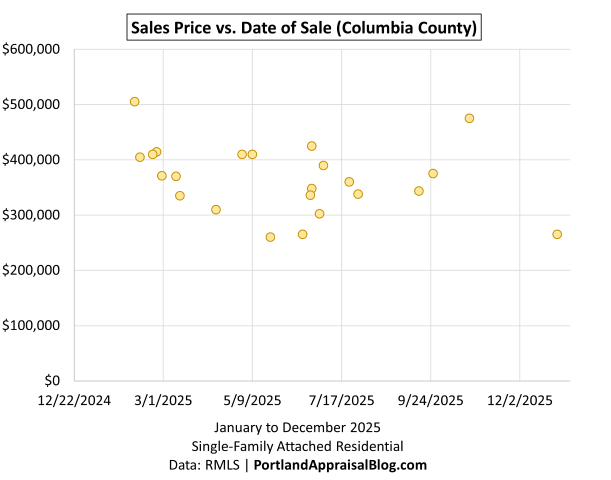
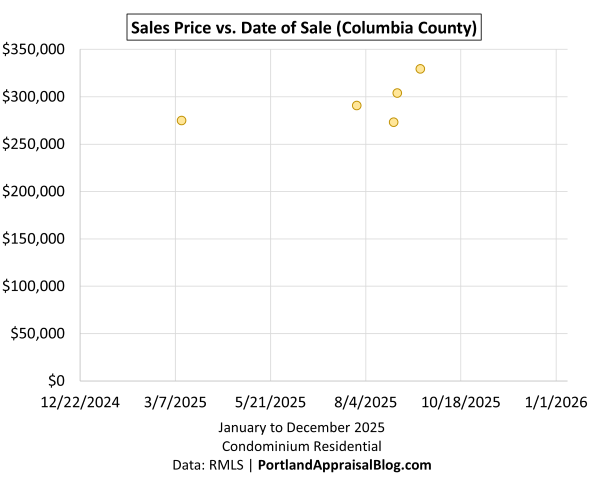
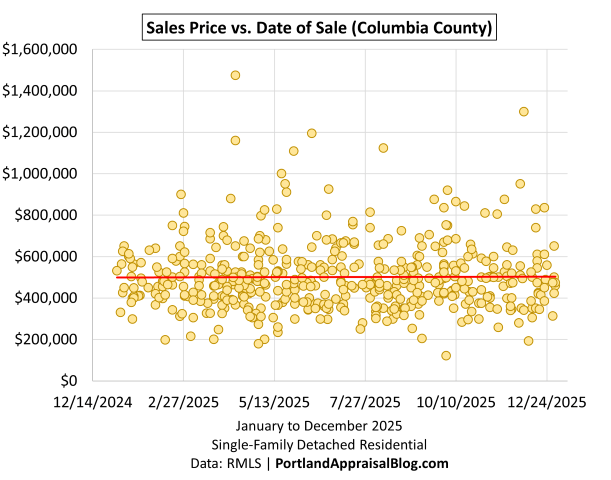
The following is a scatter plot of all Columbia County condo sales in 2025 (sales price vs. date of sale):
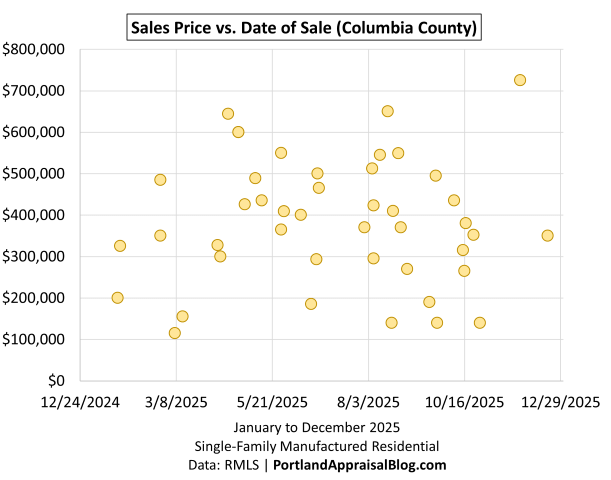
The five sales tightly clustered between $250k-$350k.

Hood River County 2025 Stats

Hood River County, a rural and resort-oriented area in the eastern part of the service region, remained a very low-volume condominium market in 2025, with only 7 sales representing less than 0.3% of regional activity. All transactions occurred within the City of Hood River proper—the only area with active condo inventory in the county.

The table below summarizes key metrics for Hood River condominium residential sales in 2025 compared with 2024.

Category20242025% Change
Total $ Volume$4.45 Million$3.94 Million-11.39%
Average Price$556,213$563,286+1.27%
Median Price$564,350$478,000-15.30%
Avg SP/OLP91.94%97.07%+5.58%
Avg PPSF (TSF)$425.51$520.97+22.43%
Avg HOA Dues$386.25$478.60+23.91%
Avg Age (Yrs)28.6326.57-7.17%
Avg CDOM85.2599.57+16.80%
Avg Total SF1,3271,118-15.77%
Total # of Sales87-12.50%
# of New Constr.02
# of REOs00
# of Short Sales00
Note: Average monthly HOA Dues reflects only sales with reported HOA dues (5 sales in 2025). All other metrics use the full dataset.
Condominium Residential | 2024 & 2025
Data: RMLS | PortlandAppraisalBlog.com

Hood River County saw minimal activity (7 sales, down from 8 in 2024), with median price declining -15.3% to $478,000 while average price edged up +1.3% to $563,286 (small-sample volatility; PPSF increased +22.4%, with smaller units sold). Cumulative days on market rose +16.8% to 99.57 days average, and HOA dues climbed +23.9% to $478.60. Two new construction sales appeared in 2025 (from zero the prior year), but overall demand remained negligible. No distress sales occurred.

These figures should be interpreted cautiously due to the extremely low volume—individual transactions can materially shift averages. Overall, Hood River County reflects the sparse nature of condominium inventory in rural/resort areas.

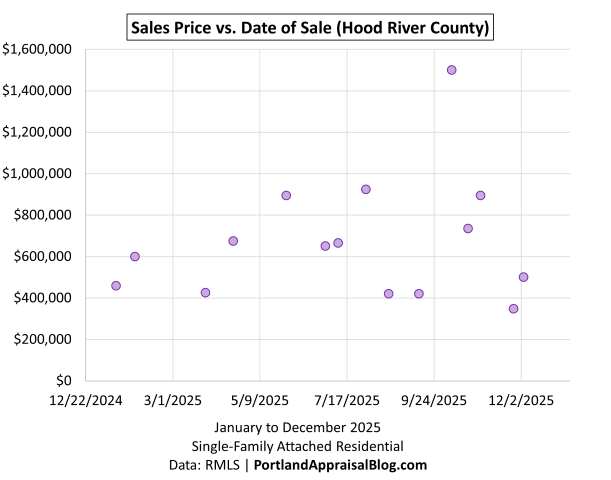
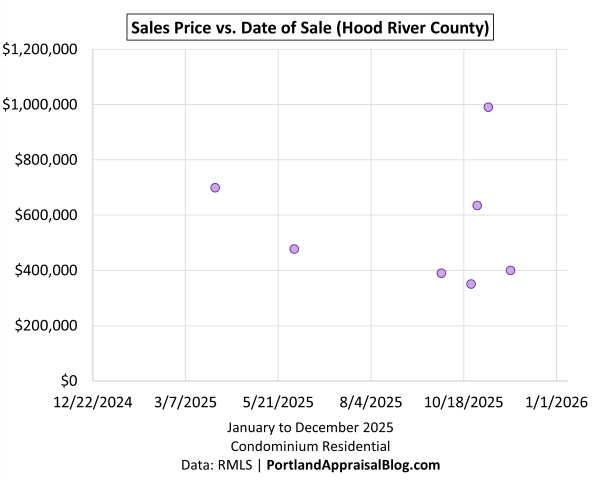
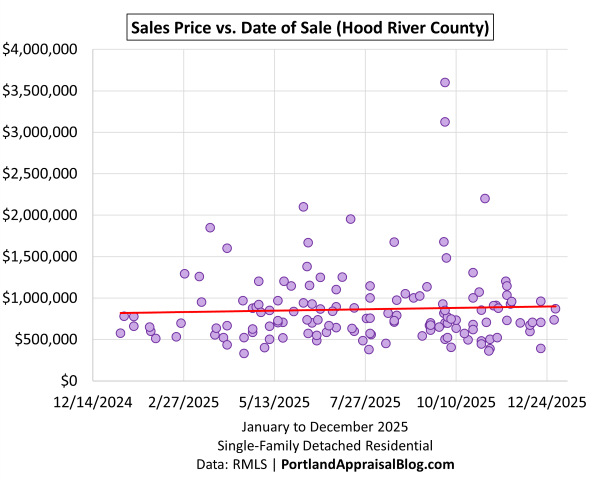
The following is a scatter plot of all Hood River County condo sales in 2025 (sales price vs. date of sale):
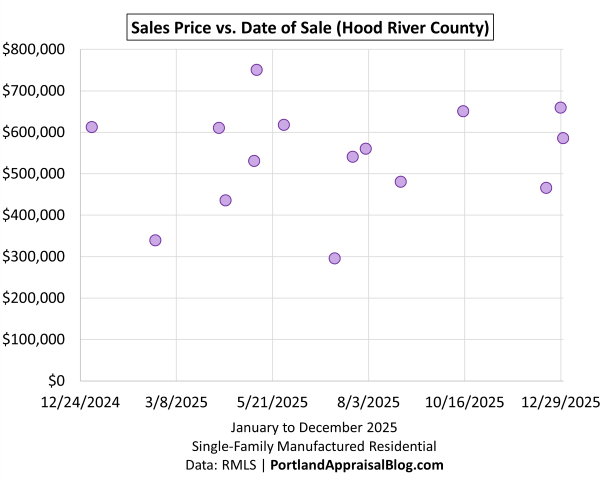
Sales activity largely remained near $400k with a few data points above $600k.

Closing Thoughts

The 2025 Portland Region condominium market reflected a continuation of the gradual softening that has defined the segment in recent years. Prices declined modestly overall, with average and median figures down year-over-year, while time-on-market metrics lengthened substantially and inventory levels rose into clearly buyer-favored territory. Rising HOA dues and persistently high interest rates amplified monthly payment pressures, narrowing buyer pools and increasing selectivity—particularly in complexes with elevated carrying costs. Yet the market remained functional: transactions continued at a steady pace, volume held relatively close to the prior year, and affordability persisted at a moderate level relative to the HUD MSA median household. This was not a collapse, but a measured shift toward conditions favoring buyers, with the most pronounced effects visible in extended marketing times, higher months of supply, and selective pricing behavior across the region.

From an appraisal perspective, the year’s trends underscore several practical realities. The tight size distribution and flat PPSF-vs-SF relationship in condos make PPSF declines a more direct indicator of price softness than in detached homes, where compositional effects often play a much bigger role. Prolonged CDOM and elevated MOS highlight the need for careful time and motivation adjustments when selecting and weighting comparables, especially in segments with high HOA dues or project-specific challenges. The bifurcation between low-dues “winners” (small infill, minimal associations) and high-dues “losers” (premium or challenged complexes) further emphasizes the importance of in-complex comps to neutralize carrying-cost variance and reduce adjustment subjectivity.

Looking ahead, the condo market’s trajectory will likely depend on the trajectory of interest rates and ongoing pressures on HOA dues (insurance, reserves, major repairs). While the segment has shown resilience in the urban core—where demand remains anchored to location and lifestyle—suburban and rural areas face greater vulnerability to supply constraints and buyer caution. The persistent oversupply in key urban condo submarkets like the Pearl District and Portland Downtown suggests that stabilization may take time, but the market’s continued functionality—even in a challenging environment—indicates that condos remain a viable housing option for many in the region.

What trends do you expect to see in 2026? I’d love to hear your thoughts—feel free to reply here or reach out directly.

Sources & Further Reading

All data presented in this annual review is sourced directly from RMLS and has been subjected to my rigorous cleaning and validation process to ensure reliability for condominium residential analysis in the six-county Portland Region. The trends, comparisons, and commentary are the result of original appraisal expertise and independent analysis—not aggregated from secondary sources or news summaries.

Decorative text divider.

Coda

Thanks for reading—I hope you found a useful insight or an unexpected nugget along the way. If you enjoyed the post, please consider subscribing for future updates.

Are you an agent in Portland who wonders why appraisers always do “x”?

A homeowner with questions about appraiser methodology?

If so, feel free to reach out—I enjoy connecting with market participants across Portland and the surrounding counties, and am always happy to help where I can.

And if you’re in need of appraisal services in Portland or anywhere in the Portland Region, we’d be glad to assist.
The 2025 Portland Region Detached Homes Market in Review

The Portland Region detached homes market in 2025 remained stable—modest gains in volume (+2.11%) and prices (+0.84% median to $599,990) amid longer CDOM (+11.09% to 59.15 days) and reduced new construction (-11.86%). Tight supply (~2.9 months MOS) supported resilience in a selective, balanced environment.

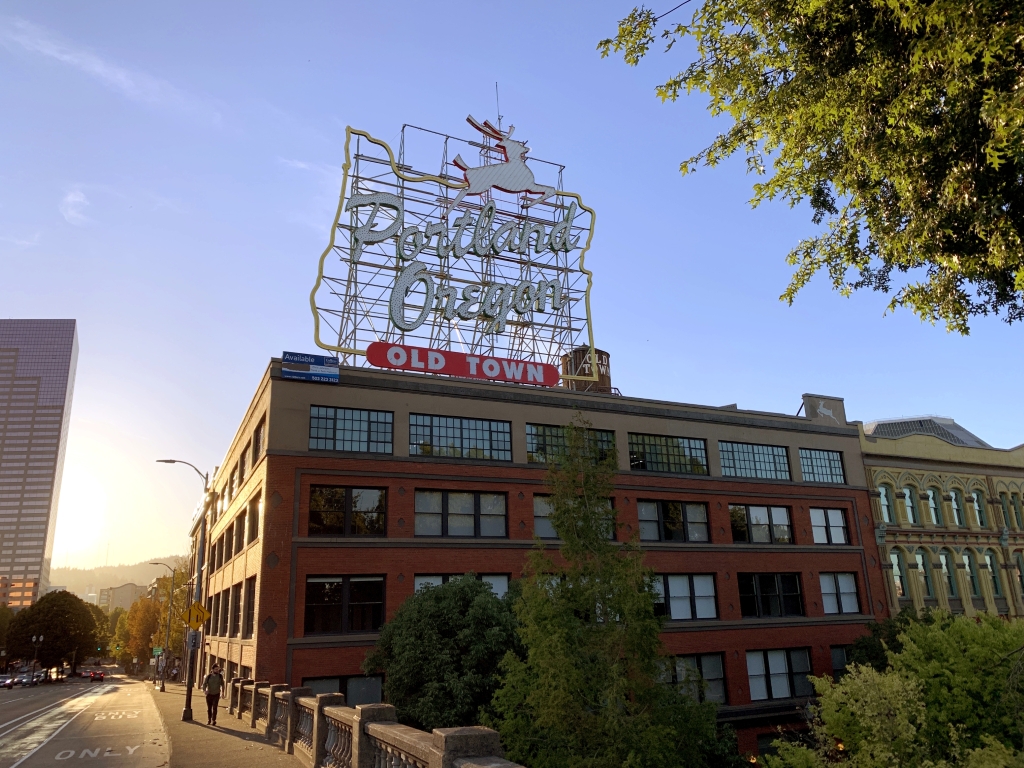
Famous Portland White Stag sign in trees in autumn colors.
Portland White Stag sign with trees in autumn colors.
Via Canva Pro

The Portland Region’s detached single-family home market in 2025 remained in a state of equilibrium—a continuation of the balanced conditions observed throughout the quarterly updates. After the sharp rate-driven shifts of 2022–2023, the region has settled into a new normal: modest growth, increased buyer selectivity, and persistent supply constraints. Prices held firm with slight upward movement, transaction volume grew incrementally, and marketing times lengthened as buyers became more deliberate in a still-elevated borrowing environment.

This stability was not uniform across segments or submarkets. Core properties continued to drive the majority of activity, while luxury showed resilience in select pockets. New construction retreated further, pushing the average home age older and reinforcing resale dominance. Months of supply stayed tight, supporting price levels without dramatic volatility.

The following sections provide a regional overview, segment breakdown, monthly trends, and detailed county-level statistics.

Table of Contents

Data Housekeeping

The Portland Region in this review comprises the six Oregon counties of Columbia, Clackamas, Hood River, Multnomah, Washington, and Yamhill. These counties form a contiguous housing ecosystem centered on Portland—Multnomah as the core home county, with the others tightly integrated through commuting patterns, economic ties, and shared market dynamics (e.g., Yamhill’s strong connection via Highway 99W and wine-country adjacency). Beyond Yamhill, the MLS system changes, further distinguishing this six-county area from broader geographic aggregations. For a detailed overview—including county profiles, population data, key value influencers, and why this definition differs from the official seven-county Portland–Vancouver–Hillsboro MSA—see my dedicated page: The Portland Region – Six-County Market Area Overview.

Colored map of the six counties comprising the Portland Region: Clackamas, Columbia, Hood River, Multnomah, Washington, and Yamhill.
The six-county Portland Region
Via SunCatcherStudio

All data is sourced from RMLS and reflects open-market detached single-family residential sales (excluding condos, attached homes, manufactured homes on leased land, and multifamily). SNL (“Sold Not Listed”) entries—off-market transactions entered retroactively—have been excluded to preserve consistency with true market activity.

All figures have undergone my standard cleaning process to address common RMLS accuracy challenges, including misclassifications (e.g., condos listed as detached), square footage/price typos, incomplete fields, status/date mismatches, and non-representative entries. For a detailed overview of these issues, their impact on market analysis, and how I mitigate them through automated flagging, cross-verification, and manual review, see the dedicated page: RMLS Data Accuracy Challenges.

Important note for the 2025 annual review: I published quarterly updates for each quarter of 2025, and sharp readers may notice that the total sales count here exceeds the sum of the four quarterly figures. This occurs because some agents delay updating records for months after closing. A recent comprehensive check of all non-close-sale data uncovered additional stragglers that were not captured in the quarterly snapshots. As a result, this full-year aggregation provides the most complete and accurate picture of 2025 detached home activity in the region.

Portland Region 2025 Overview

The Portland Region’s detached single-family home market in 2025 remained in a state of equilibrium—modest gains across key metrics despite increased buyer selectivity and a continued retreat in new construction.

Overall Regional Trends

The table below summarizes key metrics for detached single-family residential sales in the Portland Region (Columbia, Clackamas, Hood River, Multnomah, Washington, and Yamhill counties) for all of 2025 compared with 2024.

Category20242025% Change
Total $ Volume$11.4 Billion$11.7 Billion+2.11%
Average Price$676,839$682,557+0.84%
Median Price$595,000$599,990+0.84%
Avg SP/OLP97.92%97.24%-0.69%
Avg PPSF (TSF)$320.37$321.05+0.21%
Avg Lot Size (ac)0.650.64-0.51%
Avg Age (Yrs)43.0048.52+12.84%
Avg CDOM53.2459.15+11.09%
Avg Total SF2,1802,203+1.04%
Total # of Sales16,87217,083+1.25%
# of New Constr.2,1081,858-11.86%
Avg Supply (Mos.)2.662.92+9.77%
# of REOs111110-0.90%
# of Short Sales2337+60.87%
2024 & 2025
Data: RMLS | PortlandAppraisalBlog.com

Key Observations From the Aggregate Data

The 2025 full-year metrics reinforce the theme of stability that defined the quarterly updates—modest gains in volume and prices occurred within a market that remained balanced rather than shifting dramatically in any direction.

  • Modest overall growth with compositional support: Total sales volume rose +2.11% to $11.7 billion on +1.25% more transactions (17,083 closings). Median and average close prices advanced +0.84% each—to $599,990 and $682,557—while average PPSF edged +0.21% to $321.05 despite homes becoming slightly larger (+1.04% to 2,203 SF). Normally, larger average sizes exert downward pressure on PPSF; the fact that PPSF held positive suggests underlying value support through quality or compositional shifts in the sold inventory.
  • Aging inventory and reduced new construction: Average home age increased +12.84% to 48.52 years, driven primarily by a -11.86% decline in new construction closings (1,858 vs 2,108 in 2024). This shift skewed the transaction mix toward older existing stock, limiting fresh supply and reinforcing resale dominance.
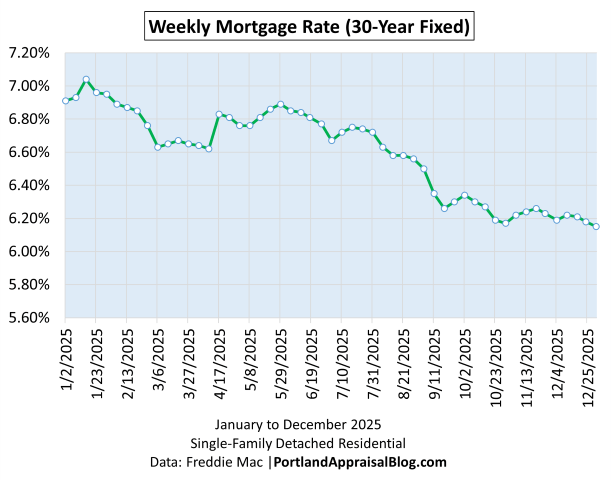
  • Increased buyer selectivity: Average cumulative days on market lengthened +11.09% to 59.15 days—a clear sign of greater deliberation and caution. Even as mortgage rates eased gradually through 2025 (from early highs near 7.0% to year-end levels around 6.1–6.2%), rates remained elevated relative to historical norms and sustained the lock-in effect for many homeowners. Buyers took more time to decide, compare, and negotiate, contributing to the modest dip in SP/OLP ratio to 97.24% (-0.69%).
  • Tight supply conditions: Months of supply averaged approximately 2.9 months—well below the traditional 4–6 month benchmark for balance. This continued tightness supported price resilience and prevented broader volatility, even as selectivity rose.
Line graph showing the weekly 30-year fixed mortgage rate for 2025.

The gradual downward trend in weekly 30-year fixed mortgage rates throughout 2025—from early-year highs near 7.0% to year-end levels around 6.1–6.2%—provided some affordability relief compared to 2024. However, rates remained elevated relative to recent historical norms and continued to contribute to buyer caution, as evidenced by the increase in average cumulative days on market.

Portland Region Scatter Plots

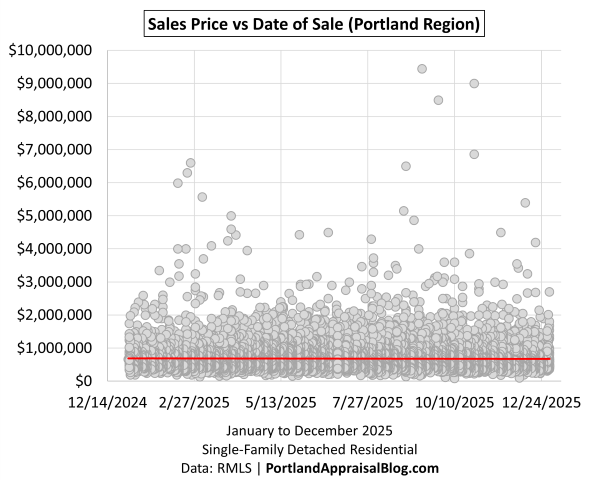
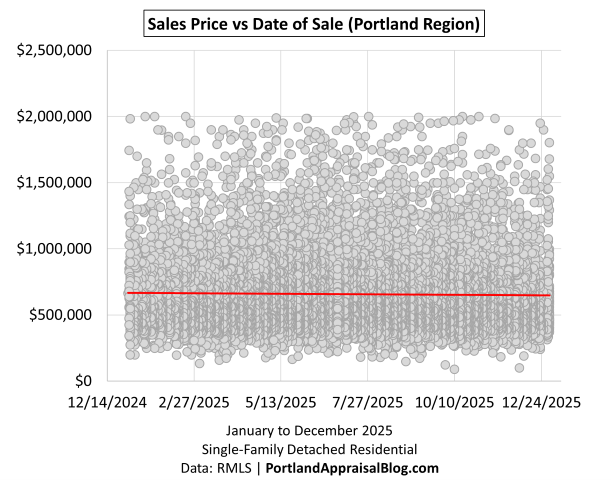
To visualize the distribution of individual sale prices across 2025, the following scatter plots show sales price against date of sale. The first graph displays the full range of transactions, while the second focuses on the $0–$2M range. In both, the red line represents a fitted trendline across all transactions.

Scatter plot showing individual home sales in the Portland Region during 2025. Each dot represents a closed sale, plotted by date on the x-axis and price on the y-axis. The data is sourced from RMLS.

The full-range scatter illustrates the complete distribution of detached single-family home sales prices in the Portland Region for 2025. The majority of transactions cluster in the lower bands, with occasional high-end outliers extending up to $10M+. The fitted trendline shows no clear upward or downward direction, reinforcing the year’s price stability.

Scatter plot showing individual home sales in the Portland Region during 2025, with a focus on sales at or below $2 million. Each dot represents a closed sale, plotted by date on the x-axis and price on the y-axis. The data is sourced from RMLS.

The zoomed view focuses on the $0–$2M range, revealing a dense “wall” of sales below approximately $1.3M–$1.5M throughout the year. Density thins noticeably above that level, highlighting the core market’s dominance in transaction volume while higher-price sales remain comparatively sparse and scattered. This pattern aligns with the broader stability theme: modest gains supported by compositional factors rather than broad appreciation.

Bottom-line Summary

The 2025 Portland Region detached single-family home market delivered a year of continued equilibrium—modest gains in volume and prices persisted within a balanced, non-volatile environment. While cumulative days on market lengthened and new construction retreated, the overall picture remained one of stability three years after the rapid mortgage rate rise. Supply stayed tight, buyer selectivity increased modestly, and prices held firm with slight upward movement, reflecting a market that has settled into a sustainable new normal.

Core Market (< $1M)

The core market—homes under $1 million—continued to anchor the majority of activity in the Portland Region during 2025, driving most of the transaction volume while showing modest resilience amid broader selectivity. This segment remained the primary engine of market movement, with buyers in this price range facing affordability constraints yet benefiting from greater availability of inventory compared to the luxury tier.

The following table compares core market metrics (< $1M) in 2025 with 2024:

CategoryCore (< $1M) 2024Core (< $1M) 2025% Change
Total $ Volume$9.04 Billion$9.19 Billion+1.71%
Average Price$592,349$596,742+0.74%
Median Price$570,525$575,000+0.78%
Avg SP/OLP98.15%97.47%-0.69%
Avg PPSF (TSF)$311.84$312.93+0.35%
Avg Lot Size (ac)0.420.46+10.06%
Avg Age (Yrs)46.3948.93+5.48%
Avg CDOM49.9956.50+13.02%
Avg Total SF2,0072,026+0.91%
Total # of Sales15,26015,406+0.96%
# of New Constr.1,9041,698-10.82%
# of REOs79.16%78.84%-0.39%
# of Short Sales90.45%90.18%-0.29%
2024 & 2025
Data: RMLS | PortlandAppraisalBlog.com

The core market—homes under $1 million—continued to anchor the majority of activity in the Portland Region during 2025, accounting for 90.18% of total sales count and 78.84% of dollar volume. This segment drove the bulk of transaction movement while demonstrating modest resilience amid broader selectivity pressures. Transaction volume grew slightly (+0.96% to 15,406 sales), and dollar volume advanced +1.71% to $9.19 billion. Median and average close prices rose +0.78% and +0.74% respectively—to $575,000 and $596,742—with average PPSF edging +0.35% to $312.93 despite a modest increase in average home size (+0.91% to 2,026 SF).

The core segment experienced more pronounced lengthening of marketing times than the region overall, with average cumulative days on market rising +13.02% to 56.50 days. This reflects heightened buyer caution in the more rate-sensitive price range, though sellers conceded only modestly more ground (SP/OLP ratio 97.47%, down -0.69%). New construction in core declined -10.82% to 1,698 closings, contributing to an older average age (+5.48% to 48.93 years) and further emphasizing resale dominance. Notably, average lot size in core increased +10.06% to 0.46 acres—a compositional shift that likely supported the modest PPSF gain by adding value through additional land.

Overall, the core market remained the foundation of regional activity in 2025, absorbing the majority of demand while navigating increased selectivity and reduced fresh supply. Its performance—modest gains in volume and prices with firmer PPSF resilience—helped maintain the year’s broader equilibrium.

Luxury Market (≥ $1M)

The luxury segment—homes priced at $1 million and above—represented a smaller but resilient portion of the Portland Region’s 2025 detached single-family market. While core properties drove the majority of transaction volume, luxury homes showed greater stability in certain metrics, particularly time on market, amid a year of overall equilibrium. This segment benefited from buyers who were often less rate-sensitive and more decisive when the right property aligned with their preferences.

The following table compares luxury market metrics (≥ $1M) in 2025 with 2024:

CategoryLuxury (≥ $1M) 2024Luxury (≥ $1M) 2025% Change
Total $ Volume$2.38 Billion$2.47 Billion+3.63%
Average Price$1,476,662$1,470,905-0.39%
Median Price$1,259,667$1,255,000-0.37%
Avg SP/OLP95.72%95.11%-0.63%
Avg PPSF (TSF)$401.07$395.59-1.37%
Avg Lot Size (ac)2.812.33-17.16%
Avg Age (Yrs)39.3844.71+13.55%
Avg CDOM84.0083.47-0.63%
Avg Total SF3,8133,829+0.41%
Total # of Sales1,6121,677+4.03%
# of New Constr.204160-21.57%
% of $ Volume20.84%21.16%+1.49%
% of Market9.55%9.82%+2.75%
2024 & 2025
Data: RMLS | PortlandAppraisalBlog.com

Luxury homes accounted for 9.82% of total sales count and 21.16% of dollar volume in 2025, with transaction count rising +4.03% to 1,677 and dollar volume advancing +3.63% to $2.47 billion. Median and average close prices softened slightly—down -0.37% to $1,255,000 and -0.39% to $1,470,905—while average PPSF declined -1.37% to $395.59.

Average cumulative days on market showed resilience, dipping -0.63% to 83.47 days, in contrast to the core segment’s more pronounced lengthening (+13.02% to 56.50 days). This suggests that well-positioned high-end homes are still finding buyers efficiently, and emphasizes the need to price homes realistically.

New construction in luxury fell more sharply (-21.57% to 160 closings), contributing to a shift toward resale dominance within the segment.

Average lot size decreased -17.16% to 2.33 acres, though this may reflect a compositional move toward smaller urban or estate parcels rather than a broad trend.

Overall, the luxury market demonstrated relative strength in marketing time and modest dollar-volume growth, even as per-unit metrics softened. This resilience—particularly in time on market—helped balance the year’s broader selectivity, with luxury buyers remaining committed when the right property appeared.

Sales Volume

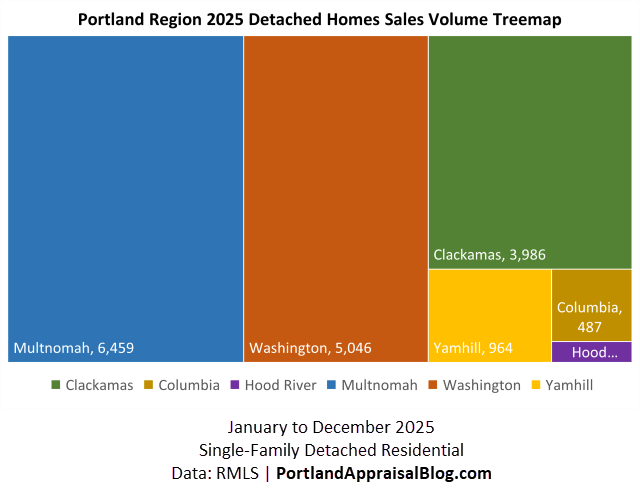
Washington, Clackamas, and Multnomah counties together accounted for nearly 91% of the region’s detached single-family sales in 2025, underscoring their central role in overall market activity. The following treemap visualizes the distribution by county, sized by sales count:

This treemap graph illustrates the sales volume of single-family homes in the Portland Region for 2025. The data is sourced from RMLS.

Multnomah led with 6,459 sales (37.81% of regional total), followed by Washington (5,046 sales, 29.54%) and Clackamas (3,986 sales, 23.33%). Yamhill contributed 964 sales (5.64%), Columbia 487 sales (2.85%), and Hood River 141 sales (0.83%). This geographic concentration remained highly consistent with 2024—the top three counties held ~90.68% of sales in 2025 compared to ~90.26% the prior year—reflecting the region’s enduring urban and suburban dominance.

The modest year-over-year shifts in county shares (e.g., Multnomah up slightly to 37.81%, Washington down to 29.54%, Clackamas essentially flat) further illustrate the stability that characterized 2025. Smaller counties showed greater percentage volatility due to lower base volumes, but the overall distribution reinforced a balanced market without significant reallocation of activity.

Monthly sales counts in 2025 followed a classic seasonal pattern typical of the Portland Region—lower activity in winter, a ramp-up through spring, peak momentum in late spring and early summer, a modest dip in early fall, and a surprising late-year rebound. The following bar chart shows total detached single-family sales by month for 2025:

This bar graph shows the number of single-family detached residential sales in the Portland Region for each month of 2025. The data is sourced from RMLS.

The chart reveals the expected seasonality: weakest in January and February, building steadily to a spring peak in May and then gradually declining until October (1,686—the year’s highest month) before tapering in November and December. This late-year strength in October and December helped offset softer mid-spring and summer months compared to 2024, contributing to the modest annual increase in total closings.

Monthly sales counts in 2025 tracked closely with 2024 for most of the year, reflecting the same underlying stability across seasons. The following double bar chart compares total detached single-family sales by month for the two years:

This bar graph compares the number of single-family detached residential sales in the Portland Region for 2024 and 2025. The data is sourced from RMLS.

The two years remained remarkably neck-and-neck in monthly activity, with differences mostly modest in scale. 2024 showed noticeable strength in May, June, and November, while 2025 pulled ahead in January, October, and December. This pattern aligns with gradual mortgage rate easing throughout 2025, which likely encouraged some buyers to act earlier in the year or wait for improved affordability late in the year. The standout October performance in 2025 (1,686 sales, the year’s high point) echoed a strong fall trend seen in 2024, likely influenced by families finalizing moves after the school year start, pre-holiday motivation, and Portland’s relatively mild October weather facilitating showings and closings.

Overall, the close month-to-month alignment reinforces that 2025 was not a year of dramatic seasonal shifts or momentum changes—just incremental variations that netted the modest +1.25% increase in annual sales.

Sales Price

Monthly average sales prices in 2025 remained remarkably stable throughout the year, closely mirroring 2024’s patterns with only modest seasonal fluctuations and no significant directional trend. The following bar chart shows average close prices by month for 2025:

This bar graph shows the average sales price of single-family detached residential sales in the Portland Region for each month of 2025. The data is sourced from RMLS.
Note: The y-axis starts at $600,000 to allow better examination of monthly differences.

The chart reveals a narrow range of monthly averages—from approximately $657,000 in November and December to $703,265 in June—a spread of about 7% from low to high. Prices peaked in late spring and early summer (April–August mostly $690k–$703k), then gradually softened through fall and winter. This seasonal arc is typical of the region, with stronger activity and higher-value closings during peak buyer season, followed by a quieter late-year period. The overall flatness across months reinforces the year’s broader price equilibrium.

The following line graph below compares monthly average sales prices for 2024 (blue) and 2025 (red), with a full y-axis scale starting near zero to show true proportional differences:

This line graph shows the average monthly sales prices of homes in the Portland Region for 2024 and 2025. The lines are nearly identical.

When viewed on this full scale, the two years appear nearly identical across most months, with only minor divergences — primarily a stronger start in January and February 2025. This visual compression underscores the high degree of price stability year-over-year. Zooming in we have:

This line graph shows the average monthly sales prices of homes in the Portland Region for 2024 and 2025. The y-axis starts at $580,000 to allow better viewing of minor variations between the two years for each month.
Note: The y-axis starts at $580,000 to allow better examination of monthly differences.

The above graph reveals the modest seasonal movements more clearly.

New Construction

New construction activity in 2025 declined noticeably from 2024 levels, with 1,858 new homes closing compared to 2,108 the prior year (-11.86%). As a share of total sales, new construction averaged 10.88% for the year, reflecting a reduced contribution from fresh inventory to overall market volume. The following double bar chart shows monthly total sales (primary bars) versus new construction closings (nested/secondary bars) in 2025:

This bar graph shows the number of single-family detached residential sales in the Portland Region for each month of 2025 with the number of new constructions sales embedded within as a different colored bar. The data is sourced from RMLS.

New construction share was highest early in the year (February 15.35%, January 13.05%, March 13.03%), then trended lower through spring and summer (June–August ~9–10%), reached a low in September (8.41%), and rebounded modestly in November and December (~11–12%). This pattern reflects typical builder closing cycles—more completions in Q1/Q2 — while total sales peaked later in the spring/summer buyer season, resulting in lower relative share during high-volume months. The annual decline contributed to older average inventory and reinforced resale dominance across the region.

While new construction declined regionally, the geographic distribution of new closings remained concentrated in the larger suburban counties. The following side-by-side double bar chart compares new construction sales volume by county in 2024 versus 2025:

This bar graph compares the number of new construction single-family detached residential sales in the Portland Region for 2024 and 2025 broken out by county. The data is sourced from RMLS.

Washington County continued to dominate new construction activity, accounting for 52.53% of regional new closings in 2025 (976 sales, down -8.87% from 2024). Clackamas followed at 26.16% (486 sales, -4.14%), and Multnomah contributed 14.10% (262 sales, -15.76%). Yamhill saw the sharpest relative drop (-42.86% to 120 sales, 6.46% share), while Columbia remained flat at 9 sales (0.48%) and Hood River posted a small gain (5 sales from 0, 0.27% share). The concentration in Washington and Clackamas—together nearly 79% of 2025 new closings—reflects their suburban growth areas and remaining builder pipelines, while smaller counties saw more volatility due to limited scale.

The table below shows new construction sales volume by dollar amount for 2025 compared with 2024.

County2024 $ Amount2025 $ Amount% Change% of Total 2025 $ Amount
Clackamas$431,392,884$423,842,357-1.75%3.63%
Columbia$5,398,000$4,704,700-12.84%0.04%
Hood River$0$3,081,2500.03%
Multnomah$190,014,459$142,381,946-25.07%1.22%
Washington$813,200,663$719,942,866-11.47%6.17%
Yamhill$107,849,192$65,484,912-39.28%0.56%
Sum$1,547,855,198$1,359,438,031-12.17%11.66%
2024 & 2025
Data: RMLS | PortlandAppraisalBlog.com

The following double bar chart provides the above information at a glance:

This bar graph compares the dollar amount of new construction single-family detached residential sales in the Portland Region for 2024 and 2025 broken out by county. The data is sourced from RMLS.

Washington County dominated new construction dollar volume in 2025 ($719.9 million, 52.96% of regional total), followed by Clackamas ($423.8 million, 31.18%). Together these two counties accounted for over 84% of regional new-home value, reflecting their suburban growth areas and remaining builder pipelines. The regional decline in new construction dollar volume (~12.17% to $1.36 billion) slightly outpaced the count drop, indicating modest softening in average new-home pricing alongside reduced volume.

Clackamas County’s strong showing in new construction value was supported by vested projects in growth areas like Sandy. However, the ongoing sewer moratorium in Sandy (extended to June 2026) may limit future pipeline, potentially reducing Clackamas’s regional share in 2026–2027 as approved projects are completed. For full details on the moratorium’s history, impacts, and timeline, see my recent analysis.

Despite the measurable pullback in new construction closings and dollar volume, the segment remained a significant economic force in the Portland Region. Nearly $1.4 billion in new home value changed hands in 2025—a substantial contribution to local jobs, supply-chain activity, tax base support, and overall economic circulation. This underscores the ongoing importance of home building even in a year of reduced activity and resale dominance.

Cumulative Days on Market

Average cumulative days on market (CDOM) rose +11.09% year-over-year to 59.15 days in 2025, reflecting increased buyer selectivity in a market where mortgage rates, while easing modestly, remained elevated relative to historical norms. The following bar chart shows average CDOM by calendar month for 2025:

This bar graph shows the average cumulative days on market for single-family detached residential sales in the Portland Region for each month of 2025. The data is sourced from RMLS.

The chart reveals the classic “V” pattern typical of the region: longest marketing times in winter months (January & December), a sharp drop through spring (March through May), a trough in late spring/early summer (June & July), then a gradual rise through fall/early winter (September through December). This seasonality aligns with expected patterns—stronger buyer activity and faster turnover during peak season, slower movement in winter due to holidays, weather, and reduced showings.

The bar chart below compares cumulative days on market for 2024 and 2025:

This bar graph compares the average days on market (CDOM) for single-family detached residential homes in the Portland Region for 2024 and 2025. The data is sourced from RMLS.

2025 CDOM was higher in nearly every month, with the increase most pronounced in winter (January +26 days, December +18 days) but evident across the board. The “V” shape persisted in both years, yet the overall elevation in 2025 underscores structural factors—persistent affordability hurdles and buyer caution—rather than seasonal-only shifts. Sellers contributed by holding firm to initial list prices, conceding only modestly more ground (SP/OLP ratio 97.24%, down -0.69%), which extended exposure periods without triggering widespread reductions.

The Core vs Luxury CDOM comparison further illustrates segment-specific dynamics within the year’s broader selectivity trend. The following bar chart shows average cumulative days on market by calendar month for 2025, segmented by core (< $1M) and luxury (≥ $1M):

This bar graph compares the average days on market (CDOM) for single-family detached residential homes in the Portland Region for 2024 and 2025 segmented by under $1M or $1M+. The data is sourced from RMLS.

Luxury CDOM remained consistently higher than core throughout the year, reflecting the longer marketing times typical of higher-price properties that attract fewer, more selective buyers. Annual averages were 83.47 days for luxury (-0.63% from 2024) versus 56.50 days for core (+13.02% from 2024), highlighting greater resilience in the luxury segment. The “V” seasonality persisted in both, with winter highs and summer lows, but luxury showed a flatter profile overall—less pronounced seasonal swings—while core experienced more noticeable lengthening during peak periods.

This divergence aligns with buyer behavior: core buyers, more rate-sensitive and facing affordability constraints, exercised greater caution and took longer to decide, contributing to the segment’s sharper CDOM rise. Luxury buyers—often with more equity or cash positions—remained decisive when the right property appeared, resulting in relatively stable marketing times despite a slower sales pace. The contrast reinforces that selectivity pressures in 2025 were more acute in the core market, while luxury benefited from targeted demand in premium submarkets.

Housing Supply

Months of supply (MOS)—the number of months it would take to absorb current active inventory at the prevailing sales pace, assuming no new listings enter the market—remained low throughout 2025, averaging approximately 2.9 months. This continued tightness supported price resilience and modest gains despite increased buyer selectivity and longer marketing times. The following bar chart shows MOS by calendar month for 2025:

This bar graph shows the months of housing supply for single-family detached residential sales in the Portland Region for each month of 2025. The data is sourced from RMLS.

The chart illustrates clear seasonality: MOS peaked in January (3.36 months) as sales slowed and some listings lingered or re-entered the market post-holidays, dipped through spring (March 2.67, April 2.71), rose modestly during summer (June 3.08, July 3.22, August 3.15), and reached its lowest point in December (2.25 months). The December low reflects widespread year-end listing cancellations and withdrawals—a common pattern as sellers pause for holidays, tax considerations, or motivation loss—while January’s high results from many of those listings re-entering the market alongside new ones.

This seasonal wave aligns with expected regional patterns: stronger sales pace relative to inventory in peak buyer months (spring/summer) pulls MOS lower, while slower winter activity allows inventory to build relative to closings. The annual average of ~2.9 months stayed well below the traditional 4–6 month benchmark for a balanced market, maintaining a seller-leaning environment that helped anchor price stability even as CDOM lengthened.

The line graph below compares monthly months of supply for 2024 (blue line) and 2025 (red line), with a full y-axis scale to show true proportional differences:

This line graph shows the months of housing supply for homes in the Portland Region for 2024 and 2025.

Both years exhibited similar seasonal waves: higher MOS in winter (January peaks around 3.4–3.5 months), a dip through spring as sales pace accelerated, a modest rise in summer, and lows in late fall/early winter (December ~2.2–2.3 months in both years). The lines converged closely at the start (January) and end (December) of the year, with the most noticeable divergence occurring in spring and summer months, where 2024 showed lower (more constrained) MOS—often 0.5–0.8 months below 2025 levels—indicating relatively stronger absorption relative to inventory during peak buying season in 2024.

Overall, 2025 averaged modestly higher supply (2.92 months) compared to 2024 (2.66 months), remaining well below the traditional 4–6 month benchmark for a balanced market. This slight increase contributed to incremental affordability relief and helped support the year’s modest transaction volume growth, while the persistent tightness anchored price stability and limited broader volatility.

Miscellaneous Statistics & Standout Transactions

The 2025 Portland Region detached single-family market produced a range of notable extremes and interesting figures that highlight the diversity and breadth of activity across price points, sizes, features, and marketing times. The following standouts capture some of the year’s most remarkable data points.

Lowest close price: $90,000—a 1930s fixer cabin in Forest Grove (Washington County). The property offered original character but required extensive rehabilitation, including interior plumbing repairs and floor work. Photos of this property are currently available online.

Highest close price: $9.45 million—a lakefront estate in Lake Oswego (Clackamas County). The property featured approximately 280 feet of private Oswego Lake shoreline, panoramic views, a primary suite addition, pool, extensive entertaining spaces, six-car garage (pre-wired for expansion), and a boathouse. This transaction reflects sustained demand for premium waterfront properties in Clackamas County, consistent with the area’s historical strength at the upper end of the market. Photos of this property are currently available online.

Lowest PPSF: $49.84—an REO (bank-owned) fixer-upper in Clatskanie, OR 97016 (Columbia County). This 2-story home with basement offered good natural light and scenic surroundings but required significant vision and effort to restore to its potential. As one of the region’s most affordable major counties, Columbia continues to produce entry-level opportunities for buyers willing to undertake rehabilitation work. Photos of this property are currently available online.

Highest PPSF: $1,646.65 per square foot—a lakefront property on Oswego Lake in Clackamas County that is near the highest sale. The home sold for $8,500,000 and measured 5,162 square feet, featuring 4 bedrooms, 6 full bathrooms, 1 half bathroom, and a 0.26-acre lot. This transaction reflects strong demand for premium waterfront locations in the region, where location and views can drive exceptional value per square foot. Photos of this property are currently available online.

Longest CDOM: 1,923 days—a working vineyard estate in Yamhill County. The property first listed in March 2019 for $1.3 million, saw no price adjustment until March 2023, went pending in July 2024, and closed in August 2025 for $1.195 million. The extended marketing time reflects the challenges of selling a specialized vineyard property on a small-volume market, though the final discount was moderated by appreciation since the initial listing. This extreme duration highlights how niche or rural properties can face prolonged exposure in a selective environment. Photos of this property are currently available online.

Oldest home sold in 2025: Built in 1858—the former residence of Capt. George Jerome in Oregon City, OR (Clackamas County, Canemah historic neighborhood). This 3-bedroom home (main level living plus 3 upstairs bedrooms) sits adjacent to Willamette Falls, with a detached garage offering bonus room potential for hobbies or an ADU. The property represents a piece of Oregon’s early history, located in a neighborhood poised for future development tied to the falls area. Photos of this property are currently available online.

Largest lot sold in 2025: 90.9 acres—a property in North Plains, Oregon (Washington County). The 4,335-square-foot home sits on a mostly sloped and heavily forested lot, offering significant land area with limited immediate buildable potential. This sale reflects the region’s occasional demand for large rural or acreage parcels, often appealing to buyers seeking privacy, recreation, or long-term investment. Photos of this property are currently available online.

Largest home sold in 2025: 13,379 square feet—a sprawling estate in West Linn, Oregon (Clackamas County). The property sat on 20.18 acres adjacent to the Oregon Golf Club and included a shop building larger than the main residence itself. It sold for $6,500,000 after 299 days on market. This sale highlights demand for expansive, large-lot properties in the region’s suburban and semi-rural areas, where size and outbuildings add significant utility. An exterior photo of the property may be viewed here.

Smallest home sold in 2025: 426 square feet—a cabin in Scappoose, Oregon (Columbia County) on 1.4 acres. This compact property offered a minimal footprint with potential for buyers seeking an affordable entry into detached ownership or a rural retreat. Photos of the cozy home are currently available online and may be viewed here.

Most bedrooms: 11—a former adult foster care home in Tigard, OR (Washington County). The 7-bathroom property included a large kitchen, laundry area, living and family rooms, formal and informal dining, a back living/dining area with wet bar and desk setup, recent updates (new roof, AC/furnace, water heater, LVP flooring, electrical panel, interior/exterior paint), furniture negotiable, detached garage for storage, private deck, and an adjacent city-owned lot for extra parking. It sold to another adult care company, reflecting continued demand for larger, adaptable homes suitable for group living or care facilities in the region. Photos of this property are currently available online.

Most bathrooms: 10—a 9,500-square-foot residence in Dundee, Oregon (Yamhill County), currently operating as the Franziska Haus bed and breakfast. The property included 10 bedrooms and was designed for guest accommodations, making it convenient for wine-tasting visitors in the area. It likely could be converted to a private residence with minimal interior changes. Photos of the home are currently available online and may be viewed here.

Multnomah County 2025 Stats

Multnomah County remained the Portland Region’s core and highest-volume market in 2025, accounting for 37.81% of all detached single-family sales with 6,459 transactions. The following table compares key metrics for the county in 2025 with 2024:

Category20242025% Change
Total $ Volume$3.9 Billion$4.1 Billion+6.10%
Average Price$623,165$635,278+1.94%
Median Price$540,000$550,000+1.85%
Avg SP/OLP98.41%98.15%-0.27%
Avg PPSF (TSF)$313.41$316.80+1.08%
Avg Lot Size (ac)0.260.28+8.69%
Avg Age (Yrs)65.7768.84+4.68%
Avg CDOM46.8649.14+4.87%
Avg Total SF2,0852,108+1.08%
Total # of Sales6,2066,459+4.08%
# of New Constr.311262-15.76%
# of REOs5154+5.88%
# of Short Sales916+77.78%
2024 & 2025
Data: RMLS | PortlandAppraisalBlog.com

The table below summarizes key metrics for Multnomah County detached single-family residential sales in Q1 2026 compared with Q1 2025.

Multnomah showed modest growth in transaction volume (+4.08% to 6,459 sales) and dollar volume (+6.10% to $4.1 billion), outpacing the regional increase in both metrics. Median and average close prices rose +1.85% to $550,000 and +1.94% to $635,278 respectively, while average PPSF gained +1.08% to $316.80. The PPSF gains occurred despite a modest home size increase (+1.08% to 2,108 SF), suggesting underlying value support through compositional factors (larger average lot size) and location premiums in the county’s urban/suburban mix. Average cumulative days on market lengthened +4.87% to 49.14 days—a milder increase than the regional +11.09%—indicating relatively stronger demand and quicker turnover compared to surrounding counties. New construction fell -15.76% to 262 closings, contributing to an older average age (+4.68% to 68.84 years) and further emphasizing resale dominance.

The scatter plots below visualize individual sale prices against date of sale in Multnomah County for 2025. The first shows the full range, while the second focuses on the $0–$2M range:

Scatter plot showing individual home sales in Multnomah County during 2025. Each dot represents a closed sale, plotted by date on the x-axis and price on the y-axis. The data is sourced from RMLS.
Scatter plot showing individual home sales in Multnomah County during 2025, with a focus on sales at or below $2 million. Each dot represents a closed sale, plotted by date on the x-axis and price on the y-axis. The data is sourced from RMLS.

The full-range plot includes occasional high-end outliers up to nearly $6M, while the zoomed view reveals a dense “wall” of transactions below approximately $1M, accounting for roughly 91% of the county’s sales count. Density thins noticeably above that level, underscoring Multnomah’s role as the primary driver of core and mid-range volume while luxury sales remained comparatively sparse and scattered throughout the year. This distribution aligns with the county’s urban/suburban character and older inventory base.

Washington County 2025 Stats

Washington County, the region’s second-largest market by volume, represented 29.54% of all detached single-family sales in 2025 with 5,046 transactions. The following table compares key metrics for the county in 2025 with 2024:

Category20242025% Change
Total $ Volume$3.54 Billion$3.45 Billion-2.38%
Average Price$695,447$684,155-1.62%
Median Price$635,000$626,699-1.31%
Avg SP/OLP98.34%97.02%-1.34%
Avg PPSF (TSF)$324.23$317.20-2.17%
Avg Lot Size (ac)0.470.42-10.34%
Avg Age (Yrs)30.1932.24+6.78%
Avg CDOM51.5761.89+20.03%
Avg Total SF2,2212,245+1.09%
Total # of Sales5,0855,046-0.77%
# of New Constr.1,071976-8.87%
# of REOs1517+13.33%
# of Short Sales87-12.50%
2024 & 2025
Data: RMLS | PortlandAppraisalBlog.com

Washington posted a near-flat sales count (-0.77% to 5,046) but saw dollar volume soften -2.38% to $3.45 billion, reflecting modest price erosion and compositional shifts. Median price declined -1.31% to $626,699, average price -1.62% to $684,155, and average PPSF -2.17% to $317.20. These declines occurred despite a slight increase in average home size (+1.09% to 2,245 SF) and were driven primarily by smaller average lot sizes (-10.34% to 0.42 acres) and reduced new construction (-8.87% to 976 closings), which limited higher-priced fresh inventory. Average cumulative days on market surged +20.03% to 61.89 days—the sharpest increase among major counties—signaling greater buyer selectivity and slower absorption in this suburban-heavy market. SP/OLP ratio fell -1.34% to 97.02%, indicating increased concessions.

The scatter plots below visualize individual sale prices against date of sale in Washington County for 2025. The first shows the full range, while the second focuses on the $0–$2M range:

Scatter plot showing individual home sales in Washington County during 2025. Each dot represents a closed sale, plotted by date on the x-axis and price on the y-axis. The data is sourced from RMLS.
Scatter plot showing individual home sales in Washington County during 2025, with a focus on sales at or below $2 million. Each dot represents a closed sale, plotted by date on the x-axis and price on the y-axis. The data is sourced from RMLS.

The full-range plot includes occasional high-end outliers up to $4M, while the zoomed view reveals a dense “wall” of transactions below approximately $1M, thinning noticeably above that level. This pattern underscores Washington’s core market strength in volume while highlighting softer momentum in the luxury segment, consistent with localized pressures in tech-heavy submarkets like Hillsboro. For a detailed look at how Intel layoffs have impacted inventory, pricing, and absorption in Hillsboro during 2024–2025, see my recent analysis.

Clackamas County 2025 Stats

Clackamas County, the region’s third-largest market by volume, represented 23.33% of all detached single-family sales in 2025 with 3,986 transactions. The following table compares key metrics for the county in 2025 with 2024:

Category20242025% Change
Total $ Volume$3.08 Billion$3.16 Billion+2.72%
Average Price$782,331$793,962+1.49%
Median Price$649,950$658,750+1.35%
Avg SP/OLP97.12%96.49%-0.65%
Avg PPSF (TSF)$333.10$336.43+1.00%
Avg Lot Size (ac)1.040.94-9.29%
Avg Age (Yrs)37.4038.27+2.33%
Avg CDOM62.5164.41+3.04%
Avg Total SF2,3812,394+0.55%
Total # of Sales3,9383,986+1.22%
# of New Constr.507486-4.14%
# of REOs2826-7.14%
# of Short Sales510+100.00%
2024 & 2025
Data: RMLS | PortlandAppraisalBlog.com

Clackamas delivered modest but genuine growth in 2025. Sales count rose +1.22% to 3,986, dollar volume increased +2.72% to $3.16 billion, median price advanced +1.35% to $658,750, average price gained +1.49% to $793,962, and average PPSF edged +1.00% to $336.43. These gains occurred despite a reduction in average lot size (-9.29% to 0.94 acres) and only modest home size increase (+0.55% to 2,394 SF), suggesting underlying value support through location, quality, or compositional factors rather than broad size-driven appreciation. Average cumulative days on market lengthened only +3.04% to 64.41 days—a relatively mild increase compared to regional +11.09% or Washington +20.03%—indicating stronger relative demand and quicker turnover in this diverse county. New construction declined modestly -4.14% to 486 closings, the smallest drop among major counties.

Clackamas’s performance was bolstered by its mix of rural/exurban areas and premium enclaves, particularly Lake Oswego and West Linn, which contribute to the county’s outsized share of regional luxury activity. In 2025, Clackamas accounted for approximately 42.1% of the Portland Region’s luxury dollar volume (≥ $1M), totaling $1.04 billion out of the regional $2.47 billion—the largest share among counties. This contrasts with the core market (< $1M), which comprised only ~67% of Clackamas’s own dollar volume, the smallest core dollar volume share among major counties with significant activity.

The scatter plots below visualize individual sale prices against date of sale in Clackamas County for 2025. The first shows the full range, while the second focuses on the $0–$2M range:

Scatter plot showing individual home sales in Clackamas County during 2025. Each dot represents a closed sale, plotted by date on the x-axis and price on the y-axis. The data is sourced from RMLS.
Scatter plot showing individual home sales in Clackamas County during 2025, with a focus on sales at or below $2 million. Each dot represents a closed sale, plotted by date on the x-axis and price on the y-axis. The data is sourced from RMLS.

The full-range plot includes occasional high-end outliers up to nearly $10M, while the zoomed view reveals a dense “wall” of transactions below approximately $1.3M–$1.5M throughout the year, with density thinning noticeably above that level. This pattern highlights Clackamas’s strong core volume alongside its leading role in regional luxury value, driven by premium lakefront and waterfront properties.

Yamhill County 2025 Stats

Yamhill County, a smaller but growing market in the region (5.64% of total sales), saw 964 detached single-family sales in 2025. The following table compares key metrics for the county in 2025 with 2024:

Category20242025% Change
Total $ Volume$603 Million$574 Million-4.88%
Average Price$578,576$595,444+2.92%
Median Price$500,000$515,000+3.00%
Avg SP/OLP97.06%96.49%-0.59%
Avg PPSF (TSF)$302.08$312.04+3.30%
Avg Lot Size (ac)1.661.90+14.23%
Avg Age (Yrs)32.5735.51+9.03%
Avg CDOM67.2676.14+13.19%
Avg Total SF1,9491,972+1.21%
Total # of Sales1,043964-7.57%
# of New Constr.210120-42.86%
# of REOs64-33.33%
# of Short Sales13+200.00%
2024 & 2025
Data: RMLS | PortlandAppraisalBlog.com

Yamhill experienced a sharp decline in transaction volume (-7.57% to 964 sales) and dollar volume (-4.88% to $574 million), driven primarily by a steep drop in new construction (-42.86% to 120 closings). This reduction in fresh supply limited higher-priced inventory and contributed to the overall pullback. Despite these headwinds, price metrics showed resilience: median price rose +3.00% to $515,000, average price +2.92% to $595,444, and average PPSF +3.30% to $312.04. These gains occurred amid only modest home size increase (+1.21% to 1,972 SF) and were largely supported by a significant rise in average lot size (+14.23% to 1.90 acres), suggesting buyers prioritized additional land or rural parcels that added value. Average cumulative days on market lengthened +13.19% to 76.14 days, reflecting increased selectivity, while SP/OLP ratio fell -0.59% to 96.49%, indicating modestly greater concessions.

The scatter plot below visualizes individual sale prices against date of sale in Yamhill County for 2025:

Scatter plot showing individual home sales in Yamhill County during 2025. Each dot represents a closed sale, plotted by date on the x-axis and price on the y-axis. The data is sourced from RMLS.

The scatter shows a dense concentration of transactions below approximately $1M throughout the year, with sparser, more scattered points above that level. This pattern reflects Yamhill’s more rural and affordable character, where core and mid-range volume dominates while luxury sales remain limited. The absence of strong seasonal clustering in the price cloud supports the county’s price resilience despite the volume decline, bolstered by larger lot sizes and selective demand for wine-country or rural properties.

Columbia County 2025 Stats

Columbia County, the region’s smallest major market by volume, represented 2.85% of all detached single-family sales in 2025 with 487 transactions. The following table compares key metrics for the county in 2025 with 2024:

Category20242025% Change
Total $ Volume$226 Million$244 Million+8.00%
Average Price$484,795$501,012+3.35%
Median Price$458,000$477,125+4.18%
Avg SP/OLP95.93%96.08%+0.16%
Avg PPSF (TSF)$272.01$281.23+3.39%
Avg Lot Size (ac)1.942.25+16.33%
Avg Age (Yrs)49.1247.25-3.82%
Avg CDOM71.2481.81+14.84%
Avg Total SF1,8851,933+2.51%
Total # of Sales466487+4.51%
# of New Constr.990.00%
# of REOs119-18.18%
# of Short Sales01N/A
2024 & 2025
Data: RMLS | PortlandAppraisalBlog.com

Columbia County delivered solid performance in 2025, with sales count rising +4.51% to 487 and dollar volume advancing +8.00% to $244 million — growth that outpaced the increase in transactions. Median price gained +4.18% to $477,125, average price +3.35% to $501,012, and average PPSF +3.39% to $281.23. These improvements occurred alongside larger average home size (+2.51% to 1,933 SF) and a substantial increase in average lot size (+16.33% to 2.25 acres), indicating compositional factors — more spacious properties and land parcels — supported genuine value appreciation. Average cumulative days on market lengthened +14.84% to 81.81 days, reflecting increased selectivity consistent with regional trends. New construction remained flat at 9 closings, and SP/OLP ratio improved slightly +0.16% to 96.08%.

The scatter plot below visualizes individual sale prices against date of sale in Columbia County for 2025:

Scatter plot showing individual home sales in Columbia County during 2025. Each dot represents a closed sale, plotted by date on the x-axis and price on the y-axis. The data is sourced from RMLS.

The scatter shows an extremely dense concentration of transactions below approximately $600,000 throughout the year, with thin activity above that level; $1M+ sales are rare outliers. This tight clustering reinforces Columbia’s position as the most affordable county in the region, where the core market (< $1M) overwhelmingly dominated (98.56% of sales count, 96.57% of dollar volume) and luxury activity remained negligible (only 7 sales, ~3.43% of county dollar volume).

Hood River County 2025 Stats

Hood River County, the region’s smallest market by volume, represented 0.83% of all detached single-family sales in 2025 with 141 transactions. Due to its low base numbers, the county is prone to large percentage swings. The following table compares key metrics for the county in 2025 with 2024:

Category20242025% Change
Total $ Volume$105.7 Million$121.9 Million+15.27%
Average Price$789,004$864,341+9.55%
Median Price$720,500$735,000+2.01%
Avg SP/OLP96.08%94.00%-2.17%
Avg PPSF (TSF)$424.03$417.15-1.62%
Avg Lot Size (ac)1.242.47+98.78%
Avg Age (Yrs)42.0743.70+3.89%
Avg CDOM52.8276.21+44.29%
Avg Total SF1,9902,136+7.30%
Total # of Sales134141+5.22%
# of New Constr.05N/A
# of REOs00N/A
# of Short Sales00N/A
2024 & 2025
Data: RMLS | PortlandAppraisalBlog.com

Hood River posted solid growth on a small base: sales count rose +5.22% to 141, and dollar volume advanced +15.27% to $121.9 million. Median price gained +2.01% to $735,000, average price increased +9.55% to $864,341, and average PPSF softened -1.62% to $417.15. These results were driven by compositional factors—larger average home size (+7.30% to 2,136 SF) and a substantial increase in average lot size (+98.78% to 2.47 acres)—which added value and supported the dollar volume jump despite only modest sales growth. Average cumulative days on market lengthened significantly +44.29% to 76.21 days, amplified by the small base and reflecting increased selectivity. New construction emerged modestly (5 closings from 0), while SP/OLP ratio fell -2.17% to 94.00%, indicating greater discounts.

The scatter plot below visualizes individual sale prices against date of sale in Hood River County for 2025:

Scatter plot showing individual home sales in Hood River County during 2025. Each dot represents a closed sale, plotted by date on the x-axis and price on the y-axis. The data is sourced from RMLS.

The scatter shows a relatively tight mid-range cluster ($500k–$1.5M) for much of the year, with several high-end outliers ($2M–$3.5M+) appearing more frequently in the latter months. The fitted trendline reflects an upward shift in the second half of 2025, driven by these late-year luxury sales. This pattern aligns with the segment’s strong performance (luxury sales count +60% to 32, dollar volume +68.15% to $47.3M) on a small base, contributing significantly to the county’s overall growth. Hood River’s scenic Gorge location, wine-country appeal, and tourism/second-home demand help explain the selective strength at the upper end despite limited overall volume.

Closing Thoughts

The 2025 Portland Region detached single-family home market delivered a year of continued equilibrium—modest gains in volume and prices persisted within a balanced, non-volatile environment. While cumulative days on market lengthened and new construction retreated, the overall picture remained one of stability three years after the rapid mortgage rate rise. Supply stayed tight, buyer selectivity increased modestly, and prices held firm with slight upward movement, reflecting a market that has settled into a sustainable new normal.

This stability played out against a backdrop of remarkable diversity across the six-county region. From urban core neighborhoods in Multnomah to suburban growth corridors in Washington and Clackamas, rural and wine-country areas in Yamhill, affordable exurban pockets in Columbia, and scenic Gorge communities in Hood River, the market offered a wide spectrum of options. Affordability remained a challenge for many, yet detached ownership was still attainable at the lower end—the year’s lowest sale closed at $90,000. Homes were found for those willing to be patient, search diligently, and consider rehabilitation or rural locations. Meanwhile, the 17,083 transactions represented substantial movement: long-time owners parting with properties held for decades, families relocating for schools, jobs, or lifestyle, and first-time buyers achieving detached homeownership. Each closing reflected real human transitions and progress in a selective but functional market.

Sources & Further Reading

All data presented in this annual review is sourced directly from RMLS and has been subjected to my rigorous cleaning and validation process to ensure reliability for detached single-family residential analysis in the six-county Portland Region. The trends, comparisons, and commentary are the result of original appraisal expertise and independent analysis—not aggregated from secondary sources or news summaries.

Coda

Thanks for reading—I hope you found a useful insight or an unexpected nugget along the way. If you enjoyed the post, please consider subscribing for future updates.

Are you an agent in Portland who wonders why appraisers always do “x”?

A homeowner with questions about appraiser methodology?

If so, feel free to reach out—I enjoy connecting with market participants across Portland and the surrounding counties, and am always happy to help where I can.

And if you’re in need of appraisal services in Portland or anywhere in the Portland Region, we’d be glad to assist.
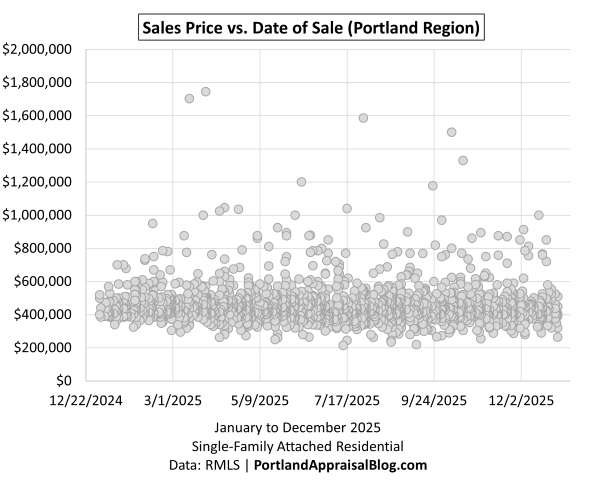
The 2024 Portland Region Manufactured Housing Market in Review

Manufactured homes on owned land in the Portland Region posted modest gains in 2024 amid tight supply. This review covers sales volume, pricing adjustments, and key valuation factors unique to this segment.
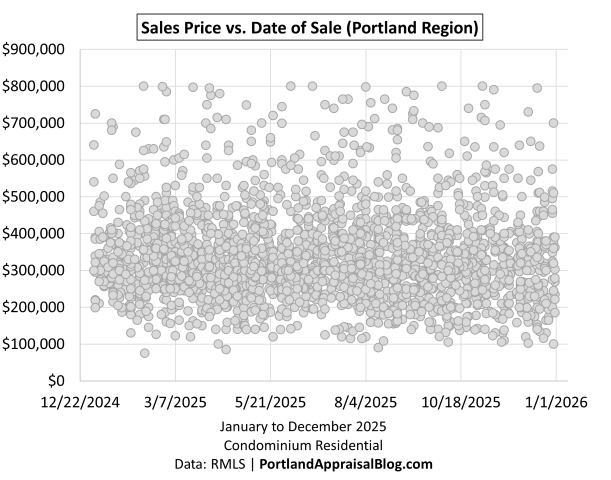
Photo by Jimmy Woo
Via Unsplash

We are wrapping up our annual reviews of the various housing segments in the Portland, Oregon region with a consideration of manufactured homes. We will restrict our attention to manufactured homes permanently affixed to land that is also owned by the same party. This means we are excluding classic mobile home parks where the owner of the mobile home must pay a lease/lot rental fee.
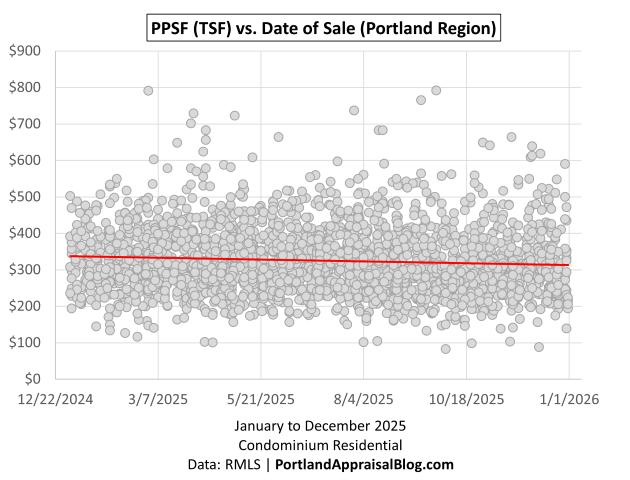
If you missed the previous annual reviews covering single-family detached homes, condominiums, and attached homes, you may click this link.

Let’s define the Portland Region as the following six counties: Columbia, Clackamas, Hood River, Multnomah, Washington, and Yamhill—essentially all counties contiguous with Portland’s home county of Multnomah, plus Yamhill.

Image of Portland Region counties.

DATA HOUSEKEEPING

The information in this post will be based on properties that sold on the open market, defined as listed in RMLS, the primary multiple listing service for the Portland Region. The data was parsed with tools created by the blog author to weed out/correct, among other things, listing errors and misclassifications (e.g. manufactured homes hiding in other categories, such as the detached category). RMLS has a listing category, SNL, Sold Not Listed, that allows agents to put properties that were sold off market into the database. Those properties have been excluded from the following analyses.

WHAT IS A MANUFACTURED HOME?

Images via Wikimedia Commons: Image 1; Image 2

The U.S. Department of Housing and Urban Development provides the following definition and conditions for FHA mortgage insurance:

Manufactured Housing is a Structure that is transportable in one or more sections.

To be eligible for FHA mortgage insurance as a Single Family Title II Mortgage, all Manufactured Housing must:
• be designed as a one-family dwelling;
• have a floor area of not less than 400 square feet;
• have the HUD Certification Label affixed or have obtained a letter of label verification issued on behalf of HUD, evidencing the house was constructed on or after June 15, 1976, in compliance with the Federal Manufactured Home Construction and Safety Standards;
• be classified as real estate (but need not be treated as real estate for purposes of state taxation);
• be built and remain on a permanent chassis;
• be designed to be used as a dwelling with a permanent foundation built in accordance with the Permanent Foundations Guide for Manufactured Housing (PFGMH); and
• have been directly transported from the manufacturer or the dealership to the site.

The definition comes from the HUD manual (4000.1) and helps to differentiate manufactured homes from other type of prefabricated housing, such as modular homes or tiny homes. Fannie Mae essentially follows the HUD definition. Once a manufactured home is brought to the site, they state in their Selling Guide:

The towing hitch, wheels, and axles must be removed. The dwelling must assume the characteristics of site-built housing.

The manufactured home must be attached to a permanent foundation system in accordance with the manufacturer’s requirements for anchoring, support, stability, and maintenance.

The foundation system must be appropriate for the soil conditions for the site and meet local and state codes.

The manufactured home must be permanently connected to a septic tank or sewage system, and to other utilities in accordance with local and state requirements.

Manufactured homes are built in a factory and must meet the minimum guidelines established by HUD. While modular homes are also built in a factory in sections, they are not meant to movable beyond the initial transportation from the factory and have their final construction and assembly at the site and are placed on a permanent foundation. Modular homes have more stringent guidelines and building codes and are more expensive as a result.

Tiny homes, are just that, tiny. They usually don’t meet the minimum square footage requirements for manufactured homes and are often left in a transportable state; that is, they are relatively easy to move to another location. (Not a plus for collateral underwriting.) While there may be state or local ordinances, there are no federal guidelines for them and they are generally considered personal property. Getting them financed through typical mortgage channels is very difficult to nigh impossible.

So, to recap: we consider manufactured homes to be factory-built one-family dwellings that meet HUD guidelines and are permanently affixed to the land and the land must be under the same ownership. To be eligible for general financing, the manufactured home must have been built on or after June 15, 1976. The RMLS database does have a few properties in the manufactured category that were constructed before the cutoff date; those properties, while not meeting the modern requirements for manufactured housing, have been left in the dataset. Often they are not financeable, but they usually convey to the buyer the right to put a replacement manufactured dwelling or single-family home. That can be important, as there are some land parcels (mostly farmland) with zoning that does not allow residential use outright and will only permit an exception dwelling if the site has had continuous residential use (grandfathering the use in). That old manufactured home on a site could make a world of difference in the property value of an acreage lot!

Okay, so that was a lengthy preamble, let’s dive into some stats!

Portland Region 2024 Manufactured Homes Overview

The following table compares 2024 with 2023:

Total dollar sales volume dropped about 9% in 2024 but this is largely a function of the total number of sales declining about 11%. Looking at the composition of sales for each year, 2024 had manufactured homes nearly the same size and age as 2023, but on lots about a half acre smaller. This points to a slightly stronger year per unit sold in 2024, which is reflected in higher average prices, median prices, and price per square foot.

New construction was only 1% of the market and bank repossessions were steady each year and represented less than 3% of the market.

Let’s dive into the rest of the data with some visuals.

SALES VOLUME

The following is a treemap of manufactured home sales volume in the Portland Region for the year 2024:

Clackamas County had almost twice as many manufactured home sales than the next largest county. This is not surprising as Clackamas County is 1,868 sq. mi. and has a lot of farming activity. The second largest county by sales volume, Yamhill, is also known for its rural areas and extensive agriculture.

Sales followed a bell curve (with October being the exception); the market generally peaked during the summer months:

As the following graph shows, 2023 beat 2024 in sales volume eight out twelve months:

SALES PRICE

Prices were fairly level for most of the year:

2023 and 2024 were very close in average prices each month:

CUMULATIVE DAYS ON MARKET

The average cumulative days on market was about two months for the entire year of 2024. Marketing time varied erratically, with no pronounced seasonality pattern:

While the average marketing time in 2024 was only up about 3 days compared to 2023, some months sharply diverged from each other. Variation like this is to be expected when the dataset is so small each year:

HOUSING SUPPLY

Housing supply tracks how long would it take the market to exhaust all available inventory at the current rate of absorption. For most of 2024 the months of housing supply for manufactured homes was above 4 months:

2024 was significantly above 2023 in months of housing supply during the spring and summer months, while 2023 was higher in the fall:

MISC STATS

Before concluding our overview of the Portland Region as a whole, let’s look at some miscellaneous stats:

The highest price for a manufactured home in 2024 is shared by two properties. A manufactured home in Estacada, Oregon and one in Newberg, Oregon. Both closed for $1,125,000.

The home in Estacada was built in 1998, sits on 19.8 acres, and is 1,976 sq. ft. The property has outbuildings. Photos of the home are currently available online and may be viewed here.

The home in Newberg was built in 1981, has a 9.4-acre lot, and is 1,920 sq. ft. The manufactured home was in average shape. The principal component of value for this home was the dividable lot (three parcels). After the sale the manufactured home sold again in 2025, this time for only $595,000 and the lot was only 2.5 acres. Photos of the home are currently available online and may be viewed here.

The least expensive manufactured home in 2024 was a property in Clatskanie, Oregon, which is in Columbia County. The property sold for $143,000. This was an older manufactured home that predates the HUD cutoff date and therefore could not be financed and closed as a cash sale. The home sits on a 1.58-acre lot and is only 744 sq. ft. The structure looks like it is at the end of its useful life, so this was essentially a land sale. Photos of the home are currently available online and may be viewed here.

The most expensive ZIP code for manufactured homes in 2024 was 97132. This area takes in parts of Newberg. While only 4 sales occurred in 2024, the average price was about $741,000:

The ZIP code with the highest volume of sales was 97038:

This ZIP code is in Clackamas County and covers nearly 131 sq. mi. A total of 27 manufactured home sales occurred in this ZIP code in 2024.

A manufactured home in Sandy, Oregon with an 80-acre lot took the crown for the largest site in 2024. The home is a newer unit, with a manufacture date of 2021. The home is 1,836 sq. ft. and has quality interior upgrades. The site appears to be a former tree farm. While not the most expensive sale of the year, this manufactured home did rank #5 on the list! Photos of the home are currently available online and may be viewed here.

The largest manufactured home to sell in 2024 was a property in Dayton, Oregon, which is in Yamhill County. The unit was 2,813 sq. ft. and was manufactured in 2007. The home sits on a 5-acre lot. Given the average size for a manufactured home in 2024 was a little over 1,600 sq. ft., this one would be considered quite spacious. (Photos of the home are currently available online and may be viewed here.) The following histogram shows the distribution of square footage for manufactured homes in 2024:

Approximately 84% of all manufactured homes sold in 2024 are under 1,950 sq. ft.

Let’s wrap up this post with a quick look at the individual counties comprising the Portland Region.

Multnomah County 2024 Stats

Multnomah County contains most of the City of Portland. A sliver of the City of Portland is located in Clackamas and Washington counties. The following table summarizes important metrics for Multnomah County:

Multnomah County saw a nearly 6% drop in the sales volume dollar amount. The total number of sales dropped almost 19%; the reason the sales volume dollar amount did not drop more is due to the average size of the units sold increasing as well as the lot size. Marketing time increased almost 27%. The new construction and distressed categories had almost no activity.

Washington County 2024 Stats

Washington County contains many properties with a Portland address that are outside official city limits and are under county control. The following table summarizes important metrics for Washington County:

The total sales volume dollar amount increased by over 13% thanks, in part, to a 27% increase in the total number of sales. The reason the sales volume dollar amount did not climb higher is due to smaller units selling on smaller lots. There were no distressed sales or new construction in 2024.

Clackamas County 2024 Stats

Clackamas County, due to being a large and mostly rural county, has the most activity for manufactured homes in the Portland Region. The following table summarizes important metrics for Clackamas County:

The Clackamas manufactured home sales volume dollar amount was down about 20% in 2024. This tracks the decrease in total sales (-22%). Average prices were slightly up, but so was the average total square footage of homes selling. The one-acre drop in average lot size does not appear to have had a substantial impact on average prices. There were two new construction units in 2024 and just one distressed sale.

Yamhill County 2024 Stats

Yamhill County is known for its wineries and other agricultural products. Due to its rural areas, Yamhill had the second highest number of manufactured home sales. The following table summarizes important metrics for Yamhill County:

The total sales volume dollar amount was flat year over year. There was little change in the number of homes sold. Average prices rose nearly 3% despite smaller units on smaller lots for 2024. This indicates manufactured homes had a stronger year overall compared to 2023. There was no new construction activity and only a couple of distressed sales in 2024.

Columbia County 2024 Stats

This county is 688 square miles but only has a population of approximately 54,000 people. Due to it mostly rural nature, Columbia County came in third for the total number of manufactured home sales. The following table summarizes important metrics for Columbia County:

Total sales volume dollar amount changed only 2.4% and there was almost no change in the size of the average manufactured home. Average prices rose 12% but that may be partially attributed to a nearly 61% increase in average lot size.

Hood River County 2024 Stats

Hood River is the second smallest county in Oregon by area at 533 square miles. The population is estimated to be about 24,000 people. With such a sparse population it is no surprise this county had little activity.

There was a 33% drop in the sales volume dollar amount, but that almost mirrors the 25% decline in the total number of sales. The average size of the units did not meaningfully change, but the average lot size dropped 21%, which likely contributed to the sharper decline of the sales volume dollar amount.

That wraps up our look at the Portland Region 2024 manufactured home market!

Thank you for reading the post! I hope you found some useful or interesting nugget of information. Please consider subscribing.

Question: Do you think 2025 will see the number of manufactured home sales rebound or will high interest rates keep a clamp on the market?

CODA

Are you an agent and wonder why appraisers always do “x”? Are you a homeowner who received a report and has one or two questions about appraisal terminology or methodology? If so, please feel free to contact me. I enjoy interacting with various market participants and am always happy to help out where I can! And if you are in need of any appraisal services, feel free to reach out to us!

The 2024 Portland Region Attached Housing Market in Review

Attached homes (townhomes and rowhouses on owned land) in the Portland Region showed resilience in 2024 despite higher rates. Appraiser insights on market performance, comp selection challenges, and segment-specific trends.

Photo: Abdur Abdul-Malik, Portland Appraisal Blog

We are well into 2025, but let’s review how the Portland Region’s attached home market performed in 2024. High mortgage interest rates have plagued most segments of the housing market, however, the attached home market was one of the few segments that saw a boost in 2024—largely due to an influx of new construction units.

We will examine how the Portland Region’s attached home market performed as a whole and by individual county. We already examined the 2024 single-family detached and condominium markets and will have a future post dealing with manufactured homes.

Let’s define the Portland Region as the following six counties: Columbia, Clackamas, Hood River, Multnomah, Washington, and Yamhill—essentially all counties contiguous with Portland’s home county of Multnomah, plus Yamhill.

Image of Portland Region counties.

DATA HOUSEKEEPING

The information in this post will be based on properties that sold on the open market, defined as listed in RMLS, the primary multiple listing service for the Portland Region. The data was parsed with tools created by the blog author to weed out/correct, among other things, listing errors and misclassifications (e.g. condominium sales hiding in other categories, such as in the attached or detached category).

It is important to note that attached homes are just that: attached; whether on just one or both sides. They also entail ownership of the land the structure sits on. This makes them distinct from condominiums. They are also distinguished from multifamily properties in that each unit is individually owned. With a duplex, for example, there is a single owner, although the owner may rent or occupy each unit as they see fit. The owner cannot sell half of a duplex (one unit). It can get confusing, and the data in RMLS reflects that.

RMLS has five major property categories:

Generally speaking, agents pick the correct property category when inputting a listing—although at times a multifamily property is advertised under the residential category. Where agents run into a bit (or a lot) of trouble is picking the appropriate property type (essentially a subcategory), particularly for residential. Here are the choices RMLS offers under the “Residential” category:

This breakdown seems innocuous enough, but it actually conflates descriptive property characteristics with property ownership types. For instance, condominium is a classification of ownership and condos come in many distinct varieties: detached, attached, townhome style, common wall, or even large converted apartment complexes. This often leads to agents inputting condominiums in many of the other property type categories, including attached.

The reason this is important is condominiums often have distinct mortgage underwriting guidelines and even different reporting forms. Again, with a condominium the property owner does not own the land or even the structure itself, but only the air space within the walls of the unit. The property owner also has an interest in the common elements on the site.

As stated before, attached homes involves ownership of the land under the structure and maintenance of the structure falls upon the owner. An attached home is just like a single-family detached home in rights and responsibilities; the principal difference is whether the structure is completely freestanding or joined at the hip with a neighbor or two.

The blog author has carefully separated out errors in classification. The attached category is full of them! Hundreds of misclassified homes “pollute” the dataset each year. It underscores relying on “raw” or unprocessed data from any MLS system can give a distorted picture and lead to incorrect conclusions.

Finally, RMLS has a listing category, SNL (Sold Not Listed), that allows agents to put properties that were sold off market into the database. Those properties have been excluded from the following analyses.

Portland Region 2024 Attached Homes Overview

The following table compares 2024 with 2023:

Total sales volume was $715 million, increasing almost 12% from the previous year. Average and median prices barely changed year over year, so the sales volume increase was purely a function of more sales in 2024 (a 13% jump from 2023). Most of that increase was due to nearly 200 more new construction units coming on the market—a nearly 60% jump over 2023!

Most of the other stats were flat: sales price to original list price; average price per square foot; monthly HOA dues; and average total square footage only had nominal changes. Attached homes averaged more than 17 extra days on market; confirmation that persistently high mortgage interest rates are making it harder and harder to move homes.

Bank owned sales decreased while three short sales occurred in 2024. Distressed sales represented less than 1% of the entire market.

Let’s dive into the rest of the data with some visuals.

SALES VOLUME

The following is a treemap of attached home sales volume in the Portland Region for the year 2024:

Washington County took the crown, representing 52.3% of the market. Multnomah and Clackamas counties were nearly equal, totaling 24.5% and 20% respectively. Columbia, Hood River, and Yamhill counties represented the crumbs of the market; barely getting over 3% of sales volume combined.

Sales followed a stairstep pattern, gradually increasing until October—with May being the only exception and the peak for the year:

As the following graph shows, 2024 beat 2023 ten out twelve months:

SALES PRICE

Prices were highest in spring and then gradually declined, with the year’s peak being in May:

Note: The y-axis starts at $410,000 to allow better examination of monthly differences.

2023 was ahead of 2024 for nine out of the twelve months, but generally the two years were close each month:

Note: The y-axis starts at $340,000 to allow better examination of monthly differences.

NEW CONSTRUCTION

New construction was strong the entire year in 2024, averaging between 22-44% of monthly sales:

Washington County had the biggest share of new attached homes while Multnomah County had the biggest yearly increase (92.3%):

CUMULATIVE DAYS ON MARKET

The average cumulative days on market was slightly above two months for the entire year of 2024. Marketing time varied seasonally, with the slowest months being in winter:

Average marketing time was up sharply in 2024 compared to 2023:

HOUSING SUPPLY

Housing supply tracks how long would it take the market to exhaust all available inventory at the current rate of absorption. For most of 2024 the months of housing supply was near or above 3 months:

2024 was significantly above 2023 in months of housing supply for nearly every month, with the only exception being the month of November:

HOA DUES

HOA dues for the region increased by only 1.6%, with the average being $234. Columbia, Hood River, and Yamhill counties are showing more year-over-year variation, but this is largely due to so few attached home sales in those counties.

MISC STATS

Before concluding our overview of the Portland Region as a whole, let’s look at some miscellaneous stats:

The most expensive attached home that sold on the open market in 2024 in the Portland Region was, surprisingly, a luxury townhome in Hood River with views of the Columbia River. The townhome sold for $1,450,000, has four bedrooms, three bathrooms, and is 2,472 sq. ft. Photos of the townhome are currently available online and may be viewed here.

The least expensive attached home in 2024 was a bank repossession that was actually in decent shape despite some repairs needed. The townhome sold for $157,000 in the Portland Maplewood neighborhood. Prices in the PUD averaged $276,000 over the last four years, so the unit was a good deal.

The most expensive ZIP code for 2024 was 97209. This area is located in the Portland Pearl District. While only 3 sales occurred in 2024, the average price was about $1,027,000:

The ZIP code with the highest volume of sales was 97123:

This ZIP code is in Washington County and covers nearly 56 sq. mi. and takes in part of Hillsboro. A total of 213 attached home sales occurred in this ZIP code in 2024.

An attached home in the Northwest Heights neighborhood in Portland took the number one spot for the highest monthly HOA dues at $808. The agent did mention that there is an additional $400 semiannual dues for trail maintenance, making the effective monthly HOA amount about $875. This property is only attached to its neighbor via the garage. The home is 3,403 sq. ft. and sold for $803,437. Photos of the attached home are currently available online and may be viewed here.

Let’s wrap up this post with a quick look at the individual counties comprising the Portland Region. We will examine the three largest counties individually, but will group the three smallest together, as they comprise about 3% of the overall attached home market.

Multnomah County 2024 Stats

Multnomah County contains most of the City of Portland. A sliver of the City of Portland is located in Clackamas and Washington counties. The following table summarizes important metrics for Multnomah County:

Multnomah County saw almost no change in the sales volume dollar amount. Total sales increased 6.5%, while average prices fell by more than almost 6%; this was almost entirely due to the average total square footage declining 7% in 2024. Marketing time spiked over 28%. New construction comprised a third of the market and was almost double the number over the previous year. HOA dues ticked upwards by 4.2% in 2024.

Washington County 2024 Stats

Washington County contains many properties with a Portland address that are outside official city limits and are under county control. The biggest city in Washington County, Hillsboro, saw 269 attached home sales in 2024. The following table summarizes important metrics for Washington County:

The total sales volume dollar amount increased by almost 20%, which is similar to the increase in the total number of sales (~18%). New construction sharply increased by 55% in 2024 compared to the previous year and was 36% of the overall attached home market. Average monthly HOA dues were flat year over year. Marketing time saw a 77% jump; however, this is distorted somewhat by the large percentage of new construction homes, which often have longer marketing times.

Clackamas County 2024 Stats

Clackamas County, despite having has many rural portions, has a decent amount of attached home activity. The cities of Happy Valley and Wilsonville had about 1/3rd of the sales. The following table summarizes important metrics for Clackamas County:

The Clackamas attached home sales volume dollar amount was up 11% in 2024. This tracks the increase in total sales (+12.7%). Average prices were slightly down, but so was the average total square footage of homes selling. Monthly HOA dues saw a nearly 4% bump (or about $10). There was very little distressed sale activity in this county over the last two years.

Columbia, Hood River, & Yamhill Counties 2024 Stats

Given how little of the attached market occurs in these three counties, they have been lumped together:

The total sales volume dollar amount slid nearly 4%, while the total square footage averaged 4.8% higher; this indicates a genuine decline in attached home prices in the three-county block. Marketing time was up by almost 20 days.

That wraps up our look at the Portland Region 2024 attached home market!

Thank you for reading the post! I hope you found some useful or interesting nugget of information. Please consider subscribing.

Question: Do you think 2025 will see more of the same in the attached home market or will prices increase for the region?

CODA

Are you an agent and wonder why appraisers always do “x”? Are you a homeowner that got a report and have a question or two about appraisal terminology or methodology? If so, please feel free to contact me. I enjoy interacting with various market participants and am always happy to help out where I can! And if you are in need of any appraisal services, feel free to reach out to us!

The 2024 Portland Region Condominium Housing Market in Review

Portland-area condominiums in 2024 faced limited inventory, HOA impacts, and shifting buyer preferences. This annual review analyzes closed sales, price per square foot trends, and valuation considerations for condo properties.

Photo by Adam Blank
Via Unsplash

The first quarter of 2025 is already drawing to a close, but let’s take the time to review how the Portland Region’s condominium market performed in 2024. High mortgage interest rates have been a concern in all segments of the housing market and condominiums were no exception. To be direct, 2024 was not a great year for condos.

Let’s take a look at how the Portland Region’s condo market performed as a whole and by individual county. We already examined the 2024 single-family detached home market and will have future posts dealing with attached homes and manufactured homes.

Let’s define the Portland Region as the following six counties: Columbia, Clackamas, Hood River, Multnomah, Washington, and Yamhill—essentially all counties contiguous with Portland’s home county of Multnomah, plus Yamhill.

Image of Portland Region counties.

DATA HOUSEKEEPING

The information in this post will be based on properties that sold on the open market, defined as listed in RMLS, the primary multiple listing service for the Portland Region. The data was parsed with tools created by the blog author to weed out/correct, among other things, listing errors and misclassifications (e.g. condominium sales hiding in other categories, such as in the attached or single-family category). It is important to understand that condominium is a classification of ownership and that condos come in many distinct varieties: detached, attached, townhome style, common wall, or even large converted apartment complexes. Condos are the ultimate chameleons, and can be mistaken for any other type of housing segment. With condominiums the property owner does not own the land or even the structure itself, but only the air space within the walls of the unit. The property owner also has an interest in the common elements on the site. Condos almost always entail monthly dues to the governing HOA. Condominiums often have distinct mortgage underwriting guidelines and it is important for real estate agents and appraisers to classify them properly.

Finally, RMLS has a listing category, SNL (Sold Not Listed), that allows agents to put properties that were sold off market into the database. Those properties have been excluded from the following analyses.

Portland Region 2024 Condo Overview

2024 was worse than 2023 in most important metrics. The following table compares 2024 with 2023:

Total sales volume was just north of $900 million, dropping over 8% from the previous year. Some of that decrease was due to a slight dip in the average size of the units selling in 2024 compared to the previous year, but average price per square foot was down as well. Typically as a unit gets smaller its price per square foot increases, so a drop in both total square footage and price per square foot definitely indicates a weaker market.

While prices have declined, the average monthly HOA dues increased nearly 3% in the region.

Bank owned and short sales both decreased in 2024 as compared to the previous year; the numbers are trivial and represent less than 1% of the entire market.

The only real bright spot in 2024 was more new construction condominium units came online that year. The annual increase was a healthy 35.7%.

Let’s dive into the rest of the data with some visuals.

SALES VOLUME

The following is a treemap of condo sales volume in the Portland Region for the year 2024:

Unsurprisingly, Multnomah County had the most sales (~64% of the entire market), with 93% of all Multnomah sales being in the City of Portland. Clackamas, Multnomah, and Washington counties comprised virtually all of the sales volume, with Columbia, Hood River, and Yamhill barely getting over 1%.

Sales peaked in April of 2024 and then began to gradually decline:

As the following graph shows, 2023 beat 2024 eight out twelve months:

SALES PRICE

Prices were u-shaped during the months of February to July, with the year’s peak being in June. Late summer to fall/winter saw prices mostly declining.

Note: The y-axis starts at $340,000 to allow better examination of monthly differences.

2023 was ahead of 2024 every single month, with a couple of near ties in the months of May and November:

Note: The y-axis starts at $340,000 to allow better examination of monthly differences.

NEW CONSTRUCTION

New construction was fairly level in 2024, averaging between 13-23% of monthly sales:

Multnomah County had the biggest share of new condominiums as well as the biggest year-over-year increase:

CUMULATIVE DAYS ON MARKET

The average cumulative days on market edged towards three months for the entire year of 2024. Marketing time varied seasonally, with the slowest months being November and December:

Average marketing time was up sharply in 2024 compared to 2023:

HOUSING SUPPLY

Housing supply tracks how long would it take the market to exhaust all available inventory at the current rate of absorption. For most of 2024 the months of housing supply was above 5 months, with the year averaging 5.6 months.

2024 was significantly above 2023 in months of housing supply for nearly every month, with parity only being reached in November and December. The extended marketing times combined with the higher prices may make condominiums a more attractive housing option compared to single-family detached—particularly for first-time buyers:

HOA DUES

HOA dues for the region increased by nearly 3%, with the average being $440. Surprisingly, monthly dues in Multnomah and Yamhill counties declined in 2024, while Clackamas, Hood River, and Washington counties all saw increases. Columbia County had no condominium sales in 2023.

MISC STATS

Before concluding our overview of the Portland Region as a whole, let’s look at some miscellaneous stats:

The most expensive condo that sold on the open market in 2024 in the Portland Region was a riverfront unit on the Willamette. The condo sold for $3,197,617, has three bedrooms, three and a half bathrooms, and is 4,290 sq. ft. Photos of the condo are currently available online and may be viewed here.

The least expensive condominium for 2024 was a bank repossession that was completely trashed. The condo sold for $96,000 in the Portland Powellhurst-Gilbert neighborhood. The unit has significant structural damage and closed as a cash sale.

The most expensive ZIP code for 2024 was 97028. This area is located in the Mount Hood Villages. While only 9 sales occurred in 2024, the average price was about $728,000:

The ZIP code with the highest volume of sales was 97209:

This ZIP code covers a large portion of the Portland Pearl District and is part of Portland’s urban core. A total of 239 condominium sales occurred in this ZIP code in 2024.

A condominium in the Pearl District’s Casey complex took the crown for the highest monthly HOA dues—a whopping $2,919! The penthouse unit has panoramic city views, is 3,273 sq. ft. and sold for $2.4 million. Photos of the condo are currently available online and may be viewed here.

Let’s wrap up this post with a quick look at the individual counties comprising the Portland Region. We will examine the three largest counties individually, but will group the three smallest together, as they comprise less than 2% of the overall condominium market.

Multnomah County 2024 Stats

Multnomah County contains most of the City of Portland. A sliver of the City of Portland is located in Clackamas and Washington counties. The following table summarizes important metrics for Multnomah County:

Multnomah County saw a more than 5% decline in the sales volume dollar amount. Total sales dipped 1.4%, while average prices fell by more than 4%. Marketing time spiked nearly 21%. New construction comprised almost 27% of the total market and increased 58% year over year. HOA dues modestly declined by 1.3% in 2024.

Washington County 2024 Stats

Washington County contains many properties with a Portland address that are outside official city limits and are under county control. The second biggest city in Washington County, Beaverton, saw 234 condo sales in 2024. The following table summarizes important metrics for Washington County:

The total sales volume dollar dropped 16.1%. New construction sharply declined by 76% in 2024 compared to the previous year and was only 2% of the overall condo market. Average monthly HOA dues jumped almost $50 per month year over year, representing a nearly 14% increase. Marketing time saw a 48% jump, with condos averaging almost two months before closing.

Clackamas County 2024 Stats

Clackamas County, despite having has many rural portions, has a decent amount of condo activity. The cities of Happy Valley and West Linn have the majority of the sales, with the Mount Hood area coming in third. The following table summarizes important metrics for Clackamas County:

The Clackamas condo sales volume dollar amount was down 9.2% in 2024. Median and average prices were both off by almost 7% compared to 2023. Average monthly HOA dues saw a sight 2% bump (or about $10). The total number of sales was flat year over year.

Columbia, Hood River, & Yamhill Counties 2024 Stats

Given how little of the condo market occurs in these three counties, they have been lumped together:

The total sales volume dollar amount dropped nearly 14%, while average and median prices were down 10% & 25% respectively. The total number of sales was flat, while average monthly HOA dues declined nearly 4%—the only bright spot in these peripheral areas.

That wraps up our look at the Portland Region 2024 condo market!

Thank you for reading the post! I hope you found some useful or interesting nugget of information. Please consider subscribing.

Question: Do you think 2025 will be see condo prices rebound for the region?

CODA

Are you an agent and wonder why appraisers always do “x”? Are you a homeowner that got a report and have a question or two about appraisal terminology or methodology? If so, please feel free to contact me. I enjoy interacting with various market participants and am always happy to help out where I can! And if you are in need of any appraisal services, feel free to reach out to us!