The 2024 Portland Region Manufactured Housing Market in Review

Via Unsplash

We are wrapping up our annual reviews of the various housing segments in the Portland, Oregon region with a consideration of manufactured homes. We will restrict our attention to manufactured homes permanently affixed to land that is also owned by the same party. This means we are excluding classic mobile home parks where the owner of the mobile home must pay a lease/lot rental fee.

If you missed the previous annual reviews covering single-family detached homes, condominiums, and attached homes, you may click this link.

Let’s define the Portland Region as the following six counties: Columbia, Clackamas, Hood River, Multnomah, Washington, and Yamhill—essentially all counties contiguous with Portland’s home county of Multnomah, plus Yamhill.
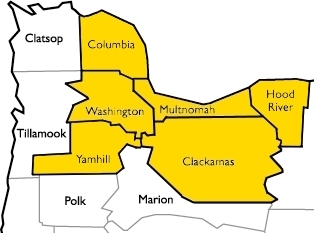
Image of Portland Region counties.

DATA HOUSEKEEPING

The information in this post will be based on properties that sold on the open market, defined as listed in RMLS, the primary multiple listing service for the Portland Region. The data was parsed with tools created by the blog author to weed out/correct, among other things, listing errors and misclassifications (e.g. manufactured homes hiding in other categories, such as the detached category). RMLS has a listing category, SNL, Sold Not Listed, that allows agents to put properties that were sold off market into the database. Those properties have been excluded from the following analyses.

WHAT IS A MANUFACTURED HOME?

Images via Wikimedia Commons: Image 1; Image 2

The U.S. Department of Housing and Urban Development provides the following definition and conditions for FHA mortgage insurance:

Manufactured Housing is a Structure that is transportable in one or more sections.

To be eligible for FHA mortgage insurance as a Single Family Title II Mortgage, all Manufactured Housing must:
• be designed as a one-family dwelling;
• have a floor area of not less than 400 square feet;
• have the HUD Certification Label affixed or have obtained a letter of label verification issued on behalf of HUD, evidencing the house was constructed on or after June 15, 1976, in compliance with the Federal Manufactured Home Construction and Safety Standards;
• be classified as real estate (but need not be treated as real estate for purposes of state taxation);
• be built and remain on a permanent chassis;
• be designed to be used as a dwelling with a permanent foundation built in accordance with the Permanent Foundations Guide for Manufactured Housing (PFGMH); and
• have been directly transported from the manufacturer or the dealership to the site.

The definition comes from the HUD manual (4000.1) and helps to differentiate manufactured homes from other type of prefabricated housing, such as modular homes or tiny homes. Fannie Mae essentially follows the HUD definition. Once a manufactured home is brought to the site, they state in their Selling Guide:

The towing hitch, wheels, and axles must be removed. The dwelling must assume the characteristics of site-built housing.

The manufactured home must be attached to a permanent foundation system in accordance with the manufacturer’s requirements for anchoring, support, stability, and maintenance.

The foundation system must be appropriate for the soil conditions for the site and meet local and state codes.

The manufactured home must be permanently connected to a septic tank or sewage system, and to other utilities in accordance with local and state requirements.

Manufactured homes are built in a factory and must meet the minimum guidelines established by HUD. While modular homes are also built in a factory in sections, they are not meant to movable beyond the initial transportation from the factory and have their final construction and assembly at the site and are placed on a permanent foundation. Modular homes have more stringent guidelines and building codes and are more expensive as a result.

Tiny homes, are just that, tiny. They usually don’t meet the minimum square footage requirements for manufactured homes and are often left in a transportable state; that is, they are relatively easy to move to another location. (Not a plus for collateral underwriting.) While there may be state or local ordinances, there are no federal guidelines for them and they are generally considered personal property. Getting them financed through typical mortgage channels is very difficult to nigh impossible.

So, to recap: we consider manufactured homes to be factory-built one-family dwellings that meet HUD guidelines and are permanently affixed to the land and the land must be under the same ownership. To be eligible for general financing, the manufactured home must have been built on or after June 15, 1976. The RMLS database does have a few properties in the manufactured category that were constructed before the cutoff date; those properties, while not meeting the modern requirements for manufactured housing, have been left in the dataset. Often they are not financeable, but they usually convey to the buyer the right to put a replacement manufactured dwelling or single-family home. That can be important, as there are some land parcels (mostly farmland) with zoning that does not allow residential use outright and will only permit an exception dwelling if the site has had continuous residential use (grandfathering the use in). That old manufactured home on a site could make a world of difference in the property value of an acreage lot!

Okay, so that was a lengthy preamble, let’s dive into some stats!

Portland Region 2024 Manufactured Homes Overview
The following table compares 2024 with 2023:

Total dollar sales volume dropped about 9% in 2024 but this is largely a function of the total number of sales declining about 11%. Looking at the composition of sales for each year, 2024 had manufactured homes nearly the same size and age as 2023, but on lots about a half acre smaller. This points to a slightly stronger year per unit sold in 2024, which is reflected in higher average prices, median prices, and price per square foot.

New construction was only 1% of the market and bank repossessions were steady each year and represented less than 3% of the market.

Let’s dive into the rest of the data with some visuals.

SALES VOLUME

The following is a treemap of manufactured home sales volume in the Portland Region for the year 2024:
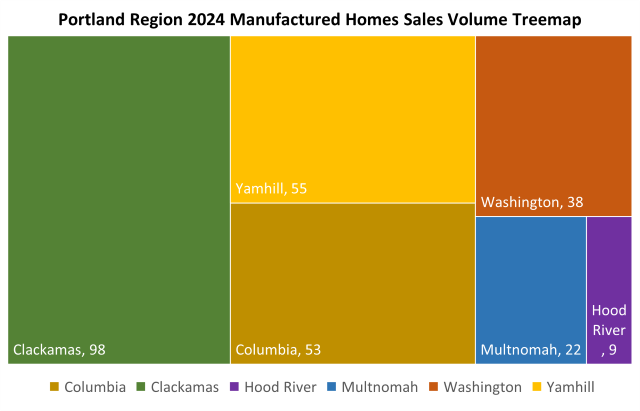
Clackamas County had almost twice as many manufactured home sales than the next largest county. This is not surprising as Clackamas County is 1,868 sq. mi. and has a lot of farming activity. The second largest county by sales volume, Yamhill, is also known for its rural areas and extensive agriculture.

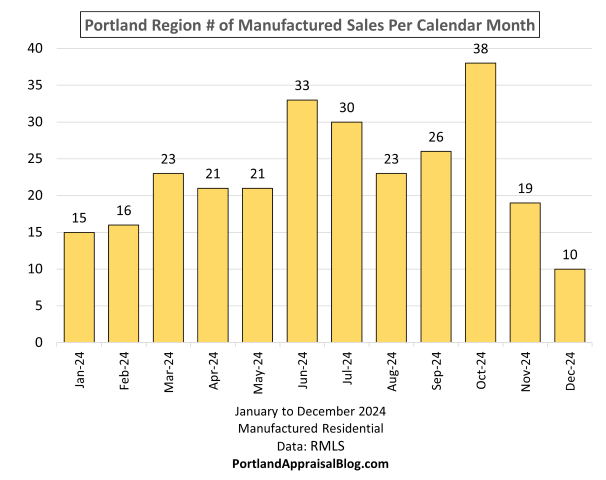
Sales followed a bell curve (with October being the exception); the market generally peaked during the summer months:
As the following graph shows, 2023 beat 2024 in sales volume eight out twelve months:

SALES PRICE

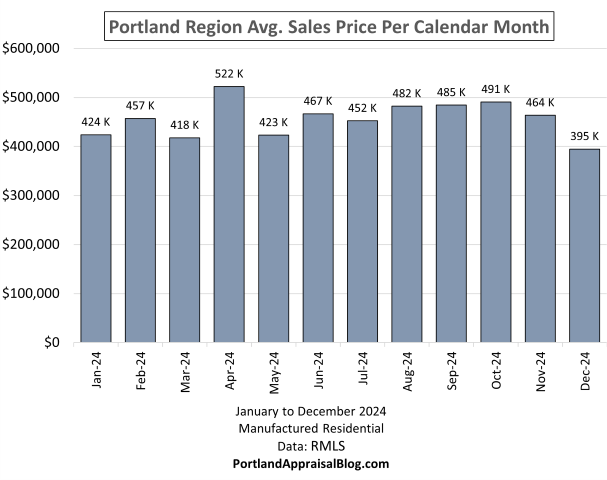
Prices were fairly level for most of the year:
2023 and 2024 were very close in average prices each month:

CUMULATIVE DAYS ON MARKET

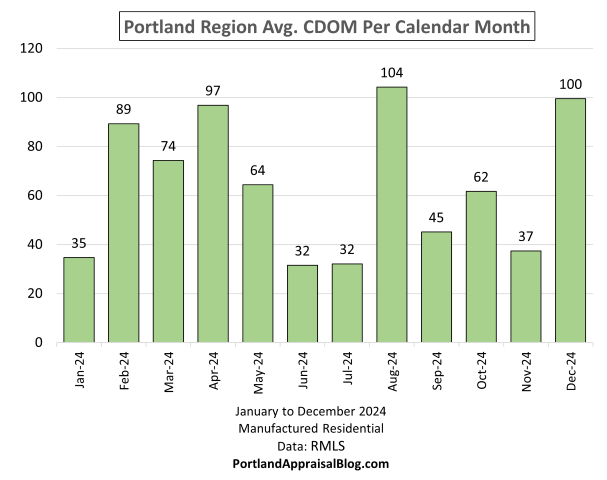
The average cumulative days on market was about two months for the entire year of 2024. Marketing time varied erratically, with no pronounced seasonality pattern:
While the average marketing time in 2024 was only up about 3 days compared to 2023, some months sharply diverged from each other. Variation like this is to be expected when the dataset is so small each year:

HOUSING SUPPLY

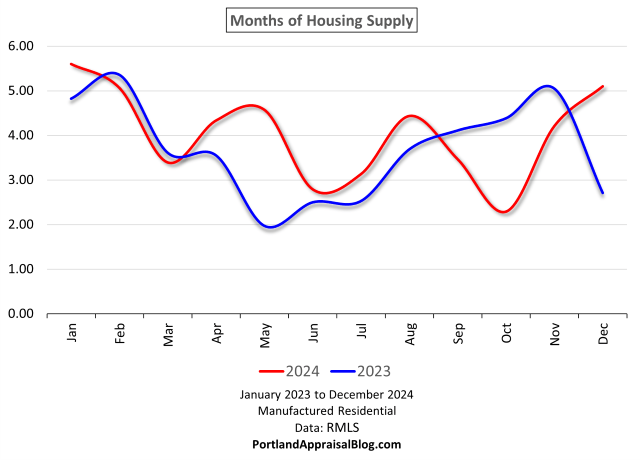
Housing supply tracks how long would it take the market to exhaust all available inventory at the current rate of absorption. For most of 2024 the months of housing supply for manufactured homes was above 4 months:

2024 was significantly above 2023 in months of housing supply during the spring and summer months, while 2023 was higher in the fall:
MISC STATS

Before concluding our overview of the Portland Region as a whole, let’s look at some miscellaneous stats:
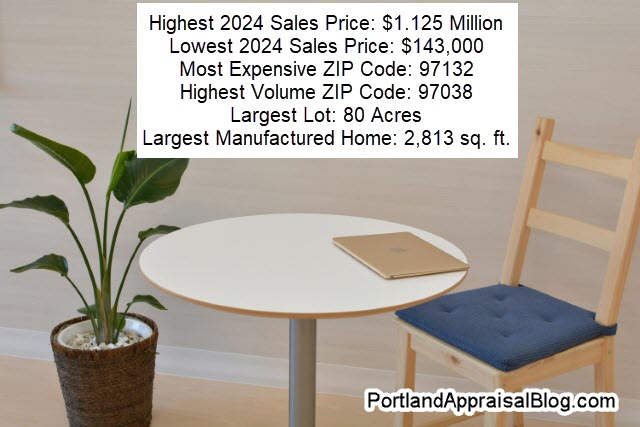
The highest price for a manufactured home in 2024 is shared by two properties. A manufactured home in Estacada, Oregon and one in Newberg, Oregon. Both closed for $1,125,000.

The home in Estacada was built in 1998, sits on 19.8 acres, and is 1,976 sq. ft. The property has outbuildings. Photos of the home are currently available online and may be viewed here.

The home in Newberg was built in 1981, has a 9.4-acre lot, and is 1,920 sq. ft. The manufactured home was in average shape. The principal component of value for this home was the dividable lot (three parcels). After the sale the manufactured home sold again in 2025, this time for only $595,000 and the lot was only 2.5 acres. Photos of the home are currently available online and may be viewed here.

The least expensive manufactured home in 2024 was a property in Clatskanie, Oregon, which is in Columbia County. The property sold for $143,000. This was an older manufactured home that predates the HUD cutoff date and therefore could not be financed and closed as a cash sale. The home sits on a 1.58-acre lot and is only 744 sq. ft. The structure looks like it is at the end of its useful life, so this was essentially a land sale. Photos of the home are currently available online and may be viewed here.

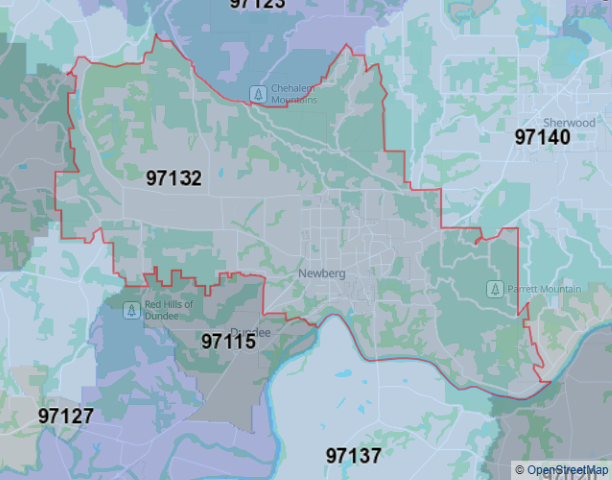
The most expensive ZIP code for manufactured homes in 2024 was 97132. This area takes in parts of Newberg. While only 4 sales occurred in 2024, the average price was about $741,000:
The ZIP code with the highest volume of sales was 97038:

This ZIP code is in Clackamas County and covers nearly 131 sq. mi. A total of 27 manufactured home sales occurred in this ZIP code in 2024.

A manufactured home in Sandy, Oregon with an 80-acre lot took the crown for the largest site in 2024. The home is a newer unit, with a manufacture date of 2021. The home is 1,836 sq. ft. and has quality interior upgrades. The site appears to be a former tree farm. While not the most expensive sale of the year, this manufactured home did rank #5 on the list! Photos of the home are currently available online and may be viewed here.

The largest manufactured home to sell in 2024 was a property in Dayton, Oregon, which is in Yamhill County. The unit was 2,813 sq. ft. and was manufactured in 2007. The home sits on a 5-acre lot. Given the average size for a manufactured home in 2024 was a little over 1,600 sq. ft., this one would be considered quite spacious. (Photos of the home are currently available online and may be viewed here.) The following histogram shows the distribution of square footage for manufactured homes in 2024:
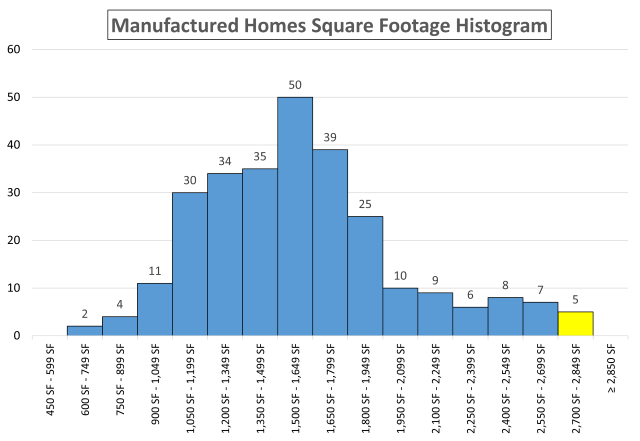
Approximately 84% of all manufactured homes sold in 2024 are under 1,950 sq. ft.

Let’s wrap up this post with a quick look at the individual counties comprising the Portland Region.

Multnomah County 2024 Stats

Multnomah County contains most of the City of Portland. A sliver of the City of Portland is located in Clackamas and Washington counties. The following table summarizes important metrics for Multnomah County:
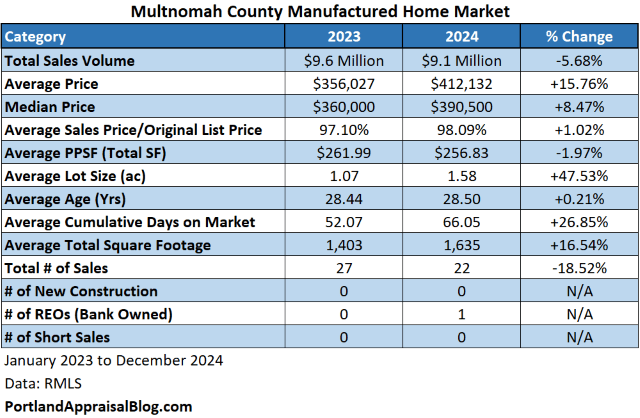
Multnomah County saw a nearly 6% drop in the sales volume dollar amount. The total number of sales dropped almost 19%; the reason the sales volume dollar amount did not drop more is due to the average size of the units sold increasing as well as the lot size. Marketing time increased almost 27%. The new construction and distressed categories had almost no activity.

Washington County 2024 Stats

Washington County contains many properties with a Portland address that are outside official city limits and are under county control. The following table summarizes important metrics for Washington County:
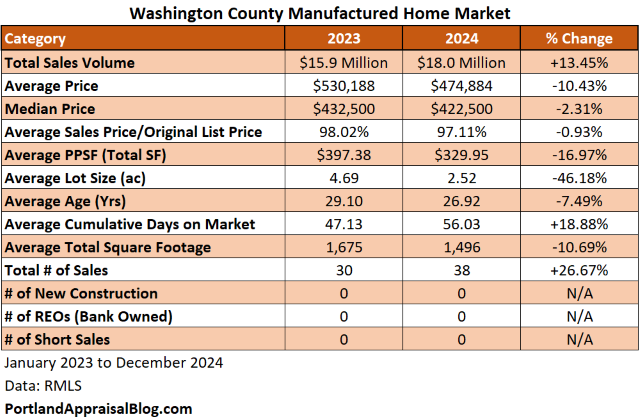
The total sales volume dollar amount increased by over 13% thanks, in part, to a 27% increase in the total number of sales. The reason the sales volume dollar amount did not climb higher is due to smaller units selling on smaller lots. There were no distressed sales or new construction in 2024.

Clackamas County 2024 Stats

Clackamas County, due to being a large and mostly rural county, has the most activity for manufactured homes in the Portland Region. The following table summarizes important metrics for Clackamas County:
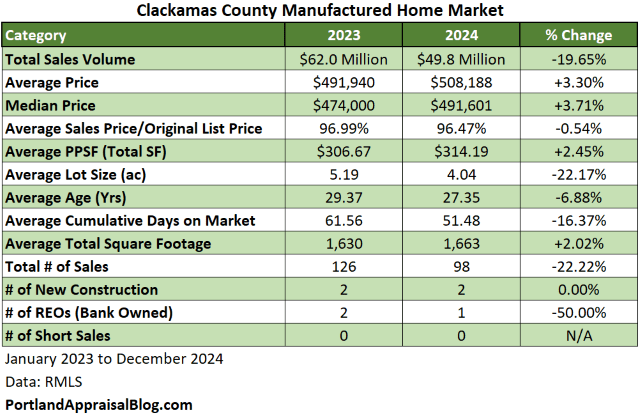
The Clackamas manufactured home sales volume dollar amount was down about 20% in 2024. This tracks the decrease in total sales (-22%). Average prices were slightly up, but so was the average total square footage of homes selling. The one-acre drop in average lot size does not appear to have had a substantial impact on average prices. There were two new construction units in 2024 and just one distressed sale.

Yamhill County 2024 Stats

Yamhill County is known for its wineries and other agricultural products. Due to its rural areas, Yamhill had the second highest number of manufactured home sales. The following table summarizes important metrics for Yamhill County:
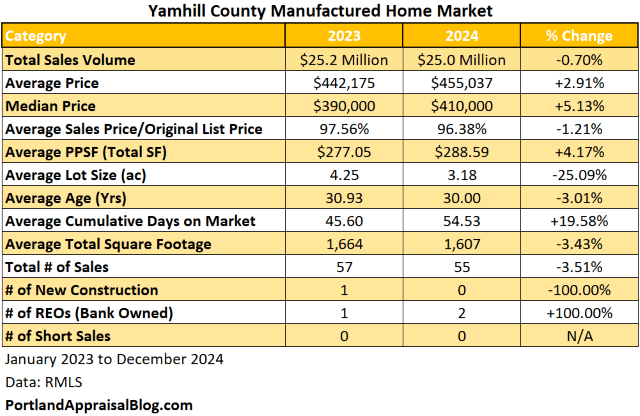
The total sales volume dollar amount was flat year over year. There was little change in the number of homes sold. Average prices rose nearly 3% despite smaller units on smaller lots for 2024. This indicates manufactured homes had a stronger year overall compared to 2023. There was no new construction activity and only a couple of distressed sales in 2024.

Columbia County 2024 Stats

This county is 688 square miles but only has a population of approximately 54,000 people. Due to it mostly rural nature, Columbia County came in third for the total number of manufactured home sales. The following table summarizes important metrics for Columbia County:

Total sales volume dollar amount changed only 2.4% and there was almost no change in the size of the average manufactured home. Average prices rose 12% but that may be partially attributed to a nearly 61% increase in average lot size.

Hood River County 2024 Stats

Hood River is the second smallest county in Oregon by area at 533 square miles. The population is estimated to be about 24,000 people. With such a sparse population it is no surprise this county had little activity.
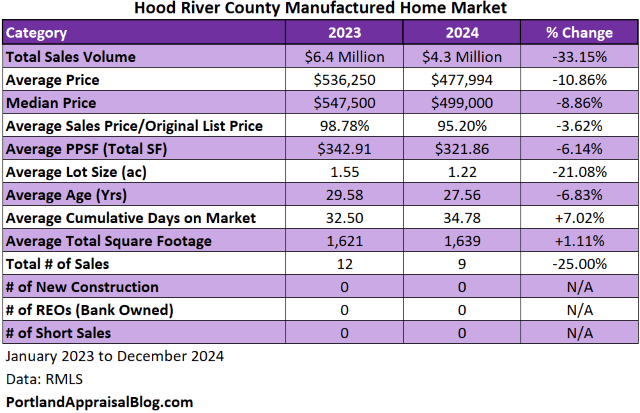
There was a 33% drop in the sales volume dollar amount, but that almost mirrors the 25% decline in the total number of sales. The average size of the units did not meaningfully change, but the average lot size dropped 21%, which likely contributed to the sharper decline of the sales volume dollar amount.

That wraps up our look at the Portland Region 2024 manufactured home market!

Thank you for reading the post! I hope you found some useful or interesting nugget of information. Please consider subscribing.

Question: Do you think 2025 will see the number of manufactured home sales rebound or will high interest rates keep a clamp on the market?

CODA

Are you an agent and wonder why appraisers always do “x”? Are you a homeowner who received a report and has one or two questions about appraisal terminology or methodology? If so, please feel free to contact me. I enjoy interacting with various market participants and am always happy to help out where I can! And if you are in need of any appraisal services, feel free to reach out to us!
The 2024 Portland Region Attached Housing Market in Review

Via Unsplash

We are well into 2025, but let’s review how the Portland Region’s attached home market performed in 2024. High mortgage interest rates have plagued most segments of the housing market, however, the attached home market was one of the few segments that saw a boost in 2024—largely due to an influx of new construction units.

We will examine how the Portland Region’s attached home market performed as a whole and by individual county. We already examined the 2024 single-family detached and condominium markets and will have a future post dealing with manufactured homes.

Let’s define the Portland Region as the following six counties: Columbia, Clackamas, Hood River, Multnomah, Washington, and Yamhill—essentially all counties contiguous with Portland’s home county of Multnomah, plus Yamhill.

Image of Portland Region counties.

DATA HOUSEKEEPING

The information in this post will be based on properties that sold on the open market, defined as listed in RMLS, the primary multiple listing service for the Portland Region. The data was parsed with tools created by the blog author to weed out/correct, among other things, listing errors and misclassifications (e.g. condominium sales hiding in other categories, such as in the attached or detached category).

It is important to note that attached homes are just that: attached; whether on just one or both sides. They also entail ownership of the land the structure sits on. This makes them distinct from condominiums. They are also distinguished from multifamily properties in that each unit is individually owned. With a duplex, for example, there is a single owner, although the owner may rent or occupy each unit as they see fit. The owner cannot sell half of a duplex (one unit). It can get confusing, and the data in RMLS reflects that.

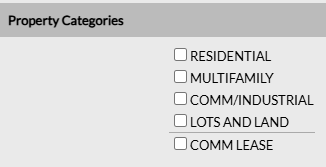
RMLS has five major property categories:

Generally speaking, agents pick the correct property category when inputting a listing—although at times a multifamily property is advertised under the residential category. Where agents run into a bit (or a lot) of trouble is picking the appropriate property type (essentially a subcategory), particularly for residential. Here are the choices RMLS offers under the “Residential” category:

This breakdown seems innocuous enough, but it actually conflates descriptive property characteristics with property ownership types. For instance, condominium is a classification of ownership and condos come in many distinct varieties: detached, attached, townhome style, common wall, or even large converted apartment complexes. This often leads to agents inputting condominiums in many of the other property type categories, including attached.

The reason this is important is condominiums often have distinct mortgage underwriting guidelines and even different reporting forms. Again, with a condominium the property owner does not own the land or even the structure itself, but only the air space within the walls of the unit. The property owner also has an interest in the common elements on the site.

As stated before, attached homes involves ownership of the land under the structure and maintenance of the structure falls upon the owner. An attached home is just like a single-family detached home in rights and responsibilities; the principal difference is whether the structure is completely freestanding or joined at the hip with a neighbor or two.

The blog author has carefully separated out errors in classification. The attached category is full of them! Hundreds of misclassified homes “pollute” the dataset each year. It underscores relying on “raw” or unprocessed data from any MLS system can give a distorted picture and lead to incorrect conclusions.

Finally, RMLS has a listing category, SNL (Sold Not Listed), that allows agents to put properties that were sold off market into the database. Those properties have been excluded from the following analyses.

Portland Region 2024 Attached Homes Overview

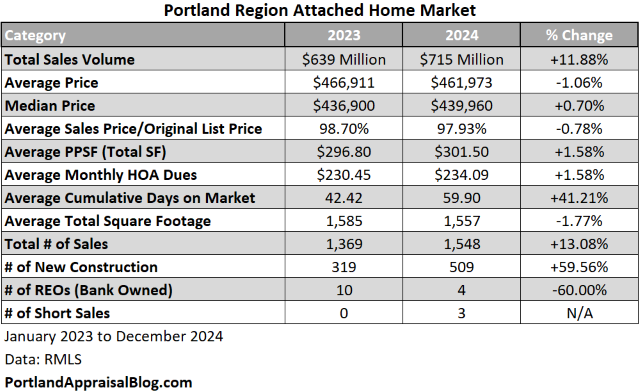
The following table compares 2024 with 2023:

Total sales volume was $715 million, increasing almost 12% from the previous year. Average and median prices barely changed year over year, so the sales volume increase was purely a function of more sales in 2024 (a 13% jump from 2023). Most of that increase was due to nearly 200 more new construction units coming on the market—a nearly 60% jump over 2023!

Most of the other stats were flat: sales price to original list price; average price per square foot; monthly HOA dues; and average total square footage only had nominal changes. Attached homes averaged more than 17 extra days on market; confirmation that persistently high mortgage interest rates are making it harder and harder to move homes.

Bank owned sales decreased while three short sales occurred in 2024. Distressed sales represented less than 1% of the entire market.

Let’s dive into the rest of the data with some visuals.

SALES VOLUME

The following is a treemap of attached home sales volume in the Portland Region for the year 2024:

Washington County took the crown, representing 52.3% of the market. Multnomah and Clackamas counties were nearly equal, totaling 24.5% and 20% respectively. Columbia, Hood River, and Yamhill counties represented the crumbs of the market; barely getting over 3% of sales volume combined.

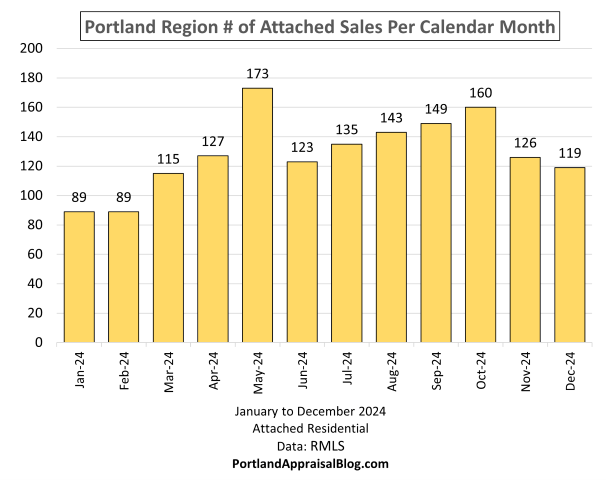
Sales followed a stairstep pattern, gradually increasing until October—with May being the only exception and the peak for the year:

As the following graph shows, 2024 beat 2023 ten out twelve months:

SALES PRICE

Prices were highest in spring and then gradually declined, with the year’s peak being in May:

Note: The y-axis starts at $410,000 to allow better examination of monthly differences.

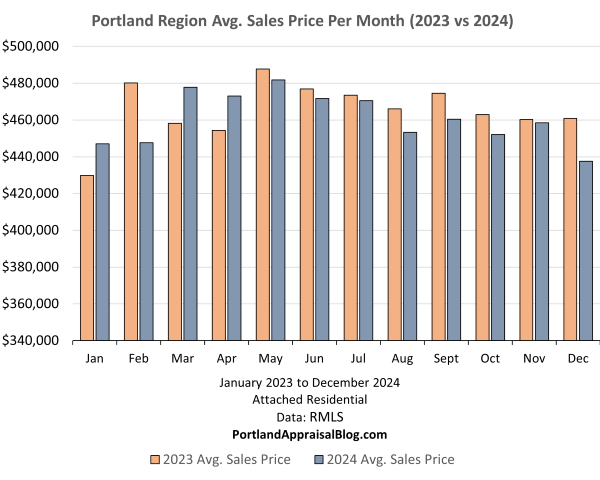
2023 was ahead of 2024 for nine out of the twelve months, but generally the two years were close each month:

Note: The y-axis starts at $340,000 to allow better examination of monthly differences.

NEW CONSTRUCTION

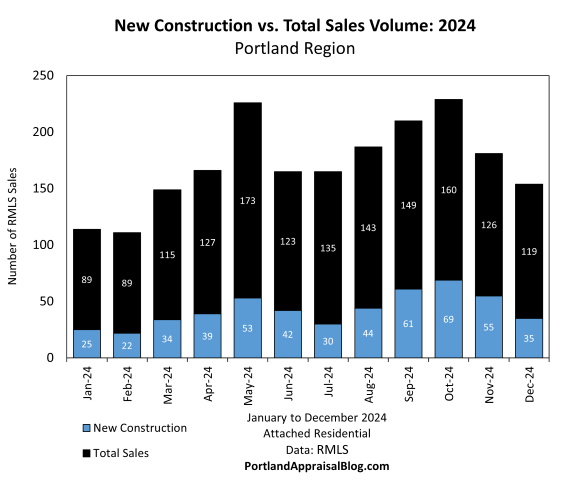
New construction was strong the entire year in 2024, averaging between 22-44% of monthly sales:

Washington County had the biggest share of new attached homes while Multnomah County had the biggest yearly increase (92.3%):

CUMULATIVE DAYS ON MARKET

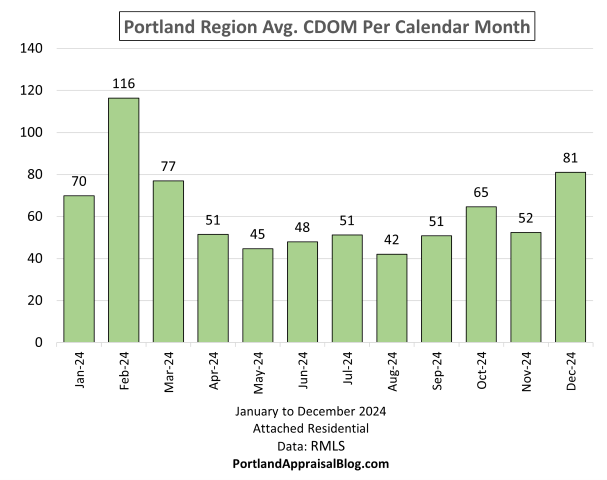
The average cumulative days on market was slightly above two months for the entire year of 2024. Marketing time varied seasonally, with the slowest months being in winter:

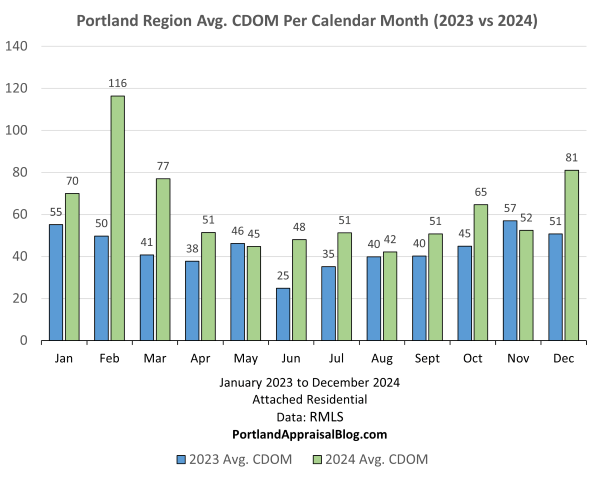
Average marketing time was up sharply in 2024 compared to 2023:

HOUSING SUPPLY

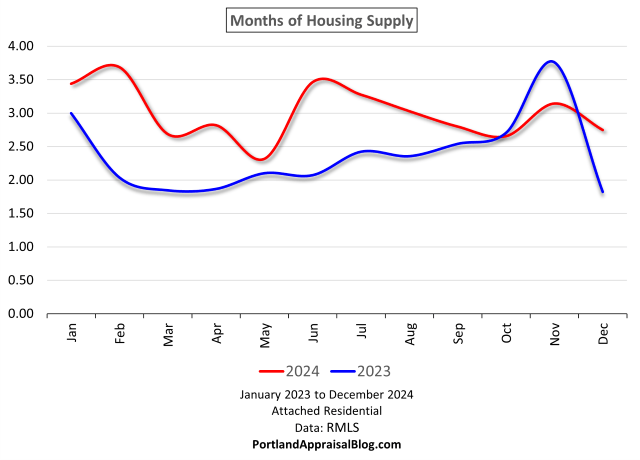
Housing supply tracks how long would it take the market to exhaust all available inventory at the current rate of absorption. For most of 2024 the months of housing supply was near or above 3 months:

2024 was significantly above 2023 in months of housing supply for nearly every month, with the only exception being the month of November:

HOA DUES

HOA dues for the region increased by only 1.6%, with the average being $234. Columbia, Hood River, and Yamhill counties are showing more year-over-year variation, but this is largely due to so few attached home sales in those counties.

MISC STATS

Before concluding our overview of the Portland Region as a whole, let’s look at some miscellaneous stats:

The most expensive attached home that sold on the open market in 2024 in the Portland Region was, surprisingly, a luxury townhome in Hood River with views of the Columbia River. The townhome sold for $1,450,000, has four bedrooms, three bathrooms, and is 2,472 sq. ft. Photos of the townhome are currently available online and may be viewed here.

The least expensive attached home in 2024 was a bank repossession that was actually in decent shape despite some repairs needed. The townhome sold for $157,000 in the Portland Maplewood neighborhood. Prices in the PUD averaged $276,000 over the last four years, so the unit was a good deal.

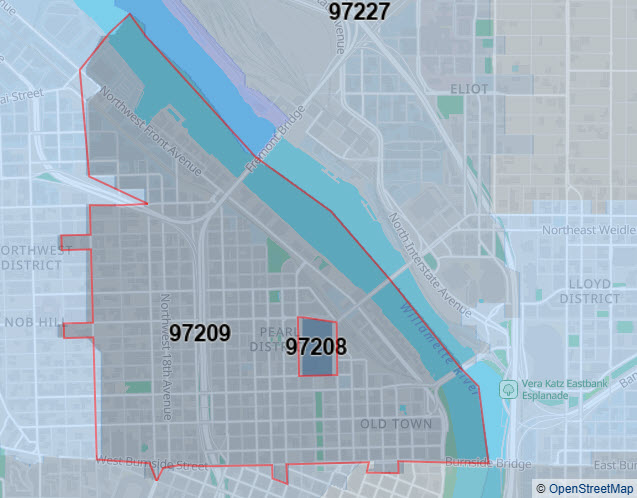
The most expensive ZIP code for 2024 was 97209. This area is located in the Portland Pearl District. While only 3 sales occurred in 2024, the average price was about $1,027,000:

The ZIP code with the highest volume of sales was 97123:

This ZIP code is in Washington County and covers nearly 56 sq. mi. and takes in part of Hillsboro. A total of 213 attached home sales occurred in this ZIP code in 2024.

An attached home in the Northwest Heights neighborhood in Portland took the number one spot for the highest monthly HOA dues at $808. The agent did mention that there is an additional $400 semiannual dues for trail maintenance, making the effective monthly HOA amount about $875. This property is only attached to its neighbor via the garage. The home is 3,403 sq. ft. and sold for $803,437. Photos of the attached home are currently available online and may be viewed here.

Let’s wrap up this post with a quick look at the individual counties comprising the Portland Region. We will examine the three largest counties individually, but will group the three smallest together, as they comprise about 3% of the overall attached home market.

Multnomah County 2024 Stats

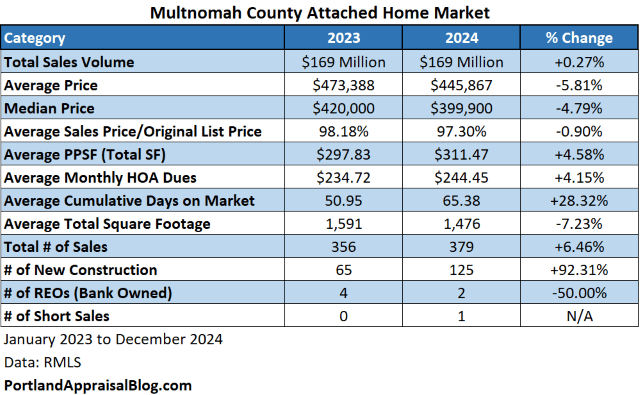
Multnomah County contains most of the City of Portland. A sliver of the City of Portland is located in Clackamas and Washington counties. The following table summarizes important metrics for Multnomah County:

Multnomah County saw almost no change in the sales volume dollar amount. Total sales increased 6.5%, while average prices fell by more than almost 6%; this was almost entirely due to the average total square footage declining 7% in 2024. Marketing time spiked over 28%. New construction comprised a third of the market and was almost double the number over the previous year. HOA dues ticked upwards by 4.2% in 2024.

Washington County 2024 Stats

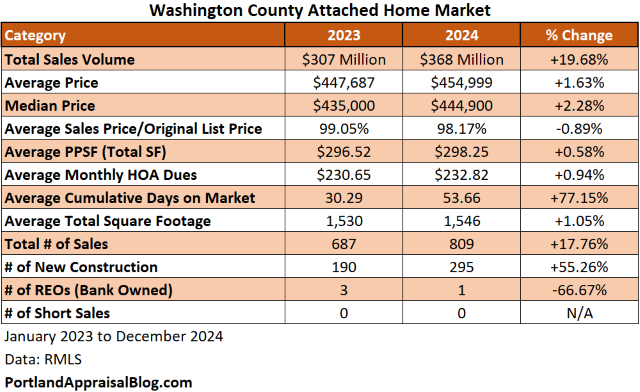
Washington County contains many properties with a Portland address that are outside official city limits and are under county control. The biggest city in Washington County, Hillsboro, saw 269 attached home sales in 2024. The following table summarizes important metrics for Washington County:

The total sales volume dollar amount increased by almost 20%, which is similar to the increase in the total number of sales (~18%). New construction sharply increased by 55% in 2024 compared to the previous year and was 36% of the overall attached home market. Average monthly HOA dues were flat year over year. Marketing time saw a 77% jump; however, this is distorted somewhat by the large percentage of new construction homes, which often have longer marketing times.

Clackamas County 2024 Stats

Clackamas County, despite having has many rural portions, has a decent amount of attached home activity. The cities of Happy Valley and Wilsonville had about 1/3rd of the sales. The following table summarizes important metrics for Clackamas County:

The Clackamas attached home sales volume dollar amount was up 11% in 2024. This tracks the increase in total sales (+12.7%). Average prices were slightly down, but so was the average total square footage of homes selling. Monthly HOA dues saw a nearly 4% bump (or about $10). There was very little distressed sale activity in this county over the last two years.

Columbia, Hood River, & Yamhill Counties 2024 Stats

Given how little of the attached market occurs in these three counties, they have been lumped together:

The total sales volume dollar amount slid nearly 4%, while the total square footage averaged 4.8% higher; this indicates a genuine decline in attached home prices in the three-county block. Marketing time was up by almost 20 days.

That wraps up our look at the Portland Region 2024 attached home market!

Thank you for reading the post! I hope you found some useful or interesting nugget of information. Please consider subscribing.

Question: Do you think 2025 will see more of the same in the attached home market or will prices increase for the region?

CODA

Are you an agent and wonder why appraisers always do “x”? Are you a homeowner that got a report and have a question or two about appraisal terminology or methodology? If so, please feel free to contact me. I enjoy interacting with various market participants and am always happy to help out where I can! And if you are in need of any appraisal services, feel free to reach out to us!

The 2024 Portland Region Condominium Housing Market in Review

Via Unsplash

The first quarter of 2025 is already drawing to a close, but let’s take the time to review how the Portland Region’s condominium market performed in 2024. High mortgage interest rates have been a concern in all segments of the housing market and condominiums were no exception. To be direct, 2024 was not a great year for condos.

Let’s take a look at how the Portland Region’s condo market performed as a whole and by individual county. We already examined the 2024 single-family detached home market and will have future posts dealing with attached homes and manufactured homes.

Let’s define the Portland Region as the following six counties: Columbia, Clackamas, Hood River, Multnomah, Washington, and Yamhill—essentially all counties contiguous with Portland’s home county of Multnomah, plus Yamhill.

Image of Portland Region counties.

DATA HOUSEKEEPING

The information in this post will be based on properties that sold on the open market, defined as listed in RMLS, the primary multiple listing service for the Portland Region. The data was parsed with tools created by the blog author to weed out/correct, among other things, listing errors and misclassifications (e.g. condominium sales hiding in other categories, such as in the attached or single-family category). It is important to understand that condominium is a classification of ownership and that condos come in many distinct varieties: detached, attached, townhome style, common wall, or even large converted apartment complexes. Condos are the ultimate chameleons, and can be mistaken for any other type of housing segment. With condominiums the property owner does not own the land or even the structure itself, but only the air space within the walls of the unit. The property owner also has an interest in the common elements on the site. Condos almost always entail monthly dues to the governing HOA. Condominiums often have distinct mortgage underwriting guidelines and it is important for real estate agents and appraisers to classify them properly.

Finally, RMLS has a listing category, SNL (Sold Not Listed), that allows agents to put properties that were sold off market into the database. Those properties have been excluded from the following analyses.

Portland Region 2024 Condo Overview

2024 was worse than 2023 in most important metrics. The following table compares 2024 with 2023:

Total sales volume was just north of $900 million, dropping over 8% from the previous year. Some of that decrease was due to a slight dip in the average size of the units selling in 2024 compared to the previous year, but average price per square foot was down as well. Typically as a unit gets smaller its price per square foot increases, so a drop in both total square footage and price per square foot definitely indicates a weaker market.

While prices have declined, the average monthly HOA dues increased nearly 3% in the region.

Bank owned and short sales both decreased in 2024 as compared to the previous year; the numbers are trivial and represent less than 1% of the entire market.

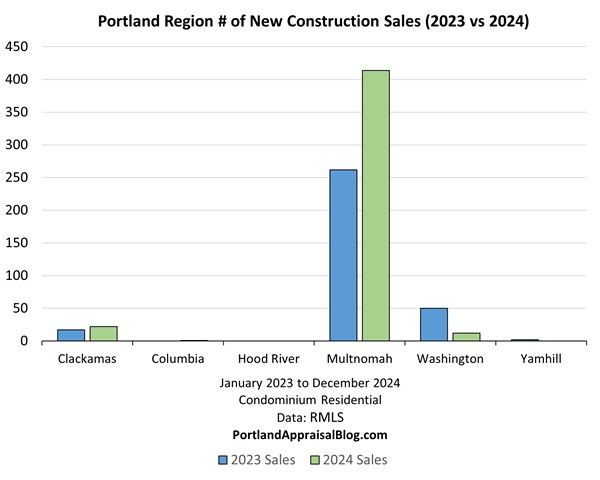
The only real bright spot in 2024 was more new construction condominium units came online that year. The annual increase was a healthy 35.7%.

Let’s dive into the rest of the data with some visuals.

SALES VOLUME

The following is a treemap of condo sales volume in the Portland Region for the year 2024:

Unsurprisingly, Multnomah County had the most sales (~64% of the entire market), with 93% of all Multnomah sales being in the City of Portland. Clackamas, Multnomah, and Washington counties comprised virtually all of the sales volume, with Columbia, Hood River, and Yamhill barely getting over 1%.

Sales peaked in April of 2024 and then began to gradually decline:

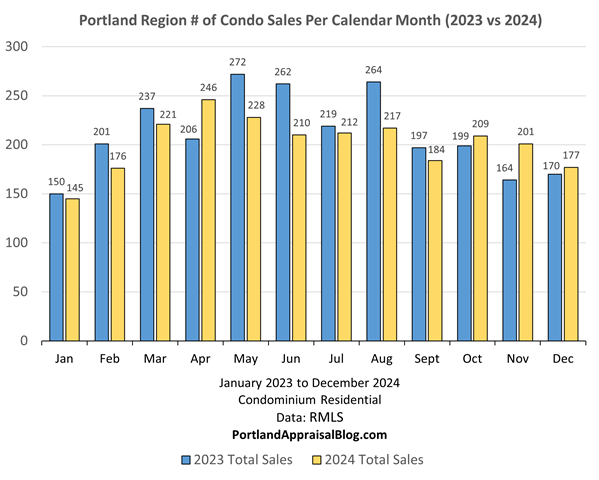
As the following graph shows, 2023 beat 2024 eight out twelve months:

SALES PRICE

Prices were u-shaped during the months of February to July, with the year’s peak being in June. Late summer to fall/winter saw prices mostly declining.

Note: The y-axis starts at $340,000 to allow better examination of monthly differences.

2023 was ahead of 2024 every single month, with a couple of near ties in the months of May and November:

Note: The y-axis starts at $340,000 to allow better examination of monthly differences.

NEW CONSTRUCTION

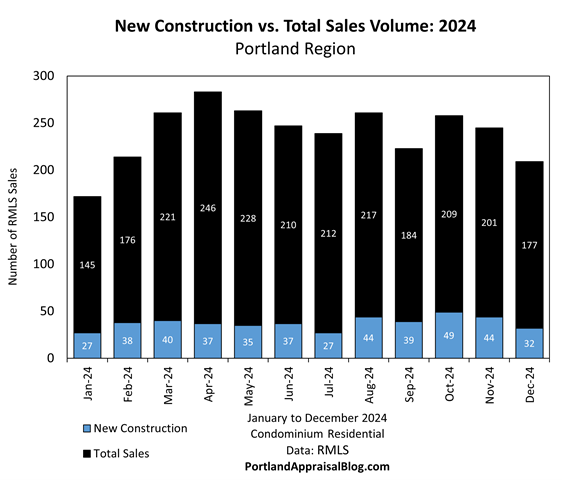
New construction was fairly level in 2024, averaging between 13-23% of monthly sales:

Multnomah County had the biggest share of new condominiums as well as the biggest year-over-year increase:

CUMULATIVE DAYS ON MARKET

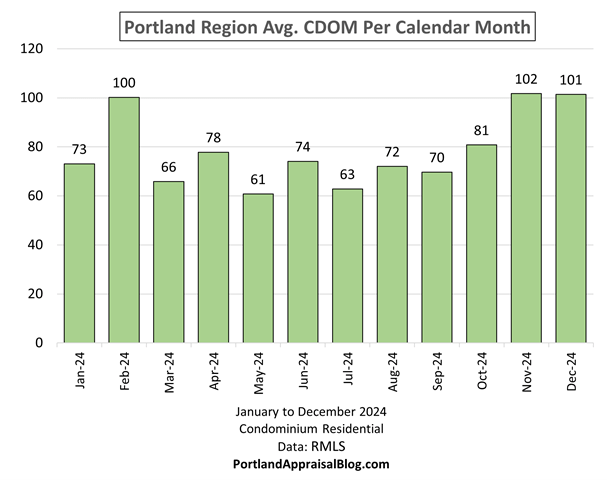
The average cumulative days on market edged towards three months for the entire year of 2024. Marketing time varied seasonally, with the slowest months being November and December:

Average marketing time was up sharply in 2024 compared to 2023:

HOUSING SUPPLY

Housing supply tracks how long would it take the market to exhaust all available inventory at the current rate of absorption. For most of 2024 the months of housing supply was above 5 months, with the year averaging 5.6 months.

2024 was significantly above 2023 in months of housing supply for nearly every month, with parity only being reached in November and December. The extended marketing times combined with the higher prices may make condominiums a more attractive housing option compared to single-family detached—particularly for first-time buyers:

HOA DUES

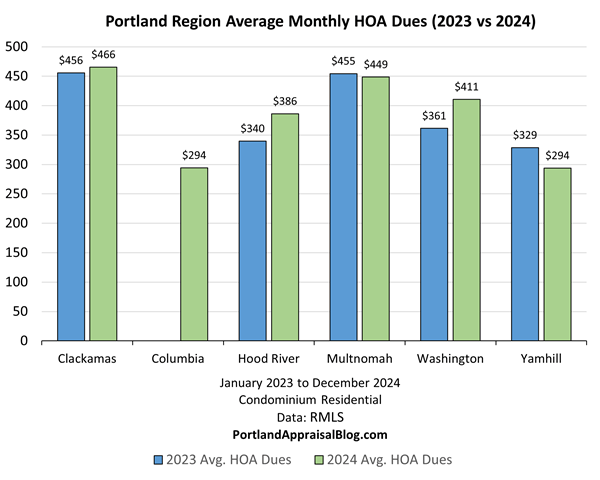
HOA dues for the region increased by nearly 3%, with the average being $440. Surprisingly, monthly dues in Multnomah and Yamhill counties declined in 2024, while Clackamas, Hood River, and Washington counties all saw increases. Columbia County had no condominium sales in 2023.

MISC STATS

Before concluding our overview of the Portland Region as a whole, let’s look at some miscellaneous stats:

The most expensive condo that sold on the open market in 2024 in the Portland Region was a riverfront unit on the Willamette. The condo sold for $3,197,617, has three bedrooms, three and a half bathrooms, and is 4,290 sq. ft. Photos of the condo are currently available online and may be viewed here.

The least expensive condominium for 2024 was a bank repossession that was completely trashed. The condo sold for $96,000 in the Portland Powellhurst-Gilbert neighborhood. The unit has significant structural damage and closed as a cash sale.

The most expensive ZIP code for 2024 was 97028. This area is located in the Mount Hood Villages. While only 9 sales occurred in 2024, the average price was about $728,000:

The ZIP code with the highest volume of sales was 97209:

This ZIP code covers a large portion of the Portland Pearl District and is part of Portland’s urban core. A total of 239 condominium sales occurred in this ZIP code in 2024.

A condominium in the Pearl District’s Casey complex took the crown for the highest monthly HOA dues—a whopping $2,919! The penthouse unit has panoramic city views, is 3,273 sq. ft. and sold for $2.4 million. Photos of the condo are currently available online and may be viewed here.

Let’s wrap up this post with a quick look at the individual counties comprising the Portland Region. We will examine the three largest counties individually, but will group the three smallest together, as they comprise less than 2% of the overall condominium market.

Multnomah County 2024 Stats

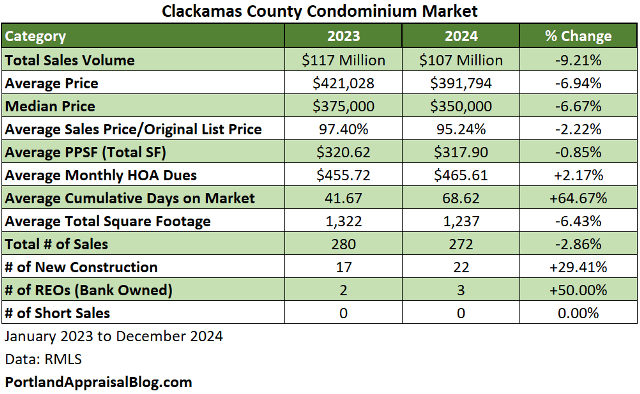
Multnomah County contains most of the City of Portland. A sliver of the City of Portland is located in Clackamas and Washington counties. The following table summarizes important metrics for Multnomah County:

Multnomah County saw a more than 5% decline in the sales volume dollar amount. Total sales dipped 1.4%, while average prices fell by more than 4%. Marketing time spiked nearly 21%. New construction comprised almost 27% of the total market and increased 58% year over year. HOA dues modestly declined by 1.3% in 2024.

Washington County 2024 Stats

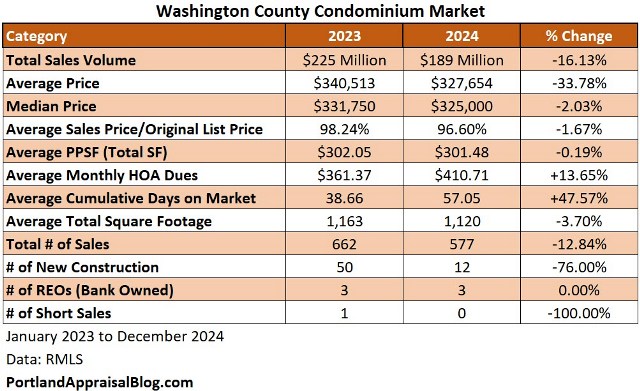
Washington County contains many properties with a Portland address that are outside official city limits and are under county control. The second biggest city in Washington County, Beaverton, saw 234 condo sales in 2024. The following table summarizes important metrics for Washington County:

The total sales volume dollar dropped 16.1%. New construction sharply declined by 76% in 2024 compared to the previous year and was only 2% of the overall condo market. Average monthly HOA dues jumped almost $50 per month year over year, representing a nearly 14% increase. Marketing time saw a 48% jump, with condos averaging almost two months before closing.

Clackamas County 2024 Stats

Clackamas County, despite having has many rural portions, has a decent amount of condo activity. The cities of Happy Valley and West Linn have the majority of the sales, with the Mount Hood area coming in third. The following table summarizes important metrics for Clackamas County:

The Clackamas condo sales volume dollar amount was down 9.2% in 2024. Median and average prices were both off by almost 7% compared to 2023. Average monthly HOA dues saw a sight 2% bump (or about $10). The total number of sales was flat year over year.

Columbia, Hood River, & Yamhill Counties 2024 Stats

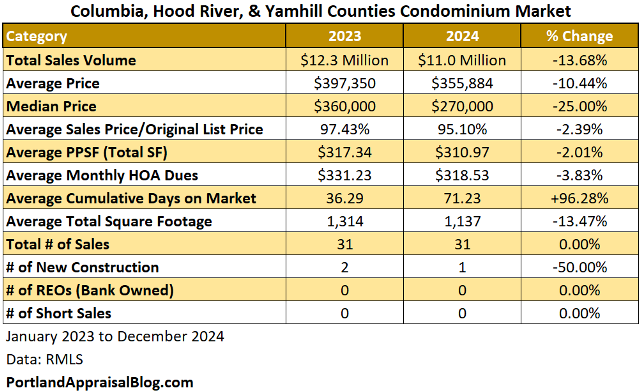
Given how little of the condo market occurs in these three counties, they have been lumped together:

The total sales volume dollar amount dropped nearly 14%, while average and median prices were down 10% & 25% respectively. The total number of sales was flat, while average monthly HOA dues declined nearly 4%—the only bright spot in these peripheral areas.

That wraps up our look at the Portland Region 2024 condo market!

Thank you for reading the post! I hope you found some useful or interesting nugget of information. Please consider subscribing.

Question: Do you think 2025 will be see condo prices rebound for the region?

CODA

Are you an agent and wonder why appraisers always do “x”? Are you a homeowner that got a report and have a question or two about appraisal terminology or methodology? If so, please feel free to contact me. I enjoy interacting with various market participants and am always happy to help out where I can! And if you are in need of any appraisal services, feel free to reach out to us!
The 2024 Portland Region Single-Family Housing Market in Review

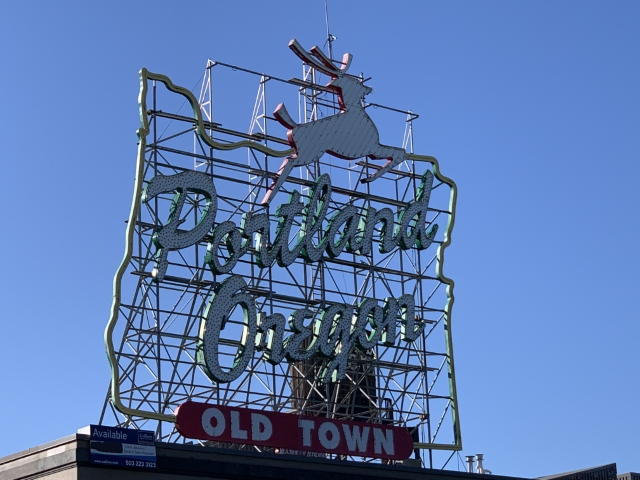
Picture of famous Portland, Oregon white stag neon sign.
Via Wikimedia Commons

2024 has come and gone in a flash! The housing market has been digesting high interest rates for a couple of years now. While interest rates have been a net drag on the market, 2024 did have some bright spots—especially compared to 2023. Let’s take a look at how the Portland Region housing market performed as a whole and by individual county. We’ll be examining only single-family detached homes in this post. We’ll take a look at condominiums and other types of housing stock in future posts.

Let’s define the Portland Region as the following six counties: Columbia, Clackamas, Hood River, Multnomah, Washington, and Yamhill—essentially all counties contiguous with Portland’s home county of Multnomah, plus Yamhill.

Image of Portland Region counties.

DATA HOUSEKEEPING

The information in this post will be based on properties that sold on the open market, defined as listed in RMLS, the primary multiple listing service for the Portland Region. The data was parsed with tools created by the blog author to weed out/correct, among other things, listing errors and misclassifications (e.g. land or condominium sales in the single-family category). RMLS has a listing category, SNL, Sold Not Listed (not Saturday Night Live), that allows agents to put properties that were sold off market into the database. Those properties have been excluded from the following analyses.

Portland Region 2024 Overview

2024 saw higher home prices compared to 2023, but houses took longer to sell

2024 beat 2023 in most important metrics, but that came at the expense of longer marketing times for homes. The following table compares 2024 with 2023:

Table of metrics for Portland Region comparing 2023 with 2024.

Total sales volume topped $11 billion in 2024, representing a nearly 6% increase over the previous year. Some of that increase was due to more homes selling in 2024 compared to the previous year, but average prices (as well as average price per square foot) had modest bumps as well. The average home size and lot size were about the same for 2023 and 2024 so we know the increase in average prices wasn’t due to larger homes selling.

Despite the increase in home prices, the typical seller was a bit optimistic with their list price and had to cut about 2% before closing the deal.

While bank owned and short sales increased in 2024 as compared to the previous year, they represented less than 1% of the entire market.

Let’s dive into the rest of the data with some visuals.

SALES VOLUME

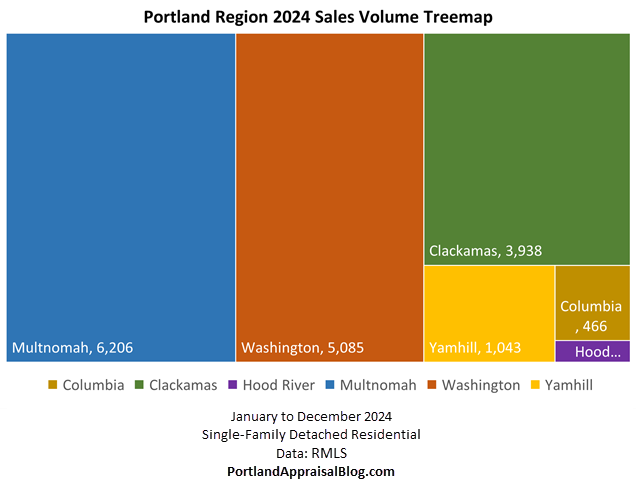
The following is a treemap of sales volume in the Portland Region for the year 2024:

Treemap of 2024 sales volume.

Unsurprisingly, Multnomah County had the most sales (~37% of the entire market), with 84% of all Multnomah sales being in the City of Portland. Clackamas, Multnomah, and Washington counties comprised 90% of the sales volume.

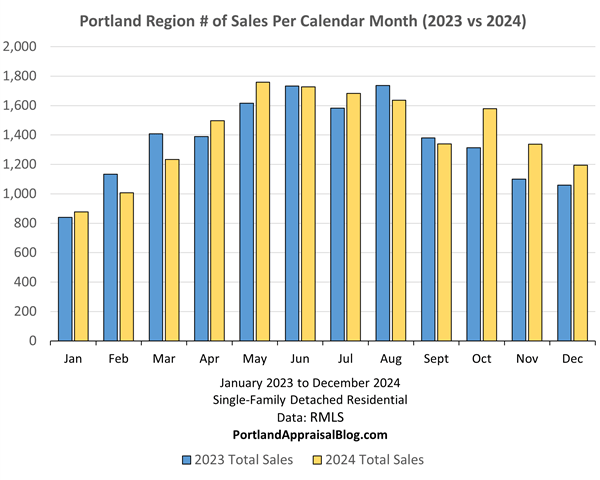
Sales peaked in May of 2024 and then began to gradually decline, with September being the odd duck; likely due to kids heading back to school and parents being distracted.

Bar graph of number of sales in the Portland Region.

As the following graph shows, 2023 had a stronger start than 2024 and 2024 had a better finish:

Bar graph of number of sales in the Portland Region comparing 2023 with 2024.

SALES PRICE

Prices plateaued April-September and then declined in the fall/winter months.

Note: The y-axis starts at $580,000 to allow better examination of monthly differences.

2024 was ahead of 2023 every single month except December:

Bar graph of average monthly prices in the Portland Region comparing 2023 with 2024.
Note: The y-axis starts at $540,000 to allow better examination of monthly differences.

NEW CONSTRUCTION

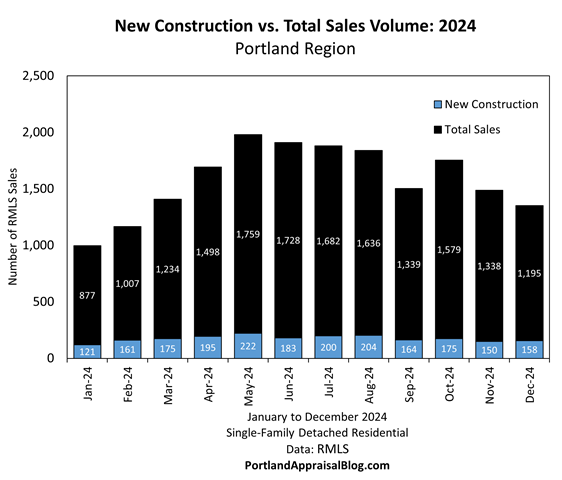
New construction was steady in 2024 and averaged between 11-16% of monthly sales:

Bar graph of monthly number of new construction sales compared to total sales volume in the Portland Region for 2024.

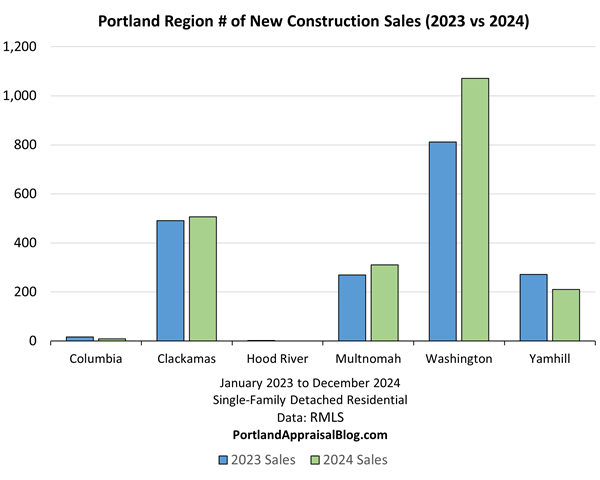
Washington County had the biggest share of new homes and also the biggest year-over-year increase:

Bar graph of number of new construction sales broken out by county and comparing 2023 to 2024 in the Portland Region.

CUMULATIVE DAYS ON MARKET

The average cumulative days on market edged towards two months for the entire year of 2024. Marketing time varied seasonally, with the slowest month being February:

Bar graph of monthly average days on market in the Portland Region for 2024.

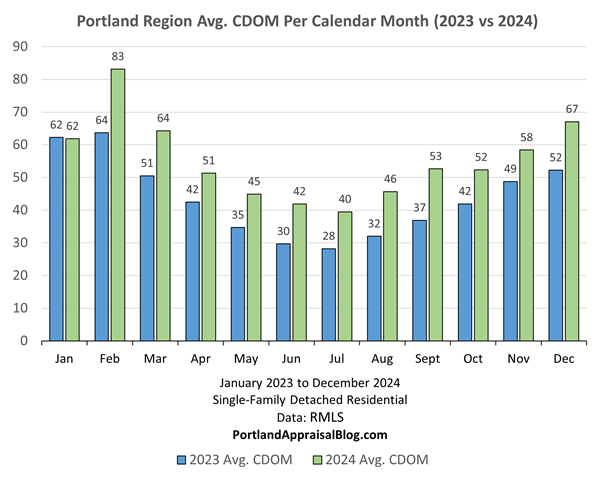
Marketing time was up sharply (28%) for nearly the entirety of 2024 compared to 2023:

Bar graph of average monthly days on market in the Portland Region comparing 2023 with 2024.

HOUSING SUPPLY

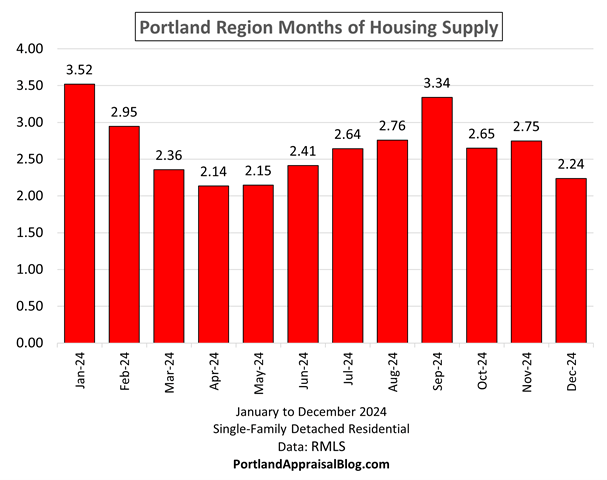
Housing supply tracks how long would it take the market to exhaust all available inventory at the current rate of absorption. For most of 2024 the months of housing supply was less than 3, with the year averaging 2.7 months.

Bar graph of months of housing supply in the Portland Region for 2024.

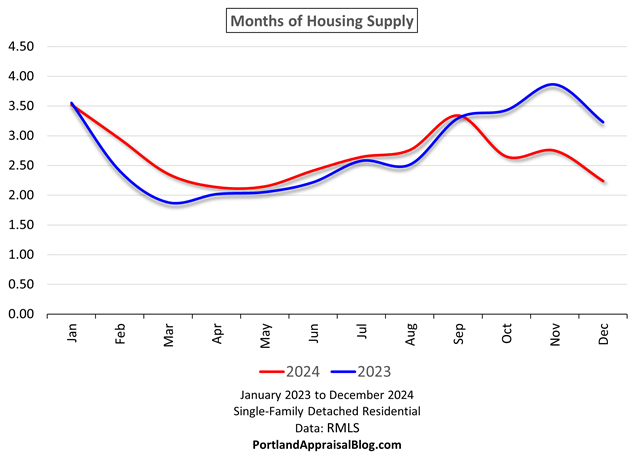
From February to September the year 2024 had more months of supply compared to 2023; however, 2024 ended strong with a sharp decline in supply compared to the previous year. This is an encouraging trend for home sellers as it may indicate higher prices in 2025. For frustrated first-time buyers, this may indicate getting into the housing market in 2025 will be even more difficult. The following line graph compares the housing supply of 2023 against 2024:

Line graph comparing months of housing supply int he Portland Region for the years 2023 and 2024

MISC STATS

Before concluding our overview of the Portland Region as a whole, let’s look at some miscellaneous stats:

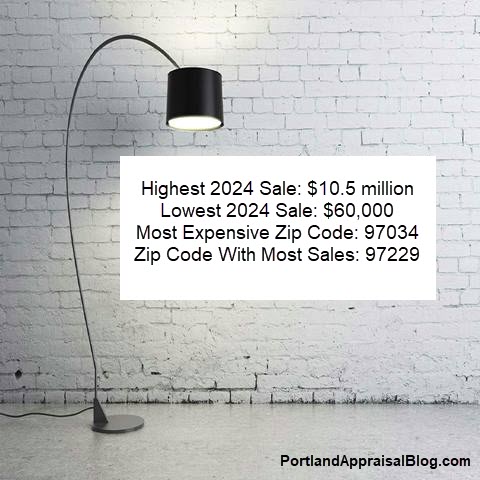
The most expensive home that sold on the open market in the Portland Region was a lakefront property on Oswego Lake. The home sold for $10,500,000, has five bedrooms, six bathrooms, and is 6,147 sq. ft. Photos of the house are currently available online and may be viewed here.

The least expensive home was a literal fire sale. The home sold for $60,000 in Willamina, which is in Yamhill County, and the structure was likely a teardown due to a fire. The lot size was 5,480 sq. ft.

The most expensive ZIP code for 2024 was 97034. This area takes in most of the waterfront area of Oswego Lake:

Map of ZIP code 97034.

The ZIP code with the highest volume of sales was 97229:

Map of ZIP code 97229.

This ZIP code is large, covering 20.6 square miles and has parts of Multnomah and Washington counties. 729 single-family homes sold in this area in 2024.

Let’s wrap up this post with a quick look at the six individual counties comprising the Portland Region. We will examine them in the order of largest number of sales to the smallest.

Multnomah County 2024 Stats

Multnomah County contains most of the City of Portland. Very tiny portions of the City of Portland are located in Clackamas and Washington counties. The following table summarizes important metrics for Multnomah County:

Table of metrics for Multnomah County comparing 2023 with 2024.

Multnomah County saw little change in the sales volume dollar amount. Total sales dropped 2.6% but average prices increased by 2.7%. Average marketing time modestly increased by less than 3 days. New construction comprised 5% of the total market and increased 15.2% year over year. Distressed sales are less than 1% of the total market.

Washington County 2024 Stats

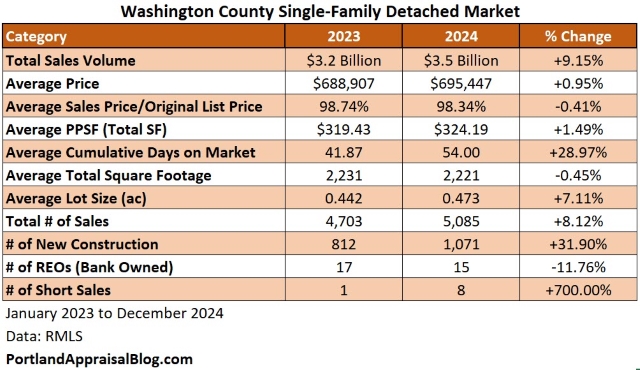
Washington County contains many properties with a Portland address that are outside official city limits and are under county control. The biggest city in Washington County, Beaverton, saw 1,353 sales in 2024. The following table summarizes important metrics for Washington County:

Table of metrics for Washington County comparing 2023 with 2024.

The total sales volume dollar amount grew at a healthy 9.2%, in part due to the substantial number of new construction homes entering the market. New construction rose nearly 32% compared to the previous year and comprised 21% of the total 2024 Washington County single-family market. Most of the new construction homes are located in Beaverton, Hillsboro, county-controlled areas of Portland, and Tigard.

Clackamas County 2024 Stats

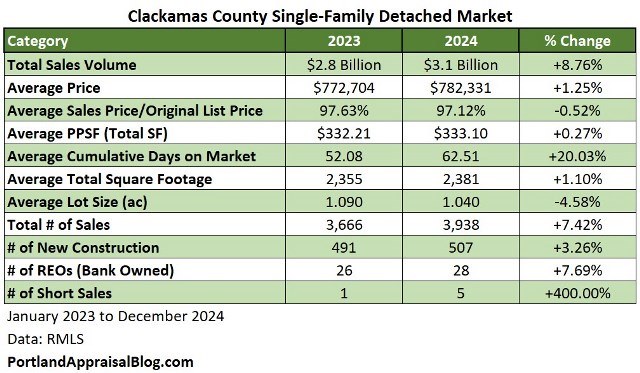
Clackamas County, while comprised of some urban cities, has many rural portions and houses on acreage lots. Commercial and hobby farming is common throughout the county. The following table summarizes important metrics for Clackamas County:

Table of metrics for Clackamas County comparing 2023 with 2024.

The sales volume dollar amount is up 8.8%, but that nearly tracts with the overall increase in the number of sales. The average annual price only moved about 1.3%. New construction was about 13% of the 2024 market.

14% of the overall market were properties that had at least one acre of land. The largest acreage sale (that had a single-family home on it) was 222 acres and was comprised of two tax lots. The property had a tree farm.

Yamhill County 2024 Stats

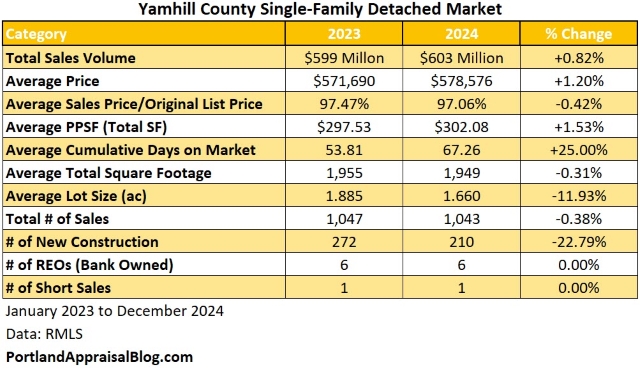
Yamhill County is known for its wineries and other agricultural products. The following table summarizes important metrics for Yamhill County:

Table of metrics for Yamhill County comparing 2023 with 2024.

The total sales volume dollar amount, the average sales price, and the number of sales were all flat year over year. New construction dropped by nearly 23% and marketing time increased by 25%.

Columbia County 2024 Stats

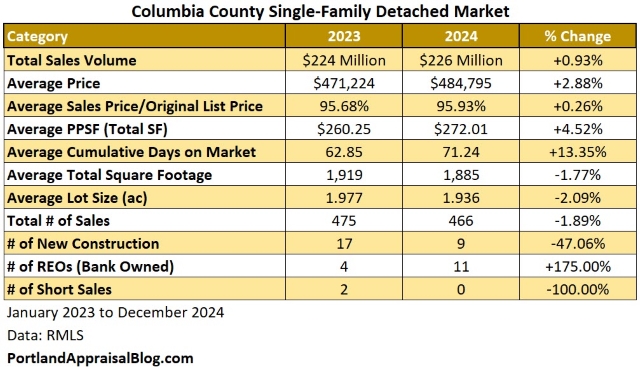
While this county is 688 square miles it only has a population of approximately 54,000 people. The county is known for timer and wood products. The following table summarizes important metrics for Columbia County:

Table of metrics for Columbia County comparing 2023 with 2024.

The total sales volume dollar amount was up nearly 1% against an almost 2% drop in the number of home sold. Very few new construction homes came online in 2024. Marketing time increased by 13.4%.

Hood River County 2024 Stats

Hood River is the second smallest county in Oregon by area at 533 square miles. The population is estimated to be about 24,000 people. This county is known for its fruit products and outdoor recreational activities.

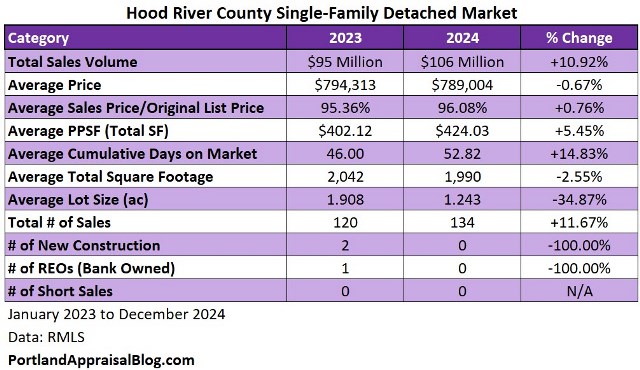
Table of metrics for Hood River County comparing 2023 with 2024.

The sales volume dollar amount was up nearly 11%, which tracks the increase in the total number of homes sold. The average price was flat year over year, while the composition of sales saw a decrease in home size and a significant decrease in average lot size. With so few sales, swings in average property metrics from year to year are more common.

That wraps up our look at the Portland Region 2024 single-family market!

Thank you for reading the post! I hope you found some useful or interesting nugget of information. Please consider subscribing.

Question: Do you think 2025 will be a strong year for regional prices?

CODA

Are you an agent and wonder why appraisers always do “x”? Are you a homeowner that got a report and have a question or two about appraisal terminology or methodology? If so, please feel free to contact me. I enjoy interacting with various market participants and am always happy to help out where I can! And if you are in need of any appraisal services, feel free to reach out to us!