
What Happened This Week
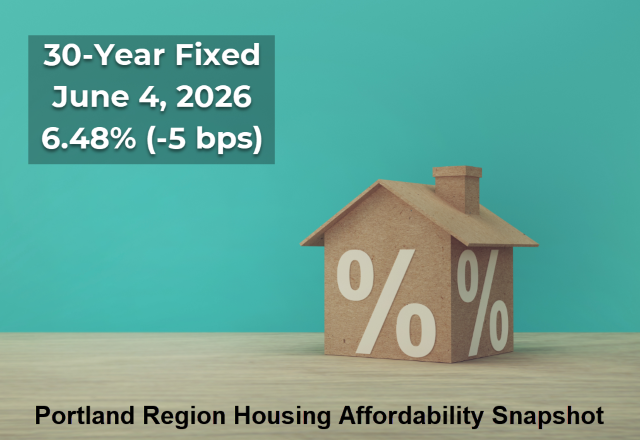
Mortgage rates eased slightly this week, with the 30‑year fixed slipping to 6.48% from last week’s 6.53%. It’s only a five‑basis‑point move, but it breaks the late‑May surge that pushed rates to their highest level of 2026. The broader pattern remains intact: rates bottomed at 5.98% on February 26th, climbed steadily through March, spiked sharply into early April, and then oscillated in a tight band before pushing to new highs in late May. Today’s reading pulls us just off the peak, but we’re still operating near the top of the year‑to‑date range.
Affordability remains strained despite the modest improvement. Monthly payments are still far above their late‑February lows, and qualifying costs remain among the toughest of the year. As the charts below show, today’s rate sits only a hair below last week’s high, and the PABAI continues to reflect a challenging affordability environment for the Portland Region as we move into June.
Mortgage Rate Context
Long‑Run View (Since 2000)
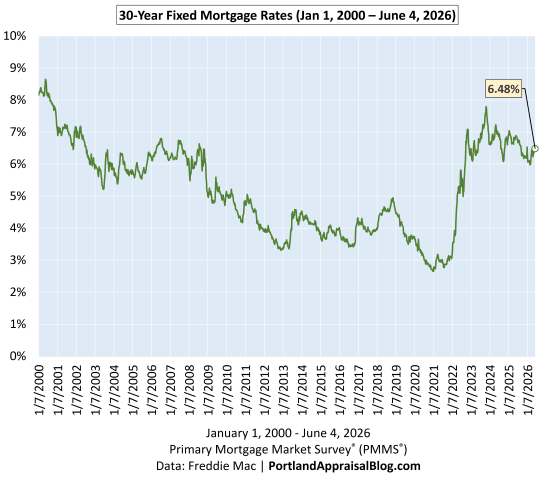
The long‑run chart shows how today’s rate fits into a 25‑year history of mortgage cycles. The early 2000s sat in the 6–8% range, the post‑Great Recession era brought a decade of unusually low rates, and the pandemic period pushed borrowing costs to historic lows. Years after leaving that ultra‑low‑rate environment, the market continues to adjust to more difficult financing constraints, and today’s 6.48% reflects that ongoing shift.
Medium‑Run View (Since COVID)
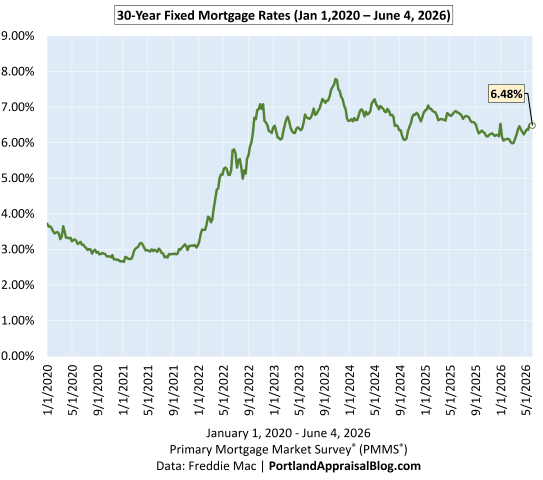
The COVID‑era chart highlights the dramatic rate compression of 2020–2021, the rapid surge of 2022, and the choppy plateau that has defined the past two years. Rates have been oscillating between roughly 6% and 7% since mid‑2023, and today’s 6.48% sits near the middle of that band. Volatility has cooled compared to 2022, but the medium‑run trend remains one of elevated and persistent borrowing costs.
Short‑Run View (2026 YTD)
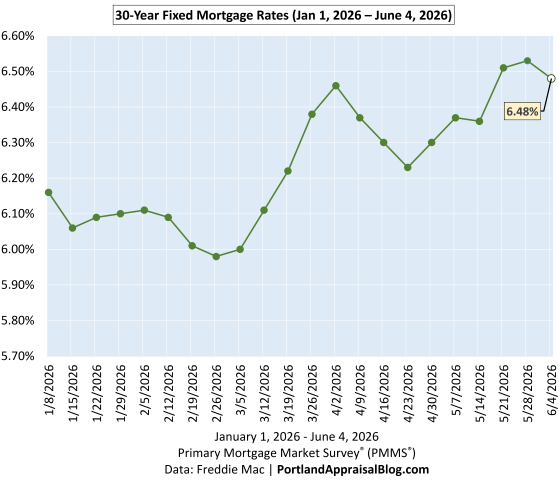
The year‑to‑date chart shows the full shape of the 2026 cycle: a clear bottom at 5.98% on February 26th, a sharp rise into early April, a brief cooldown, and a renewed climb that pushed rates to 6.53% last week—the highest level of the year. This week’s dip to 6.48% pulls us slightly off that peak, but affordability remains near its weakest point of 2026. This short‑run pattern is the most relevant for buyers today, as it directly shapes monthly payments and qualifying power.
Portland Appraisal Blog Affordability Index (PABAI)
What PABAI Measures
The Portland Appraisal Blog Affordability Index (PABAI) measures how the average home close price compares to what a median‑income household can qualify for under standard lending assumptions (HUD Portland‑Vancouver‑Hillsboro MSA median income, 20% down, and a 28% DTI for principal, interest, taxes, insurance, and HOA dues).
Unlike national affordability indices, PABAI is built from actual RMLS transactions—all 3,349 detached sales for the Portland Region in Q1 2026—which allows for far more precise, locally grounded insights into Portland‑area affordability than any national model can provide.
A PABAI of 100 means the market is exactly affordable at that income level (the Q1 2026 HUD median MSA income was $124,100 for a family of four). Values above 100 indicate excess qualifying capacity (more affordable), while values below 100 indicate a shortfall (strained affordability). Full methodology and the interpretation scale are available on the PABAI explainer page.
| PABAI Range | Interpretation |
|---|---|
| 120+ | Strongly Affordable |
| 100–119 | Moderately Affordable |
| 80–99 | Strained |
| Below 80 | Severely Constrained |
Q1 2026: Actual vs. Constant‑Rate Affordability
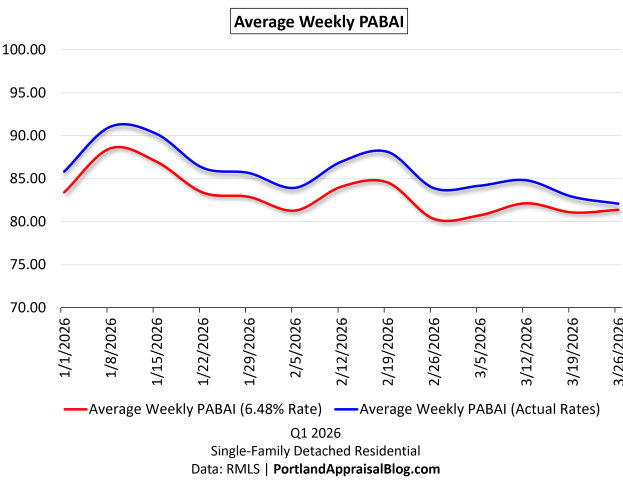
The Q1 chart compares two versions of PABAI: one using actual weekly mortgage rates, and one using today’s rate (6.48%) as a constant. Because the constant‑rate line uses a rate near the top of the 2026 range, it naturally sits below the actual‑rate line for most of the quarter. That part isn’t the story.
The key insight is the size and behavior of the gap between the two lines. Early in the quarter, actual rates were meaningfully lower than today’s rate, giving buyers more qualifying power than a flat‑rate environment would suggest. But as rates climbed through March and into April, the two lines began to converge—a visual confirmation of how persistent rate increases eroded affordability heading into spring. Today’s 6.48% rate keeps the constant‑rate line close to the actual‑rate line at the end of Q1, reflecting the tightening affordability conditions that carried into mid to late spring.
Structural Unaffordability and the Seasonal Pattern
Detached homes in the Portland Region remain structurally unaffordable to a household earning the HUD median MSA income. PABAI has been below 100 for years, and Q1 2026 continues that pattern. What the chart makes clear is that winter remains the best window for buyers on tight qualifying budgets: affordability improves when rates soften and seasonal pricing cools. As spring approaches, both rates and prices firm up, and affordability reliably compresses.
With the 30‑year fixed now sitting near the highest levels of 2026, the convergence of the two PABAI lines at the end of the quarter reflects the same reality: rising rates have pushed qualifying costs to their weakest point of the year, and the early‑year affordability advantage has largely evaporated.
Affordability Snapshot (This Week)
Q1 2026 Affordability Recomputed at Today’s Rate
The table below shows how Q1 2026 affordability metrics change when all 3,349 detached sales are recalculated at this week’s 6.48% rate. This is the clearest way to see how rising rates reshape qualifying power, housing burden, and the share of homes accessible to a median‑income household.
| Metric | Actual Q1 2026 Rates | Recomputed at 6.48% Rate | Change |
|---|---|---|---|
| Average PABAI | 85.45 | 82.76 | -2.69 pts |
| Required income (28% ratio) | $145,236 | $149,955 | +3.25% |
| Median‑income shortfall | 17.03% | 20.83% | +3.80 pts |
| Avg monthly mortgage pmt | $3,932.66 | $4,056.00 | +$123.34 |
| Avg housing burden (DTI) | 38.03% | 39.25% | +1.22 pts |
| # of Affordable homes | 967 | 845 | -122 homes |
| % of homes affordable | 28.87% | 25.23% | -3.64 pts |
HUD Portland‑Vancouver‑Hillsboro MSA median income: $124,100
Data: RMLS (3,349 observations) | PortlandAppraisalBlog.com
How Rising Rates Reshape Affordability
Taken together, these metrics show how quickly affordability erodes when rates rise into the mid‑6% range. The drop in Average PABAI from 85.45 to 82.76 may look modest at first glance, but it represents a meaningful tightening of qualifying power across the entire detached market. Required income rises to nearly $150,000, widening the gap between what a median‑income household earns and what the market demands. That shortfall now approaches 21%, a reminder that the typical Portland household remains well outside traditional affordability thresholds.
The payment side tells the same story. Recomputing Q1 sales at today’s rate pushes the average monthly mortgage obligation up by roughly $123, which may seem incremental on a monthly basis but compounds sharply over a 30‑year horizon. More importantly, the higher rate pushes the average front‑end DTI from 38.03% to 39.25%, a level that would be considered stretched even in more forgiving underwriting environments. These shifts are not abstract; they directly shape who can buy, what they can buy, and how competitive they can be.
The Buyer‑Side Impact
The most visible consequence of these changes is the shrinking pool of homes accessible to a median‑income household. Under actual Q1 2026 rates, 967 detached homes were affordable; at today’s rate, that number falls to 845. In percentage terms, the share of the market within reach drops from 28.9% to 25.2%—a loss of more than three and a half percentage points in a single recalculation. This is the practical expression of rising rates: fewer viable options, tighter qualifying margins, and a market that becomes increasingly selective about who can participate.
For buyers, the experience varies by circumstance but the direction is the same. Households with limited flexibility feel the tightening most acutely, as even small rate movements can eliminate entire segments of the market. Move‑up buyers face a widening payment gap between their current home and the next one, making the trade‑up calculus more difficult unless equity is substantial. Cash buyers, by contrast, gain relative leverage as financed demand thins—though that advantage is uneven across price tiers.
Across all buyer types, the message is consistent: rising rates are reshaping the market in real time, and the affordability landscape at a 6.48% mortgage rate is meaningfully different from the one buyers faced just a few months ago.
The Seller‑Side Impact
Rising rates don’t just reshape the buyer experience—they influence seller outcomes as well. In the 2025 detached market, cumulative days on market (CDOM) increased 11.09%, and the current rate environment suggests that upward pressure on market times may persist. As affordability tightens and the pool of qualified buyers shrinks, homes that would have moved quickly in a lower‑rate environment may begin to sit longer, particularly in segments where pricing is already stretched. This doesn’t imply an abrupt market shutdown, but it does mean sellers need to price with greater precision and expect a more selective buyer pool as 2026 progresses.
TIP: Total Interest Paid — Why Small Rate Moves Matter
Total Interest Paid (TIP) is one of the clearest ways to understand how mortgage rates shape long‑run affordability. While buyers shop based on monthly payment, the lifetime cost of borrowing moves far more dramatically than the payment itself. Even small rate changes can add—or remove—tens of thousands of dollars in interest over the life of a loan.
At today’s 6.48% rate, the lifetime interest on a standard Portland‑area purchase sits far above the levels buyers saw during the pandemic and meaningfully higher than the early‑March lows of this year. The difference between a 5.98% environment and a 6.48% environment may feel subtle on a monthly basis, but over 30 years it compounds into a substantial increase in total repayment.
This is why TIP matters: it captures the hidden cost of rising rates. Buyers feel the payment, but the long‑run financial burden is embedded in the interest curve. As the charts below show, the 2026 rate path has pushed TIP to some of the highest levels for the year, even as the monthly payment has moved more gradually.
2026 YTD Total Interest Paid
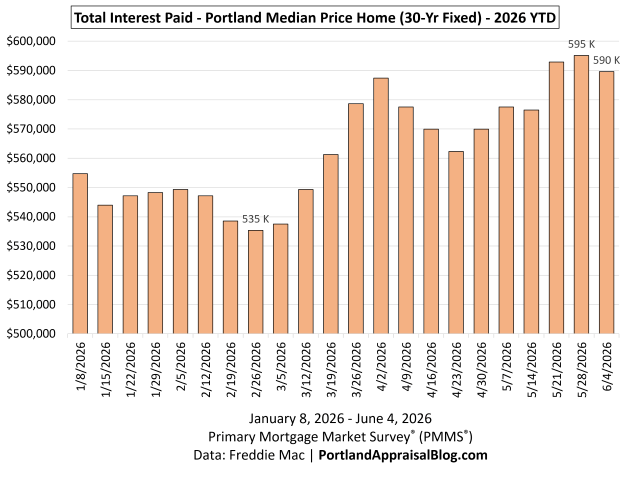
The 2026 YTD TIP chart shows how sharply lifetime borrowing costs have moved as rates climbed through the first half of the year. These calculations are based on the total interest a buyer would pay on the Q1 2026 Portland median‑priced home of $580,000, assuming a 20% down payment and applying the rate effective in each week. This isolates the impact of rate movements alone, holding price and loan structure constant.
The low point came on February 26th, when a 5.98% mortgage rate produced a total interest burden of $535,342. As rates rose through March and into late May, TIP increased steadily, reaching a year‑to‑date high of $595,104 at the 6.53% rate on May 28th. That’s nearly a $60,000 increase in lifetime interest in just three months, driven entirely by rate movement.
This week’s 6.48% rate pulls TIP slightly off the peak, but only marginally: the total interest burden at today’s rate is $589,610. The shape of the chart makes the pattern unmistakable—at today’s price levels, even small rate changes translate into large long‑run cost differences. Buyers feel the monthly payment, but the lifetime interest curve is where the true financial impact of rising rates becomes visible.
TIP per $1 Borrowed
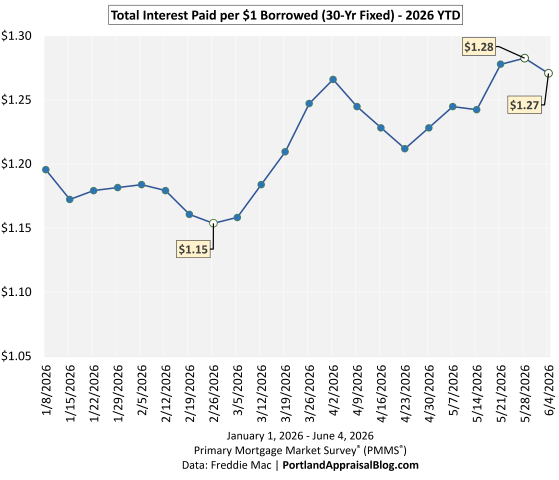
The TIP‑per‑$1 chart shows how much interest a buyer pays for every dollar borrowed at different mortgage rates. This is the clearest way to visualize the rate sensitivity of long‑run borrowing costs. At the year‑to‑date low of 5.98%, each dollar borrowed generated about $1.15 in interest over the life of the loan. As rates climbed through the spring, that figure rose steadily, reaching $1.28 at the late‑May peak of 6.53%. Today’s 6.48% rate places the cost at $1.27 per $1 borrowed, only slightly below the YTD high.
Regional Interest Delta (RID)
The Regional Interest Delta (RID) models how much total lifetime interest the Portland Region’s Q1 detached‑home buyers would collectively pay when mortgage rates shift. To keep the metric consistent, RID assumes that all 3,349 Q1 detached sales were financed under standard 20%‑down, 30‑year conventional underwriting, even though the actual dataset includes cash purchases and loans under FHA, VA, jumbo, and other programs. Rates are matched to each home’s close date to reflect the real timing of rate movements, but individual buyers may have locked slightly different rates depending on their specific loan terms. This approach provides a clean, apples‑to‑apples way to measure how rate changes affect the region’s total interest burden.
| Scenario | Rate | Total Lifetime Interest | RID |
|---|---|---|---|
| Actual Q1 2026 Pipeline | Actual rate matched to close date | $2,091,901,976 | — |
| Modeled at Today’s Rate | 6.48% | $2,244,228,907 | +$152,326,931 |
Data: RMLS (3,349 observations) | PortlandAppraisalBlog.com
Using those actual matched rates, the region’s Q1 2026 pipeline will generate $2,091,901,976 in lifetime interest. Recomputing the same loans at today’s 6.48% rate increases the total to $2,244,228,907. The difference—the RID—is $152,326,931 in additional lifetime interest.
To put that number in perspective: $152 million is the cost of hollywoodHUB, a 222‑unit affordable housing development in Portland. A single rate shift—applied across one quarter’s mortgage activity—creates a lifetime interest delta equivalent to building an entire affordable housing project from the ground up.
RID makes the scale of rate movements unmistakable. What looks like a modest rate change at the household level becomes a nine‑figure regional impact when applied across thousands of loans.
Payment Delta
The Payment Delta shows how monthly affordability shifts as mortgage rates move. Using the Q1 2026 Portland median‑priced home of $580,000 with a 20% down payment, the monthly principal‑and‑interest payment changes meaningfully even with small rate movements.
| Date | Rate | Monthly P&I |
|---|---|---|
| Feb 26, 2026 | 5.98% | $2,775.95 |
| May 28, 2026 | 6.53% | $2,941.96 |
| Jun 4, 2026 | 6.48% | $2,926.70 |
Primary Mortgage Market Survey® (PMMS®)
Data: Freddie Mac | PortlandAppraisalBlog.com
From the YTD low to the late‑May peak, the monthly payment increased by $166, and today’s payment remains $151 higher than the February low.
While the Payment Delta is smaller in scale than the lifetime interest changes shown in TIP and RID, it is the number buyers feel most immediately. For households shopping at the lower end of the market, even a $150–$175 shift can meaningfully affect qualifying ratios, required down payment, or even which housing types remain viable—such as moving from detached homes to attached or condos. These adjustments often matter more for affordability‑sensitive buyers than for the broader market.
Closing Thoughts
The story of this week is straightforward: mortgage rates remain elevated, and the effects are visible across every major affordability metric. The PABAI continues to signal structural strain for median‑income households, and the recalculated Q1 data shows how even modest rate movements reshape qualifying power, monthly payments, and the share of homes within reach. The TIP and RID visuals make the pattern clear: higher rates don’t just affect individual buyers—they reshape the long‑run financial burden carried across the entire region.
For buyers, the takeaway is that financing conditions remain tight as we move into early summer. Winter continues to offer the best affordability window, but today’s rate environment means households on the margin feel pressure sooner and more sharply than in prior years. Even a $150–$175 shift in the Payment Delta can influence qualifying ratios, required down payment, or which housing types remain viable.
For sellers, the implications are more subtle but no less real. Last year’s detached market saw CDOM rise more than 11%, and the current rate backdrop suggests that upward pressure on market times may persist. A smaller pool of qualified buyers and higher monthly payments can translate into longer exposure, especially for homes priced aggressively or positioned in segments where affordability is already stretched. Pricing discipline and realistic expectations matter more in this environment than they did during the ultra‑low‑rate era.
As always, the Portland market adapts—sometimes quickly, sometimes reluctantly—but the direction of travel is clear. Higher rates are reshaping both sides of the transaction, and the early summer of 2026 is operating under some of the most constrained financing conditions we’ve seen this year.
Sources & Further Reading
All data presented in this weekly mortgage rate update is based on the Q1 2026 detached homes segment. The data is sourced directly from RMLS and has been subjected to rigorous cleaning and validation processes to ensure reliability for detached single-family residential analysis in the six-county Portland Region. The trends, comparisons, and commentary are the result of original appraisal expertise and independent analysis—not aggregated from secondary sources or news summaries.
- Freddie Mac Primary Mortgage Market Survey® (PMMS®): Dataset
- HUD Portland-Vancouver-Hillsboro, OR-WA MSA: Median Household Income
- Portland Region Housing Affordability Snapshot – Rates Rise to 6.53% (May 28, 2026): Portland Appraisal Blog
- The Portland Region – Six-County Market Area Overview: Portland Appraisal Blog
- RMLS Data Challenges: Portland Appraisal Blog
- Portland Affordability Index – PABAI: A Realistic Housing Qualification Metric for the Portland Region: Portland Appraisal Blog
- The 2025 Portland Region Detached Homes Market in Review: Portland Appraisal Blog

Coda
Thanks for reading—I hope you found a useful insight or an unexpected nugget along the way. If you enjoyed the post, please consider subscribing for future updates.
Are you an agent in Portland who wonders why appraisers always do “x”?
A homeowner with questions about appraiser methodology?
If so, feel free to reach out—I enjoy connecting with market participants across Portland and the surrounding counties, and am always happy to help where I can.
And if you’re in need of appraisal services in Portland or anywhere in the Portland Region, we’d be glad to assist.
About the Author — Abdur Abdul‑Malik, SRA, ASA
Abdur Abdul‑Malik is the founder, author, and publisher of the Portland Appraisal Blog, where he produces original regional and neighborhood‑level housing analytics for the Portland Region. He is a certified residential appraiser serving Oregon and Washington, drawing on RMLS transaction data, public records, and custom segmentation models he has built.
He developed the Portland Appraisal Blog Affordability Index (PABAI), a payment‑based affordability metric built from actual RMLS sales. PABAI incorporates weekly updates based on the prevailing 30‑year fixed mortgage rate, providing a locally grounded measure of housing affordability across the region.
Learn more → PABAI explainer • mortgage rate series • full author bio


